The Janitor’s Chronicle: A Night of Cosmic Horror at Miskatonic University

Prologue: The Invisible Man
Arthur “Artie” Higgins had spent forty years as the invisible custodian of Miskatonic University’s hallowed halls. At seventy-two years old, his knees cracked like dry kindling with every step, but he possessed something far more valuable than youth: he knew every secret passageway, every loose floorboard, and every shadow in the ancient building. On the night of November 12, 1924, that knowledge would be tested beyond anything his decades of experience could have prepared him for.
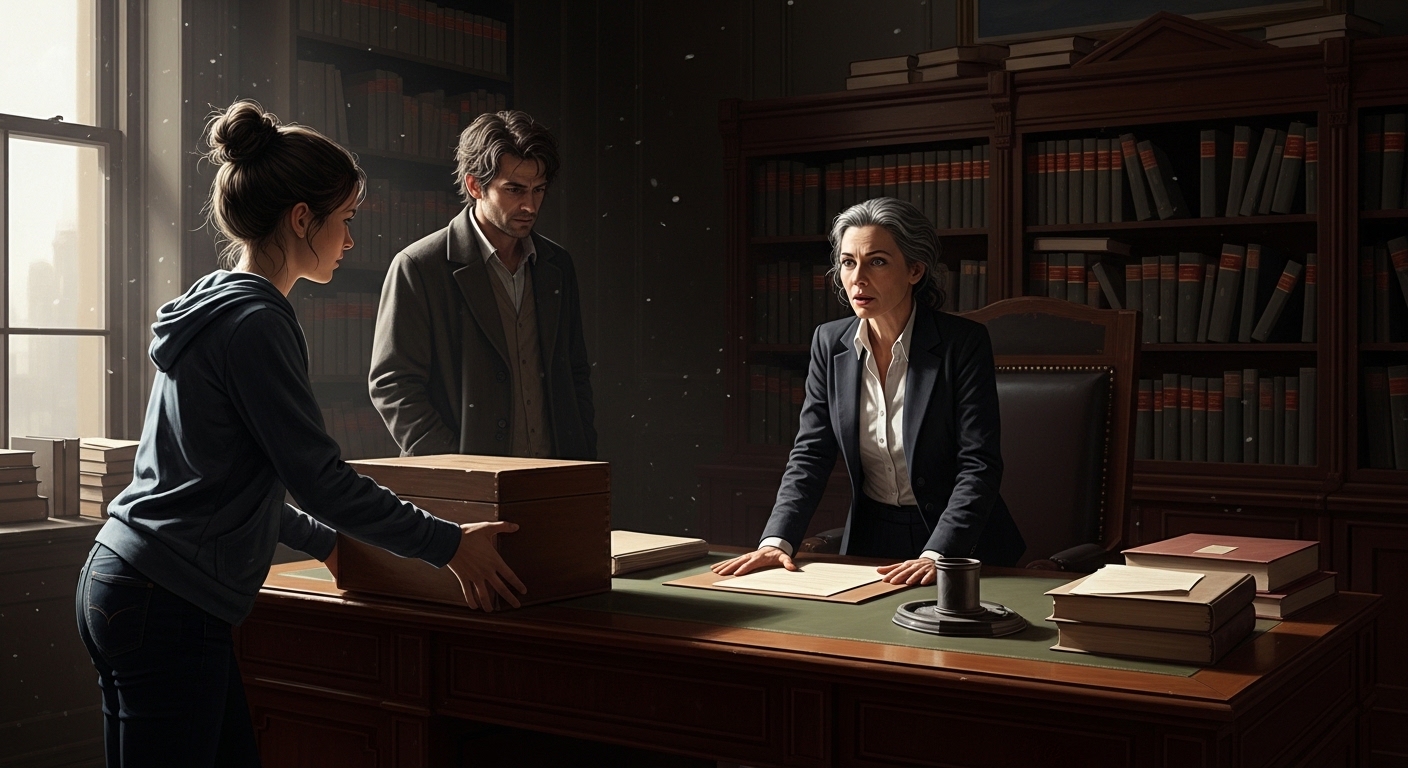
The evening began innocuously enough. Sleet battered the stained-glass windows of the library as Artie settled into a heavy oak chair at the Restricted Section table. Before him lay the Blackwood Ledger, a journal recovered from a house that had reeked of low tide and old copper. The leather binding felt disturbingly organic beneath his weathered fingers, and though the library was officially closed, a man with master keys and four decades of service considered such restrictions merely suggestions.
Artie’s attempt to decipher the ledger’s cramped, feverish script proved futile. The handwriting swam before his tired eyes—Latin mixed with what resembled a butcher’s shorthand. He could make out the name “Blackwood” and a date from 1792, but little else beyond cryptic references to “the tide rising in the cellar.” The only sounds were the grandfather clock’s ominous ticking and the distant, rhythmic thumping of what he hoped was merely a loose shutter on the third floor.
The First Signs
Frustrated, Artie decided to abandon his investigation for the evening. As he rose from his chair, his knees announced their displeasure with a sharp crack that echoed far too long among the bookshelves. He tucked the unnaturally warm ledger under his arm and made his way toward the main exit, only to discover the heavy brass handles refused to budge. The doors were locked from the outside—impossible, as he carried the only keys capable of throwing those particular deadbolts.
A faint, briny smell began wafting up from the floor vents, an odor of dead fish and stagnant marsh water that had no business in a landlocked university library. The thumping sound from earlier had transformed into something far more disturbing: the wet dragging of something heavy across a freshly waxed floor. It emanated from the basement stairs, the very door Artie had locked himself just an hour prior.
Drawing upon his intimate knowledge of the building’s architecture, Artie turned toward the rear service entrance near the loading docks. His keen eyes, though dimmed by age, caught the glint of the emergency bar behind the reference desk. But as he approached, his custodian’s instinct for identifying problems immediately registered an anomaly: a thick, translucent slime was oozing from the top of the doorframe, dripping onto the floor with rhythmic splashes. Where the substance touched the wood, the varnish hissed and bubbled as if subjected to acid.
The wet dragging sound had moved. It was no longer in the basement—it was on the other side of the door, pressed against the metal, waiting.
The Janitor’s Arsenal
With the almost willful ignorance that sometimes shields the elderly from harsh realities, Artie squinted at the dissolving doorframe and muttered about irresponsible students and their biology projects. He turned to retrieve his mop from the nearby closet, determined to address this mess with the same methodical approach he had applied to forty years of spills and stains.
As he fumbled with the closet lock, a new sound pierced the silence: the wet impact of something heavy dropping from the ventilation duct behind him. Whatever had fallen hit the polished floor with the sickening thud of raw meat striking a butcher’s block. The acoustics of the room, which Artie knew intimately, told him the thing was exactly twelve feet away, positioned between the Reference Desk and the Fiction section. It was wet, it was heavy, and it was making a sound like someone attempting to whistle through a throat full of seawater.
Artie managed to open the closet and stepped carefully inside, surrounded by the familiar chemical comfort of industrial bleach and ammonia. His attempt at stealth was betrayed by his aging body—his hip hitched, and his heavy ring of master keys clattered against the concrete floor with a melodic announcement of his presence. Through the slats of the closet door, he watched as a pale, translucent filament probed the air near his face, searching.
The ledger in his hand began to pulse with a heartbeat that was not his own.
Chemical Warfare
“Nothing a little Vitamin B—Bleach—won’t fix,” Artie muttered, reaching for the gallon jug of industrial-strength bleach on the top shelf. With hands steadied by decades of pouring caustic liquids, he unscrewed the cap and waited for the searching appendage to probe further through the wooden slats. When it did, he poured the concentrated chemical directly onto the intruder.
The reaction was immediate and violent. The translucent filament shriveled as if touched by fire, and from beyond the door came a sound no living thing should produce—like a steam whistle blown through a wet sponge. The creature thrashed and retreated, its dissolving mass slapping wetly across the floor as it fled toward the shadows of the Reference Section.
But Artie’s relief was short-lived. The Blackwood Ledger began to glow with a sickly green light, vibrating so intensely it numbed his arm. The smell of bleach was suddenly overwhelmed by the overwhelming stench of freshly turned earth and decay. The book was awakening in response to the violence.
Recognizing his narrow window of opportunity, Artie burst from the closet. He grabbed his metal mop bucket and, with surprising fluidity for a man with a bad hip, sent it clattering magnificently down the North corridor. The wounded creature, reacting to the vibration, launched itself toward the decoy with terrifying speed—a blur of wet limbs and snapping appendages.
The path to the Grand Staircase was clear. Artie shuffled toward it as fast as his seventy-two-year-old legs would carry him, his breath coming in ragged wheezes. He was halfway there when his rubber-soled work boots—purchased specifically for their non-slip properties—betrayed him with a long, high-pitched squeak against the polished floor.
The clattering bucket in the North hall stopped. The silence that followed lasted exactly two seconds before Artie heard the sound of the creature realizing it had been deceived.
Into the Storm
Rather than ascending the stairs, Artie made for a staff-only side door near the Periodicals room. His old lungs burned and his vision blurred at the edges, but adrenaline proved a powerful drug even for a septuagenarian. He reached the heavy oak door just as a cold, wet tendril lashed out, narrowly missing his ankle to instead shatter a nearby display case of Early Babylonian Pottery.
He threw the bolt and shouldered the door open with every ounce of strength he possessed. The transition was violent—from the stifling, brine-scented library to a wall of freezing November rain and wind that nearly knocked him from his feet. But the open air offered no sanctuary.
The campus was eerily dark, all streetlamps extinguished. Under the flickering illumination of a lightning strike, Artie saw why: a thick, oily yellow mist was rolling off the Miskatonic River, hugging the ground at hip height and moving against the wind with unnatural purpose. The Blackwood Ledger in his hand stopped vibrating and simply opened, its pages flipping frantically until they displayed a sketch of the very quad where he stood—but in the drawing, the buildings were crumbled ruins and the sky was filled with countless staring eyes.
A low, guttural moan rose from the yellow mist on all sides. Not one voice, but dozens, speaking in tones that suggested the speakers had never possessed proper lungs. Tall, spindly shapes moved within the fog—things that resembled upright crickets draped in the tattered remains of academic robes.
The creature from the library paused at the doorway behind him, seemingly hesitant to enter the yellow mist. It was a choice between known and unknown horrors, and Artie chose the devil he didn’t know. He began the agonizing hobble across the quad toward his 1922 Ford Model T.
Mechanical Failures
The yellow mist tasted of sulfur and old pennies as Artie pushed through it, keeping his eyes fixed on the black silhouette of his Ford. The moaning clarified into something worse—the sound of air being forced through structures that had never evolved to produce speech. In his peripheral vision, he glimpsed the tall, spindly things moving with deliberate purpose through the fog.
He reached his car, but starting a 1922 Model T was never a simple matter of turning a key. Cold, stiff fingers fumbled with the spark lever. He rushed to the front and heaved on the iron crank. The engine coughed a mocking cloud of black smoke and died. His bad hip screamed in protest at the effort.
Behind him, the slapping sound from the library had returned. The creature he had burned with bleach had decided the yellow mist was a lesser threat than allowing him to escape with the ledger. Worse yet, one of the tall, spindly things in the mist had stopped moaning. It turned its head—a collection of wet, black eyes set in something that might once have been a face—toward the sound of his stalling engine. Twenty feet away, it unfolded a limb that resembled a rusted scythe.
Artie made his decision. “To hell with the car,” he growled. “I’ve spent forty years fixing this place. It isn’t going to do me in with a bit of fog and some oversized garden pests.”
He turned back toward the university, clutching his master keys like a holy relic. He wasn’t aiming for the door he had exited—the Bleached Wonder still lurked there. Instead, he headed for the basement coal chute, a heavy iron flap near the foundation that led directly into the boiler room. It would be a tight squeeze for a man with a bad hip, but it represented solid sanctuary.
The yellow mist had other plans. As Artie pivoted toward the foundation, his left foot slipped in a puddle of yellow slush. He went down hard on one knee, and the spindly creature was upon him in a heartbeat. One of its serrated, insectoid limbs whistled through the air, catching him across the shoulder of his heavy wool coat. Pain exploded—a white-hot spike that cut through the numbing cold. His coat shredded, and warm, sticky blood began soaking his shirt.
The Ledger’s Power
Pinned against the cold stone wall of the university, the yellow mist choking his lungs, Artie found himself facing the spindly horror as it loomed over him. The Blackwood Ledger tucked under his arm suddenly let out a sharp, rhythmic sound—thud-thud, thud-thud—the unmistakable beat of a heart. The spindly creature flinched, its many eyes dilating in what appeared to be terror at the sound emanating from the book.
“Here,” Artie wheezed through gritted teeth, the taste of blood copper in his mouth. “Read the fine print, you damn trespasser.”
He thrust the now-scalding ledger directly into the cluster of wet, black eyes at the center of the creature’s head. The effect was instantaneous and horrifying. As the leather-bound book made contact, the heartbeat inside released one final, deafening pulse. A discharge of sickly green sparks arced from the book into the creature’s eyes. The thing didn’t simply scream—it imploded, its misty, insectoid form collapsing in on itself like a punctured lung. Its flesh dissolved into a foul-smelling gray vapor that was instantly sucked into the ledger’s pages.
The weight in Artie’s hand doubled. The book felt bloated, its leather stretching as if it had just consumed a heavy meal. The yellow mist began recoiling from him, swirling in frantic patterns as if the ledger were a vacuum threatening to draw in everything around it.
With adrenaline substituting for lost youth, Artie seized the handle of the coal chute and yanked. The metal screeched in protest, but the grate swung open. Without hesitation, he sat on the edge and let gravity take him, sliding down the soot-slicked metal ramp into total darkness. He landed with bone-jarring force on a pile of anthracite coal, the impact driving the breath from his lungs.
Above him, the coal chute clanged shut, leaving him in suffocating darkness broken only by the faint, rhythmic green pulse of the ledger lying in the dust beside him.
The Workshop Siege
The air in the basement was hot, dry, and thick with soot and stagnant water. Artie dragged his bruised body off the coal pile and stumbled through the darkness toward his workshop, navigating by muscle memory and the count of his shuffling steps. He didn’t need light—he knew the distance between the boiler and his workbench by heart.
He reached the workshop, a small cage-like room filled with the smell of oil, metal shavings, and comfort. Rather than risk turning on a light that might attract attention, he relied on the sickly green pulse of the Blackwood Ledger to illuminate his workspace. His attempt to treat the scythe wound with shaking, cold-numbed hands was clumsy at best. The rag he wrapped around his shoulder was already seeping blood.
The barricade, however, was another matter. Artie slid a heavy steel cabinet in front of the door and jammed a pipe through the handle with the practiced efficiency of forty years of improvised repairs. Nothing short of a battering ram would breach that door quietly.
As he collapsed into his swivel chair, the ledger on the workbench began to change. The leather binding, once dry and cracked, grew slick and warm like living tissue. The heartbeat he had felt earlier was now audible—a dull thud-thud that vibrated through the steel surface.
Then, through the vents from the boiler room outside, came a voice—or the suggestion of one. It sounded like someone attempting to speak through a throat full of sand, clicking and gurgling behind each word.
“Artie… Artie Higgins… Open the door, Artie. The Dean wants to discuss your… retirement package.”
It was the voice of Dean Marsh, but there was a rhythmic clicking behind the words, like an insect’s mandibles working in mimicry of human speech.
From the ledger on his desk, a single drop of black ink leaked out and began crawling across the table toward his hand, spelling out a single word in elegant, eighteenth-century script: RUN.
The Molotov Trap
“Retirement package, my foot,” Artie muttered, the rag around his shoulder turning deep crimson. “I’ve seen how this university handles turnover. No thanks, Dean.”
He moved with frantic efficiency, grabbing a glass jar and filling it halfway with the high-grade kerosene he used for industrial heaters, topping it off with turpentine—a chemical cocktail that smelled like a funeral pyre. He rigged a strike-anywhere match against sandpaper, tethering the volatile mixture to the heavy steel cabinet he had used as a barricade. If that cabinet moved an inch inward, the jar would tip, the match would strike, and the workshop would become an oven.
The cabinet groaned. Something heavy slammed into the door from the other side, and the pipe jammed through the handle bent slightly. “Artie… don’t make this difficult,” the Dean’s voice warbled, now sounding less like a man and more like a recording played underwater. “We just want the ledger back. It’s… overdue.”
Artie didn’t wait to discuss library fines. He heaved aside empty crates to reveal the rusted grate of the steam tunnel access. His wounded shoulder failed him on the first attempt—the pain was a blinding white flare. A sharp crack came from the door. The cabinet was sliding. The tripwire was tensing. He had seconds.
“Goddamn is right,” he wheezed, planting his good shoulder against the wall and putting every ounce of seventy-two years of frustration, labor, and stubbornness into one final heave. The rust screamed, and the grate gave way.
At that exact moment, the cabinet tipped. Artie dove headfirst into the dark tunnel as the match struck. A muffled explosion of heat licked at his heels, turning his workshop into a roaring furnace. Behind him, a shrieking, bubbling wail rose from what had called itself the Dean.
The Pump Room
The tunnel was barely wide enough for his shoulders, hot and cramped, smelling of ancient steam and dead rats. Artie crawled for what felt like hours, the Blackwood Ledger tucked against his chest, casting its rhythmic, sickly green pulse ahead. Finally, he reached a junction where he could smell the damp, metallic scent of the university’s main water lines.
The ledger pulsed again, and new ink appeared on its page: “THEY ARE WAITING BY THE WATER.”
“Well, let them wait,” Artie rasped. “I’ve been waiting for a pay raise since the McKinley administration. They can get in line.”
He chose the left path toward the familiar plumbing, shuffling through the narrow stone passage. His shoulder throbbed in time with the ledger’s pulse. Behind him, far back in the direction of the smoldering workshop, came a wet, rhythmic thumping—the sound of something heavy being squeezed through a space too small for it.
The passage opened into the Main Pump Room, a vaulted chamber of dripping brick dominated by three massive Victorian-era steam pumps that resembled sleeping iron beasts. The floor was covered in two inches of standing water. The Blackwood Ledger suddenly went ice cold, its green light dying to a dull, bruised purple.
Artie looked down at the standing water. The reflection wasn’t showing the vaulted ceiling or his own haggard face. It showed a clear, sunlit sky and a vast, black ocean. Dozens of pale, bloated faces stared up at him from beneath the surface of the two-inch-deep puddle. Among them, he recognized old “Dusty” Miller, the janitor who had disappeared in 1908.
One pale hand reached up out of the shallow water and clamped around his ankle like a vise made of wet clay.
“Artie…” the water whispered. “The ledger belongs to the deep. Give it back, and we’ll let you sleep. No more mopping. No more knees that ache. Just the cold… and the quiet.”
Steam and Sacrifice
“Hey Miller,” Artie attempted cheerfulness despite the increasing dread. “Uh, I see you’re looking… clammy. The book—what’s it to ya?”
His attempt at janitorial camaraderie fell on deaf, waterlogged ears. “The book… is the tide,” the voices whispered in unison, gurgling like a backing-up drain. “The tide must… come in.” The grip on his ankle tightened, cold pressure sinking into bone.
Artie’s ears, sharp despite his age, picked up a new sound from the tunnel he had just exited—a wet, slopping noise of something large being forced through a narrow opening. The creature from the library had arrived, badly burned and very angry.
Stuck between drowning ghosts and a vengeful, acidic jellyfish, Artie made his decision. “If you wanted to retire me, Dusty, you should’ve filled out the paperwork,” he grunted, leaning his weight toward the primary pressure valve of the Number Three Steam Pump.
This pump was a relic of the nineteenth century—over-engineered, temperamental, and holding enough pressurized death to level a city block if mishandled. Fortunately, mishandling was exactly what the situation required. Artie knew precisely which safety governor to kick and which lever to yank.
He hammered the release lever with the heel of his palm. After a moment of metallic silence, a sound like the world’s largest teakettle erupted in fury. The pipes shuddered, rivets groaned, and a massive jet of superheated steam burst from the main gasket.
Artie dove behind the thick cast-iron housing just as the room became a whiteout of scalding vapor. The heat was agonizing, but he was shielded. The Bleached Wonder, squeezed in the tunnel with nowhere to go, took the full force of the steam. Its translucent flesh hissed and popped like bacon in a pan. The water ghosts shrieked as the boiling water disrupted their cold medium. Dusty’s hand vanished into the rising mist.
Through the white haze, Artie saw the flickering red light of the Emergency Manual Ladder leading to a sidewalk grate on the North Quad. But the Blackwood Ledger was reacting to the steam. As heat struck the book, ink boiled off into thick black smoke that filled his lungs. A strange, cold presence slid into his mind, whispering names of stars that had died before Earth was born.
For a split second, Artie forgot who he was. He became a vast, cold eye looking down at a tiny, burning university. Then the searing pain in his shoulder snapped him back to himself—a seventy-two-year-old man in a basement, losing consciousness from heat and smoke.
The Ascent
“I didn’t spend forty years hauling cast-iron radiators up three flights of stairs just to be outdone by a bit of vertical plumbing,” Artie hissed through gritted teeth.
He tore off the remaining sleeve of his work shirt—the one not soaked in blood—and wrapped it tightly around the Blackwood Ledger. Tucking the bundle into the crook of his good arm, he reached for the first iron rung. The metal was hot from the steam, slick with condensation and soot.
Behind him, the Bleached Wonder let out a final, gurgling roar. Blind and dying, it sensed his movement. A blackened, whip-like tendril lashed out through the steam, blindly seeking him.
Through pure, stubborn geriatric will, Artie ignored the grinding of his shoulder joint and the way his vision spotted with black. One rung. Two rungs. The steam boiled around his ankles, and the creature’s tendril slammed into the ladder just inches below his boots, vibrating the iron so hard his teeth rattled.
He reached the top, his head thumping against the underside of the heavy sidewalk grate. Through the iron lattice, he could see the cold, beautiful November rain and the flickering, distant lights of Arkham. Dangling thirty feet above a boiling basement of monsters, one-handed, holding a book that felt like it was trying to pulse its way into his heartbeat, Artie heaved his good shoulder against the iron.
The grate shrieked, rust gave way, and he tumbled out onto the cold, wet concrete of the North Quad. Rain hit his face like a benediction. He rolled onto his back, gasping for air that didn’t taste of bleach or sulfur.
But the quiet was short-lived. The Blackwood Ledger lay on the wet pavement beside him. The word “BLACKWOOD” had vanished from its cover. In its place, embossed in fresh, dark gold, were two new words: HIGGINS’ CHRONICLE.
The Hospital
“St. Mary’s Hospital,” Artie wheezed, the words coming out as a spray of red mist against the rain. “And I’m keeping the book. Finder’s keepers… and I’ve paid for this damn thing in blood.”
A police cruiser appeared through the yellow-tinted rain, its electric headlights cutting through the storm. Young Officer O’Malley leaped from the car, his face pale with shock at Artie’s appearance. “Jesus, Mary, and Joseph! Artie? Artie Higgins? What in the name of God happened to you? The library is on fire!”
“Boiler… exploded,” Artie managed to rasp. “And I… I found a student’s book. I’m taking it… to the lost and found.”
O’Malley didn’t look at the book. To Artie’s surprise, the officer didn’t seem to see the blue glow at all. He saw only the massive, jagged tear in Artie’s shoulder and the soot on his face. He bundled the old janitor into the back of the Buick.
At St. Mary’s Hospital, Artie lay on a gurney in a curtained-off bay. The smell of bleach here was different—clean, sterile, and carrying no memories of translucent horrors. A doctor stitched his shoulder with rhythmic, clinical movements. The Ledger—the Chronicle—sat on the bedside table, disguised under a stack of blood-stained clothes.
When the doctor left, Artie was alone in blessed quiet for the first time in hours. He reached out a trembling hand and pulled the book from the pile. The blue light was gone; it looked like a normal, high-quality ledger. He flipped it open to the first page.
The entry wasn’t in his handwriting, but it was in his voice. It described the Bleached Wonder, the Dusty-thing, and the fire. But the last line made his heart freeze: “And so Artie Higgins left the University, carrying the seed of the new world. He thinks he is in a hospital. He does not yet realize that the ‘Doctor’ who stitched him has too many joints in his fingers.”
A cold realization dawning, Artie looked toward the curtain. The shadow of the doctor standing just outside was too long. His arms were far too long. And there was that familiar, rhythmic clicking sound.
The Surgeon
“Damned kids,” Artie muttered with the almost willful ignorance of the elderly, but his brain—stubborn and experienced—knew when something was genuinely wrong. The smell wasn’t quite right. The stitches felt hot.
He slid his legs off the hospital bed and moved carefully toward the window. He was on the third floor, approximately thirty-five feet above a rain-slicked cobblestone alleyway. The heavy sash window was, mercifully, recently greased and unlocked—a stroke of luck in a night that had offered precious little.
As he reached the window, the curtain rings shrieked against the metal rod. Standing there was a man in a pristine white coat, his name tag reading “Dr. Aristhone.” But the thing wearing the coat was an architectural disaster. His neck was too long, tilting his head at an angle that should have snapped his spine. His face was a mask of sweating, translucent skin stretched over a skull that seemed to rearrange itself in real-time. Each finger had four knuckles, clicking and snapping like a nest of crabs.
For a moment, Artie’s mind—already frayed by the library and the boiler room—began to unravel at the edges. He didn’t scream; he didn’t have the breath. He simply stared as “Dr. Aristhone” opened his mouth to vent a cloud of that same yellow, sulfuric mist.
“Mr. Higgins,” the thing gurgled, its jaw unhinging. “The stitches I gave you… they aren’t just thread. They are roots. They are already growing into your heart. Give me the Chronicle, and I will make the harvest… painless.”
Artie felt a sharp, sickening tug in his shoulder. The stitches moved, burrowing deeper into his muscle with every passing second.
“Nothing a little Vitamin B won’t fix,” he muttered, reaching not for a weapon but for the heavy white jug of industrial bleach on the top shelf. But the “Doctor” didn’t wait. He lurched forward with unnatural speed, his multi-jointed fingers extending like a carpenter’s rule to snatch at Artie’s throat.
Artie pivoted on the windowsill and thrust the Higgins’ Chronicle—now radiating a cold, abyssal blue—directly into the unhinged, mist-venting maw of Dr. Aristhone.
The Feeding
The contact was like completing an electrical circuit. The moment the leather touched the Doctor’s face, the blue light didn’t just glow—it flashed with the intensity of a magnesium flare. The creature’s yellow mist was sucked into the book’s open pages with the sound of a vacuum cleaner struggling with a heavy rug. The Doctor screeched, his multi-jointed fingers clawing at the book as his flesh began to liquefy, turning into a foul black slurry that the Chronicle hungrily absorbed.
But there was a price. As the Chronicle fed on the monster, it drew power through the very stitches the Doctor had given Artie. He gasped as the black threads in his shoulder glowed blue, burning like white-hot wires inside his chest. The creature collapsed into a pile of empty surgical clothes and rapidly evaporating gray sludge.
The room was silent save for the hiss of rain through the window and the frantic thud-thud of Artie’s heart. But the heartbeat wasn’t just in his chest—it was coming from the floor. The black slurry was swirling, forming a small, dark vortex that looked less like a spill and more like a drain leading somewhere very deep.
Artie heard them then—not one Doctor, but dozens. The clicking sound came from everywhere: the walls, the ceiling, the vents. The hospital wasn’t a place of healing; it was a larder. And the staff had just realized their prize patient was trying to check out early.
The door to his room began to buckle as multiple surgeons threw their weight against it. At his feet, the black vortex reached for his boots.
The Vortex
“Well,” Artie grunted, clutching the vibrating book to his chest. “I always did prefer a shortcut.”
With the surgeons only a heartbeat away, their multi-jointed fingers snapping at his heels, he didn’t look back. He threw his weary, battered body into the swirling black vortex on the floor.
The sensation wasn’t one of falling. It was the sensation of being erased. For a heartbeat, Artie was not himself; he was a smudge of graphite on a cosmic blueprint. The screams of the surgeons and the sterile smell of the hospital were replaced by a deafening, rhythmic thud-thud—the heartbeat of the book. Space twisted like a wet rag being wrung by a giant’s hand.
He hit something hard, flat, and cold—stone steps. The sun was beginning to peek over the horizon, casting pale shadows. Artie was lying face-down on the stone steps of the Miskatonic University Library. The yellow mist was gone. The hospital, the surgeons, and the Bleached Wonder felt like a fever dream, but the jagged, stitched-up hole in his shoulder said otherwise.
Beside him lay the Higgins’ Chronicle, closed and looking for all the world like a simple leather-bound ledger. But when he touched the cover, he felt a faint, warm vibration—a purr of contentment.
His 1922 Ford Model T sat exactly where he had left it, rusted and covered in fine gray ash. But on the front door of the library was a notice dated November 13, 1924: “By Order of the Board of Regents: The Miskatonic Library is closed indefinitely following the tragic passing of Head Custodian Arthur Higgins in a boiler malfunction. Funeral services to be held at St. Mary’s Chapel.”
Artie stood at his own grave, holding the book and his life, but according to the world, he was dead.
The Perfect Library
“What?” Artie rasped to himself. “Dead? I haven’t even collected my pension yet.”
He found his master keys and slid the heavy iron skeleton key into the main door. It turned with buttery smoothness, insulting his forty years of maintenance. The heavy oak doors swung open without a single creak.
The interior was breathtaking. No soot. No smell of chlorine. No shattered pottery. The library looked better than it had in decades—mahogany polished to a mirror shine, marble floors pristine, air scented faintly with vanilla and expensive pipe tobacco.
But something was wrong. Every single book had been replaced. They all shared the same dark, supple leather binding and the same title embossed in gold: HIGGINS’ CHRONICLE: VOL I – MMMCCVI.
The silence was broken by a rhythmic swish-thump of a mop in the North Corridor. Artie turned the corner and saw a man in a gray janitor’s uniform, his back turned. He was tall, his movements fluid and youthful, mopping with supernatural precision.
The janitor stopped, leaned his mop against a shelf, and slowly turned around. He had Artie’s face—but it was Artie’s face from forty years ago, unlined, bright-eyed, and full of a terrifying, hollow ambition.
“You’re late for the hand-off, Artie,” the Young-Artie said in a perfect, haunting echo. “The Board of Regents was starting to think you’d decided to keep the ink for yourself.”
For the second time that night, Artie’s mind began to slip. This wasn’t a restoration. This was a rewrite. Reality itself was being edited, and he was holding the pen.
“I don’t know who the hell you think you are,” Artie spit, “but I’ve spent forty years scrubbing the filth off this floor, and I’m not about to let a hallucination in a cheap suit tell me I’m finished.”
Into the Real
Artie lunged for the service door behind the circulation desk. Young Artie swung a heavy brass floor buffer that whistled through the air, smashing a hole in the mahogany desk where Artie’s head had been a second before. Splinters of “perfect” wood flew like shrapnel as Artie scrambled over the counter.
He reached the door to the basement. In this new library, the door was polished silver with a plaque reading “THE ARCHIVE OF INFINITE HISTORIES.” But beneath the silver plating, Artie’s trained eye caught a stubborn patch of charred, soot-blackened oak—the reality of his fire bleeding through the illusion.
He slammed his master key into the lock. It shouldn’t fit a silver door, but he forced it with pure janitorial spite. The lock screamed—a sound of tearing metal and weeping paper—and the door flew open.
The descent was like falling into a bucket of cold ash. The Archive disappeared. The vanilla smell was replaced by wet charcoal, melted rubber, and ozone. This was the Original Basement, exactly as he had left it after the explosion—walls blackened, pipes burst, floor a lake of soot-clogged water.
Behind him, at the top of the stairs, Young Artie stood in the doorway. He wouldn’t step into the dark. “You’re choosing a grave in the ruins, Artie,” the thing called down. “You could have had a kingdom of books. Now, you’ll just have the soot.”
The silver door slammed shut, locking Artie in the lightless, burnt-out basement. He collapsed into his swivel chair in the workshop area, his vision swimming. The ledger sat before him, its glow now fierce and angry red, illuminating a single unblemished object on top of the ruined pump: a heavy, old-fashioned rotary telephone.
The phone began to ring.
The Board
Artie lifted the heavy black receiver. The plastic was ice-cold, and the cord wasn’t plugged into anything—the frayed end dangled uselessly in the oily water. There was no dial tone, only the sound of a thousand pens scratching on parchment.
A voice spoke, not into his ear but from the center of his own skull—a deep, resonant vibration that tasted of old ink.
“Maintenance… at last. Artie Higgins, you have been remarkably difficult to file. You have burnt the catalog, drowned the staff, and now you sit in the Real while the Ideal waits above. The Board is… displeased with the mess.”
“The Board can shove it,” Artie wheezed into the dead receiver. “I’m retired. I saw the sign on the door.”
“The sign is a draft, Artie. A suggestion. The Higgins’ Chronicle in your hand is the only thing keeping this basement from being erased entirely. You are the anchor. If you let go, the soot, the ruins, and your own weary soul will be bleached away to make room for the Perfect Library. But if you sign the final page… you can be the Architect.”
The Chronicle fell open to its last page—a vast, terrifyingly white sheet of vellum. Beside it, lying in the soot, appeared a silver fountain pen.
“Artie… I can hear your breathing, old man,” the voice continued. The clicking sound was getting faster, more rhythmic. The steel cabinet he had used as a barricade vibrated as something heavy leaned against it from the other side.
Pulling the Plug
“I’ve spent my whole life cleaning up after people who thought they were more important than they were!” Artie roared into the dead receiver. “I don’t want your Perfect Library. I want a world that stays fixed when I fix it!”
He dropped the receiver into the black water with a splash and lunged for the frayed, blackened wire. With hands slick with soot but steady with purpose, he wrapped the copper around the spine of the Higgins’ Chronicle. The book screamed—not a sound but a vibration that threatened to liquify his marrow. The red light turned blinding, jagged white—the color of lightning trapped in leather.
Artie shoved the book and wire deep into the standing water, right against the copper grounding pipe of the main university line. He wasn’t just grounding a wire; he was grounding a god. The power of the Chronicle—the ink, the histories, the Ideal world above—rushed through him. He became the filament in a cosmic lightbulb.
Above him, the silver door didn’t just break; it dissolved. The Perfect Library began to flicker like a dying film reel. Young-Artie let out a distorted, digital shriek as he was pulled apart into streaks of unset ink. The white light from the book surged up the pipes, into the walls, through the very foundations of Miskatonic University. The Ideal was being shorted out by the Real.
The ceiling groaned. The weight of the library was no longer supported by the Board’s magic but by burnt, nineteenth-century beams. “ARTIE!” the voice from the phone wailed, now sounding like a thousand distant, dying radios. “YOU HAVE BROUGHT THE DARKNESS BACK! YOU HAVE REJECTED THE ETERNITY—”
“No,” Artie wheezed, falling to his knees in the boiling, electrified water. “I just… turned off the lights… for the night.”
A massive roar filled the air. The Perfect Library above collapsed—not into the basement, but away, simply ceasing to exist. For a moment, Artie saw the real stars, cold and uncaring, before the charred remains of the actual library floor came crashing down.
Epilogue: The River
Artie woke in a small wooden shack by a river he didn’t recognize, sitting in a rocking chair with his shoulder healed—not with stitches but with a faint, silvery scar. On the table beside him sat a cup of steaming coffee and a small, plain notebook. He opened it to find a single sentence in his own tired handwriting: “Shift’s over. Time to go home.”
He found an old bamboo fishing rod leaning against the porch. The river here didn’t smell of the Miskatonic’s brine or the hospital’s chemicals; it smelled of moss, fresh water, and the slow passage of time. He cast his line into the clear water, the splash small and clean.
The Blackwood Ledger—now simply the Higgins’ Chronicle—sat on the grass beside him, its pages fluttering in the breeze. It was just a book now. No glowing ink, no heartbeats. A record of a life that was supposed to end but didn’t.
As Artie sat watching the bobber dance on the ripples, he realized that Arkham was a long way off—maybe in another state, maybe in another century. He didn’t much care. He had spent forty years maintaining a world for other people. Now he was just maintaining this spot on the river.
A silver-scaled trout leaped from the water a few yards out, catching the light. Artie didn’t even try to hook it. He just watched the circles it left behind as they widened and eventually disappeared, leaving the surface perfectly smooth.
According to the official record, Arthur Higgins had died in a boiler malfunction at Miskatonic University on November 12, 1924. According to the cosmic record, he had deleted himself from the Board’s filing system. According to the truth—the only truth that mattered to the old janitor—he had simply clocked out for the night and found himself somewhere he couldn’t be found, where the only thing that needed fixing was the occasional tangled fishing line.
The shift was over. Artie had earned the quiet.