Previously on… The Architecture of Desperation
The air inside the Brass Ring Café was thick with the sharp, ozone tang of impending warfare. Outside, the Sixteenthday morning was crisp and unnervingly bright, a perfect day for a parade or a public execution. Inside, however, the mood was considerably darker. Across the street, occupying a storefront that had been vacant just yesterday, hung a brand new, aggressively trendy, gold-leafed sign: THE SOVEREIGN BEAN. There was a line out their door. Their patrons held cups of imported porcelain. A man in a ridiculously tailored apron was handing out free samples. It was not commerce; it was a declaration of war.
The Siege of the Sovereign Bean
“It is a coordinated, heavily funded siege,” Cornelius Caulfield murmured, his voice the dry rustle of autumn leaves over a grave. The Brass Ring’s new accountant stood beside Eddi Voss at the polished mahogany bar, looking profoundly, existentially offended. “I have reviewed their pricing model. They are operating at a deliberate seventy percent loss. They are attempting to bleed our foot traffic dry. This is not commerce, Mr. Voss. It is a targeted assassination of our operational boundaries.”
From her corner table, Rabbit nursed a black coffee with exactly three sugars, her dark hazel eyes fixed on the rival establishment with the flat, unblinking intensity of a sniper. By the door, Turtle’s massive arms were crossed over his chest, his tectonic brow furrowed in a silent, immovable glower.
Mick Tallow, the café’s manager and resident baker, burst from the kitchen. He was covered in flour, his sandy hair falling into his eyes, and he clutched a tray of cardamom buns to his chest like a shield. “They have imported milk,” Mick squeaked, pointing a trembling finger at the window. “From the highlands. Eddi, the cows have names. How are we supposed to compete with named cows?”
Caulfield adjusted his cuffs with fastidious, lethal care. “I have already drafted a letter to the municipal health inspector,” he stated smoothly, his shark-like gaze never leaving the enemy across the street. “If I forge the signature of the Chief Medical Officer, we can have their espresso machine classified as a localized plague vector by noon. Alternatively, I know men in the Warrens who will re-route their plumbing to discharge directly into their pastry display. Say the word, Mr. Voss. I shall commence the audit of their physical safety.”
Rabbit tapped a rapid, complex rhythm against her coffee cup. “The syndicate is fracturing,” she pointed out quietly. “The fourteen recipients lost Pell and the Terminus, but they didn’t lose their bank accounts. They can’t touch us legally because of Vex’s injunction, so they are trying to bankrupt us. It’s clean. It’s bloodless.” She glanced at Caulfield. “Unless we start blowing up their plumbing.”
Eddi took a sip of his own coffee, the familiar bitterness a grounding force in the storm of murderous accounting and existential dairy-related terror. “Okay, first off, Cornelius,” he said cordially. “No physical audits. The last thing we need is to run out Vex’s goodwill.”
The microscopic tightening of Caulfield’s jaw conveyed the profound, tragic disappointment of an artist told he cannot use his favorite brushes. “A severe limitation of our tactical paradigm, Mr. Voss,” he murmured. “But I acknowledge the legal parameters. We shall keep the plumbing intact.”
Eddi then turned his full attention to the flour-dusted, hyperventilating man clutching a tray of baked goods. “You’re the man in this, Mickolas,” he said, the intentional use of his full name landing with the weight of a general’s commission. “Your war, and I’ll do as you say. Take point.”
The café went exceptionally still. Rabbit lowered her cup, her eyes shifting to Mick with the clinical fascination of an engineer waiting to see if a building will hold its weight or collapse into the cellar. Mick stared, his hand flying to the iron ring on his finger, spinning it with frantic energy. Eddi had just handed the keys to their commercial survival to a man whose primary defense mechanism had historically been apologizing for his own existence. But Eddi wasn’t looking at him like a liability. He was looking at him like a general.
A War Fought with Pastries

Mick took a long, shuddering breath. He looked down at the tray of perfectly laminated cardamom buns, then at the gold-leafed sign across the street. The terror didn’t leave his face, but it crystallized into something entirely new. It crystallized into professional outrage.
“Right,” Mick said. His voice hit a high pitch, cracked, and then miraculously found a solid, working-class anchor. “No plagues. No bombs. But look at them, Eddi. Look at the staff they hired.” He pointed through the glass. The baristas at The Sovereign Bean were wearing stiff, heavy canvas aprons with leather cross-straps, moving frantically behind a gleaming, overly-complex espresso machine. “Those aprons restrict the shoulders,” Mick declared, his social intelligence kicking in with laser precision. “And there are only three of them working a line of forty people. They aren’t smiling because they’re happy. They’re smiling because they are terrified of their management. The syndicate might have deep pockets, but they don’t know the first thing about hospitality.”
He turned to Caulfield, pulling himself up to his full, flour-dusted height. “Mr. Caulfield,” Mick said, his voice shaking only a fraction. “I do not want you to audit their physical safety. I want you to audit their wage structure. Find out exactly what the Sovereign Bean is paying those miserable people. And then…” He looked down at his tray. “…I want you to box up three dozen of our freshest lemon-cardamom buns. We are going to walk across the street and introduce ourselves. We are going to welcome the rival staff to the neighborhood.”
Caulfield stared at his direct supervisor. For a moment, the deadly accountant computed the sheer, unadulterated madness of the order. Then, a look of profound, chilling realization washed over his precise features.
“Weaponized philanthropy,” Caulfield whispered, his voice a dry rustle of approval. “You intend to shatter their operational morale by demonstrating superior working conditions and providing them with high-density caloric bribes. Diabolical, Mr. Tallow. I shall draft the unionization pamphlets immediately.”
A sound dangerously close to a laugh escaped Rabbit’s lips. The café’s baker had officially engaged the enemy, choosing to fight the syndicate’s bottomless bank accounts with extreme empathy and baked goods.
“Your command, general?” Eddi gently nudged Mick. Mick’s hand twitched toward his ring, a reflex born of years expecting the sky to fall, but his fingers stopped short. Cornelius Caulfield emerged from the back room carrying three pristine white bakery boxes, held with the same lethal precision he once used to handle ledgers of municipal treason. “The munitions are prepared, Mr. Tallow,” Caulfield stated smoothly. “I have ensured the lemon-cardamom distribution is mathematically flawless.”
Mick took the boxes. He drew himself up, a solid, working-class anchor overriding his usual desire to apologize for existing. “Right,” he said, his voice ringing clearly. “Turtle, open the door. Cornelius, you are with me. Keep your hands where they can be seen, and try not to look like you’re calculating their mortality rate. Eddi… you watch the till.”
Turtle hauled the heavy oak door open. Mick stepped out onto the cobblestones, Caulfield falling into step exactly half a pace behind him. Together, the flour-dusted baker and the former syndicate assassin marched across the street to welcome the enemy. “He’s going to have their entire staff unionized and working for us by noon, isn’t he?” Rabbit observed quietly from her stool at the bar.
Eddi simply relaxed. He stepped behind the polished mahogany, the iron ring on his finger a cool, heavy reminder of the crew he’d built. He counted the crowns and pennies in the till, the simple task a balm. The Solicitor’s Injunction hanging on the wall rendered them legally untouchable. For the first time in a long time, no heavily armed goons were going to kick the door in. Rabbit hopped onto a stool beside him. “I give it ten minutes,” she said, her voice a dry, flat drawl, “before Caulfield mathematically proves to their shift supervisor that their current wage structure is a violation of the basic laws of thermodynamics.”
“Mick is in charge,” Eddi replied, wiping down the counter. “He set ground rules. No plagues, no bombs, no physical audits.”
“Mick is holding a box of lemon-cardamom buns like it’s a reinforced riot shield,” Rabbit pointed out. “You realize you just sent a man who stress-bakes at three in the morning to command a man who used to calculate murder margins for a living?”
Eddi leaned against the bar, watching the scene unfold across the street. “That’s the beauty of it, Bea. The syndicate understands leverage, extortion, and fear. They put those baristas in stiff canvas aprons and understaffed them because they view people as cogs in a machine.” He spun his ring. “Mick views them as people who need a break and a decent pastry. The syndicate has absolutely no defense against weaponized empathy.”
Rabbit stopped tapping her fingers against the mahogany. A microscopic smirk touched the corner of her mouth. “Weaponized empathy,” she repeated, tasting the phrase. “It’s absurd. It’s completely, structurally unhinged.” She raised her mug. “I love it.”
An Architect’s Lock

The quiet of the Brass Ring was a fragile, beautiful thing. Just as Eddi and Rabbit were settling in to watch Mick’s masterclass in psychological warfare paralyze the syndicate’s coffee operation, the brass bell above the door chimed. It was not a customer seeking refuge from the line across the street. It was Oskar Flint, the Gildmarket pawnbroker, a man who looked as though he had been physically dredged from the bottom of a wine barrel.
He scurried past Turtle, clutching a heavy canvas sack to his chest with the desperate grip of a man holding a live grenade. “Voss,” Flint croaked, his one good eye darting around the empty café. “They told me you were untouchable now. They said you had a magic piece of paper from the Solicitor’s office that keeps the hounds out.”
“Word travels fast,” Eddi said mildly. “What’s in the sack, Oskar?”
Flint glanced at Rabbit, swallowed hard under her predatory stare, and pulled out a box. He set it on the mahogany with a dense, incredibly heavy thud. It was a cube, the size of a human head, constructed of interlocking, oxidized brass plates and dark iron gears. It radiated a cold, oppressive weight, as if the object itself fundamentally disapproved of being looked at. And right in the center, worn but unmistakable, was the crest of the Aldric Foundation.
Rabbit stopped breathing. “A mud-larker pulled it out of the river muck near the South Marsh yesterday,” Flint whispered, his hands shaking. “Dredged it up from where that condemned bridge collapsed. Sold it to me for ten crowns. Last night, two men in sensible coats came into the Gildmarket asking if anyone had recently acquired any ‘Foundation architecture.’ It’s a puzzle-vault, Voss. It hissed at me. I don’t want it.”
Rabbit leaned forward, her fingers hovering an inch above the brass. “It’s an Architect’s lock,” she murmured, her voice a low, reverent whisper Eddi had never heard before. “A pure, mathematical sequence. No tumblers. No pins. Just geometric pressure points. They’re supposed to be myth. Mathematically unpickable.” She looked up at him, her eyes burning with pure, unadulterated professional ego. “Buy it, Eddi,” she said. It was the closest she had ever come to begging.
Eddi leaned across the bar, projecting the absolute, unshakable confidence of a man who values his inventory. “I’ll take it off your hands. What do you say to seven crowns? You said you bought it for ten, but I’ll throw in a cup of coffee too.”
Flint stared, his one good eye twitching. He looked at the heavy, ticking brass cube, then at the tectonic expanse of Turtle standing by the door. “Seven crowns,” he repeated, his voice hollow. “And the coffee. Black.” Flint grabbed the hot mug, shoved the crowns into his coat, and practically sprinted for the door, vanishing into the Merchant Quarter.
Rabbit was already on it, sliding onto the stool, pulling a slender tension wrench and a half-diamond pick from her duster. She hovered her fingers over the geometric panels. “It’s cold,” she murmured. “And there’s a faint vibration. Not a clockwork tick. Something deeper. A pressure differential.” She looked up. “Eddi, if this is an original Architect’s lock, it wasn’t designed to keep thieves out. It was designed to keep something very specific in. It belonged to whoever built the original cage.”
She tapped her fingers against the mahogany. “I need quiet. I need three hours. And I need you to promise me that if this thing starts ticking faster, you and Turtle will throw it into the alley before it takes the café with it.”
The Blueprint in the Brass

While Rabbit became lost to the physical world, her ear pressed to the cold brass of the puzzle-vault, Eddi leaned against the front window, practicing the long read on the river of municipal ambition flowing past. He saw a clerk carrying bad news, a pickpocket learning a valuable lesson, and then, he saw an anomaly. Amidst the joyous, unionizing chaos outside The Sovereign Bean, a man in an impeccable plum coat stood leaning on a silver-tipped walking stick. He was not looking at the pastries. He was watching Cornelius Caulfield with the flat, unblinking intensity of an apex predator recognizing a rival.
The man jotted two lines in a silver-bound notebook, then his gaze tracked across the cobblestones, directly to the window of the Brass Ring. Directly to Eddi. The man offered a slow, deliberate tip of his hat, then strolled into an alleyway and vanished. Eddi didn’t hesitate. Slipping out of the café, he moved with the fluid, silent stride of a man who belongs in the shadows. He emerged onto a cross-street just in time to see the man in the plum coat climbing into a glossy, emerald green carriage.
“…accountant is the variable,” the man said, his voice a smooth, rich baritone. “Tell the Board we may need to accelerate the merger. The baker is irrelevant.” The carriage lurched forward, disappearing into the traffic. A new player was on the board. One who dismissed Mick as irrelevant and marked Caulfield as a target.
Eddi returned to find his crew victorious. “Total capitulation, Mr. Voss,” Caulfield reported. “The rival staff has agreed to a collective bargaining meeting at noon.” Mick whispered, horrified, “They were using margarine, Eddi. In the croissants. We saved those people.”
But Rabbit hadn’t moved. She was staring at the brass cube, her fingers resting lightly on its spinning panels. “It’s not a lock,” she said, her voice distant. “It’s a map. The pressure points… they correspond to district elevations. Eddi, I think this box opens to coordinates, not a key.”
The revelation sent them not on a grand city-wide excursion, but ten feet to the left, to the dusty shop of Benedek & Fills, Cartographers. After a bit of professional ego-stroking, the two mapmakers excitedly unrolled a massive, hand-drawn topological chart of the original city. Rabbit placed the puzzle-vault on the vellum. “The Aldric crest is dead center,” she muttered. “If center is sea level… then the four corner pressure points correspond to the highest foundational points of the original city districts.”
She looked at Eddi. “I need you to press the top-left panel and the bottom-right panel at the exact same time I press the other two. When I nod, push down with exactly five pounds of pressure.”
Eddi did as he was told. On Rabbit’s signal, they pressed. For a heartbeat, nothing. Then, a heavy, resonant *Click*. The top panel of the cube split open, unfolding like a mechanical flower. It flattened out across the drafting table, transforming into a three-dimensional, relief-map of the city as it was planned to be, complete with waterways never dug and towers never built.
“It’s not just a map,” Rabbit said, her voice low. “It’s a blueprint for the Foundation’s network.” She pointed to a series of small, ruby-colored gemstones embedded in the brass streets. Her finger traced a line from the South Marsh up through the city arteries, stopping dead in the middle of the Merchant Quarter. There, a single, large sapphire was embedded at the corner of Tallow Street and Miller’s Row. Rabbit looked at the map, then at Eddi, her face pale. “Eddi,” she said. “That’s our street.” She squinted at the brass relief building standing directly on the sapphire. “That’s our basement.”
The Siege of Tallow Street

The descent into the cellar was a journey into a different reality. The air was cool, smelling of coal dust and damp earth. Rabbit paced out the coordinates from the brass map, pointing to a patch of packed earth dangerously close to a load-bearing arch. “The vault isn’t under the center of the room,” she noted dryly. “If we dig wrong, the espresso machine falls into the hole. And then Mick dies of a broken heart.”
Turtle hefted a pickaxe. Guided by Eddi’s intrinsic knowledge of the building’s structure, he brought the heavy iron down. *Thwack*. It was not the sound of metal hitting dirt; it was the heavy, dull thud of metal on metal. Beneath the soil lay a heavy iron plate, stamped with the crest of the Aldric Foundation. In its center was a single indentation, shaped exactly like the heavy gold signet ring sitting in Eddi’s pocket.
Eddi placed the ring in the slot. It fit with a satisfying, oiled *snick*. The floor shuddered, and with the grinding complaint of industrial gears, the iron plate rotated, a camera shutter iris opening to the dark. A rush of stale, pressurized air hissed out, and a heavy, brass pneumatic canister rose from the hole. It was not an ancient relic. It was a message, sent just moments ago.
Eddi broke the seal. Inside was a thick sheaf of vellum, bound by an iron wire. It was a masterpiece of bureaucratic annihilation. “Eddi,” Rabbit whispered, her voice stripped of cynicism, leaving only cold horror. “This isn’t a ledger. It’s an execution order for the entire neighborhood. The dying Architect is trying to drag the city down with them by simultaneously invoking thousands of conflicting city ordinances and compulsory purchase orders. They are threatening to literally erase the Merchant Quarter from the city maps.”
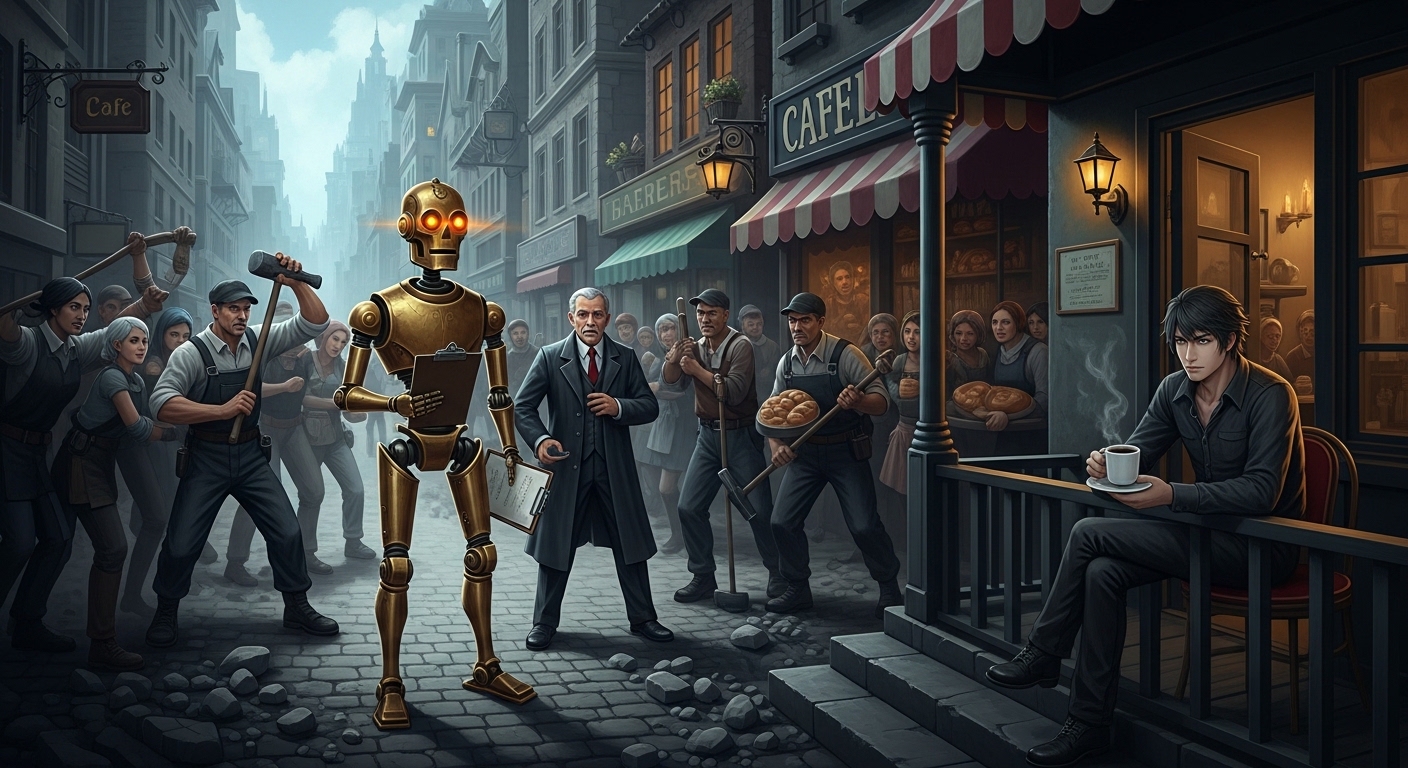
As if on cue, the floorboards above thumped with Mick’s frantic boots. “EDDI!” he shrieked. “THERE ARE MEN OUTSIDE! MEN WITH SLEDGEHAMMERS AND CLIPBOARDS! THEY HAVE EVICTION NOTICES!”
They burst out of the cellar into chaos. A small army of municipal demolition crews and syndicate functionaries was gathering on the cobblestones. Eddi stepped outside, facing them down with nothing but a smile and a preposterous offer of directions. The audacity of it stalled them, buying just enough time for Cornelius Caulfield to press a red-ink-bled copy of their own mandate against the window, surgically dismantled and cross-referenced with Vex’s untouchable injunction. The thugs were stymied, their paperwork useless against the deadliest auditor in the city.
But the mandate was for the whole block. As the crew turned their hammers toward the neighboring bakery, Eddi played his most audacious card yet. “Wait!” he shouted. “Gentlemen, it’s midday. You deserve a lunch break, don’t you? Come inside, we got soup.”
The working class of Caulfield understands the sacred geometry of a free lunch. The demolition crew filed into the café. Eddi pulled the door shut behind them and turned the lock. He had just trapped them. Breaking out of a building protected by a Solicitor’s Injunction was civic treason. They were bureaucratic hostages, held captive by red tape and leek and potato soup.
Meanwhile, Rabbit and Turtle had gathered the neighborhood—bakers with rolling pins, cartographers with compasses, and the newly unionized baristas from across the street. They formed a human shield around the café. The final piece of the puzzle arrived with a CLANK and a HISS of lavender-scented steam. Falstaff, the seven-foot-tall automaton, boomed, “I DETECT AN UNAUTHORIZED GATHERING OF UNSANCTIONED BLUNT INSTRUMENTS.” The automaton proceeded to threaten the remaining thugs with seventeen copies of the very demoralizing Form 402-B.
Inside, Caulfield tapped on the glass. He had found the kill-shot. Eddi read the loophole aloud for all to hear: executing the ordinance without the Guild’s countersign transformed it from urban renewal into unauthorized civic terrorism. The thugs dropped their hammers and fled. The syndicate clerk ran. The siege was broken. The street was theirs.
The Banality of the Ledger

The victory was temporary. The open pneumatic tube in the basement was a direct line to the heart of the city’s disease. The brass map led them not to a grand manor, but to a maintenance crypt deep beneath Founders’ Square. There, behind a massive, unlocked iron vault door, they found the source.
The original headquarters of the Aldric Foundation was a tomb of bureaucracy. And sitting behind a heavy mahogany desk, surrounded by mountains of ledgers, was the Architect. Not a monster, but a frail, elderly man in a wheelchair, kept alive by a hissing brass oxygen lung. His name was Elias, and he had been the Chief Auditor. “I simply… found a new revenue stream,” he rasped. “I discovered that leverage is a far more stable currency than charity. I didn’t hate the people I ruined, Mr. Voss. I just… stopped seeing them as people.” He sighed, a sound of profound bureaucratic fatigue. “The purge… it wasn’t personal spite. It was simply a final balancing of the accounts. Standard operating procedure.”
The sheer, suffocating banality of it was a physical blow. Eddi walked out into the corridor and retched, spitting bile onto the ancient stones. He gave his orders. “Destroy everything in here. Except the lung.”
Turtle dismantled the architecture of misery with the methodical rhythm of a man breaking down a rusted crane. The pneumatic console crunched, the filing cabinets splintered, the ledgers became confetti. Rabbit found a master cipher key in the wheelchair’s lining and crushed it. They left Elias in the wreckage, a dying clerk in a broken room, and walked away.
Back in the cellar of the Brass Ring, Eddi swung a sledgehammer at the exposed pneumatic tube. The hammer glanced off with a jarring CLANG, a brutal reminder from the dice that he was a proprietor, not a demolitions man. Turtle took the hammer and, with two perfectly placed blows, crumpled the brass and shattered the valve. He dragged the iron plate back over the hole. The pipeline was closed. The ledger was balanced.
Aftermath
Eddi walked back upstairs, leaving the crushed brass and the ghost of an eleven-year nightmare in the dark. He stepped from the cold cellar directly into the beating, roasted-coffee heart of the Brass Ring. Mick had orchestrated a flour-dusted symphony of relief. Turtle was at his stool with a beer. Ropey dropped from the rafters to steal a pastry. At the bar, Cornelius Caulfield was meticulously cataloging their newly acquired arsenal of municipal sledgehammers, amortizing the bludgeons over a five-year depreciation schedule as a hedge against future zoning disputes.
Eddi poured a coffee, black, from the good pot. He added one, two, three scoops of sugar and slid it across the mahogany to Rabbit. She took the mug, wrapped her lock-oil-stained fingers around the warm ceramic, and didn’t give it back.
“The street is quiet,” Rabbit murmured, looking at the chaotic, beautiful family filling the café.
“The street is ours,” Eddi corrected her gently.
He leaned against the bar and spun the iron ring on his right middle finger. It didn’t stand for a criminal syndicate or unlock a subterranean vault.
It meant: I climbed a roof with these people and didn’t die.
It meant: I’m not alone anymore.
It meant: I built a little corner of the universe, and I made it stay peaceful.
Outside, the city was indifferent to the apocalypse it had just avoided.
But inside the Brass Ring, the lamps were golden, the coffee was hot, and the ledger of a life was finally, perfectly balanced.