
The Blackwood Creek Incident: A Chronicle of Unraveling
Prelude: The Weight of Fifteen Years
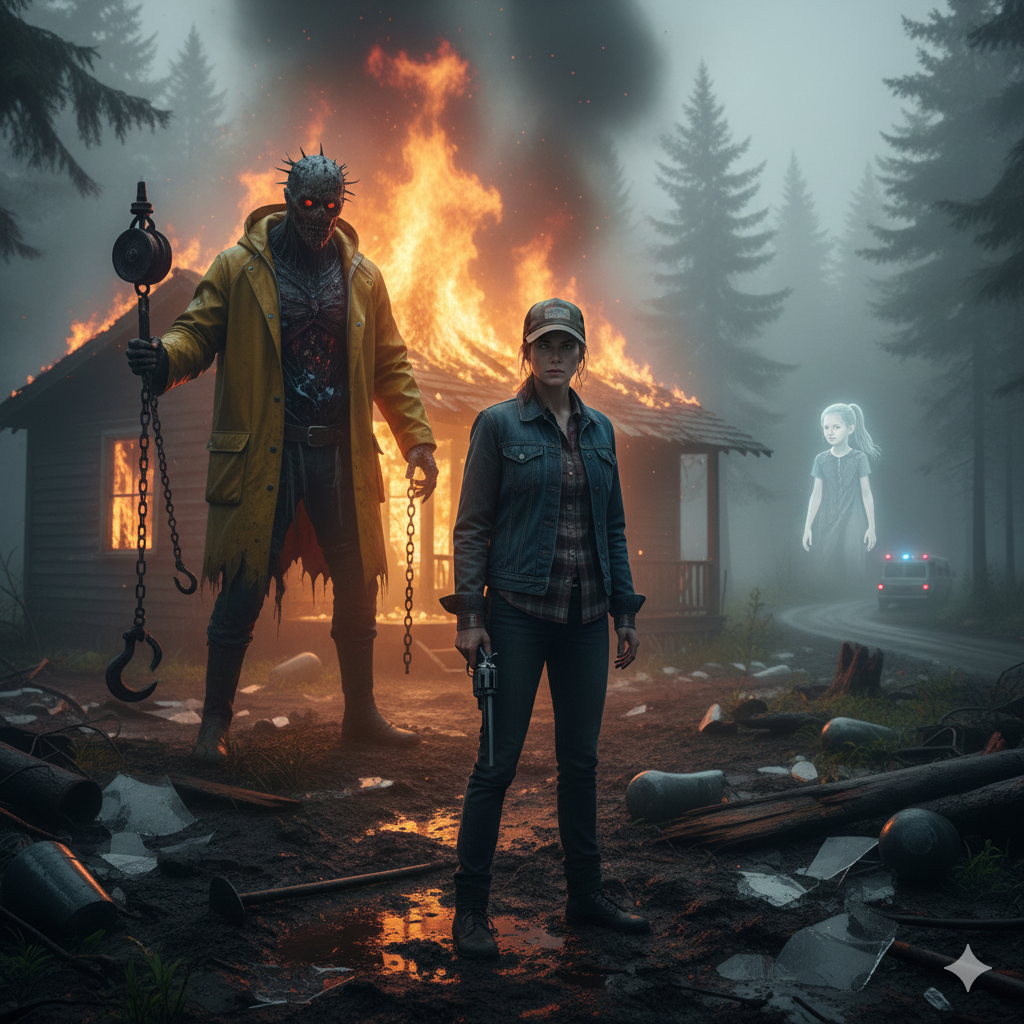
There are places in this world where grief settles like sediment, layering year upon year until the very ground becomes saturated with loss, until the air itself tastes of copper and regret. Blackwood Creek was such a place, and Susie Miller—whose denim jacket bore the patina of a thousand sleepless nights, whose trucker cap concealed eyes that had stared too long into the abyss of her sister’s absence—returned to it as one returns to the site of an amputation, compelled by phantom pain to touch the place where something vital was severed.
Fifteen years. Long enough for trees to grow tall over a grave, for a child to become a woman, for the world to forget. But not long enough—never long enough—for the dreams to stop, for the questions to cease their gnawing, for the image of Lily’s ponytail bobbing ahead on that final trail to fade into merciful obscurity. The accident, they called it. The flood of 1972, they said, as if weather alone could explain the selective cruelty of nature, as if random chance could account for why some bodies wash up and others vanish into earth’s hungry throat.
Susie had learned, through those fifteen years of accumulating shadows, that accidents were often orchestrated, that floods sometimes served as convenient alibis, and that the truest monsters wore human faces—or wore them once, before whatever corruption claimed them had progressed too far to maintain even that basic deception.
Act I: The Veneer of Normalcy
The golden hour at Blackwood Creek possessed the particular quality of light that precedes violence, that strange amber glow that seems, in retrospect, to have been a warning written in photons that human eyes lack the capacity to properly interpret. College students—soft, untested creatures who had never learned that the world contains teeth—played at camp counselor with the unselfconscious enthusiasm of those who believe their youth renders them immortal. Their laughter carried across the water with a crystalline fragility that made Susie’s jaw ache, for she recognized in their carefreeness something she herself had possessed once, before Lily’s disappearance had taught her that happiness was merely the interval between horrors.
Mike approached her truck with the kind of smile that suggested his worst day had involved nothing more traumatic than a failed exam or a broken heart—the small tragedies of a life lived in blessed ignorance of true darkness. He invited her to dinner, to spaghetti and garlic bread in the main lodge, and Susie accepted because sometimes the hunter must walk among the herd to draw out the predator, must play at being prey to set the proper trap. She could feel the weight of the thirty-eight revolver in her glove box like a talisman, like a promise she had made to the dead, and she left it there because the time for lead and powder would come soon enough, after the masks had fallen away.
The lodge interior possessed that particular temporal dislocation common to such places—yellowing floor wax and cedar logs suggesting permanence, yet underneath, the subtle wrongness of a stage set, of something performing the idea of normalcy rather than embodying it. Susie’s eyes, trained by fifteen years of obsessive examination of every photograph, every news clipping, every whispered rumor, found what she sought on the History of Blackwood wall: the 1972 staff photo, with Lily frozen in mid-laugh, forever young, forever on the cusp of a death she couldn’t see approaching.
But there—in the background, where shadows accumulated against the tree line—stood something that shouldn’t have been. A tall figure in a yellow rain slicker, present on a sunny day, its placement in the composition suggesting it had been there all along, lurking just outside the frame of their awareness, waiting. And more disturbing still, someone had taken a ballpoint pen and pressed so hard against the photograph that the paper tore, obliterating the face of one particular man with the desperate violence of someone trying to erase not just an image but a memory, a knowledge too terrible to be allowed visual representation.
The groundskeeper. The name excised from records with surgical precision. The gap in the narrative where a human being should have been catalogued but had instead been rendered into deliberate absence, into the kind of void that attracts the eye precisely because it represents something someone desperately needed to hide.
Susie’s fingers traced the cold glass of the frame, and in that moment of contact, the performance of normalcy began to crack, to reveal the rot beneath.
Interlude: The Dripping
It began, as these things so often do, with a single drop.
The acoustics of dread have their own language, their own grammar of approach—the distant thunder that announces the storm, the creak of old wood settling, the rustle that might be wind or might be something that has learned to move like wind. But nothing quite matches the particular horror of liquid falling where liquid should not be, of wetness appearing on surfaces that should remain dry, of gravity asserting itself to carry something from above to below in that patient, inexorable way that suggests the laws of physics have become complicit in nightmare.
Plip.
The drop landed in Susie’s spaghetti with the delicacy of a period ending a sentence—small, final, darkly crimson. Then another. Then another, with increasing frequency, as if whatever hemorrhaged above was losing its capacity to contain itself, was giving in to the inevitable spillage that comes when flesh can no longer maintain its integrity.
Mike remained oblivious, still talking about coffee and visitors and the camp’s pleasant quietude, his awareness not yet having caught up to the fact that the ceiling wept blood, that the floorboards groaned under a weight they were never designed to bear, that something was being dragged across the second-floor balcony with the methodical patience of someone who had all the time in the world because time, for them, had stopped having meaning somewhere in the long decay between life and whatever they had become.
The power flickered—once, twice—and in that interval of darkness before the lights surged back, every person in that lodge existed in a state of quantum superposition between the world they believed they inhabited and the one they were about to discover had been true all along. The girl with the glasses looked up. The varsity athlete pointed. The dark saturation on the white-painted wood bloomed like a grotesque flower.
And then the ceiling didn’t just leak. It detonated.
Act II: The Revelation of the Yellow King
Six feet of rotted timber and accumulated secrets gave way in a shower of splinters and the viscera of something—someone—who had been systematically disassembled above their heads while they ate pasta and pretended the world was safe. What crashed through that ceiling onto the dining table was no longer entirely human, if it had ever been, though it wore the rough shape of humanity the way a hermit crab wears a borrowed shell—functional, recognizable, but fundamentally wrong in some essential way that defied articulation.
The yellow rain slicker, jaundiced and slicked with fluids both ancient and fresh, hung on a frame that stood six and a half feet tall, its proportions subtly wrong in the way that deep-sea creatures are wrong when brought to the surface, when pressure and darkness no longer constrain them to their proper forms. The face—and here the word “face” becomes a courtesy extended to something that merely occupied the space where a face should be—consisted of stitched burlap and what appeared to be human hair, though whether it had been harvested from victims or had simply grown that way, some vestigial remnant of whatever transformation had occurred, remained mercifully unclear.
In its hand, it dragged a logging chain ending in a rusted pulley hook, the metal scraping against floorboards with a sound that bypassed the ears entirely and resonated directly in the hindbrain, in that ancient part of human consciousness that still remembers being prey, that still knows the sound of the predator’s approach.
The counselors scattered like startled birds, their youth and inexperience rendering them incapable of anything but flight, but Susie—who had been preparing for this confrontation in every dream and waking moment for fifteen years, who had imagined a thousand variations of this encounter until imagination and premonition blurred—moved with the terrible clarity that comes when fantasy finally solidifies into flesh and consequence.
Her hand closed around the iron poker at the hearth, three feet of solid metal that had warmed countless fires and now would serve as an instrument of something far hotter than mere combustion. The thing in the yellow slicker tilted its head, and though it possessed no visible eyes, Susie felt the weight of its recognition. It knew her. It knew the Miller blood that ran in her veins, the same blood that had run in Lily’s, and in that moment of mutual acknowledgment, the final pretense fell away.
This had never been an accident. The flood had been convenient cover. Lily had been chosen, selected, collected—the first piece in some grotesque assemblage that had waited fifteen patient years for the set to be completed.
Interlude: The Old Man’s Confession
The violence that followed possessed the strange, balletic quality of inevitability—Susie’s poker connecting with the creature’s skull in an impact that sent not blood but something darker, thicker, more fundamentally wrong spraying across the lodge’s cedar walls; the logging chain lashing out in retaliation, its rusted teeth finding purchase in her denim jacket and the flesh beneath, trading harm for harm in the ancient arithmetic of predator and prey, where both parties emerge wounded and the victory belongs to whichever can endure the longest.
The old man emerged from the kitchen with a shotgun, but his trembling hands betrayed that he was no threat, merely another piece of this unfolding horror, a jailer who had kept the secret for decades, feeding the monster not out of malice but out of terror, because some things, once known, cannot be unknown, and some bargains, once struck, cannot be unmade.
“The Millers!” he screamed, his voice cracking with the strain of confession, with the relief of finally speaking what should have remained forever silent. “It wasn’t just a flood in ’72! He was taking them before the levee broke! He don’t just kill, he collects! He took your sister to start the set, and he’s been waiting fifteen years for the blood to match again!”
The revelation landed with the weight of absolute truth, heavy enough to bend the architecture of reality, to make the past fifteen years collapse into a new configuration where every assumption had to be revised, where accident became murder became something worse than murder—a deliberate harvesting, a taxonomist’s patience applied to human souls, a collection that required specific specimens and would wait however long necessity demanded.
The creature in the yellow slicker, enraged by the exposure of what should have remained hidden, turned its attention from Susie to the old man, and the shotgun blast that followed—that double thunder of buckshot tearing wood and something that should have been flesh but wasn’t—accomplished nothing except to confirm what Susie had already begun to suspect: that lead and steel might wound but could not kill what had already died and been remade into something that wore death like a comfortable garment.
Act III: The Flight to False Sanctuary
Susie ran—not from cowardice but from tactical necessity, abandoning the poker and the lodge and the old man’s dying screams—because the revolver in her truck represented finality in a way that improvised weapons could not, represented the kind of definitive statement that might, if she were fortunate, end this nightmare before it could extend its tendrils further into the world.
The rain had risen to a deluge, as if the sky itself wept for what was transpiring below, and the distance between the lodge and her Chevy Blazer stretched with the elastic quality of nightmare geography, where safety remains always just beyond reach, always receding at precisely the pace of approach. Her fingers, slicked with her own blood and the black ichor of the thing she had wounded, fumbled with the glove box latch until it finally yielded, and there—cold, heavy, real—sat the thirty-eight revolver, its cylinder loaded with six rounds that would have to serve as both salvation and judgment.
The impact that rocked the entire vehicle came from above, preceded by no warning except the sudden compression of metal, the groan of a roof never designed to support such weight. A massive gray hand punched through the driver’s side window with the casual violence of something breaking an eggshell, reaching for her throat with fingers that terminated in nails caked with decades of accumulated dirt and worse, reaching with the patient inevitability of death itself, which comes for everyone eventually but had chosen this particular moment to accelerate its schedule.
Susie did not aim, did not breathe, did not allow herself the luxury of thought—she simply pressed the muzzle against the buckling roof and pulled the trigger again and again and again, the reports deafening in the enclosed space, the muzzle flash painting the interior in strobing orange, the smell of cordite mixing with rain and blood and that peculiar odor of the creature’s internal fluids, something like pond water left too long in darkness, like organic matter suspended in formaldehyde, like corruption bottled and preserved.
The weight shifted, scraped, fell away, and Susie scrambled across the gearshift to the passenger window where the silhouette loomed in the rain, where she emptied the remaining three rounds at point-blank range into what passed for its face, the bullets tearing through burlap and bone and something that might once have been a brain but had been replaced by some other organizing principle, some other architecture of consciousness that allowed it to move and hunt and remember.
But even in falling, even in what should have been death, the creature’s arm lashed out with that rusted pulley hook, opening a deep gash across Susie’s ribs that split skin and muscle and introduced her to a new calibration of pain, the kind that makes the body understand its own fragility, its own temporary lease on animation.
Interlude: The Mathematics of Survival
Blood loss has its own timeline, its own mathematics of diminishing returns where each heartbeat pumps precious volume toward entropy, where the body’s capacity to maintain consciousness decreases along an exponential curve that ends, always and inevitably, in darkness. Susie collapsed in the mud—that same mud that had swallowed Lily fifteen years ago, that had drunk deeply of Miller blood before and seemed eager for a second helping—and for a long moment, the seductive simplicity of surrender whispered its sweet poison: Rest. Sleep. Let go. You’ve done enough.
But fifteen years of grief had calcified into something harder than bone, had transformed soft tissue of mourning into the inflexible architecture of purpose, and that purpose—that terrible, sustaining rage—would not permit cessation, would not allow the story to end here in the freezing slurry of earth and rain and the thing’s black ichor, would not grant the mercy of an ending before the final accounting had been rendered in full.
She crawled. Inch by agonizing inch, using roots and rocks to drag her broken body across ground that seemed to actively resist her progress, that seemed invested in keeping her prostrate, keeping her vulnerable, keeping her available for whatever might emerge from the burning lodge or the dark woods to finish what had been started. The world had narrowed to a pinhole of consciousness, to a single imperative written in neural fire: Move. Survive. Continue.
Behind her, the main lodge had become an inferno, its dry cedar transformed into a cathedral of flame that cast dancing shadows across the clearing, painting the trees in shades of orange and crimson that seemed less like illumination than revelation, as if fire had burned away pretense to show the world’s true colors, its fundamental violence.
The creature’s body lay somewhere in that darkness, though Susie possessed enough hard-won wisdom to know that “not moving” was not synonymous with “dead,” that some things could play possum with the patience of stones, could wait in stillness for the proper moment to resume their hunt. But she could not afford to verify its termination, could not spare the time or consciousness for confirmation when the gravel of the main road remained achingly distant and her blood pressure continued its inexorable decline.
When the ambulance’s headlights finally swept across the road and caught the reflection of her denim jacket against the Blackwood Creek entrance sign, Susie allowed herself the luxury of unconsciousness, that small death that is sleep’s more dangerous cousin, trusting that she had crawled far enough, had survived long enough, had earned this brief reprieve from the necessity of remaining vigilant.
Act IV: The Hospital and Its Revelations
Consciousness returned in fragments, in disconnected impressions that assembled themselves slowly into the sterile geometry of Oakhaven Memorial Hospital: white ceiling tiles, the antiseptic smell that unsuccessfully masked the underlying odor of suffering, the peculiar silence that is not true silence but rather the muffled symphony of medical machinery maintaining the boundary between life and its alternatives.
Detective Henderson manifested like a figure from dream logic, his tired eyes and cigarette-scented suit suggesting he existed in that liminal space between the official narrative and the truth that lurks beneath it, that he had seen enough of the world’s underside to no longer fully belong to the sunlit surface. The manila folder he dropped onto her lap contained photographs that transformed her near-death at Blackwood Creek from climax into opening act: surveillance images of herself taken days before her arrival, professional-grade tracking that suggested resources and planning and an organization rather than an individual, that suggested the thing in the yellow slicker had been merely an instrument, a tool wielded by hands that remained hidden.
“Someone was waiting for you to come home, Susie,” Henderson said, and in those words Susie heard the echo of larger machinery grinding into motion, of gears that had been turning for far longer than fifteen years, of a mechanism so vast and patient that human lifespans represented merely the intervals between its movements.
Before Henderson could elaborate, before he could peel back the next layer of horror, the hospital room’s door shattered—not opened, but shattered—and what entered wore an orderly’s uniform the way certain deep-sea fish wear bioluminescence: as camouflage that only highlights the fundamental alienness of what lies beneath. It moved with that same wrong fluidity as the thing in the yellow slicker, though this specimen had been processed differently, refined, made more subtle in its monstrousness but no less deadly for that subtlety.
Henderson’s wrist broke with a sound like green wood snapping, his service weapon clattering uselessly to the linoleum as he was slammed unconscious against the wall with the casual violence of someone swatting a fly. The orderly—and here Susie’s mind rebelled against applying human terminology to what was so clearly other, so distinctly beyond the boundaries of human variation—held a surgical needle filled with milky fluid that caught the fluorescent light and seemed to swirl with its own internal luminescence, seemed to contain not merely chemicals but something more fundamental, something that might alter the very substrate of her being.
“You’re a difficult piece to place in the set, Susie Miller,” it said, its voice possessing the dry-leaves quality of something that had learned speech phonetically without truly understanding the human context of language. “You don’t fit the mold of the others. You have too much iron in your blood.”
The phrase resonated with terrible significance: the set. Not a metaphor but a literal description, a collection being assembled with curatorial precision, and Susie herself—by virtue of her survival, her resistance, her refusal to die on schedule—represented an anomaly, a variable that complicated the careful taxonomy of the Institute’s acquisitions.
Interlude: The Taste of Not-Blood
Fighting while pinned to a hospital bed by something that wore human shape but possessed the grip strength of industrial machinery requires accessing resources that exist beyond muscle and leverage, requires tapping into that primal core where desperation and rage alchemize into something that can momentarily exceed the body’s normal limitations. Susie’s teeth found the orderly’s thumb, sinking through skin into the meat beneath, but the taste was all wrong—not blood but something mineral and bitter, not flesh but some other substance that had learned to approximate flesh’s consistency without quite achieving its authenticity.
Her thumb found the soft orbit of its eye and pushed, pushed past resistance and into yielding wetness, and the orderly screamed—a sound like tearing metal, like feedback from a PA system, like something that had learned what screaming should sound like from recordings but lacked the organic apparatus to properly reproduce it. Dark fluid leaked between its fingers as it recoiled, but not before the surgical needle plunged into Susie’s thigh, not before the plunger depressed and introduced that milky fluid into her bloodstream, not before whatever it contained began its work.
The world fractured into kaleidoscope fragments, into impossible colors that human eyes were never meant to process, into sensory input that bypassed the orderly channels of perception and wrote itself directly onto consciousness in a language that predated speech. The fluorescent lights began to hum a song whose mathematics suggested realities operating on different fundamental constants, whose harmonics implied dimensions that intersected with this one at angles that made topology weep.
Through the fragmenting prism of her vision, Susie saw Henderson’s service weapon on the floor, saw it with the hyper-clarity of hallucinogenic perception, saw not merely its physical form but its potential, its purpose, the violence it contained in latent form waiting only for will to catalyze into kinetic consequence. Her hand closed around the grip, and the metal felt warm, alive, eager to perform its designated function of introducing high-velocity lead into targets that needed such introduction.
The shot lifted the orderly off its feet and slammed it backward into the life-support machinery, glass shattering and oxygen tanks hissing their escape, and as it fell, as it crashed through the fourth-floor window, its final words carried across the gulf of its departure: “The set… is already… complete…”
The implication detonated in Susie’s fragmenting consciousness: complete. Not in progress but finished, not a threat but an accomplished fact, suggesting that whatever the Institute had been assembling, whatever vast and terrible purpose animated its collections, had achieved fruition, had moved beyond the preventable into the realm of the already-manifested.
Act V: The Director’s Library
The passage between unconsciousness and waking in the Director’s study felt less like sleep and more like a fundamental reorganization of self, as if the drug in her system had required her to be disassembled at the molecular level and reassembled in a new location, as if the conventional methods of transportation—ambulance, vehicle, simply walking—were beneath the Institute’s dignity and capability. The air here smelled of lavender attempting to mask something older, something that predated the invention of pleasant odors, something like formaldehyde and old paper and the particular staleness of places where natural light never penetrates, where only artificial illumination has painted the walls for decades.
The Director himself possessed the refined appearance of someone who had made peace with monstrosity so long ago that it no longer registered as moral compromise, who had rationalized the inexcusable until it became not merely acceptable but noble, necessary, the only reasonable response to the universe’s fundamental indifference. His beard was well-groomed, his hands steady as he poured tea with the ceremonial precision of someone enacting a ritual, and his eyes held the peculiar emptiness of the true believer, the fanatic who has long since surrendered any capacity for doubt.
“You really should have stayed at the camp, Susie,” he said, his voice carrying the slight disappointment of an artist whose canvas has proven more resistant than anticipated. “The ’72 set was so much more… elegant. But I suppose we must adapt.”
While he spoke—and he spoke with the verbose enthusiasm of someone who has waited too long for a proper audience, who has rehearsed his philosophy in the echo chamber of his own mind until it has achieved the false profundity of any belief system hermetically sealed from contradiction—Susie’s eyes mapped the room with predatory precision, cataloguing weapons and exits, vulnerabilities and opportunities, the accumulated tactical knowledge of fifteen years spent preparing for a confrontation that kept revealing itself to be larger, more complex, more deeply rooted than any single encounter could encompass.
The glass canisters behind his chair caught her attention: vessels containing some refined version of the milky fluid that fueled the orderlies, connected to a pneumatic system that suggested life support, that implied the Director’s own existence had become entangled with the very monsters he commanded, that he had tied his survival to the machinery of horror with such thoroughness that his termination and the Institute’s might be synonymous.
“We preserve trauma,” he explained, warming to his subject with the enthusiasm of a professor whose student has finally asked the right question. “The body is merely a vessel, temporary and disposable, but the moment of terror—the exquisite instant when the mind realizes that safety was always an illusion, that the universe contains no mercy, that consciousness itself is a cruel joke played on matter that briefly learned to contemplate its own dissolution—that energy is eternal, if properly contained. We’ve kept Lily in the sub-basement, Susie. She isn’t a girl anymore. She is a beautiful, static moment of 1972.”
The words landed with the weight of revelation and sacrilege combined, suggesting that Lily had not merely died but had been processed, refined, transformed into some kind of psychic battery, her final terror harvested and maintained as an energy source for the Institute’s continued operations, her consciousness—whatever remained of it—trapped in an eternal loop of that final moment before understanding, before the flood, before the ground opened and darkness claimed her.
And yet beneath the horror of the description, Susie’s tactical mind recognized opportunity: the Director had revealed the location of his most precious specimen, had provided the map to the Institute’s heart, had given her the target that would justify whatever it cost to reach it.
Interlude: The Mask of Interest
Susie leaned forward, letting the teacup tremble in her hand with calculated vulnerability, playing the role of the traumatized survivor considering corruption, the sister so desperate for reunion that she might be willing to compromise every principle, to become complicit in monstrosity if it meant seeing Lily again, even in some debased and horrific form. It was a performance, but performances contain their own truth, and beneath the tactical deception lay the genuine ache of fifteen years’ longing, the terrible temptation of accepting any version of her sister rather than continuing to endure her absolute absence.
“What do you mean?” she whispered, and in those words invested enough authentic hunger that the Director’s eyes lit with predatory satisfaction, with the conviction that he had found the proper lever, had identified the vulnerability through which Susie Miller could be recruited, transformed from threat into tool, from opposition into compliance.
He leaned across the desk, his hand extended in invitation, and spoke of “seeing her again,” of how Susie could “apologize for being the one who lived,” and in his words Susie heard the echo of every survivor’s guilt, every sibling’s irrational conviction that perhaps they should have been the one taken, that some cosmic mistake had occurred in the selection process and they had been allowed to continue existing only through clerical error.
But while he spoke, while he wove his web of terrible promises and philosophical justification, Susie’s eyes catalogued the brass letter opener on the desk’s surface, noted the remote control bulging in his waistcoat pocket, observed the pressure plate’s slight elevation beneath the oriental rug, mapped the dumbwaiter behind the desk that represented the only exit not requiring her to fight through whatever orderlies guarded the corridors beyond.
She had two questions that mattered, two pieces of information that would determine her course of action, and the investigation of mystery requires choosing the right inquiries, requires asking not what you want to know but what you need to know to survive what comes next.
What can hurt it? The glass canisters, she learned from his careful avoidance of their mention, from the way his eyes never quite looked at them, from the unconscious protective gesture whenever his peripheral vision registered their presence. The canisters were his life support, his vulnerability, the Achilles heel of an operation that had made itself invulnerable through every conventional method but had created a single point of failure in that pneumatic system, that delicate balance of pressure and chemistry that sustained both the orderlies and, Susie suspected, increasingly the Director himself.
What was it going to do next? Not recruitment in any genuine sense, but bait. She would be displayed, kept conscious enough to suffer, to scream, to lure other Millers to their own collection, to test whether the “iron” in her blood represented a heritable trait, whether the family line could be mined for specimens that resisted the Institute’s processing, that required more sophisticated techniques of preservation and extraction.
The understanding crystallized with the clarity of absolute certainty: there would be no negotiation, no escape through compliance, no version of cooperation that didn’t end with her essence trapped in some tank, her final moment of betrayed hope preserved and harvested for whatever sick purpose animated the Institute’s operations.
Act VI: The Shattering
“That’s okay,” Susie said, and in her voice something had shifted, had shed the mask of vulnerability and revealed the cold iron beneath. “I’ll find my own way there.”
The motion that followed possessed the compressed violence of a coiled spring releasing, of potential energy transforming into kinetic consequence faster than the human eye could properly track. Her hand closed around the brass letter opener, and before the Director’s brain could process the transition from supplicant to threat, she had vaulted across the mahogany desk, had driven the blade against his throat with just enough pressure to part skin, to introduce him to the exquisite sensation of metal kissing the carotid, of understanding that his next heartbeat might be his last if she chose to increase pressure by even a few pounds per square inch.
“Tell the scarecrow in the corner to drop the saw,” she hissed, and the orderly that had been standing motionless in the shadows shifted its weight, the surgical saw in its hand whirring to life with a sound like insects, like a thousand tiny wings beating in unison, like something that had learned to imitate mechanical noise without quite understanding what machines were or why they sounded the way they did.
But as Susie reached for the remote in the Director’s waistcoat, as she snarled her demands at the orderly, her heel found the pressure plate beneath the rug, and the room responded with the heavy mechanical thrum of iron shutters slamming down over the windows, sealing the library into something that resembled less a room than a tomb, less a study than a trap that had finally sprung with herself inside it.
The orderly did not obey her demands but instead spoke with the grinding-stone quality that seemed to be the uniform voice of the Institute’s servants: “The room is sealed, Miller. The Director is secondary to the security of the specimens. Release him, and I will let you live long enough to reach the cells.”
The declaration clarified the hierarchy, revealed that the Director himself—despite his grandiose philosophizing, despite his apparent command—was ultimately just another component in the Institute’s machinery, expendable if necessity demanded, valued only insofar as he continued to serve the larger function of preservation and collection.
Susie’s response required no words, only action: she pivoted, using the Director’s own weight and momentum against him, and slammed his skull into the glass canisters behind his desk.
The sound of shattering was less acoustic phenomenon than ontological event, less the breaking of glass than the breaking of some fundamental barrier between the world as it pretended to be and the world as it actually was. The reinforced containers didn’t merely crack—they exploded outward in a cloud of freezing vapor and jagged shards, releasing the concentrated source fluid into air that was never meant to contain it, introducing a substance that existed in careful equilibrium into an environment that would force catastrophic phase transition.
The Director’s scream cut short as the milky fluid drenched him, his skin turning translucent gray with the chemical frostbite of something that burned without heat, that introduced entropy at an accelerated rate, that essentially fast-forwarded the process of dissolution until living flesh began to resemble something that had been dead and decomposing for weeks, until his eyes clouded with cataracts that formed and spread in real-time, until his fingers curled into arthritic claws as if he were aging decades in seconds.
The orderly in the corner produced a sound that human language has no adequate terminology to describe—something between shriek and static, between the death cry of an animal and the failure alarm of machinery, suggesting it partook of both categories and truly belonged to neither. The sudden temperature and pressure change triggered that crystallization effect the folder had described, and Susie watched with grim fascination as black crystals erupted from its joints like some accelerated mineral growth, as its synthetic flesh developed fracture patterns like cooling glass, as its arm snapped off at the elbow with a sound like pottery breaking and fell to the floor where it shattered into fragments that bore no resemblance to human tissue, that looked more like volcanic glass or obsidian, like something geological rather than biological.
The room was filling with freezing fog, the air becoming increasingly difficult to breathe as the source fluid crystallized in the atmosphere, introducing particulates that threatened to perform the same transformation on Susie’s lungs if she remained exposed much longer. The iron shutters remained closed, but behind the Director’s desk, the dumbwaiter—jarred open by the explosion, its safety lock compromised—represented the only exit from a room that was rapidly becoming uninhabitable.
Interlude: The Descent
The dumbwaiter was not designed for human transport, was intended to carry nothing heavier than stacks of files or books, and forcing her injured body into its cramped dimensions required a flexibility born of desperation, required compressing herself into a space that seemed designed to test exactly how much abuse the human form could tolerate before something essential broke. Her wounded side screamed as she pulled the manual rope, as the counterweights groaned their protest, as the small wooden box dropped like a stone through the building’s vertical shaft.
She fell through darkness punctuated by the sounds of other horrors: the third floor with its blaring alarms suggesting containment breaches and emergency protocols engaging too late to prevent whatever catastrophe had been initiated; the second floor with its chemical smell so strong it penetrated even the confines of the dumbwaiter, suggesting laboratories where substances that should never be mixed were combining in unplanned reactions; the first floor with the distant percussion of gunfire, suggesting Henderson had found weapons and opposition, suggesting that the Institute’s collapse was occurring on multiple fronts simultaneously, that her act of sabotage had triggered a cascade failure throughout the entire structure.
The lift crashed into the bottom of the shaft with bone-jarring force, and Susie kicked open the wooden door to tumble onto cold white tile that belonged to a laboratory, to a space dedicated to the clinical examination of phenomena that should never be examined clinically, to the systematic study of horrors that humanity’s continued sanity depends upon remaining unstudied.
The sub-basement stretched before her in institutional fluorescence, its walls lined with floor-to-ceiling glass vats filled with glowing blue fluid, each containing something that had once been human or had never been human or existed in some category between those poles, suspended in chemical solution that preserved them in stasis, that prevented both decay and any possibility of final rest. This was the Institute’s heart, its museum of collected traumas, its carefully curated gallery of moments frozen at the instant before death or after death or at some point during the interval that conventional understanding insisted must be instantaneous but that the Institute had learned to extend, to stretch, to make nearly eternal.
In the center of the room stood a single isolated tank, larger than the others, connected to more elaborate machinery, clearly designated as the collection’s crown jewel, its most prized specimen. The tank contained not a body but a swirling iridescent mist that seemed to possess intentionality, that moved with patterns suggesting not random fluid dynamics but purpose, consciousness, something that knew it was observed and was attempting to communicate through the only medium available to it.
As Susie limped closer, her heart performing that peculiar arrhythmia that accompanies the recognition of something simultaneously desired and dreaded, a small hand pressed against the glass from inside—a hand wearing a silver ring that Susie would have recognized across any distance, through any distortion, a ring that had belonged to their grandmother and that Lily had worn on the day she vanished, had been wearing when the “flood” came, had been wearing when something wearing a yellow slicker had selected her for inclusion in a collection that was only beginning its assembly.
“Lily?” The name emerged as barely a whisper, as a question that contained fifteen years of accumulated anguish, of nights spent wondering, of the peculiar torture of not-knowing that is in some ways worse than the finality of confirmed death.
Act VII: The Breaking
The hand moved in response to her voice, tracing the glass as if feeling for warmth, feeling for connection across the barrier of reinforced polymer and the greater barrier of whatever transformation the Institute’s processes had wrought. But as the mist shifted, as its patterns clarified, Susie saw with growing horror that the tank contained not just Lily but a composite, a palimpsest of dozens of victims all layered atop one another, their individual moments of terminal fear blended and averaged and combined into some kind of collective consciousness, some hive mind of trauma that no longer possessed the clean individuality of separate deaths but had become a chorus of agony, a symphony of final screams harmonized into a single sustained note.
At the base of the tank, a computer terminal blinked its countdown: INITIALIZING RECOMBINATION: 02:00 MINUTES REMAINING. The meaning crystalized with terrible clarity—the separate moments were being integrated, processed, transformed into some new configuration that would make their temporary preservation permanent, that would seal them into this state not for years but forever, that would create an eternal engine of suffering powering whatever dark machinery the Institute’s true purpose required.
Susie grabbed the industrial CO2 fire extinguisher from its wall mount, its weight and heft providing the tactile confirmation of real-world physics in a room where reality had become negotiable, where the boundaries between states of being had been deliberately blurred. She swung it with every ounce of strength her battered body could muster, with all the accumulated rage of fifteen years, with the understanding that this single act of destruction represented not merely the smashing of glass but the breaking of a spell, the interruption of a ritual, the insertion of chaos into a carefully ordered system that depended on precision to function.
“For Lily!” The words emerged as a roar, as a declaration, as an invocation of the name that had defined her existence since that day in 1972 when the world had revealed itself to be far crueler and more cunningly malevolent than childhood had prepared her to understand.
The fire extinguisher connected with the tank’s surface, and for a moment—an instant that seemed to stretch and distort like the space around a black hole—nothing happened, and Susie experienced the terrible fear that perhaps she lacked sufficient strength, perhaps the glass was too thick, perhaps her one chance at liberation would fail due to the simple physics of force and resistance.
Then the glass didn’t crack. It vaporized.
The structural integrity failed catastrophically, completely, the reinforced polymer losing its capacity to maintain coherence faster than matter typically transitions between states, and the tank’s contents exploded outward with a pressure release that spoke of months or years of accumulation, of energy that had been desperately seeking egress and had finally found it.
The iridescent mist filled the laboratory in an instant, and within it Susie could see faces—could see the girl with the glasses from the lodge, could see victims she had never met but whose photographs hung in Henderson’s files, could see the accumulated harvest of the Institute’s operations manifesting briefly in quasi-corporeal form before beginning the process of dissipation, of finally being allowed to complete the transition from life to death that had been artificially interrupted and extended.
In the center of the chaos, one figure remained clear: Lily, looking exactly as she had on that final day, wearing her bright 1970s-patterned blouse and that expression of eternal youth, of being perpetually on the cusp of adulthood without ever being permitted to cross that threshold. She looked at Susie, and in her eyes—those eyes that Susie had tried so hard to remember accurately but that photographs could never quite capture—there was recognition and something that might have been gratitude or might have been goodbye or might have been both simultaneously.
Lily touched the silver ring on her hand, the gesture so characteristic, so absolutely her, that Susie felt the accumulated grief of fifteen years compress into a single moment of unbearable intensity. Then Lily reached out and placed a spectral hand against Susie’s wounded side, and warmth spread through the injury, a sensation of healing that was simultaneously physical and spiritual, that addressed not just the damage to tissue but the damage to self that accumulates when grief becomes identity, when the search for the lost becomes the only thing that provides purpose.
The image of Lily began to dissolve into white light, her form losing coherence as the mist dissipated into the laboratory’s ventilation system, finally escaping the closed circuit that had recycled it endlessly through the same loops of trauma and terror. Her final expression was peaceful—not happy exactly, but content, suggesting that whatever awareness remained had been suffering its preservation and welcomed dissolution the way the exhausted welcome sleep.
Interlude: The Alarms
The laboratory’s alarms changed their tone from the rhythmic pulse of containment breach to the flat continuous wail of catastrophic failure, of systems cascading into collapse because the central processor—the tank that had served as hub for the Institute’s entire operation—had been destroyed. Without that core, the vats of blue fluid began to boil, began to undergo the same phase transitions that had crystallized the orderlies, began to release whatever they contained in gaseous form that would soon spread throughout the building’s ventilation system and introduce that same fatal chemistry to everything and everyone still inside.
Henderson burst through the security doors, his arm in a makeshift sling suggesting he had fought his own battles in the levels above, his possession of tactical vests and incendiary charges suggesting he had found the Institute’s armory and liberated it for purposes of maximum destruction. “Susie!” he shouted over the cacophony of failing systems and structural stress. “The whole building is going into self-destruct. We have sixty seconds to reach the service tunnels!”
Sixty seconds. Not enough time to loot the Director’s files, to gather evidence, to build the legal case that would expose the Institute to public scrutiny and official investigation. Sixty seconds required a choice between justice and survival, between trying to ensure this nightmare was documented and simply ensuring she lived to see tomorrow.
Susie ran.
Not because she accepted the Institute’s destruction as sufficient—already her mind was cataloguing the references to a “Directorate,” to other collection sites, to a network rather than a single location—but because she understood that exposure required a living witness, that the dead cannot testify, that surviving to tell the tale mattered more than dying with proof in hand.
She and Henderson sprinted through service tunnels that shook with the violence of collapsing sub-levels, with vats exploding and releasing their contents in chain reactions that propagated through the building like dominoes falling, like a precisely orchestrated demolition that had been unintentionally triggered by her act of liberation. They scrambled up maintenance ladders with the kind of desperate speed that overrides the body’s normal cautions about safety and proper technique, emerging through a heavy steel hatch into the cool night air of Oakhaven woods just as the ground behind them heaved.
The sound of the Institute’s final collapse was strangely muted, as if the earth itself wanted to keep the secret, as if the building’s destruction was occurring primarily underground where its reverberations would be felt rather than heard. A plume of white crystalline smoke rose from hidden ventilation shafts, catching moonlight and dispersing it in ways that hurt to look at directly, that suggested the smoke contained particulates that bent light at angles that conventional physics insisted were impossible.
Then silence—the profound, unsettling silence that follows violence, that suggests the world is holding its breath, waiting to see if the catastrophe has truly concluded or if this is merely an intermission between acts of an ongoing nightmare.
Epilogue: The Morning After
Dawn broke over the valley with the tentative quality of light that is uncertain whether it will be welcomed, whether the world it is preparing to illuminate deserves illumination or would be better served by remaining in darkness. Susie sat on her truck’s tailgate, her body wrapped in emergency blankets that did nothing to address the cold that came from inside, Henderson leaning against the passenger door with his arm properly splinted and dressed, both of them looking down at the valley where the Oakhaven Institute no longer existed in any official capacity.
The official story would speak of gas leaks and structural failure, of outdated infrastructure finally succumbing to decades of deferred maintenance, of tragedy that was preventable in hindsight but that no one could have predicted with certainty. The police file on Lily Miller would remain closed because there was no body to find, because the evidence had quite literally evaporated, because the only witnesses were a traumatized woman with a history of obsessing over her sister’s disappearance and a detective whose credibility would evaporate the moment he attempted to describe what they had seen.
Henderson tossed a small object through the air, and Susie’s hand closed around it reflexively: the silver ring, somehow survived the Institute’s destruction, somehow found near the escape hatch where laws of physics and probability suggested it should not be. As she slid it onto her own finger—still warm, as if recently removed from living flesh—she understood that Lily was finally at rest but that the hunt was far from over.
The Director’s final words about the “Directorate” suggested an organization, a hierarchy, a structure that extended beyond any single location or individual. In the blood-stained folder on her passenger seat, she found references to Gray’s Reach, to a coastal town where the Curators had discovered something “ancient and screaming” in the salt marshes, to another collection site that was even now processing specimens according to the same protocols, harvesting the same moments of terminal terror for purposes that remained frustratingly unclear.
Susie Miller was no longer looking for her sister. She was hunting the people who had taken Lily, who had taken dozens or hundreds or perhaps thousands of others, who had created an infrastructure of horror so vast and patient that fifteen years was merely a brief interval in their operations, who had turned human suffering into a resource to be extracted and refined and deployed for ends that conventional understanding could not begin to compass.
The scars on her shoulder and side would serve as permanent reminders of what she had survived, of what she had learned, of what remained to be done. Her truck’s engine turned over with that reliable mechanical sound that represents the world continuing despite horror, despite revelation, despite the knowledge that beneath the surface of ordinary life lurked machinery dedicated to transforming human consciousness into something that could be collected and preserved like butterflies pinned to cards in a museum’s back rooms.
She pointed the truck toward the coast, toward Gray’s Reach, toward the next iteration of nightmare that required ending. The silver ring caught morning light and glinted with reflections that seemed to contain, for just a moment, a young girl’s smile—not trapped, not preserved, but finally free to be remembered rather than contained.
The hunt had only just begun, but Susie Miller had learned something valuable in the Institute’s depths: that monsters could be killed if you understood their vulnerabilities, that collections could be broken if you identified their keystone specimens, that even the most patient and elaborate evil contained its own seeds of destruction if you were willing to pay the cost of cultivating them.
She would pay that cost. Again and again, in town after town, collection site after collection site, until the Directorate was reduced to ash and memory, until no more “static moments” were trapped in tanks, until the machinery of horror ground to a halt for lack of operators willing to maintain it.
The road stretched ahead, and Susie drove into the morning with the grim determination of someone who has seen the worst the world can offer and has decided that seeing is not sufficient, that bearing witness must be coupled with action, that knowledge of evil imposes the obligation to oppose it regardless of cost.
Behind her, the valley where the Oakhaven Institute had stood remained quiet, giving no indication of the vast subterranean spaces now filled with crystallized source fluid and the inert remnants of creatures that were no longer quite alive but not quite inanimate either, waiting in darkness for decomposition or discovery, whichever came first.
Ahead of her, Gray’s Reach waited with its salt marshes and its ancient screaming thing, with whatever new configuration of horror the Directorate had assembled there, with another set of victims who did not yet know they had been selected for collection but who would, if Susie failed, join that eternal chorus of preserved trauma.
She would not fail. The silver ring on her finger was both reminder and promise: that some things could be broken, that some captives could be freed, that liberation was possible even for those who had been trapped in stasis for years or decades, that no collection was so carefully curated that it could not be disrupted by someone willing to use the Director’s own tools against him.
The morning sun climbed higher, burning away the mist that had accumulated in the valleys overnight, revealing the world in its ordinary daylight clarity. But Susie Miller no longer trusted daylight, no longer believed that clarity represented truth, no longer accepted that the world’s surface appearance bore any relationship to what lurked beneath.
She had seen behind the veil, had learned what certain people with sufficient resources and complete absence of conscience could accomplish when they dedicated themselves to the systematic exploitation of human suffering. And having seen it, having survived it, having broken one collection and freed its captives, she had become something that the Directorate had not anticipated, had not planned for, had not included in their careful calculations:
A variable that refused to be controlled. An anomaly that would not be collected. A sister who would not stop until every last trace of the Institute’s work had been erased and every curator had been taught that some collections carry a cost that even the most dedicated collector cannot afford to pay.
The road continued, and Susie drove on.