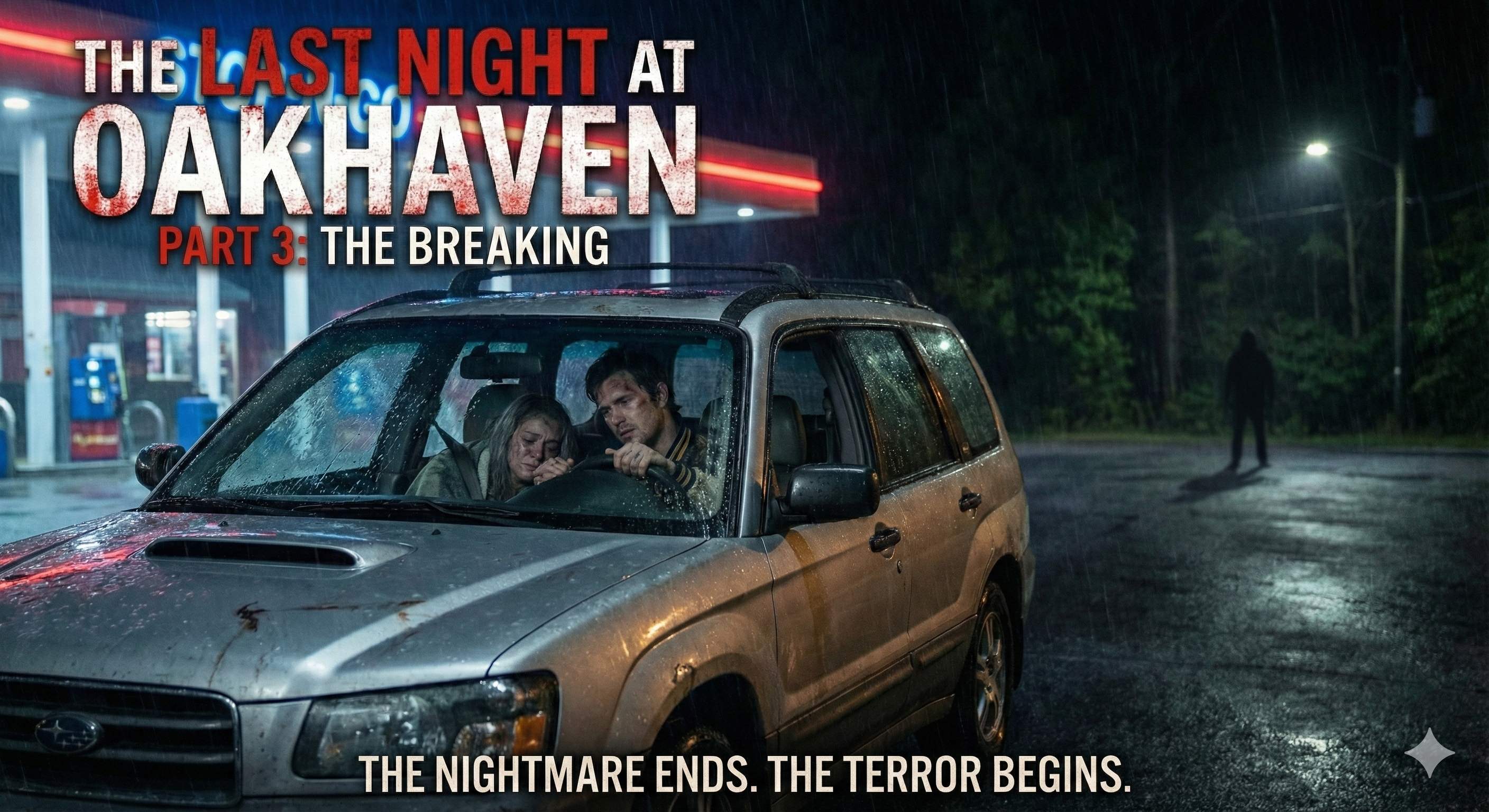
Previously on The Last Night at Oakhaven
Jason Jasonson Jr. has survived the impossible. He headbutted a killer in a pig-hide mask. He clotheslined a creature from the attic. He caught Sarah as she leaped from a burning building. He stole a Subaru and ran over at least one monster—maybe two. But now, racing down a mountain road at sixty miles per hour in the middle of a storm, he faces his final obstacle: a locked timber gate and the simple question of whether physics favors the desperate or the doomed…

Chapter Nine: The Gate
The impact was deafening, apocalyptic, the sound of God’s own door being kicked in. The Subaru’s hood buckled like tin foil struck by a hammer. The windshield shattered into a million spiderwebs as timber exploded against safety glass. Airbags deployed with twin bangs that filled the cabin with white dust and the smell of gunpowder.
Jason was blind for a heartbeat, the steering wheel kicking back against his chest, but his foot stayed buried on the accelerator because stopping meant dying and he’d decided minutes ago that death could fuck right off.
The car lurched over the wreckage, shuddering violently, fishtailing as it plowed through splintering wood and rusted chain. The gate didn’t hold. Gates were designed to keep cattle in, not to stop a two-hundred-twenty-pound linebacker in a Subaru with nothing left to lose.
The car hit asphalt with a jarring thunk that Jason felt in his teeth.
Asphalt. The main road. Civilization.
They were driving on three wheels and a rim, the front right tire gone—shredded by timber splinters—and the engine making a sound like a blender full of broken glass. But they were moving. The Timberlands were behind them. The fire was a distant orange smudge in the rearview mirror, growing smaller with every grinding rotation of the wheels.
Sarah was coughing, rubbing her eyes through the airbag dust. “We’re… we’re on the road. Jason, we’re on the road!”
Jason didn’t respond. He couldn’t. His hands were locked on the steering wheel, knuckles white, every muscle in his body vibrating with adrenaline and trauma and the simple, animal imperative to put distance between himself and that burning house.
The Subaru screamed in mechanical protest. The rim threw sparks against the wet asphalt, creating a trail of orange-white fireflies in their wake. The engine temperature gauge climbed into the red. Oil pressure dropped. Every warning light on the dashboard lit up like a Christmas tree designed by someone’s worst nightmare.
But the car kept moving.
One mile. Two miles. Three miles of grinding, spark-throwing, prayer-fueled forward momentum.
Then, like a gift from a universe that owed them at least one mercy, Jason saw it: the flickering neon sign of a 24-hour gas station. The letters spelled out “STOP-N-GO” in blue and red, the most beautiful words Jason had ever seen.
He pulled into the lot, the rim shrieking against pavement, throwing a final cascade of sparks across the oil-stained concrete. He aimed for a parking spot near the front door, under the harsh fluorescent lights that promised safety through sheer mundane brightness.
The engine coughed once. Twice. Then, with a final rattling wheeze that sounded almost relieved, it died.
Silence fell. Just the rain hitting the roof and the tink-tink-tink of cooling metal singing the song of their survival.
Chapter Ten: The Breathing
Jason sat there, Jason Jasonson Jr., covered in mud and blood and glass and glory. He had the wrong keys in his pocket, a dead friend in a burning house three miles behind them, and a forehead that felt like it had been hit by a sledgehammer wielded by God’s own personal anger.
But he was breathing.
Sarah reached over and squeezed his hand. Her grip was trembling, electric with shock and relief and something that might be laughter or tears or both. Her fingernails—the same ones that had dug into his jacket when she’d jumped from the balcony—now held on with a different kind of desperation. The desperation of someone who’d just realized they were going to live.
“We made it,” she whispered, her voice raw from smoke and screaming. “Jason, we actually made it.”
Jason looked at her. Really looked at her for the first time since the kitchen had exploded in magnesium flame. Her face was streaked with ash and tears. Her hair was matted with rain and dried blood—his blood, Tyler’s blood, maybe the killer’s blood, who could tell anymore? She looked like she’d been dragged through hell by her ankles.
She looked alive.
Jason opened his mouth to say something—something profound, something worthy of the moment. Instead, what came out was: “Ah man, Tyler.”
The reality of it hit him like a second headbutt. Tyler was dead. Tyler with his ironic t-shirts and his blockchain explanations and his dying gesture toward a junk drawer full of wrong keys. Tyler who’d spent his last breath trying to save them, pointing toward salvation with fingers that were already going cold.
“I know,” Sarah said, squeezing his hand harder. “I know.”
They sat in silence for a long moment, the rain drumming its endless percussion on the Subaru’s buckled roof. Through the shattered windshield, Jason could see the gas station attendant inside, visible through the bright windows. The man was maybe sixty, with a coffee pot in one hand and a newspaper in the other, looking bored with the kind of bone-deep ennui that suggested he’d seen everything and been impressed by nothing.
Just another Tuesday night in the mountains.
Jason looked out his side window. For a second—just a heartbeat—he thought he saw something in the treeline across the street. A silhouette, too tall to be natural, standing perfectly still in the rain. Two milky eyes catching the neon light.
Then the gas station attendant walked out, the bell above the door chiming cheerfully. He looked at the destroyed Subaru, at the two ash-covered survivors inside, and said in a voice that suggested this was maybe the third-most-interesting thing he’d seen this week: “You folks need me to call someone?”
The silhouette—if it had ever been there—was gone.
“Yeah,” Jason said, his voice coming out as a croak. “Yeah, call someone.”
The nightmare was over.
For tonight.
Epilogue: The Breathing (Three Days Later)
The police came. They took statements. They drove back to the Oakhaven Timberlands with sirens and lights and the grim determination of people who knew they weren’t going to like what they found.
They found ash. They found blood. They found the twisted wreckage of a kitchen island and the charred remains of what had been an Airbnb that boasted “modern-rustic charm and mountain serenity” in its listing.
They found a single, pig-hide mask melted into the granite countertop, the leather fused to the stone in a way that the forensics team said would require a blowtorch to replicate.
They didn’t find Tyler’s body. They didn’t find the bodies of three killers. They didn’t find anything that made sense.
The official report listed it as a “tragic accident involving a propane leak and subsequent fire.” Tyler was presumed dead, his remains “unrecoverable due to the intensity of the blaze.” The rental company’s insurance would handle it. No one wanted to talk about the things Jason and Sarah described. No one wanted to open that particular door.
Jason went home three days later, still nursing cracked ribs and a concussion that made the world tilt at odd angles. The doctors said he’d been lucky. The seatbelt bruising across his chest from the airbag deployment was “consistent with a high-speed collision.” The defensive wounds on his knuckles were “consistent with self-defense.” The massive contusion on his forehead was “consistent with blunt force trauma.”
Everything was consistent with survival.
On the fourth day, while cleaning out his jacket pockets before throwing the blood-stained thing away, Jason found the small skeleton key. The rusted one he’d grabbed from the junk drawer alongside the Subaru fob.
He held it up to the light, turning it over in his fingers. It was old—genuinely old, not antique-store-old but dug-up-from-the-foundation-old. The kind of key that opened doors that should stay closed.
He didn’t know what it unlocked. Probably never would.
He dropped it in his desk drawer and tried not to think about it.
But sometimes, late at night, when the rain hit his apartment windows with that same frantic percussion, he’d wake up and swear he could hear it. The rhythmic sound of something heavy and patient, moving through the darkness.
Thwack-creak. Thwack-creak.
And somewhere out there, in a salvage yard or a police impound lot or maybe still in that gas station parking lot, a silver Subaru Forester with a buckled hood and three wheels sat waiting.
Somewhere out there, a man in a scorched yellow slicker was looking for his car.
Author’s Note
The police never found the bodies in the ruins of the Oakhaven Timberlands. They found ash, they found blood, and they found a single, pig-hide mask melted into the kitchen granite. But the “men” Jason described? Gone.
The official explanation was fire. Propane leak. Tragic accident. The kind of explanation that lets people sleep at night because the alternative—that there are things in the mountains that hunt for sport, that wear the skins of animals and move like shadows—is too much for official reports to contain.
Jason Jasonson Jr. survived. Against mathematics, against fate, against three monsters and a burning house and his own terrible decision to grab the wrong keys from a junk drawer.
He survived because he was a Jasonson, and Jasonson men—no matter how ridiculous the name—don’t go down without headbutting something first.
Sarah survived because Jason caught her. Because sometimes, when you jump from a burning building into the rain and the dark, there’s someone below with strong shoulders and a concussed but unbreakable will.
Tyler didn’t survive. Tyler deserves better than a footnote in someone else’s survival story, but that’s all he gets. A wet whistle of air through a ruined throat. A pointing finger. A junk drawer full of wrong keys that turned out to be the right keys after all.
The tower still stands, but it’s too unstable to ever be used again.
A Note on the Game
This actual play report was generated from a Dread TTRPG session run by an AI Dungeon Master. Jason Jasonson Jr.’s player made exactly the kind of bold, physics-defying decisions that separate survivors from statistics.
No dice were fudged. No pulls were forgiven. The Jenga tower of fate held by mathematical miracle alone—twenty-nine pulls before the session ended, with a final collapse chance of 78%. By all rights, Jason should have died. The tower should have fallen. But it didn’t.
In Dread, the game ends when the tower falls or when the survivors escape. Jason and Sarah escaped with the tower still standing—barely, trembling, one strong breeze from collapse, but standing.
That’s the thing about survival. It doesn’t require grace or brilliance or perfect decision-making. Sometimes it just requires being too stubborn to die, even when the universe is practically begging you to.
Tyler deserved better. Sarah deserves therapy. Jason deserves a new last name.
But they’re all getting exactly what the dice—or in this case, the tower—decided they earned.
THE END
Or is it?
(That skeleton key is still in Jason’s desk drawer. And somewhere in the mountains, a timber gate is being rebuilt. And in a salvage yard somewhere, a silver Subaru Forester sits waiting. And in the ruins of the Oakhaven Timberlands, beneath the ash and the granite and the melted pig-hide mask, something patient is healing. Because in slasher stories, the monster always comes back.)
(But that’s a story for another night.)