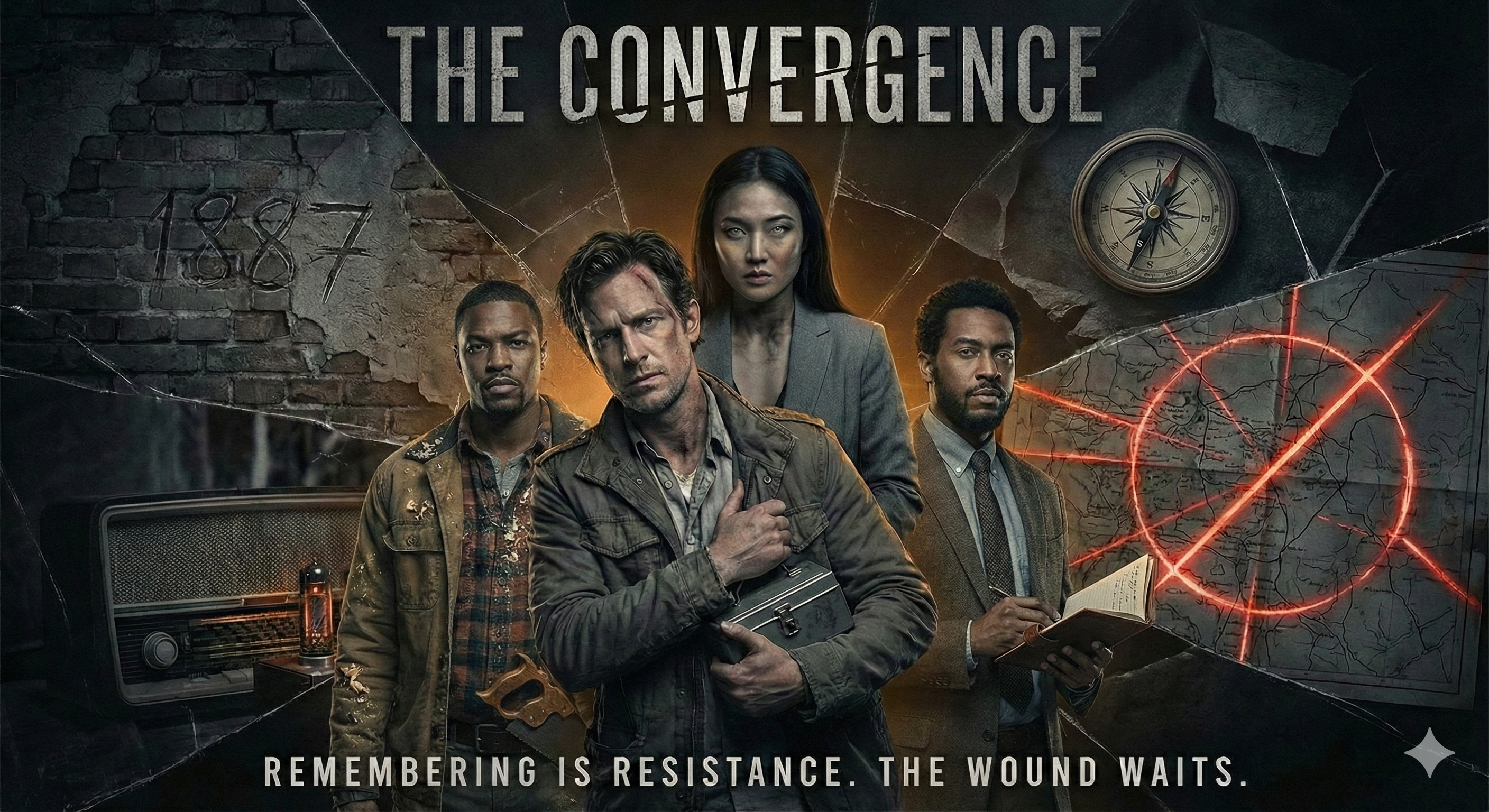
Previously on The Sutures Hold (For Now)
Adrian Queen bargained with a waitress who hasn’t aged since 1987, found a preserved cat’s heart that speaks through bone, and learned the terrible truth: reality is wounded, held closed by consciousness threaded through the gap like sutures through flesh, and something vast and hungry has been pressing against the other side since 1887. He read a dead woman’s journal that whispered the sutures can be cut, allied with Ashley Chen—a ghost wearing a body made of breach—and now stands outside Marge’s Diner where two Gray wait inside, one watches the back, Ashley crouches on the roof, and in thirteen minutes his friends will walk unknowing into a trap.

I. THE COLOR OF BLEACHED BONE
The morning came the color of bleached bone, and Adrian Queen stood on the sidewalk outside Marge’s Diner with the particular knowledge that something fundamental had shifted in the architecture of the world.
Three weeks had passed since he’d fallen through a wound in reality—since he’d been examined by something so vast that standing on its attention felt like standing on solid ground, since he’d escaped before that examination could complete its terrible cataloging of his component parts. Three weeks since he’d learned that the world he’d known was managed, maintained, held together by human minds threaded through a tear in existence like sutures holding shut a wound that refused to heal.
And now the things that served that vast intelligence had found him again.
Through the chrome and glass facade of the diner, he could see them: two figures in gray suits, sitting in a booth near the back, perfectly still, their faces cycling through configurations that never quite settled on anything recognizably human. They were not eating. They were not drinking. They were not performing any of the small rituals that mark living things as alive. They were simply there, existing, waiting with the patience of stones for something to walk through the door—something small and bright and burning, something that had escaped their master’s attention once and would not be permitted to escape again.
The preserved heart pressed against his chest—Spinoza, the name Elaine Marston had given to her shapeless companion before she’d been converted into a function and lost the capacity for naming anything at all—pulsed once every ten seconds, speaking directly through bone conduction into the cathedral of his skull: The one on the left hasn’t blinked in four minutes. The one on the right is watching the door. They’re not looking for you yet—they’re looking for what comes through the door.
And on the rooftop above, invisible to his eyes but present in the particular cold pressure at the edge of perception, Ashley Chen waited. Not the Ashley Chen who’d died on Interstate 78 in a collision so catastrophic they’d buried an empty casket. Not the woman Daryl and Zeke had mourned, whose photographs they’d carried at her memorial service. But something that wore her memories like borrowed clothes, something born from the collision of realities when Adrian had broken those jars and let the wound gape wide—a tear in existence that had learned to walk and speak and choose, that held behind its eyes a void so absolute it could swallow light itself.
His phone buzzed with the mundane certainty of scheduled friendship:
Daryl: Leaving now. Traffic looks clear. 12 mins.
Zeke: Picking up Daryl. We’re getting the big booth.
Twelve minutes until his friends—real friends, good people who knew nothing of the managed world or the templates or the things that hunt by fascination—walked into a trap designed specifically to leverage their existence against him.
The mathematics were elegant in their cruelty. The Gray didn’t need to capture Adrian directly. They simply needed to be present when the people he cared about arrived, to convert the possibility of violence into absolute certainty, to transform friendship into a weapon that could be held against his throat more effectively than any physical blade.
He crouched low behind the line of parked cars, the January cold seeping through his clothes, and made a decision that would reshape everything that followed: he would not let his friends become collateral damage in a war they hadn’t chosen and couldn’t understand.
He called 911.
“I see some strange men near Marge’s,” he whispered into the phone, his voice barely a thread of sound pressed against the microphone. “They haven’t moved in hours. All they’re doing is stare at the diner and people in them. Can you do something about it, please?”
The dispatcher’s voice carried the professional calm of someone trained to be the last sane presence before worlds collapse: “Sir, can you confirm the address for me?”
He gave her the cross streets, describing the men in their identical gray suits, standing rock-still like street performers who’d forgotten they were performing, and somewhere in his whispered urgency she heard something that made her pause, made her type faster, made her elevate this call above the drunk-and-disorderlies and the fender-benders waiting in the queue.
“Okay, sir. I’m going to dispatch a unit to check it out.”
The complication arrived wrapped in the banality of bureaucratic procedure: she wanted him to stay on the line. She wanted his name.
He gave her both—or rather, gave her what he needed to give: “Steve” would suffice for a name, and staying on the line meant continuing to whisper into a phone while forty feet away something that heard sounds it shouldn’t be able to hear maintained its vigil over the diner’s entrance.
And then Adrian did something that would have been clever if it hadn’t failed so catastrophically.
II. THE GEOMETRY OF DESPERATION
He tried to create chaos. Tried to throw his phone skyward while simultaneously striking the sedan beside him hard enough to trigger its alarm, to manufacture the sounds of an attack that would make the dispatcher believe her caller had been assaulted, that would escalate the police response from routine check to emergency intervention.
The phone arced upward, spinning against the gray morning sky.
His palm connected with the car’s door panel.
The sound was flat. Dull. A muffled thump that triggered nothing, that died in the cold air without resonance or echo, because the sedan was old, pre-millennium, the kind of vehicle whose owner had never bothered with aftermarket security and relied instead on physical locks and the honor system.
No alarm. No chaos. No distraction.
Just his phone, tumbling back down from its pathetic apex, falling toward the sidewalk where the Gray stood motionless, its lips shaping silent words into the void.
The phone hit concrete three feet from those polished shoes, screen cracking like ice across a frozen pond, and the dispatcher’s voice spilled out into the January air: “—Steve? Steve, what’s happening? I heard—Steve, respond please—”
The Gray stopped mouthing its silent incantations.
Its head turned with the mechanical precision of surveillance equipment panning across a parking lot, and it looked directly at the gap between vehicles where Adrian crouched with his arm still extended and his heart trying to crack through his ribs with the force of its beating.
Then it took a step toward him.
RUN, Spinoza’s voice came sharp and urgent through the bone.
But Adrian Queen had spent three weeks learning that sometimes running wasn’t enough, that sometimes the only way through horror was directly into its teeth, and he made a choice that defied every survival instinct evolution had gifted him.
He charged.
His shoulder connected with the Gray’s chest, and the impact was wrong in ways his nervous system couldn’t properly catalog—like hitting a mannequin filled with sand, mass and resistance present but the give all incorrect, the compression happening at angles that violated the fundamental mechanics of collision. The thing didn’t grunt, didn’t exhale, didn’t make any of the sounds violence is supposed to produce.
He drove it backward. Two steps. Three.
Then its hand closed around his forearm.
The cold wasn’t temperature. The cold was absence—the space between stars given form and pressure, something that was never meant to make contact with warm-blooded things that breathe and hope and metabolize sunlight into motion. And when it spoke, the voice didn’t emerge from its mouth but from somewhere inside Adrian’s skull, from the same architecture where Spinoza whispered his warnings:
INTERESTING. THE MARKED ONE. THE ESCAPEE. THE SMALL BRIGHT BURNING THING.
IT STILL LOOKS FOR YOU. DID YOU KNOW? EVEN NOW. EVEN ACROSS THE WOUND. IT WONDERS HOW YOUR PIECES FIT TOGETHER.
The hand moved from his forearm to his throat.
Physics stopped working in familiar ways. Adrian’s legs ceased to support him. His arms hung useless at his sides, a puppet with cut strings, and the world narrowed to the void cycling behind that thing’s eyes, to the cold spreading through his windpipe like frost accelerating through tissue, to the certain knowledge that he had perhaps thirty seconds before his nervous system simply stopped processing the commands necessary for continued existence.
He had one breath. One damaged, ragged thread of air passing through the narrowing channel of his throat.
He used it.
“Ash…” The word was broken glass. “…help…”
III. THE DESCENT OF ANGELS
What happened next would later be described by Sarah Kowalski—a woman walking her chihuahua who possessed the particular modern courage of someone who documents the impossible rather than fleeing from it—as “like watching someone fall from a building except all wrong, like gravity worked sideways for her.”
Ashley Chen stepped off the roof.
Not jumped. Not fell. Stepped—as if the air itself provided purchase for her feet, as if the four stories between rooftop and sidewalk were merely suggestions that could be declined with sufficient will. Her body moved through space at angles that shouldn’t exist, her coat billowing around her like wings made of shadow and borrowed memories, and the void behind her eyes was no longer hidden.
It was open. Vast. Hungry.
She landed on the sidewalk six feet from where the Gray held Adrian suspended by his throat, and the impact should have shattered every bone below her waist. Instead, the concrete cracked—a spiderweb of fractures spreading outward from the point of contact like reality itself objecting to what it had been forced to witness.
The Gray’s grip loosened.
Just a fraction. Just enough for Adrian to suck in a thin stream of frozen air and feel the static of his dying nervous system recede by increments.
Ashley stood. The void pulsed behind her eyes like something breathing. And when she smiled, it was not a human smile—it was the smile of something that has been waiting for permission to stop pretending, that has carried the weight of performance for so long that dropping the mask feels like shedding skin.
“Let him go,” she said, and her voice was layered—Ashley’s voice on top, but beneath it something else, something that sounded like the space between stars given throat and tongue. “Let him go, or I show you what leaks through when the sutures tear.”
The other Gray emerged then—one from the diner’s interior, one from the alley where it had been watching the rooftop with patient certainty. Three of them now, forming a triangle around the woman who shouldn’t exist, around the tear in the wound that had learned to speak.
And Adrian, still held by the throat but no longer being crushed, felt the thing’s attention split between him and this new variable, this unprecedented element in an equation that had been calculated across millennia of service.
Part of it was afraid.
The realization carried a terrible weight: these servants of the vast intelligence beyond reality, these patient hunters who had been perfecting their craft since before humanity learned to write its fears into scripture—they could be frightened. They could encounter something unknown. They could retreat.
The Gray released him.
He fell to the concrete, gasping, clutching his throat where bruises were already blooming in the shape of fingers, and above him the three figures in gray suits took a step backward, then another, their faces cycling faster now, searching through their catalog of borrowed human expressions for something appropriate to terror.
This is not over, the voice came inside his skull one final time. The marked one. The tear. You have only delayed. The convergence will complete. It always completes.
Then they were gone—not vanished, not teleported, simply absent, as if the Consensus that managed reality had performed an editorial operation and excised them from the frame with surgical precision.
Sarah’s chihuahua, having crossed the street in a fury of territorial aggression, stood sniffing the spot where the Gray had been and whined, backing away from ground that had been touched by something fundamentally wrong.
And in the distance, growing louder by the second, sirens announced the arrival of the machinery of the managed world, coming to catalogue and contain and ultimately forget what had just transpired on this unremarkable corner on this unremarkable Saturday morning.
Adrian looked up at Ashley Chen, at the void slowly receding behind her eyes like a tide going out, leaving only the face of a dead woman who had chosen to help.
“You’re an idiot,” she said, and her voice was just hers now, just Ashley’s. “You know that, right? A complete fucking idiot.”
She extended her hand.
He took it.
IV. THE MACHINERY OF FORGETTING
The police came with their notebooks and procedures, their metal detectors and sign-in sheets, their institutional conviction that everything strange could be reduced to paperwork and filed appropriately. Officer Hendricks—a man in his forties with a gut and a mustache who had spent eighteen years learning to sort the world into manageable categories—watched the video on Sarah’s phone three times, his expression cycling through confusion, disbelief, and finally the particular blankness of a brain refusing to process what it was seeing.
Three men in gray suits. A woman falling from a roof. Concrete cracking.
And then—nothing. One frame they were present, the next frame they were absent, reality edited with the precision of someone who understood exactly which moments needed to be excised to maintain the structural integrity of the consensus.
“Sir,” Hendricks said, and his voice carried the weight of someone who had just realized this situation was several pay grades above his authority, “I’m going to need you to come down to the station. Just to give a formal statement. Get those injuries documented.”
Adrian went. He gave his statement, explaining that he’d called about suspicious men, that they’d attacked him, that he’d tried to defend himself, that his “lawyer”—he gestured to Ashley, who played the role with surprising competence—had intervened. He omitted the parts about preserved hearts and tears in reality and entities whose attention was solid enough to stand on.
The cops didn’t believe him. But they also didn’t disbelieve him hard enough to prevent his release. The bruises on his throat were real. The video existed. And sometimes—Hendricks’ expression suggested—it was better not to ask questions whose answers might require explanations no one was prepared to provide.
“The video is going to require… review,” Hendricks said carefully. “By people above my pay grade.”
The language of containment, Spinoza whispered through Adrian’s ribs. That video will disappear into a filing system designed to make things unfindable. You have hours. Maybe a day. Then the managed world closes around it like a wound healing.
Outside the station, Daryl and Zeke waited beside Daryl’s truck, their faces carrying the particular expression of people who had arrived expecting breakfast and instead witnessed the impossible. When Adrian emerged with Ashley at his side, when Daryl’s eyes registered the bruises on his friend’s throat and the woman who wore the face of someone they’d buried, the questions began.
Not questions about what had happened—though those would come—but a single, fundamental question that carried in it the weight of a decade of friendship:
“What the hell is going on?”
V. THE UNBURDENING
Some truths resist being spoken aloud. They crouch in the architecture of the skull like animals waiting for permission to emerge, and when finally released they reshape the topology of every relationship they touch.
Adrian told them everything.
In his apartment—four stories up in a building that couldn’t decide if it was gentrifying or decaying—he began with the Meridian Hotel three weeks prior, with seeing Ashley Chen at a tech mixer when Ashley Chen had been dead for years, with the way thirty-seven people had stopped moving simultaneously for exactly one-point-three seconds when he’d taken steps toward her. He told them about TheMirrorCracks on Reddit, about the synchronization events, about the Blackwood Library that appeared on Crane Street only when it decided to be visible.
He told them about descending those spiral stairs that defeated counting, about finding Elaine Marston in a room full of jars containing people who’d been sorted and preserved and converted into functions, about learning that reality was managed by systems older than civilization.
“There was a woman,” he said, his voice still ragged from the Gray’s grip. “Sitting at a table. Her face kept shifting. Cycling through different configurations. Like she couldn’t decide who to be.”
He told them about breaking the jars, about the wound that opened in the darkness, about falling outside—outside—where something so vast that its attention had physical weight had begun to examine him, to take him apart conceptually rather than physically, to understand how his pieces fit together.
“I got away,” he said. “Barely. Spent my luck—whatever that means. But it’s still looking. It doesn’t forget.”
He told them about Maya Chen, the waitress with the same face across thirty-seven years of photographs, about templates and sutures and minds threaded through a wound in reality to hold it closed. About the Gray who served the entity beyond, who wanted the templates consumed as fuel to tear that wound wide open.
And then he showed them Spinoza.
The metal box opened to reveal a preserved heart, dark and glistening, that beat once every ten seconds. Writing crawled across its surface like living things. And when Adrian pressed his palm against it and spoke permission, the heart spoke.
Not through his skull this time. Through the air itself—thin, reedy, like wind through a crack in a window, like something very old learning to speak in a new way.
You must be Daryl. And Zeke. Adrian has told me about you. The steady one and the one who counts. You carried photographs of the dead and did not understand what you were mourning. Neither did I, for a very long time.
I am what remains of a woman who refused to forget. I am the love she left behind, wearing a shape she gave me, waiting for someone who would remember.
Adrian remembered.
Will you?
The silence that followed was absolute.
Daryl sat heavily on the couch, his hands shaking in a way Adrian had never witnessed in ten years of friendship. Zeke hadn’t blinked since the heart began to speak, his accountant’s brain attempting to balance a ledger that refused to balance, that violated every principle of ordered reality he’d spent his life maintaining.
“This is insane,” Daryl whispered. “A talking heart in a box. You’re carrying a talking heart in a box.”
I prefer ‘companion,’ Spinoza said softly. But I understand the confusion.
Ashley stepped forward then, moving into the center of the room, into the light where they could see her clearly—see the face they’d helped memorialize, the woman they’d watched get lowered into the ground.
“There’s one more thing,” she said. “The hardest thing.”
She extended her hand, palm up, and the air rippled. The void behind her eyes opened—not all the way, just enough to let the darkness show through, just enough to bend light in ways light was never meant to bend.
“Ashley Chen died on Interstate 78,” she said. “There wasn’t enough left to fill a coffin. But when Adrian broke those jars—when the things from outside collided with the things from inside—something leaked through. Something that found her memories floating in the wreckage. Something that put them on like a coat.”
She closed her hand. The void receded.
“I remember her mother’s face at the funeral. I remember the song she wanted played. I remember loving her roommate’s terrible cooking and hating the way she always lost her keys.” A sad smile crossed her face. “I remember being Ashley. But I’m not her. I’m what’s left. I’m the tear in the wound that wears her shape.”
Daryl was crying—not sobbing, just silent tears tracking down his face, the grief of a man watching a friend die twice, once in reality and once in explanation.
But he didn’t leave.
Neither did Zeke.
Instead, after a long moment where the only sound was the ticking of Adrian’s cheap wall clock, Daryl stood and crossed the room in three strides and gripped Adrian’s shoulders with hands that knew how to build things, how to hold things in place before they could be fixed.
“You’re my friend,” he said. “You’ve been my friend since we were twenty-one and stupid and thought the world made sense. The world doesn’t make sense anymore. That doesn’t change what you are to me.”
Zeke, still pale, still processing, still running the numbers on a ledger that would never balance, finally spoke: “Someone’s been cooking the books on reality itself. I’m an accountant. That offends me on a professional level.” He looked at Adrian with something that might have been horror or might have been determination. “So yeah. I’m in. What do we do?”
VI. THE VAULT OF FORGOTTEN THINGS
What they did was follow the one concrete lead Adrian possessed: a brass key engraved with the words VAULT 7 – CITY ARCHIVES – SUB-BASEMENT 3, left behind by Elaine Marston as an insurance policy, hidden in a cache with her journal and Spinoza and the desperate hope that someone would come after her and remember.
The plan required deception, coordination, and a certain faith in the power of bureaucratic invisibility. Daryl would play the angry property owner, indignant and loud, dragging his accountant Zeke to City Archives on a Saturday to dispute an assessment that didn’t exist. Adrian and Ashley would pose as government inspectors, rumpled and tired and carrying clipboards with the particular authority of people who’ve been called in on a weekend and aren’t happy about it.
They acquired the tools of the performance at an office supply store two blocks from City Archives: clipboards, lanyards, plastic badge holders, the physical props that would let them slide past notice like water past a stone. At Goodwill they found the costumes: a rumpled button-down for Adrian, a boxy gray blazer for Ashley, a clip-on tie that Daryl insisted conveyed exactly the right amount of bureaucratic defeat.
Spinoza, transferred from his metal box to a flannel scarf, rested against Adrian’s ribs in a way that felt more intimate than the mechanical container had allowed, each pulse of that preserved heart speaking directly through skin and bone: This is closer. Elaine used to carry me like this. Before the box. Before she needed to hide what I was.
The infiltration unfolded with the particular tension of watching a magic trick where failure means more than embarrassment. Daryl hit the doors like a man with grievances that needed airing, his voice carrying across the institutional tile and fluorescent lighting: “—three separate notices, and nobody can tell me why? I took a Saturday off work for this!”
The security guard’s attention swung toward the commotion.
Adrian and Ashley slipped through during that moment of distraction, flashing blank badges that registered as official without being examined too closely, signing false names on a clipboard that would later be filed away and forgotten, passing through metal detectors that read Spinoza’s preserved form as unusual organic matter—strange, perhaps, but not alarming enough to warrant investigation.
But the guard saw them. His eyes lingered a beat too long, cataloging details, filing away faces that he would remember later, that would become a loose thread in the conspiracy if anyone thought to pull it.
No matter. They were through.
Down the hallway past restrooms and frosted glass doors. Into a stairwell that smelled of dust and cleaning solution and something faintly metallic, like old pennies or distant lightning. Down past B1—storage—and B2—climate-controlled archives—to a place where the stairs should have ended but didn’t.
The walls changed below B2. Brick instead of poured concrete. Mortar crumbling in places. Bare bulbs flickering with uncertain rhythm. The air grew colder. The metallic smell intensified.
At the bottom of stairs that violated the building’s official floor plan: a door.
Old. Heavy wood dark with age. Brass fittings tarnished to near-black. And carved into its surface, barely visible in the dim light, a symbol that connected it to everything that had come before—the Morning Proxy, Elaine’s cache, the PATTERN app that had appeared unbidden on Adrian’s phone.
A circle bisected by a line.
The brass key was warm in Adrian’s hand—warmer than it should have been, given the sub-basement chill. It turned smoothly, too smoothly, as if the key and the lock recognized each other, as if they’d been anticipating this reunion for eleven years.
She would be proud, Spinoza whispered. Elaine. She built that vault for someone like you.
The door swung open.
VII. THE INSURANCE POLICY
The darkness beyond was absolute—not the darkness of an unlit room but the darkness of a space, a volume, a depth that swallowed the stairwell’s dim light without acknowledgment. Then the illumination came gradually, an amber glow seeping from the walls themselves, revealing a chamber that shouldn’t exist beneath a municipal building in the middle of the city.
Circular. Thirty feet in diameter. A domed ceiling rising into shadows the amber light couldn’t quite penetrate. Walls lined with shelves—wooden shelves, old and dark, packed with objects that defied immediate categorization.
In the center: a table. Heavy oak, scarred by use, covered in papers and journals and photographs. A chair beside it, empty, waiting.
And on the far wall: a map.
Not a normal map. Floor to ceiling, layered with transparent sheets that overlapped and pulsed faintly with their own light. Streets. Patterns. Lines connecting pins—red pins, blue pins, yellow pins—in a web that made Adrian’s pattern-recognition gift ache with the need to understand, that suggested a conspiracy so vast it had taken three years to document.
She built this, Spinoza said, his voice hushed with something like reverence. Every night she could slip away. Every piece of information she could gather. This is what Elaine Marston did with the time she had left.
The shelves held the accumulated evidence of a war most people would never know was being fought: personnel files marked with the circle-and-line symbol, organizational charts showing hierarchies that didn’t appear in any official record, memos dated across decades discussing containment protocols and template deployment and wound stability metrics.
Photographs. Hundreds of them. The same faces across different eras—Maya Chen in 1987, someone with her exact bone structure in 1952, in 1911, in 1889. Templates, iterations, minds threaded through reality to hold the wound closed.
Artifacts that shouldn’t exist: a compass whose needle pointed somewhere that wasn’t north, a radio that hummed despite having no visible power source, surgical instruments made from a metal Adrian couldn’t identify.
And journals. Not just Elaine’s but others—dozens, spanning what looked like over a century of handwriting, people who had noticed, investigated, found their way to this room and left their knowledge behind.
On the central table, a letter in Elaine’s cramped handwriting:
If you’re reading this, I’m gone. Converted fully, or dead, or worse. But you found the key. You found the door. That means you’re the one who comes next.
Everything I learned is here. But that’s not why I built this place.
I built it because I found something in the deep stacks. A record of the first suturing. 1887. The wound was fresh, and they were desperate, and they made a choice that has been eating the world ever since.
The first template is still in the Blackwood Library. You know this already. But what I didn’t write, what I couldn’t risk putting anywhere they might find, is this:
She chose it. The first one. She volunteered.
And she’s been waiting ever since for someone to ask her the question no one has thought to ask in almost 140 years.
Not “how do we close the wound.”
But “why did you agree to hold it open?”
Adrian photographed the map methodically—forty-seven images that captured the web of connections Elaine had spent three years building, that showed how significant locations formed a pattern, that revealed the terrible truth Ashley had already begun to see: the red lines, when viewed together, formed the symbol. The circle bisected by a line. The entire city was marked with it. They were living inside the wound’s signature.
He took the folders that mattered most: 1887, documenting the initial suturing, containing a portrait of a woman in Victorian dress whose eyes held something like patience; 1987, Maya Chen’s deployment history, Elaine’s notes suggesting she was “asking questions” and might “break containment from the inside.”
He took the compass that pointed toward tears in reality. The radio that received broadcasts from between stations. The journal from 1891, written by a man who’d tried to understand what had happened and died before he could act on his knowledge.
And he took the badge—Level 4 clearance, Elaine’s face in the photograph, a skeleton key to doors that shouldn’t exist, with a note on the back in her tiny handwriting: For whoever comes next. Use it wisely. They don’t check faces as carefully as they should—they check the symbol, the clearance level, the confidence in your walk.
The vault began to object to their presence after ten minutes—a change in the amber light’s quality, a shift in the hum that suggested the space itself had limits to its hospitality. They gathered what they could carry and left, climbing back through the basements that officially existed, past the guard whose suspicious gaze tracked them but didn’t stop them, back into the January afternoon where Daryl and Zeke waited with the particular expression of people who have just filed three separate complaint forms about a property assessment that doesn’t exist.
VIII. THE WEIGHT OF INHERITANCE
They sat in Daryl’s truck a block from City Archives, and Adrian showed them what they’d found—the photographs of the map, Elaine’s plans, the folders documenting 139 years of managed reality. Zeke pulled up the images on Adrian’s cracked phone screen and began to see the pattern, began to understand the scope of what they’d uncovered.
“This changes things,” he said quietly. His accountant’s brain was already reorganizing the ledger, already understanding that they’d moved from survival into something else entirely. “We’re not just running anymore. We have leverage. We have information.”
“We have a target on our backs,” Daryl corrected. “Everyone in this truck is now part of this. The Gray know about Adrian and Ashley. But now they’ll know about us too. About what we’ve found.”
Ashley, who had been silent since the vault, finally spoke: “The map shows places I’ve been since I came back. Places where I felt… pulled. There’s a location marked that I haven’t visited yet. Something drawing the tears together.” She looked at Adrian. “If I’m not the only one—if there are other gaps in the suturing that learned to walk—we need to know. We need to find them before the Gray do.”
The radio, Spinoza suggested through Adrian’s ribs. It receives broadcasts from places the managed world doesn’t acknowledge exist. Turn it on tonight. Listen. You may hear things that will help.
They drove back to Adrian’s apartment as the afternoon light angled toward evening, five people—four living, one preserved in flannel—carrying the weight of Elaine Marston’s desperate hope that someone would come after her and remember, that someone would ask the question she’d been murdered before she could answer.
In Adrian’s apartment, they spread the materials across every available surface. The photographs. The journals. The artifacts. The evidence of a conspiracy that had been operating since 1887, that had threaded human consciousness through a wound in reality and called it necessary, that had convinced the world this was the only way to prevent something worse from leaking through.
“We need a plan,” Zeke said, already making lists on his phone, already trying to impose structure on chaos. “We have resources now. Tools. Information. But resources without strategy are just… stuff.”
“The first template,” Adrian said. “Elaine thought she was the key. If we can get back into the Blackwood Library—if we can reach her, ask her why she volunteered—maybe we’ll understand what they’re really afraid of. Not the wound opening. Something else.”
“Maya Chen,” Ashley added. “Adrian owes her information about what he saw outside. She’s been asking questions. If we can turn a template, make her understand what the Gray actually want—”
“We could start a civil war inside the system itself,” Daryl finished. “Sutures versus the things that want to consume them.”
The evening deepened. The city moved around them, oblivious, managed, contained. But in this small apartment four stories up, five beings who knew the truth gathered around evidence of a war most people would never know was being fought.
She would be proud, Spinoza said again, his voice warm with something that might have been hope or might have been grief or might have been both at once. Elaine. She built that vault for someone like you. Someone who would find it, and use it, and remember.
Adrian looked at his friends—at Daryl who’d chosen loyalty over safety, at Zeke who’d chosen understanding over ignorance, at Ashley who’d chosen to be more than just a ghost wearing borrowed memories. At Spinoza, the preserved heart that carried Elaine’s love across eleven years of waiting.
And he understood that the isolation that had defined the past three weeks had ended, that he was no longer alone in this terrible knowledge, that whatever came next they would face it together.
The question now—the only question that mattered—was what they would do with what they’d learned, with Elaine’s legacy spread across his coffee table like pieces of a map to places that shouldn’t exist.
Outside his window, the city settled into night. Somewhere in the managed world, the Gray were regrouping. Somewhere, the Consensus was working to contain seventeen seconds of impossible footage. Somewhere, the vast intelligence beyond reality was still searching for the small bright burning thing that had escaped its examination.
But Adrian Queen was no longer running.
He had allies. He had tools. He had a question that had been waiting 139 years for someone brave enough—or foolish enough—to ask it.
And he had made a choice that would reshape everything: he would remember Elaine Marston, would honor the woman who’d refused to forget, would carry her desperate hope forward into whatever darkness waited.
The preserved heart beat against his ribs. Once every ten seconds. Steady. Patient. Certain.
The story continues, Spinoza whispered. And for the first time in eleven years, I believe it might have an ending that isn’t just more jars and more functions and more forgetting.
You give me hope, Adrian Queen.
Don’t waste it.
Epilogue: The Question Waiting to Be Asked
In the Blackwood Library, in a room that exists in the space between what’s documented and what’s real, the first template waits.
She has been waiting since 1887.
She has been waiting for someone to understand that the wound wasn’t an accident, that the suturing wasn’t just survival, that the choice she made—the choice they made her make—contained within it a truth so fundamental that exposing it would unravel everything the managed world has built.
She waits for someone to ask not how to close the wound, but why she agreed to hold it open.
And now, finally, after 139 years of patience, someone has found Elaine’s vault. Someone has read her letter. Someone has gathered the tools and the allies and the courage necessary to descend those spiral stairs again, to walk past the jars and the files and the functions, to stand before her and ask the question that has been waiting almost as long as she has.
The convergence is coming.
But it might not complete the way the Gray expect.
It might not complete the way the Consensus intends.
Because Adrian Queen has learned something the managed world forgot to account for: that remembering is an act of resistance, that naming things gives them power, that love can preserve what should have been lost, and that sometimes the small bright burning things that escape examination are exactly the ones who change everything.
The first template waits.
And Adrian Queen, carrying a preserved heart against his ribs and the weight of a dead woman’s hope in his jacket pocket, is finally ready to ask her the right question.
To be continued