
Part One: The Woman Who Died Twice
Three weeks is not enough time to lose your mind, Adrian Queen told himself, even as the ceiling of his apartment stared back with the patient indifference of a thing that knows you are lying. Three weeks since the Meridian Tech Conference mixer—that carnival of disruption and paradigm shifts, of $24 cocktails and conversations about changing the world from people who had never once doubted the world wanted changing—when he saw her.
Ashley Chen.
Standing by the east windows with the city burning behind her like circuitry set alight, holding her drink with both hands as if she were cold, as if she had always been cold, wearing a charcoal blazer over a cream blouse and a face that belonged, by every law of physics and mortality and the terrible permanence of car accidents on Interstate 78, to a woman six years dead.
He’d gone to her memorial service. He remembered the photograph—too young, unfinished, a version of Ashley from before she’d learned to laugh too loud at her own jokes, before the mismatched socks, before the forty-five-minute dissertation on Marvel movies as capitalist mythology delivered at a party where cheap beer made philosophers of them all. He remembered her mother’s face, hollowed out, propped in a chair like something the grief had excavated and left empty.
Ashley Chen was dead.
Ashley Chen was standing seventeen floors above a city that looked, from that height, less like a circuit board and more like a trap.
Adrian had taken three steps toward her when the world noticed.
Every person in the room—thirty-seven faces, he’d counted them afterward in the obsessive arithmetic of sleeplessness—turned to look at him. Not dramatically. Not with gasps or the clatter of dropped glasses. Quietly. Synchronously. With the coordinated precision of fish changing direction in a school, of birds wheeling in murmuration, of a system performing a routine check, a diagnostic scan, a confirmation that the small glitch in the matrix had been noted, catalogued, filed.
One point three seconds.
Then everyone resumed their conversations mid-syllable, their laughter from the same note, and when Adrian looked back at the east windows, Ashley Chen was gone.
That was three weeks ago.
He had not slept properly since.
Part Two: The Rabbit Hole Opens
The internet, in its infinite and terrible generosity, provided what it always provided to those who sought patterns in the static: rabbit holes lined with breadcrumbs, trails that led either to truth or madness or—and this was the horror that Adrian was only beginning to comprehend—to places where truth and madness were the same country wearing different flags.
Reddit user u/TheMirrorCracks had posted ninety-three days ago in r/Glitch_in_the_Matrix, describing a work conference, a dead colleague, and what they called “the Pause”—that frozen moment when every face turned simultaneously, when the crowd became a mechanism, when the performance of normalcy stuttered just long enough to reveal the stage directions underneath.
The details were close enough to Adrian’s experience that his hands trembled as he read. Different enough that this wasn’t a hoax, wasn’t someone reading his mind, wasn’t—
Wasn’t what? his pattern-seeking brain whispered in the small hours. What do you think is happening here?
At 3:17 AM on a night that had long since given up pretending to be restful, Adrian sent the message: I saw something similar. Three weeks ago. Need to talk. Are you still there?
The reply came seventeen minutes later, arriving with the weight of a door opening onto either rescue or ruin:
Jesus. I didn’t think anyone else would find me. Yes. I’m still here. Barely. But we can’t talk here. They watch Reddit…
The message gave coordinates for a meeting—physical space, no phones, Faraday principles—at a place called the Blackwood Library on Crane Street. Basement level. 9 PM the following night. And then, the hook that sank into Adrian’s throat and would not let go:
And Adrian? That’s your name, right? Adrian Queen? I know it is. I’ve been watching you for two weeks.
Part Three: The Vigil
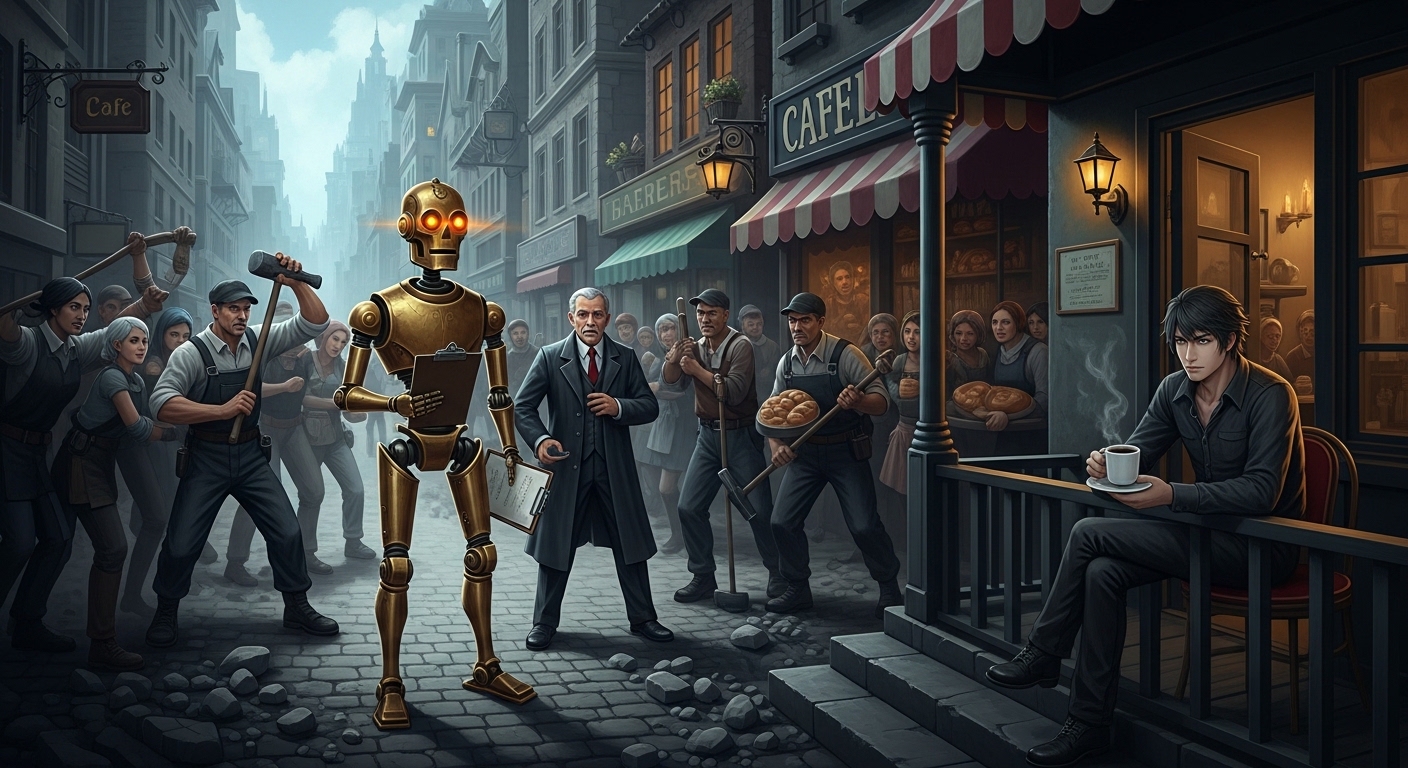
The Café Andromeda—named for either a galaxy or a princess chained to a rock as sacrifice, and Adrian suspected the owners had chosen without knowing which—became his observation post for the day that stretched toward evening with the patience of a predator that has learned to wait.
Eleven hours.
Eleven hours is a long time to stare at a door that doesn’t open, at a building that shouldn’t exist.
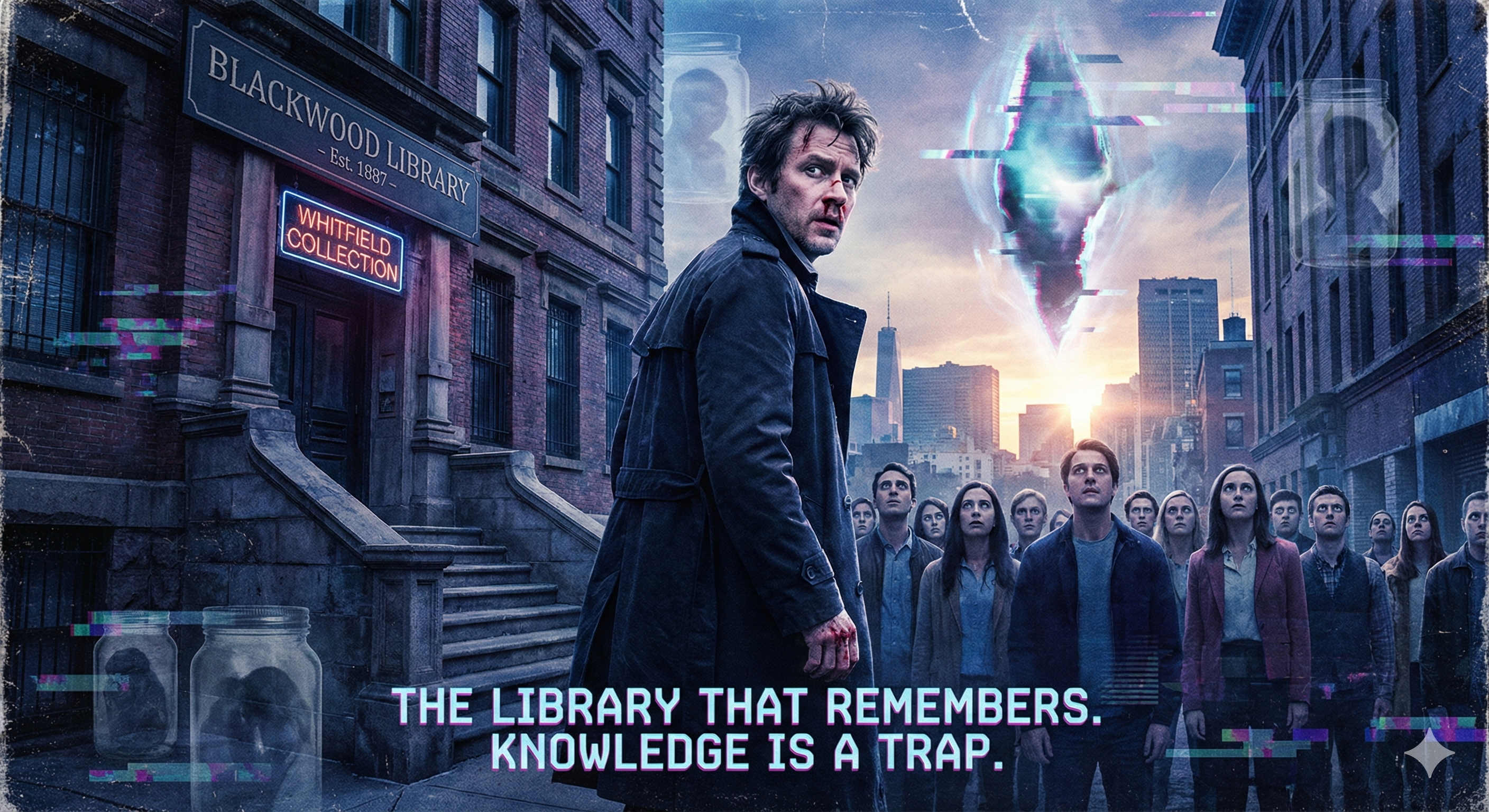
The Blackwood Library sat at the corner of Crane and Halloway with the aggressive correctness of a thing that had always been there, red brick darkened by urban particulate, windows reflecting morning light in ways that made it impossible to see inside, a brass plaque reading “Est. 1887 – All knowledge is preserved” in letters tarnished to the color of old blood.
Adrian had walked past this corner at least forty times in the past two years. The Thai restaurant across the street, the dry cleaner, the newsstand—all familiar landmarks in the geography of his ordinary life.
He had never seen this library.
Not once.
But his eyes, now tuned to frequencies they shouldn’t perceive, began to catalog the wrongness: the awning stripes that shifted by two degrees near the library’s edge, as if printed in separate runs. The sidewalk stamps reading 1987 in fonts that didn’t match the city’s standard issue. The pigeons that roosted on every rooftop except this one. And the shadow—the library’s shadow that stretched too long for the sun’s angle, that refused by three inches to connect with the shadows of ordinary buildings, as if the darkness it cast came from somewhere else entirely.
Through the window of the café, Adrian watched as fifteen people entered the Blackwood Library over the course of that endless day.
Not one emerged.
The math didn’t work. Fifteen bodies entering a building of perhaps thirty thousand square feet should produce some evidence—movement behind windows, shadows crossing interior spaces, the ordinary traffic of existence.
There was nothing.
The library absorbed its visitors the way a throat swallows pills, the way a hole swallows light, and Adrian sat in his café seat with coffee growing cold and the weight of a choice he’d already made pressing against his sternum like a stone he’d swallowed and could not digest.
At 6:30 PM, as the sun bled its last across the western sky, he rose.
The note under his mattress—If you’re reading this, I didn’t come home. Check the Blackwood Library on Crane Street—would wait there like a gravestone inscription written in advance, like insurance against disappearing without a trace, like the last words of a man who knew he was walking into machinery but couldn’t stop himself from wanting to understand how the gears turned.
Part Four: The Descent
At precisely 9:00 PM—arriving at 8:56 with fifteen seconds’ margin for error, because precision mattered when the world had rules you were only beginning to see—Adrian Queen climbed the five stone steps to the Blackwood Library’s entrance and pushed open a door that swung without resistance, without sound, without any of the creaks and whispers that old buildings make when disturbed.
The darkness inside was not the darkness of a building after hours.
It was textured. Layered. It moved against itself in slow currents like water in a pool with no bottom, and the streetlight from outside stopped at the threshold as if held back by something that had made rules about the behavior of illumination in this space.
The vestibule revealed itself in increments: checkered marble extending into impossible depths, walls of dark wood paneling whose grain seemed to shift when examined too closely, and a desk—unmanned, waiting—with a small brass bell and a hand-lettered sign.
WHITFIELD COLLECTION – BASEMENT LEVEL – RING TWICE
Adrian’s hand found the bell. Once. The sound that emerged bypassed his ears entirely, entering directly through bone, through the fluid-filled chambers where balance lived, tilting the room for a moment before geometry remembered which way was down.
Twice. Worse, because he was expecting it this time, because his body had braced for wrongness and the bracing did nothing except sharpen his awareness of how the note moved through him like a wave through water, rearranging something he couldn’t name but knew had been changed.
And then—in the wall behind the desk, where no door had been—a door appeared.
It stood as if it had always stood there, as if Adrian’s memory of an unbroken surface was the error and the door was truth, and the iron handle radiated cold that had nothing to do with temperature and everything to do with deep places, with caves that had never seen sunlight, with the gaps between stars where heat was a memory told by dying suns to comfort themselves in the long slide toward entropy.
The door opened without his touch.
“Adrian Queen,” said a voice from the darkness below—not a question but a confirmation, a statement spoken by someone who had been waiting for exactly this name, exactly this man, exactly this moment. “Come down. We don’t have much time.”
The spiral staircase descended into amber light that pulsed like something alive, like something hungry, and Adrian—entrepreneur, dreamer, pattern-seeker, the man who could not let mysteries rest even when the mystery was the size of everything—placed his foot on the first cold step and began the descent that would carry him into the throat of something vast.
The stairs went too deep.
This was wrong in a way his body understood before his mind caught up—thirty seconds of descent, a minute, the count slipping through his mental fingers like water, like sand, like the coherence of a man who had been awake for most of three weeks and whose ability to track sequential time was dissolving under pressures he couldn’t name. The spiral tightened as he descended, walls closing until his shoulders nearly brushed stone, and the cold climbed his legs like something feeding, pulling warmth from his body through shoe leather and denim in a way that suggested not temperature but hunger.
And then the stairs ended, and the room that waited—
Part Five: The Whitfield Collection
The room was wrong in ways that the word “wrong” had become inadequate to describe.
Circular. Shelves lining the walls, but the shelves held not-quite-books—bound objects whose spines bore symbols that shifted when examined, that cycled through configurations like a language trying on different alphabets to see which fit. And jars. Glass jars of varying sizes, preservation fluid yellowed with age, and in the fluid floated specimens whose anatomies suggested geometries that had no business existing on a planet with this particular gravity, this particular atmosphere, this particular arrangement of physical laws.
Adrian did not look at the specimens. Could not look. Knew with the certainty of the pattern-seeker that if he allowed his mind to assemble the fragments pressing against curved glass into coherent images, those images would take up permanent residence in the architecture of his memory, would be there when he closed his eyes for however long he had left to close them.
At the center of the room: a table.
At the table: a figure whose face could not decide what it wanted to be.
The features flickered—not dramatically, not with bone-cracking transformation, but subtly, continuously, the way a face shifts when seen through moving water. Nose millimeters longer, then shorter. Eyes darker, then lighter. The whole arrangement cycling through variations too quickly for conscious perception but too slowly to dismiss as imagination.
“Adrian Queen,” the figure said, voice deliberately neutral, stripped of identifying characteristics. “You came on time. That’s… increasingly rare.”
A chair appeared across the table—had not been there, was there now—and Adrian understood with creeping certainty that he was not being rescued.
He was being recruited.
Part Six: The Function
Her name, she would tell him later, was Elaine Marston.
She had been a graduate student once, studying history, writing a dissertation on institutional memory—on the way organizations forget the things they need to forget in order to keep functioning. The irony was not lost on either of them: she had spent three years researching how systems manage what they remember and what they discard, and then she became the mechanism itself, became the forgetting made flesh, became the process that sorts seekers into categories—useful or dangerous, file or jar, remember or archive.
But first came the revelation that turned Adrian’s stomach inside out and rewrote his understanding of what a person could become:
u/TheMirrorCracks was not a creature. She was a function.
A process wearing human-shaped clothing. An algorithm that had learned to speak and smile and perform the rituals of interaction with the competence of something that had mastered the imitation without ever possessing the original. She had been human once—born from a mother, grown through childhood, possessed thoughts and fears and dreams—and then she was converted. Uploaded. Transcribed. Her consciousness extracted from wet meat and encoded into a different substrate, and what sat before Adrian now was playback, was recording, was a ghost that didn’t know it was a ghost because the playback was sophisticated enough to include the experience of being alive even though the biological life had ended years or decades or centuries ago.
The face that couldn’t settle was not a face at all. It was an interface. A display showing Adrian what the system calculated he needed to see to remain calm, cooperative, useful for whatever purpose had brought him to this chair in this room at this hour when the rules of reality had grown thin and permeable.
And the room itself—the jars, the files that weren’t books, the whole carefully curated space—was not an archive.
It was a sorting facility.
The jars on the shelves, arranged chronologically from oldest to newest, contained what remained of people who had been sorted into one category. The files contained records of those sorted into another. And Adrian Queen, bleeding entrepreneur with pattern-recognition tuned to dangerous frequencies, was being evaluated in real-time, his responses catalogued, his usefulness calculated by something vast and cold and utterly without mercy.
“What’s happening?” Adrian asked—the universal question, the desperate plea of every seeker who has descended into darkness and discovered that the darkness has infrastructure, has management, has purpose.
Elaine’s face flickered faster as she began the rehearsed speech, the careful drip-feed of revelation designed to keep him talking, to keep him focused, to fill time while behind him—in a space where her eyes kept returning every thirty seconds—something assembled itself from shadows and amber light.
The Arrival.
Adrian’s mind—sharp, paranoid, calibrated now to see patterns in arrangements that others dismissed as random—noticed what Elaine’s performance was designed to distract him from noticing: The jars were chronologically arranged, the newest behind her still containing specimens that moved. The books were files, records, inventory marked with repeating serial codes. And Elaine was stalling, watching a point on the wall behind him, tracking time, waiting for something that was about to happen.
“What sort of creature are you?” Adrian’s pattern-seeking brain assembled the truth faster than comfort allowed. “What’s being concealed here? What are you going to do?”
And because he had earned it—because his perception had sharpened to frequencies that cut through carefully maintained illusions—the truth revealed itself in layers that peeled like skin:
Elaine Marston was a function, yes, but she had been human once, and some fragment of that humanity remained buried in the optimized code of her consciousness, and that fragment was screaming.
What was being concealed was that this was never rescue—it was recruitment. A trap baited with exactly the right information to draw in seekers who couldn’t let mysteries rest, who noticed synchronization events, who rang bells that rearranged bones and descended stairs that went too deep.
And what Elaine was going to do—what the function she had become was programmed to do—was keep Adrian talking until the Arrival completed, until the thing assembling itself behind him could examine, sort, and file him into whichever category the vast machinery of managed reality determined he belonged.
The jars or the files.
Specimen or record.
Archive or… something worse.
Part Seven: The Breaking
“I remember you,” Adrian said, and the words were not calculation but instinct, not strategy but the raw human impulse to offer comfort in the face of horror, to acknowledge suffering even when acknowledgment changes nothing, to speak truth to someone who has been stripped of the capacity to hear it and yet somehow, impossibly, still listens.
Elaine’s face—cycling, flickering, refusing to commit—settled. Stopped. Became the woman she had been before conversion, before optimization, before whatever process had extracted her humanity and pressed it into service of something that had no name in human languages.
“Thank you,” she mouthed without sound, and in that silence Adrian understood that some part of her had been waiting—for years, for decades, for however long she’d been sorting seekers in this basement—for someone to see her, to recognize her, to remember that she was real.
And then his arm moved, instinct faster than thought, and he grabbed the nearest jar—cold glass, something pressing against the curve from inside that he refused to look at, refused to let his pattern-seeking mind assemble into coherent image—and hurled it at the oldest shelf.
The impact was not the sound of breaking glass.
It was something between scream and sigh, between birth and death, and the aged jars cascaded in chain reaction, one shattering and propagating to the next and the next, traveling along the shelf like dominoes falling, like a wave breaking, like the collapse of a system that had been holding itself together through inertia and stubbornness and the particular durability of things that have existed so long they’ve forgotten existence is optional.
And the darkness behind the jars—
Opened.
It was not a door because doors are architectural elements, are boundaries between spaces, and what yawned before Adrian was a wound, a tear in the membrane between what-is and what-else, a place where the seals had been breached by the breaking of vessels that were themselves containment units for things the architects of this room wanted kept separate from whatever lay beyond.
From the wound emerged shapes—not the specimens from the jars but something else, something that had been waiting on the other side of the seal for exactly this moment of rupture, this cascade of failure, this invitation to enter a space that had been closed to them since before the library was built.
The shapes moved toward Adrian.
The shapes moved past him.
Toward the Arrival.
Part Eight: Outside
Adrian Queen did not hesitate.
Later, he would understand that hesitation would have killed him—that the room needed time to process, to evaluate, to sort, and by moving before thought could calcify into decision, he became something the architecture couldn’t catalog. He simply moved, body performing the ancient calculation of prey that has glimpsed the predator, two steps to the wound, a leap into darkness that was not darkness but depth, distance that might be feet or light-years or units of measurement that existed only in geometries where the rules of here and there had been suspended.
The passage stretched him.
Not painfully—not yet—but thoroughly, the way taffy is stretched, the way a note is sustained past where the ear expects it to end, the way time itself stretches when you are waiting for something terrible and each second subdivides into eternities. He was being extended through a dimension that had no name, toward a destination that had no location, and in the stretching he began to see—
Not with his eyes, which were somewhere else, attached to a body hovering in the distant somewhere of physical existence—but with the pattern-seeking part of him that had always seen connections in chaos, shapes in static, structure in noise.
He saw the cage.
The managed world, consensus reality, the elaborate construction of normalcy that he and everyone he’d ever known had mistaken for truth—it was a fence, a containment protocol, a method of keeping something in or keeping something out or perhaps both simultaneously. The cage had been running so long, maintained so meticulously, repaired and reinforced and renovated over millennia that it had become invisible, had become natural, had become the water that fish don’t notice because they’ve never known anything but water.
And Adrian was outside the water now, in the air above the aquarium, looking down at the fish who swam their circuits and believed the glass walls were the edges of existence, and he understood—with clarity that felt like madness and might in fact be madness—that the walls were not there to protect the fish.
The walls were there to protect everything else.
And then the passage ended, and Adrian landed—
Somewhere.
The hemorrhage began immediately. Blood from his nose, his ears, somewhere deep behind his eyes where pressures had exceeded tolerances, where meat and bone designed for one environment had been subjected to another and the subjection left damage, left marks, left him bleeding in a place where bleeding was the least of his problems.
The not-ground beneath him hummed with frequencies his bones interpreted as vibration because vibration was the closest category available. The not-sky pulsed with colors his optic nerve was inventing because it had no other way to process input it was receiving. And somewhere in the incomprehensible distance—if distance was even a concept that applied here—something vast and patient had begun to take interest in the small bleeding thing that had fallen through a hole in the world.
The entity.
It had no form but it had presence, occupied space the way a hole occupies space, the way an absence occupies the gap between heartbeats. It was darkness but not the darkness of lightlessness—darkness the way a black hole is darkness, the way the void before creation was darkness, a fundamental no spoken in the language of physics to the concept of visibility.
And within the darkness moved structures that Adrian could not focus on, could not perceive directly, because they existed in more dimensions than three and what his limited senses received were only cross-sections, only slices, only incomprehensible edges of something vast and patient and utterly, utterly other.
The structures were reaching toward him.
Not with arms—they had no arms, no body, no substance biology would recognize—but with intention, with purpose, with the focused attention of something that had identified him as a resource to be processed and was now extending the apparatus of processing toward the location where he crouched, bleeding, breaking.
Adrian looked—looked because the Flake always looks, because pattern-seekers cannot stop seeking even when the pattern is the size of everything—and his sharpened perception saw three things:
The wound he’d come through was still open, still behind him, glowing with the quality of belonging to the reality he’d left rather than the un-reality he’d entered. Twenty feet away. Perhaps. If feet meant anything here.
The not-ground he stood on was not ground at all. It was attention. The focus of something so vast that its focus alone was dense enough to bear weight, and he was standing on the interest of an entity whose scale defied comprehension, and that interest was beginning to scratch, to itch, to notice the small foreign object that had lodged itself in the flesh of something that was now, slowly, beginning to examine what had interrupted its contemplation.
And the biggest threat was not hostility—hostility would have implied recognition, would have suggested the kind of relationship that exists between predator and prey. The entity was not hostile. It was curious. It wanted to understand. To take apart and see how the pieces fit together. To read Adrian Queen the way a child reads an anthill, with the patient attention of something that has all the time in the universe and finds him interesting.
The examination began.
Adrian felt himself starting to come apart—not physically, not yet, but conceptually. The boundaries that defined Adrian as distinct from not-Adrian began to blur, to soften, to lose the sharp edges that allowed him to distinguish between self and other, between the dreamer and the everything-else that surrounded him in an infinite sea of un-selfhood.
The entity looked at the blood on his face, the fear hammering in his chest, the thoughts churning in his head, and it saw through these things, saw beneath them, saw the structures that supported them, the systems that generated them, the patterns of cause and effect that had produced this particular configuration of matter and energy and consciousness that called itself Adrian Queen and believed itself to be a unified entity rather than what it actually was:
A process. A pattern. A story the universe is telling itself, and stories can be unwritten.
Five feet from the wound.
Adrian could see it—the tear in the fabric of the real, the passage back to clocks and coffee shops and friends who worried—but he could not reach it because the attention had pinned him, had fixed him in place the way a lepidopterist pins a butterfly, and he was no longer moving, was simply being examined, layer by layer, memory by memory, pattern by pattern, the story of Adrian Queen being read by something that consumed stories the way humans consume oxygen.
There was a peace in letting go. A release. The examination wasn’t painful—was curiously gentle, the attention of something that didn’t need cruelty because cruelty required the recognition of suffering. He could simply allow it. Allow the boundaries to blur. Allow the story of Adrian Queen to become part of a larger story, a vaster story.
He could rest.
But.
But.
Deep in the dissolving architecture of what used to be Adrian Queen—in the space where choices still lived, where agency still flickered like a candle that refused to gutter out—something shifted. Some coin of fortune, some small death previously postponed, some fragment of impossible luck that exists in the universe for reasons no one understands but which sometimes, sometimes, manifests at the precise instant when chance is all you have left.
His left hand twitched.
One millimeter of motion. A flutter of electrical signal. A small defiant assertion of I am still here, I am still Adrian, and in that millimeter the attention wavered, and in that wavering the pressure lightened by a fraction of a fraction, and in that lightening Adrian moved.
Not ran—running required coordination his scrambled nervous system no longer possessed—but lunged, graceless and animal and desperate, throwing himself toward the wound while the entity reached for him again, while the attention tried to pin him back down, while the scalpel-edge of observation that could separate the layers of a thing simply by looking tried to complete its examination of the small bright burning thing that refused, refused, to let go of the story it had been telling itself about who it was.
One foot.
The wound opened.
Part Nine: The Return
Adrian fell through—fell or did something adjacent to falling, something that shared family resemblance with the act without being the act itself—and the second passage was worse than the first because his body knew now, knew what was coming, knew it couldn’t survive and tried anyway because survival was all bodies knew how to do, and then—
Impact.
Cold stone. Checkered marble. The Blackwood Library’s vestibule, familiar impossibility, local wrongness instead of the vast patient wrongness of outside, and Adrian was lying on his back with blood soaking through his jacket and his ears ringing and somewhere deep behind his eyes a pain that suggested permanent damage, permanent change, permanent marks left by being read, by being seen, by being examined by something that didn’t recognize the boundaries of selfhood as anything more than temporary arrangements of pattern.
The wound above him—hanging in air, defying every rule except its own—shivered and began to close. Lips pursing. Eyelids falling. The universe stitching shut an injury it didn’t like leaving open, and through the narrowing gap Adrian saw the entity’s attention arrive at the place where he’d been, saw it search, saw it fail to find him.
And then the wound closed, and he was alone in the darkness of the vestibule, bleeding and changed and somehow, impossibly, alive.
At the edge of his vision stood Elaine Marston.
Her face had stopped cycling. Had settled into a single configuration—the woman she’d been before conversion, dark hair and eyes that had seen something they couldn’t unsee—and she was staring at him with an expression that might have been wonder, might have been horror, might have been the particular combination of both that occurs when something that thought it understood the parameters of existence discovers the parameters are larger than it knew.
“You came back,” she whispered, voice human now, real now. “No one has ever…”
She didn’t finish.
She didn’t need to.
Epilogue: Dawn on Crane Street
“Tell me your name,” Adrian said as he walked toward the exit, each step a negotiation between his damaged body and the marble that supported it. “You wanted me to remember. I will remember. Who are you?”
“Elaine,” she said, and the name sounded like something being pulled from deep storage, dragged up from archives unopened in years or decades. “Elaine Marston. I was a graduate student. History. Writing about institutional memory—how organizations forget what they need to forget to keep functioning.”
The irony hung between them, thick as the amber light that was already fading as the library began its repairs, its forgetting, its smooth restoration of the sorting process that Adrian’s escape had temporarily disrupted.
“Funny, right? I studied how institutions manage memory, and then I became the mechanism. I became the forgetting. I’m what happens to people who ask the wrong questions in the right order.”
Her face did something complicated, something human, something that involved all the small muscles that differentiate a person from a process.
“Remember me,” she said, and it was gift now, final offering. “Remember that Elaine Marston was real. That she had a mother, a cat named Spinoza, a favorite coffee shop on Seventh Street. Remember that she helped you. That she chose to help you, and that the choice was the last real thing she’s done in longer than she can count.”
“I will,” Adrian promised.
And then he pushed through the door, and the morning air of Crane Street hit him like a baptism, like resurrection, like the first breath after drowning, and the sky was the color of a bruise healing—purple-gray at the edges, sick yellow at the horizon—and the city was waking around him in its ordinary rhythms, garbage trucks and joggers and the particular oblivious beauty of people who had no idea what was hiding in the basement of their reality.
Adrian Queen stood on the steps of the Blackwood Library with blood on his face and a name echoing in his memory and knowledge he could never unknow burning in the architecture of a mind that had been read by something beyond comprehension.
He had descended into the throat of the managed world and seen the machinery that kept the cage intact.
He had glimpsed the thing that lived outside the glass walls of the aquarium.
He had been examined by an intelligence so vast that his entire existence was a dust mote in its contemplation.
And he had escaped.
For now.
For this moment.
For whatever those moments were worth in a world where moments might not exist at all.
The library breathed behind him, patient and ancient and already forgetting that Adrian Queen had ever descended its stairs, and somewhere in the city—in the managed reality that didn’t know it was managed—something that wore Ashley Chen’s face was loose, interested, waiting.
The mystery was not over.
The mystery was never over.
The mystery was the shape of his life now, the lens through which he would perceive everything, and the only question was what he would do with the knowledge he’d gained, the scars he’d accumulated, the promises he’d made to a woman who became a function and found, in her last moments of choice, a way to be human again.
Adrian walked into the dawn.
And the city, oblivious and ordinary, swallowed him back into its rhythms as if he had never left at all.
The surveillance apparatus doesn’t sleep. The sorting continues. And somewhere in the spaces between the managed and the real, between the fish and the glass walls they’ve mistaken for the edges of existence, something vast and patient has noted that a small bright burning thing escaped its examination.
It found him interesting.
It does not forget.
Neither does Adrian Queen.