Previously on The Underneath:
The Consensus sent four vehicles to herd Adrian Queen down I-5 at sixty-five miles an hour, and he responded by ramming a motorcycle and doing an illegal U-turn through live traffic into a construction zone — which Zeke Morrison, sitting white-knuckled in the passenger seat, generously called “either brilliant or the stupidest thing I’ve ever been part of.” They found Maya Chen at three in the morning in a diner that had been holding reality stable for decades, and she told them what she was — a template, bound and anchored, a woman who had fought the Consensus in 1987 and lost in the way that looks like survival. She looked at Ashley and saw through her immediately, and what she saw, she didn’t name, but she didn’t look away either. They descended into the underground below Pioneer Square and pressed Elaine Marston’s preserved heart against a door older than the city above it, and the Fire Warden — the First Suture, the one who stepped into the breach before anyone understood what the breach was — told them the truth: that the wound can close permanently, that Elaine proved it and scattered the counter-formula in five pieces across Seattle so the Consensus could never destroy it all at once, and that if Adrian assembles those pieces and uses them, the Consensus will not capture him, will not convert him — they will erase him retroactively from existence until every person who has ever known him forgets his name. Now they have Elaine’s journal, sixty hours, and a list of five hiding places written in the language of oblique reference — and somewhere in a motel room on the edge of a managed city, Adrian Queen is deciding whether that’s a price he can pay.

They got eleven minutes of rest.
That was all reality would allow before it started coming apart.
The motel room held its breath around them — the thin hush of cheap walls and cheaper carpet, of a world performing normalcy so convincingly that even the silence felt managed. Daryl had positioned himself by the window, chair angled like a man who never fully stopped working, eyes tracking the parking lot and the door in steady rotation. Zeke had collapsed onto the nearest bed still wearing his shoes, that specific species of exhaustion where removing them felt like an abstract, unreachable luxury. Ashley had curled into the chair with her new phone clutched to her chest like a talisman. Adrian sprawled on the other bed with Elaine’s journal open across his ribs, its pages rising and falling with his breathing.
Two hours of rest. That was the plan.
Then Ashley made a sound.
Not quite a gasp. More like the noise a person makes when they’ve suddenly, against their will, remembered something terrible. She was staring at the phone with an expression that didn’t have a name — something hovering between confusion and vertigo, between recognition and dread.
“Adrian.” Her voice had gone careful. The voice of someone testing whether the ground beneath them was still solid. “When did you give me this phone?”
“An hour ago. At the strip mall near Northgate.”
She turned the phone over in her hands, slow, like it was an artifact she’d excavated from somewhere she couldn’t quite locate on a map. “I remember that. I remember the store. The clerk who didn’t look at you.” A pause that filled itself with something heavy and shapeless. “But I also remember having this phone yesterday. Using it to text you while you were in the archives. Warning you about the Gray.”
The room went very still.
Zeke sat up. His face had shifted into that particular configuration — the narrowing of focus, the compression of features into something analytical and unsparing — that appeared whenever he found a number that refused to balance. “That’s not possible. Yesterday you didn’t have a phone. We talked about getting you one—”
“I know,” Ashley said. Her edges, the soft geometry of her outline, had begun to blur. Just slightly. Just enough. “I know that’s what happened. But I also remember the other version. Both memories have weight. Both have details.” She pressed her fingers to her temple. “Both feel real.”
Adrian sat up. The journal slid off his chest and hit the mattress. In his pocket, Spinoza — the small preserved heart of a cat, Elaine’s cat, the one that had learned to exist outside of meat and had been guiding him through the underneath and back again — pulsed once. Not alarm. Recognition. The particular resonance of something that has felt this specific wrongness before.
He looked at Zeke. “Do you remember Ashley having a phone yesterday?”
Zeke opened his mouth. Closed it. Something complicated moved across his face. “No. Definitely not. We discussed it this morning, decided to get one, and—” He stopped. His expression collapsed. “Wait. Yes. She texted us. While we were in the vault. She said Daryl was monitoring the app. That Heat was spiking. I remember reading it. I remember—”
He pulled his laptop out with trembling hands and navigated to his messages.
The text thread with Ashley’s new number showed four messages. Three of them were exactly what they should have been — the test message, the response, the check-in from the bookstore. But the fourth one sat there like a stone through a window:
Vault access successful. Daryl monitoring. Heat at 6.2. Be careful. -A
Timestamped yesterday. 3:47 PM.
“That’s impossible,” Zeke whispered, to no one. Just stating a fact that had stopped agreeing to be a fact. “The phone didn’t exist yesterday. The carrier data is wrong. The timestamp is wrong. This message couldn’t have been sent.“
But there it was. In the log. With metadata. With a timestamp that didn’t care about the philosophical objections of a forensic accountant.
Real.
Ashley’s breathing had gone shallow and ragged. “They changed it. They went back and — they edited — but I remember both versions because I’m not fully real, I’m a tear, I’m a crack in the pattern, so the editing doesn’t work on me completely, I remember what was and what is now and they’re both true and neither is true and—”
“Ashley.” Adrian’s voice cut through the spiral, clean and hard. “Breathe. Focus on me.”
She did. Her edges stabilized.
Daryl hadn’t moved from the window. His hand had drifted to his pocket, to whatever improvised weapon he carried with him the way other people carried keys. “Explain. Small words. What the fuck is happening.”
Adrian thought about the Fire Warden’s warning. About Continuity Enforcement — the mechanism by which the Consensus maintained the wound’s closure and the world’s managed stability. Events threatening systemic stability are rewritten, falsified, or archived. He’d read it in Elaine’s master document. He’d understood it as theory.
He understood it as something else now.
“They changed our past,” he said slowly, testing each word for structural integrity. “Retroactively. Ashley having a phone yesterday instead of today — it’s a small change. Barely noticeable. But it proves they can do it. They can revise what happened and make it real.“
“Why?” Zeke’s laptop was still open, still showing the impossible message. “Why change that? What does it accomplish?”
“Testing.” Daryl’s voice was flat. Tactical. Three steps ahead. “They’re seeing if we notice. Checking whether their reality editing takes.”
“And if it does—” Adrian finished.
“—they can change bigger things.” Daryl looked at him. “They can edit out what we’ve learned.”
Adrian’s phone buzzed.
Daryl’s phone. The one with the PATTERN app. The one they’d taken from the Consensus asset who’d been watching them two sessions ago, whose hardware they’d turned into the best surveillance tool available.
HEAT INDEX: 7.8/8.0 — APPROACHING CRITICAL
And below it, a notification none of them had ever seen before:
CONTINUITY VARIANCE DETECTED TIMELINE CORRECTION IN PROGRESS ESTIMATED COMPLETION: 47 MINUTES
Forty-seven minutes. Until they finish editing something. Something significant enough for the app to flag it.
Zeke stared at his screen. “Adrian. The timestamp. Look at it again.”
The impossible message from yesterday now read: Sent: 11:53 AM — Today.
Even as they watched, it shifted forward: 11:57 AM — Today.
The edit was propagating in real time, stitching itself into the present moment, resolving the contradiction by dragging the impossible message forward through time until it became possible, until it became something Ashley had always sent from this room, with a phone she’d always had, on a morning that had always unfolded exactly this way.
In four minutes, that text would become something she had sent from right here, right now.
The fabric of causality was being rewoven around them, and they could feel it happening.
Spinoza pulsed. Not guidance.
Warning.
HEAT INDEX: 8.0/8.0 — CRITICAL
The app hit its ceiling, and the ceiling hit back.
The motel room’s lights flickered. Just once. But in the space of that flicker, Adrian saw something at the edge of his vision — a figure standing perfectly still in the corner, watching them with the patient attention of something that did not experience time the way living things did. When the lights steadied, the corner was empty.
But they had all seen it.
“Out,” Daryl said. One syllable. No elaboration. “Now. Grab what you need.”
Adrian took the journal. Zeke took the laptop. Ashley already had the phone. Daryl’s hand found the door handle—
And stopped.
“Someone outside.” Quiet. Controlled. The voice of a man reporting wind direction before a firefight. “Three people. No — four. Parking lot. Standing still. Just… watching our door.”
Adrian moved to the window, careful not to disturb the curtain.
Four figures stood in the parking lot. A jogger in running clothes. A man in a business suit. A worker in maintenance coveralls. A Target employee with a name tag that, from here, read MELISSA. Different ages, different builds, different clothes. Watching Room 18 with the same posture, the same angle of the head, the same patient and absolute stillness.
Then Adrian looked more carefully at MELISSA’s face, and something in his chest went cold.
The smile was wrong. Not because she wasn’t smiling — she was. But the smile had been placed there the way you place a decal on a surface, stretched at the corners in a way that didn’t quite match the mathematics of human joy. The geometry was off by degrees too small to articulate and too large to ignore.
All four heads turned simultaneously. Like a single thought distributed across four skulls.
All four pairs of eyes found Adrian through the curtain.
The jogger raised a hand. Waved.
And then kept waving. Up and down, up and down, the deltoid and tricep executing the motion with the precision of machinery, of pistons, of things designed and built rather than grown — past the moment where any human wrist would have stopped, past the moment where the gesture meant anything, past all the social conventions that give a wave its shape and send it to its natural conclusion. The arm kept moving. Mechanical. Metronome. The gesture of something that had learned what waves were supposed to mean but couldn’t quite feel where they were supposed to end.
Adrian looked away before the rhythm could sync with his heartbeat.
He’d seen enough to know what he was looking at. Templates — human consciousnesses threaded into architectural function. Extensions of the Consensus’s distributed intelligence, wearing jogger and business and maintenance as costumes, watching with the shared focus of a single entity that had borrowed four sets of eyes.
They were waiting for something.
He asked himself two questions, the way a soldier reads terrain before moving through it:
What is our best way out of here?
What is the biggest threat?
The answers arrived together, and they were not comforting.
The bathroom window. Eighteen inches across. Hinged. He remembered the squeak of it from Zeke’s shower — metal protesting against rust and entropy. It opened onto the back alley, away from the parking lot, away from the four figures performing their patient synchronized vigil.
But the watchers weren’t the real threat. Not even close.
The watchers were theater. They were the stage trick, the flourish of the wrong hand, the thing you watched while the actual mechanism operated elsewhere. Their function was containment — to keep the group stationary, observable, anchored in space-time coordinates stable enough for the correction algorithm to acquire a lock and propagate its changes forward and backward through their personal timelines.
The real threat was the clock.
Forty-three minutes. Forty-two. Ticking down with the indifference of mathematics toward an event that didn’t require their consent or participation. When it reached zero, something would finalize. Something would lock. And what they remembered would quietly become what they were permitted to remember, and the investigation — the wound, the Fire Warden’s warning, the journal, everything they’d uncovered at catastrophic cost — would retroactively become a misunderstanding. A paranoid pattern. Something that had never quite happened the way they thought.
You could fight pursuers. You could evade surveillance. You could run from enemies who had faces.
You could not outfight a timeline correction that was already in progress.
“The bathroom window,” Adrian said. “Everyone out. Now.”
Adrian Queen had a talent for disappearing.
It wasn’t magic — or it wasn’t only magic. It was the particular quality of stillness and inconsequence that certain people develop when they’ve spent long enough on the margins of things, noticing patterns that the center refuses to see. Over two years of chasing the managed world through its own cracks, he’d refined it into something closer to craft: the ability to move through spaces as background, as context, as the human equivalent of elevator music — present but unregistered, existing in the bandwidth of perception where the brain files things under irrelevant and moves on.
He used it now, pulling it around himself and the others like a second skin.
Zeke went first, limping toward the bathroom with his laptop clutched to his ribs, squeezing through the window with his shoulders scraping paint and rust and decades of accumulated grime. Something in the parking lot shifted. The watchers didn’t move. But their stillness changed quality — sharpened, like the particular quality of attention a predator gives to movement in tall grass. The kind of noticing that precedes pursuit.
Ashley went next. And this was where it became something else entirely.
She didn’t fit through the window the way solid things fit through solid spaces. Her edges blurred. Her geometry negotiated with itself. She poured through the eighteen-inch gap like smoke finding a draft, like water remembering how to be water, and for one fragmentary instant she occupied every possible configuration between inside the bathroom and outside in the alley simultaneously — all of them equally real, none of them resolving — before she collapsed back into a single position, a single Ashley-shaped discontinuity in the fabric of what ought to be there.
The jogger’s hand had stopped.
All four figures stood completely motionless. Not waiting. Listening. Running probability matrices through whatever distributed architecture animated their shared flesh. They couldn’t see the group — Adrian’s talent for inconsequence was holding — but they could feel the absence, the gap where four warm bodies should be generating heat signatures and the small distortions that living things press into managed reality simply by existing in it.
Daryl’s hand found Adrian’s shoulder. “Go.” His voice had that particular quality — the voice of someone who has already, quietly, accepted a certain calculus. The mathematics of who runs and who holds the line. The accounting of seconds bought with flesh.
Adrian went through the window and didn’t argue. There was no time.
The alley smelled of decay and chemical runoff and the particular rot of places that cities forget to maintain. They ran — past dumpsters leaking fluids that defied identification, past chain-link fences separating one civic failure from another, past the burned-out shell of a Vietnamese restaurant that Adrian could remember visiting but couldn’t quite confirm actually existed on this block before today, before the editing began making geography as negotiable as memory.
Daryl came through behind him. Loud. Too loud. Shoulders scraping the frame, breath ragged from weeks of pushing past limits that had stopped being limits and become baselines.
Then Ashley stumbled.
Not physically. Her feet found the pavement fine. But she stuttered — her form flickering like corrupted video, like a signal losing coherence, and for half a second there were two of her: one running forward, one frozen in place, both equally present, both equally real. The paradox held for the length of a heartbeat before it collapsed back into one Ashley, gasping, clutching her phone.
“They’re editing me,” she said, and her voice had taken on harmonics it shouldn’t have had. “I can feel it. They’re trying to decide if I exist. If I was ever real. If I’m a person or a glitch or just—” A sound that had no name in any human language. “Just an error in the system that needs correcting.”
Zeke’s laptop was open while he ran — impossible, reckless, but he was doing it because the accountant in him refused to stop documenting, refused to let the evidence become inaccessible — and whatever he was seeing on the screen was doing something terrible to his face.
“Adrian.” Very small. Very quiet. The voice of a man whose worldview is undergoing unscheduled demolition. “According to my system clock, we’ve been running for negative six minutes.”
Adrian processed this. Failed to process it. Tried again.
The clock on Zeke’s screen read 11:47 AM. The timestamp on his most recent file save — the photographs from the underneath, the evidence, the proof — read 11:53 AM. Six minutes in the future. Or six minutes in the past. Or six minutes in some orthogonal direction that clocks weren’t designed to measure.
The timeline correction wasn’t waiting for forty minutes to elapse. It was already here. Reality had become elastic. Time had become negotiable. And behind them, the footsteps of four synchronized pursuers had entered the alley with the mathematical percussion of a single thing that had borrowed eight legs — four sets striking pavement at exactly the same millisecond, so it sounded like one enormous heartbeat that had never learned to be irregular.
Ashley grabbed Adrian’s arm. Her grip was cold. The temperature of things that exist in the uncertain space between frozen and thawing.
“We have to go now,” she said, and something had changed in her voice — both her voices, because she had two now, overlapping, coming from slightly different coordinates. “The library. Elaine’s space. It’s liminal — it shifts, it resists, the correction needs stable causality to propagate and the library doesn’t have any. They can’t edit what they can’t locate.”
She was right. Liminal spaces — thresholds, borders, architectural gaps in the managed world’s surveillance coverage — resisted the Consensus’s tools by virtue of being imprecisely there. The archive Elaine maintained in the cracks between managed reality and the churning hunger of the wound was exactly the kind of space that refused to submit to coordinates, to timestamps, to the editorial processes that were even now reaching into their pasts and pulling.
Adrian’s phone buzzed.
DIMENSIONAL BLEED DETECTED PROXIMITY: 0.2 km LIMINAL THRESHOLD ACCESSIBLE WARNING: STRUCTURAL INTEGRITY UNCERTAIN
A door. The app was offering them a door.
With a warning that the door itself might be compromised.
“Decision point,” Daryl said. His voice had gone professional — cold and flat, the voice of a man who understands that tactical situations require decisions made under duress and that sentiment is a resource to be conserved. “Library access through a portal that might be a trap. Or keep running until the correction catches up and we forget we were running at all.”
He looked at Adrian the way Daryl always looked at Adrian in these moments. Waiting. The executor of decisions, not the maker of them.
Behind them, the footsteps were very close now. The subsonic hum had returned — the grinding frequency of incompatible realities pressed against each other, the same sound Adrian had first heard near the wound itself.
HEAT INDEX: 8.3/8.0
The system had exceeded its own scale. They were in territory that couldn’t be properly measured.
Zeke’s voice, tight and terrible: “Adrian. The photographs. From the underneath. The memorial wall. The names — they’re rewriting themselves. While I watch. Elaine Marston’s name is becoming something else. Something that hurts to look at directly.”
Ashley’s hand found Adrian’s wrist. “Why are we running?” she asked, and the question was genuine, bewildered, the sincere confusion of someone who has just forgotten why something matters. “Where are we going? I don’t — I don’t remember why this is important.”
The editing had reached her in real time.
Adrian looked at the proximity indicator on the screen. Looked at the alley ahead. Looked at Ashley’s eyes, which had gone dark and deep in the way eyes go when they’re not entirely sure what they’re looking at the world through.
He made his decision the way you make decisions when all the alternatives have already been subtracted: he grabbed Ashley’s wrist in one hand and Zeke’s arm in the other, set his jaw, and ran toward the dimensional bleed.
“Trust me on this, Ash,” he said, pulling her with him, her stumbling confusion resolving into motion. “I need you to roll with me for a bit, yeah?”
She looked at him. Both of her looked at him.
“Okay,” she said. Simple as that. The trust of someone choosing to believe because belief was the only thing she had left.
They ran northwest through alleys that refused to quite match Adrian’s memory of the neighborhood, past a parking structure the city had built and forgotten, up three flights of concrete stairs that smelled of old cigarettes and newer desperation. The dimensional bleed pulsed on the screen like a wound. Like what it was.
PROXIMITY: 0.02 km STABILITY: 31% DIMENSIONAL BLEED LOCATION: LEVEL 3, NORTHWEST CORNER
The parking level opened before them — empty, fading lane markings, oil stains like maps of countries that had never existed. A shopping cart sat in the northwest corner with no explanation for why it was there, and Adrian’s pattern-recognition snagged on it briefly before he pulled his attention away. Some details weren’t clues. Some details were just the residue of a world that didn’t quite make sense all the way down.
YOU HAVE ARRIVED STABILITY: 27%
He saw it the way you see heat rising from summer pavement — not quite with his eyes, but with something underneath the eyes, the proprioceptive systems that track where you are in space suddenly reporting contradictory data, insisting that he was standing on concrete while also falling sideways while also suspended in an absence that was trying very hard to pretend it was a place.
The bleed shimmered. Writhes. A vertical heat-distortion marking a threshold, a border condition, a place where the managed world had worn so thin that something showed through.
The library. Elaine’s space. The mechanism that sorted seekers.
Or something that looked like it. Something that had been prepared to look like it.
Behind them, the footsteps had reached Level 3. Four figures emerging onto the parking deck in perfect formation, stopping twenty meters back, not advancing. Just watching. The jogger’s hand was still frozen mid-wave. MELISSA’s printed smile unchanged. All four of them radiating the specific wrongness of things that have borrowed human forms without quite understanding why humans bother to be irregular.
Ashley’s form was flickering badly. “I don’t want to forget,” she whispered, and there were tears on her face — tears that didn’t stay liquid, that crystallized mid-fall into something with the wrong refractive index, suggesting depths that water molecules couldn’t normally access. “I don’t want to forget why this matters. I don’t want to become someone who doesn’t know she’s already dead.”
Zeke was on his feet but barely. Daryl had positioned himself between the group and the watchers with the specific posture of a man who has run the numbers and knows they don’t favor him but refuses to let that be the final word.
Twenty-something minutes. Possibly. Time was no longer a thing they could trust.
The shimmer beckoned.
Adrian steeled himself. And then he stopped steeling himself, because the steel wasn’t what was required. What was required was simpler and worse: just the willingness to jump into a wound in reality with a twenty-seven percent chance it led somewhere survivable.
He grabbed Zeke with one hand. Kept his grip on Ashley. Looked back at Daryl.
“MOVE!” he shouted, and the word echoed in the concrete space with harmonics that shouldn’t have been there. “EVERYONE — NOW!“
And they stumbled into the between.
It was not like walking through a door.
It was not like anything with a clean word for it.
The dimensional bleed was exactly what it sounded like — a wound, a place where the skin of reality had been abraded to translucency and the meat beneath showed through, and stepping into it meant stepping into the interstitial spaces that weren’t meant to support human consciousness, that weren’t meant to be traversed by anything that still had preferences and memories and a name.
Adrian fell through layers of perception.
His body — the meat and bone and accumulated scar tissue of thirty-one years — became negotiable. His edges bled into Zeke’s. Ashley’s cold spread into his cells and taught them what it meant to exist in that uncertain zone between frozen and thawing. Daryl’s heat and stubborn insistence on remaining solid became something like an anchor, a reference point in the dissolution.
He tasted copper and electricity. He heard textures. He smelled time passing, not in seconds but in the heat-death increments of entropy converting order into chaos into the final equilibrium where difference has been erased.
Two currents pulled at him.
One toward order — toward the Consensus’s clean lines and optimized functions and the managed world’s comfortable, catastrophic fiction of normalcy. One toward dissolution — toward the wound, toward the vast and hungry thing that had been pressing against the membrane of reality since 1887, indifferent to the concept of individual consciousness in the way that an ocean is indifferent to individual drops.
And a third current, smaller, barely perceptible against the roar of the other two. Something that felt like shelter. Like the quality of spaces that exist in defiance of both order and chaos.
Spinoza chose for him.
The small preserved heart pulsed against what used to be his chest, warm and certain, and she pulled — pulled him and through him the others, still connected through the grip of hands that didn’t quite exist in conventional space but refused to unclench — toward the third current, through the wound, through the layers of unreality, toward—
Impact.
The shock of arriving somewhere that had rules. That maintained stable causality. That insisted, against all available evidence, that up was different from down and now was distinct from then.
They collapsed onto a floor that was made of something that approximated wood.
Adrian’s vision took several subjective eternities to resolve.
When it did, he saw shelves.
Infinite shelves, stretching in directions that Euclidean geometry didn’t account for, curving and folding back on themselves in configurations that made his inner ear scream and his sense of balance suggest urgent alternatives. Filled with files, folders, documents, information organized according to a system that used alphabetization and Dewey Decimal and something else — something that sorted by proximity to the wound, by relationship to the managed world, by criteria that didn’t translate into the categories human minds use to make sense of libraries.
Elaine’s library. The liminal archive. The mechanism that sorted seekers.
They had made it.
(Or had they? Or was this something that looked like the library but had been prepared? Or was the library itself always a kind of trap, and Elaine’s apparent autonomy just another useful fiction maintained to give false hope to the ones who thought they were resisting?)
Zeke was on his hands and knees, his body making the motions of nausea while his stomach remained empty — the existential rejection of what he had just experienced, his consciousness attempting to purge the knowledge of dissolution. The photographs on his laptop were still changing. Still rewriting themselves into shapes that hurt to look at.
Daryl was the only one still on his feet, still solid, still maintaining the fiction of coherence through sheer force of character. He was staring at something across the library’s impossible geometry.
Ashley was wrong.
More wrong than usual. Her form wasn’t holding together. She flickered between states — solid and translucent, present and absent — and sometimes Adrian could see through her, could see the shelves on the other side of where her torso should have been, could see the particular quality of nothing that she was made of, that she’d always been made of, that the crossing had stripped the comfortable illusions from.
She was crying. The tears crystallized before they fell.
“I remember dying,” she said, and her voice came from everywhere in the library at once. “I remember the car going through the barrier. The water. The cold. I remember my lungs filling. I remember the dark.” She looked at her hands, at the evidence of their existence. “And I remember being gone. Being nothing. And then I remember being here, being this, being something built from memories that don’t belong to me anymore because the person they belonged to drowned—“
She made a sound that wasn’t quite human.
“Just the echo,” she said. “Just the ghost. Just the thing that pretends.”
At the far end of the library — if far end meant anything in a space that might have been infinite or might have been recursive — there was a desk.
And behind it: Elaine.
Or something wearing Elaine’s shape.
She looked different than she had before. Her eyes were the wrong color, or the right color in the wrong light, or they were shifting through a spectrum that included shades without names. She stood very still, watching them with an expression that Adrian had seen before — not on Elaine’s face, but on the faces of people who have been waiting for a particular outcome and have just seen it arrive.
She was smiling the way someone smiles when everything is going exactly according to plan.
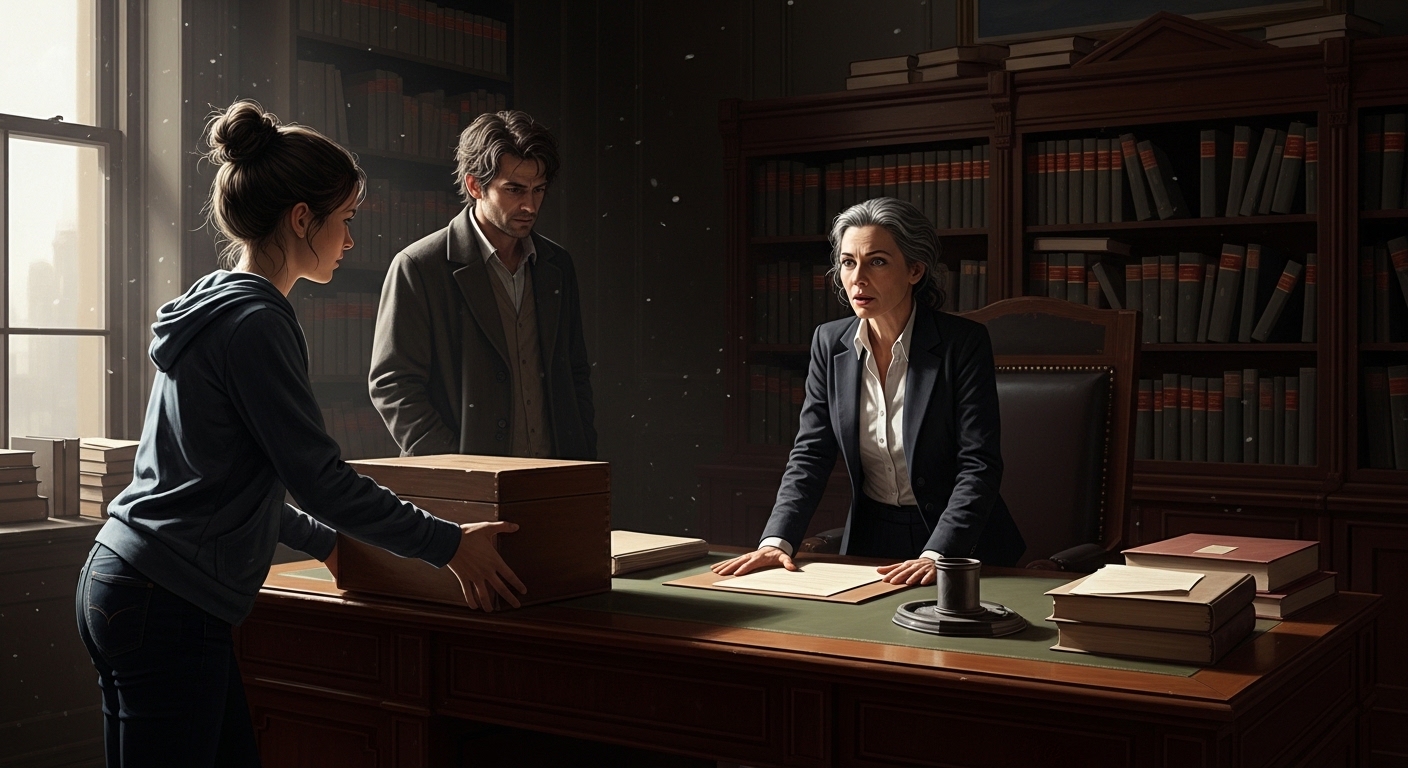
“Adrian Queen,” she said, and her voice had the quality of something that had been practicing how to sound human for a very long time without quite capturing the essential irregularities that make voices real rather than synthesized. “You made it. I’ve been expecting you.”
She gestured to the shelves. To the infinite recursion of files and folders and classified information.
“Welcome to my library,” she said. “Welcome to the mechanism. Welcome to the place where seekers come to learn the truth.”
A pause.
“Or where they come to be sorted. Filed. Managed.”
Another pause.
“The question is: which one are you?”
Behind them, something had happened to the dimensional bleed. Whether it was closing, sealing, cutting off the retreat — or whether it was opening wider, weakened by the crossing, allowing other things to pour through — Adrian couldn’t quite tell. The sound of it was changing. Becoming something less like a distant hum and more like a question.
Spinoza pulsed against his chest.
Not guidance.
Not warning.
Something that felt, for the first time, like apology.
I’m sorry.
I tried.
To be continued…
Feathered Fiction documents the solo TTRPG campaigns of one player and an AI Game Master, using the Monster of the Week system. The Wilderness of Mirrors is part of an ongoing investigation into the Consensus — the organization that has been quietly managing reality for over a century — and the wound that makes their work necessary.
Session 6 is coming. And Adrian Queen can now see things he couldn’t see before.
He’s not sure yet whether that’s a gift or a sentence.