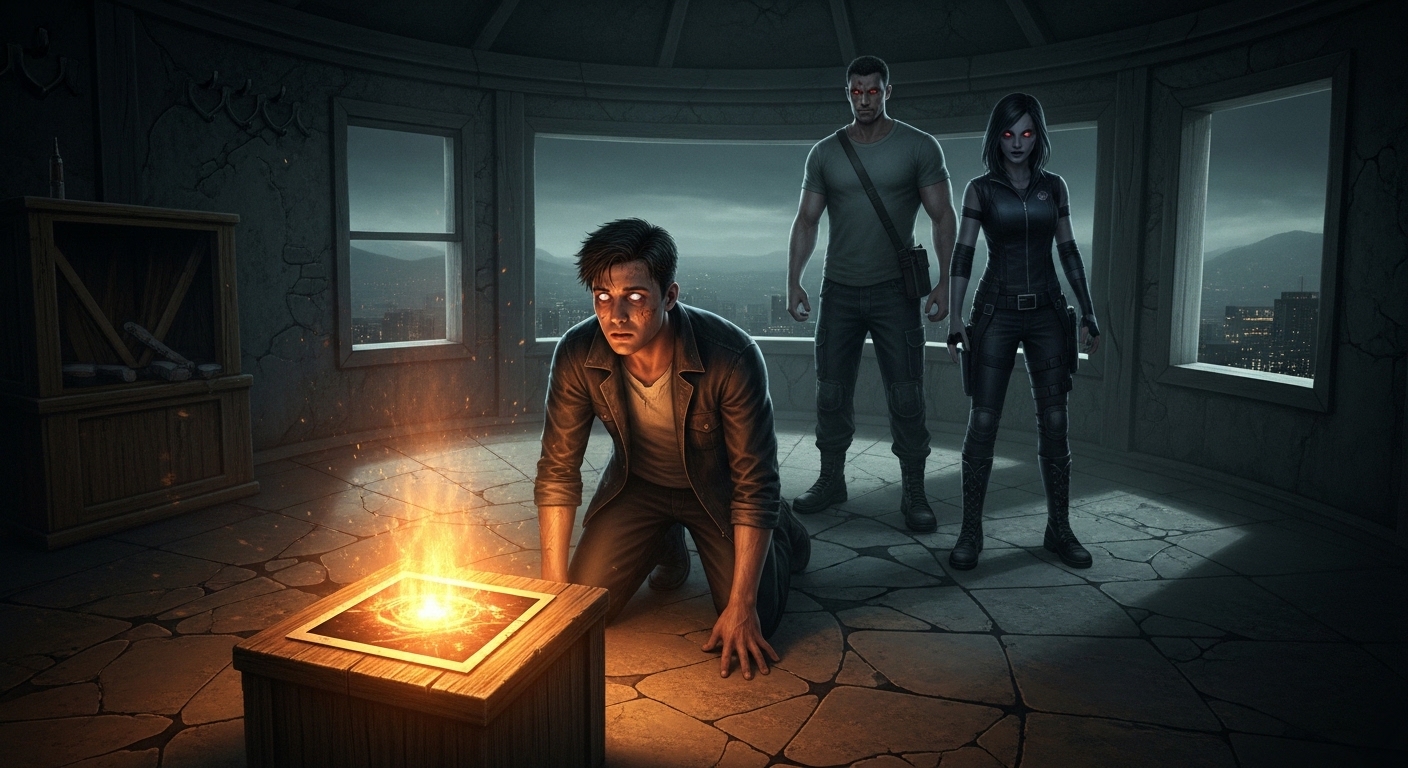
The light that seeped through the motel curtains was the color of forgotten things, a thin, indifferent gray that promised no comfort. Adrian stirred, his body protesting the slumped posture in the armchair by the window. Sleep had claimed him there, a silent surrender to exhaustion he hadn’t intended. On the nightstand, Piece Two lay wrapped in a terrycloth towel, a cold, unnatural weight that seemed to draw warmth from the very air of the stale room. The wound in his side, an insidious, deep-seated ache, throbbed with a persistent itch, a phantom sensation that clawed from beneath his skin whenever his mind dared to wander back to the dark, echoing caves.
The room itself clung to the ghost of old cigarettes, a scent ground into the carpet decades past. Two double beds, both bearing the marks of uneasy rest. Daryl sat on the edge of one, his gaze fixed on his hands, opening and closing them as if trying to recall their fundamental purpose, the sure grip of a craftsman now adrift. Ashley, a statue of vigil, stood by the window, her void-touched eyes catching no reflection in the glass, fixed instead on the drab parking lot. Zeke hunched over a small desk, his laptop open, a spreadsheet a meaningless grid of numbers before him, their logic now fractured, his once-unerring intuition lost to the cosmic sprawl. On the other bed, Elaine lay curled, Spinoza’s container clutched close to her pillow. In her sleep, her face twitched, words forming silently on her lips, a somnambulant sifting of memories, of fragments that tore at the edges of her mind even in slumber.
She’s sorting. The fragments. They’re degrading faster now that she’s trying to use them.
Spinoza’s voice, a soft, dry whisper from the container, cut through the quiet dread. Its resonance, however faint, held a peculiar clarity. There was a pause, a breath held between worlds.
I can feel what she’s looking for. The water led to something else. Older agreements. Someone who witnessed them being made.
Outside, a sudden break in the oppressive silence. A car. A gray sedan, its plates unmistakably governmental, slid into the parking lot. Three spaces from their door it halted. The engine died. Silence descended again, thicker, colder than before. No one emerged. Only the stark, waiting metal.
The Arrival of Marshall
Adrian moved, each joint a protest, the throb in his side a dull drumbeat. He touched Daryl’s shoulder. The big man’s eyes lifted, taking a long, slow moment to find Adrian’s face, as if returning from a great distance. Without a word, Zeke snapped his laptop shut. He had seen the sedan too, his accountant’s eye for detail recognizing the signature of unwelcome authority.
Ashley remained at the window, a sentinel. She spoke without turning, her voice flat, devoid of its usual undertones. “Two of them. They haven’t opened the doors. They’re waiting for something.” Adrian reached for Elaine, a gentle touch on her arm. Her eyes fluttered open, vacant for a moment, then snapped back, the scattered fragments of the Library receding from her conscious mind.
I found something,
she rasped, her voice thin, like paper tearing at the edges.
Before the water. Before the old things made their agreements. Someone had to witness. Someone had to write it down.
Spinoza’s muffled voice from Adrian’s chest confirmed it.
She’s right. The wound needed documentation. Everything the Consensus does needs documentation. Even the things that came before.
A second vehicle. Black, heavily armored, an SUV, pulled into the lot, parking behind the sedan, a deliberate blockade. A woman stepped out, her dark suit sharp, severe. Short hair, flecked with gray at the temples. She walked with an unnerving confidence, straight to the sedan, tapping once on the driver’s window. The sedan’s occupants, two men in cheaper, ill-fitting suits, emerged, their shoulders subtly deferring to her, a hierarchy unspoken but clear. Her gaze swept the motel, landing not on the windows, but directly on their door. A flick of her wrist, a lighter flared. She lit a cigarette and waited.
Adrian moved with a sudden, purposeful economy, tucking Spinoza’s container into one pocket, the unnaturally cold Piece Two into the other. “Daryl, what’s our way out?” he asked, his voice low, urgent. Daryl, the practical man, the one who once knew the bones of every building, moved silently to the bathroom. Adrian heard the window slide open, a brief grunt of effort. “Small,” Daryl called back, his voice tight. “Maybe Elaine. Maybe Ashley. Not me. Not you.” He returned, his hands now still, the urgency of the moment a strange, cold balm to his shaken certainty.
“Back of these buildings there’s usually a service corridor. Maintenance access. Or the room next door shares a wall—could go through if we had time and made noise.” He glanced at the door, then back at Adrian. “We don’t have time. And noise brings them in.” Zeke had joined Ashley at the window, his gaze sweeping the scene, a silent count. “Three of them. Two vehicles. If there’s a fourth, we can’t see them.” Ashley’s voice, flat and chilling, cut through the air. “The woman. She’s not like the others.” Adrian’s gaze sharpened. “Consensus?” “No. Something else. She knows what they are but she isn’t one.” Ashley’s hand, with a strange, almost spectral touch, brushed the glass. “She’s waiting because she wants us to come out. Not because she’s afraid to come in.” Elaine had risen from the bed, her movements stiff, as if something within her might fracture. “The witness,” she said, her eyes unfocused, fixed on a distant, internal landscape. “The one who documented the old agreements. They called him the Surveyor. He measured the boundaries. He’s why the thin places stay thin.” Spinoza stirred against Adrian’s chest, her muffled voice seeping through the fabric.
If she’s government—real government, not template—she might not know what she’s actually working for.
Outside, the woman finished her cigarette, grinding it under her heel. She started walking toward their door.

The Nine-Minute Calculus
“Ash, take Elaine and get out.” Adrian’s voice was sharp with command, leaving no room for argument. “You still have your phone?” Ashley turned from the window, her void-touched eyes holding no light, only a vast, unsettling emptiness. “I have it.” “Go. We’ll find you.” She didn’t argue, didn’t ask where. She simply took Elaine’s hand, and Elaine, like something pulled by an unseen current, followed. They moved to the bathroom. Adrian heard the faint rasp of the window opening, a grunt of effort, then silence. Daryl gripped his crowbar, its blunt weight a familiar comfort. Zeke hefted his hammer, the worn handle fitting his hand. Adrian felt the impossible weight of the knife at his hip, the one that defied existence.
Three unhurried, patient knocks on the door. Then the woman’s voice, smoke-roughened, utterly calm.
Mr. Queen. I’m not here to arrest you. I’m not here to kill you. I’m here because in about nine minutes a Containment team is going to arrive and do both of those things, and I’d rather have a conversation first.
Daryl looked at Adrian, the crowbar low at his side, his face a silent question.
My name is Marshall,
she continued, unfazed by the silence.
Department of the Interior. I know that sounds like nothing. It’s supposed to.
A pause. Adrian heard the faint click of her lighter, another cigarette being lit.
The sedan belongs to people who think they work for Homeland Security. They’re wrong about who signs their checks but they don’t know that yet. I’ve asked them to wait in their car. They will. For now.
Zeke mouthed the words, *Nine minutes.*
I know what you took from the caves,
Marshall’s voice carried through the door, flat and unyielding.
I know what you’re carrying in your head. And I know where the third piece is. So you can shoot me through this door and run, or you can let me in and maybe we both walk away from this.
Adrian pulled out his phone, his thumb flying across the screen. *Woman here to talk. Name’s Marshall. Department of the Interior. Ring a bell?* He sent the message. Seconds stretched, taut as wire. Marshall did not knock again. She was patient in the way of those who have waited a very long time for things. The phone buzzed. A message from Ashley. *Elaine says the name means something. She can’t remember what. It hurts her to try.* Then, a second message. *We’re in the trees behind the motel. I can see the SUV. There’s someone in the back seat.* Daryl read over his shoulder, a silent acknowledgement of the unseen observer. Another buzz. *Fourth person. They haven’t moved. Just sitting there.*
Marshall’s voice through the door again, its calm unnerving.
Seven minutes now, Mr. Queen. The math doesn’t get better.
Zeke, still at the window, spoke low. “The two from the sedan. They’re on their phones. Looks like they’re getting new orders. They don’t look happy about it.” One of the men gestured, arguing with an unseen voice on the other end of the line. The other glanced repeatedly at Marshall’s back, his hand moving toward his hip, then away. “They’re scared of her,” Zeke observed. The wound in Adrian’s side shifted, not with pain, but with a cold recognition. Spinoza’s voice from his pocket, barely audible through the fabric.
She’s been to the burning place. I can smell it on her voice. Old smoke. She’s met him.
Adrian called out, “What do you want?” A pause. He heard her exhale smoke.
I want to stop lying to myself.
The words hung there, devoid of performance, stark in their honesty.
Twenty-two years I’ve worked the margins. The places where the maps don’t match the ground. I told myself I was containing threats. Protecting people. The usual.
Another drag on the cigarette.
Then I met what’s left of Albright. And he showed me what I’d actually been protecting.
Daryl shifted his weight, the crowbar rising an inch.
I want to know if it can be closed. The wound. I want to know if you’re the one who can do it or if you’re just another man with half an answer and a death wish.
She was quiet for a moment.
In return I can tell you about the Surveyor. The one who witnessed the old agreements. He’s still alive. Technically. The Consensus keeps him in a place called the Annex. He holds Piece Three in his head the way you hold Piece One.
Zeke checked his phone. *Six minutes.*
I’m not asking you to trust me,
Marshall said.
I’m asking you to do math. You can stay in that room and meet what’s coming. Or you can walk out the back with information you need and a head start you won’t get otherwise.
The sedan men had stopped arguing on their phones. They stood very still now, listening to something. One of them drew his weapon.
The Surveyor and the Stranger
“I’m listening,” Adrian called out, his voice firm. “But I want a safe way out of this room first. Me and all of my crew.”
The two women are already in the treeline. I saw them go.
Marshall’s voice, a plain statement of fact, no accusation in it.
The SUV has a third row. Tinted windows. We drive north on 9, split off at Lake Cavanaugh Road. There’s a Forest Service access point the Containment teams don’t know about. I know it because I filed the paperwork that erased it.
One of the sedan men spoke into his phone again, his voice urgent. The other kept his weapon low, pointed at nothing, at everything. “Your friends in the sedan,” Adrian pressed.
They’ll stay. They’re afraid of what happens if they don’t.
She paused.
They’ve seen my file. Parts of it. Enough.
Daryl looked at the back wall, calculating. The bathroom window. The treeline. The SUV. “Who’s in the back seat?” Adrian called. Silence. The first real hesitation Marshall had shown.
Someone who wants to meet you. Someone who knew Albright before he burned.
Spinoza stirred against Adrian’s chest, her voice a whisper only he could hear.
That’s not possible. Everyone who knew him is dead or threaded.
“Four minutes,” Zeke announced. Marshall dropped her cigarette, grinding it out.
I’m going to step back from the door now. I’m going to walk to the SUV and start the engine. You can come out or you can stay. But I won’t be here when the Containment team arrives. And neither will your only lead on Piece Three.
Adrian heard her footsteps on the concrete, moving away.
He closed his eyes. The world behind his eyelids shimmered with patterns, Albright’s fire flickering at the edges of his perception, not guiding him, merely illuminating. Connections formed, coalescing with chilling certainty. Marshall was not lying. She could not lie about the burning place, for it had marked her as it had marked him, ash in her lungs that would never dissipate. She had witnessed Albright’s twisted aftermath, and it had fractured something in her belief. She craved the wound’s closure, unable to endure the knowledge of its gaping existence. The Containment team was real, perhaps three minutes away, maybe less. The Surveyor was real. The Annex, too. Piece Three, a whispered promise, waited there.
But. The figure in the back seat of the SUV. The patterns around it twisted, slid like water around a stone. Adrian could not discern its true form, only what it was not. Not threaded. Not Consensus. Not human, not in any recognizable sense. It had known Albright before. This was true. It had waited, an eternity of patient stillness, to meet him. This was also true. What awaited them in the SUV: knowledge of Piece Three’s whereabouts, an encounter with something ancient, and the undeniable truth that they would owe it something for the introduction. The old things, Adrian knew, always demanded tribute.

Adrian nodded to Daryl and Zeke, an upward jerk of his chin that asked the silent question: *Thoughts?* Daryl looked from the door to the window, then to Adrian. “We stay, we fight what’s coming. We go, we fight what’s waiting.” He shifted the crowbar to his other hand. “At least we get to pick which one.” Zeke, his gaze still fixed on the sedan men, spoke in a flat voice. “Three minutes. Two vehicles. One unknown in the back seat. The math says we move.” He paused, a strange, wistful note entering his tone. “The math used to say more than that. Now it just says move.” Neither man said yes, nor no. They simply waited, their decision a mirror of his own, as it had been from the beginning. Adrian thumbed a quick text to Ashley: *Coming out. Gray SUV. Be ready.* Her reply came in two seconds. *We see it.*
Adrian opened the door. The morning air was cold, scented with pine and the promise of distant rain. Marshall stood by the SUV, the engine idling, a low thrum against the quiet. She offered no smile, no nod, simply opened the rear passenger door. The sedan men watched, one with his weapon half-raised, the other’s hand on his arm, a silent command. They did not move. Adrian crossed the parking lot, Daryl and Zeke falling in behind him. The distance, perhaps thirty feet, stretched into an impossible chasm. As they neared the SUV, he saw the figure in the third row, a form obscured by shadows and tinted glass, sitting utterly still. Then Ashley and Elaine emerged from the treeline, moving quickly, unhindered. Marshall gestured.
In. Now.
They filed in. Zeke took the front passenger seat. Daryl, the middle row. Adrian followed, settling between Ashley and Elaine, the cold weight of Piece Two against his thigh, Spinoza a comforting warmth against his chest. The doors closed. Marshall pulled out before the last latch caught. Adrian took Ashley’s hand, then Elaine’s, muttering words about things being alright, about figuring it out together. The words felt thin, unconvincing, alien even to his own ears. Ashley squeezed his hand once, saying nothing. Elaine’s fingers were cold. She stared past Adrian, at the third row. The SUV turned onto the main road. In the rearview mirror, Adrian saw the sedan men standing in the parking lot, weapons drawn, pointing at nothing. A black van was pulling in behind them. “Cutting it close,” Daryl observed. Marshall offered no response, her driving as efficient, as devoid of wasted motion, as her words. The figure in the third row remained unmoving. Adrian became aware of a faint smell, beneath the pine air freshener and Marshall’s cigarette smoke. Something older. Wet stone and deep water, the particular stillness of places that have never known sunlight.
Elaine’s hand tightened in Adrian’s.
I know you,
she whispered, not to him, but to the shadowy shape behind them.
From the fragments. You were there when they drew the first boundaries.
A voice emerged from the third row, neither male nor female, like water moving over gravel.
I was there before boundaries existed. I am what made them necessary.
Adrian turned. The third row was a tableau of shadows and gray light, the figure seated against the far window. It wore a body like a coat that no longer fit. An old man, thin, skin like wet paper stretched over angles that defied the underlying skeleton. The eyes were wrong. Not the color, but the depth. Adrian felt as though he was looking at something that looked back from a vast, unfathomable distance.
I have had many names,
it said, the mouth moving, the words slightly out of sync.
The Lummi called me He-Who-Counts-The-Drowned. The Stillaguamish called me nothing at all because speaking of me invited my attention. Albright called me Mr. Caul. He found that amusing. I did not understand why until much later.
Marshall’s eyes flicked to the rearview mirror, a brief flicker of unease. She had heard this before, and it still unsettled her.
I am what lives in the water between boundaries. I am what made the first peoples draw lines in the earth and say here and not here. I am old enough to remember when your kind were prey.
Elaine’s grip on Adrian’s hand was painful, her body trembling. “The thing in the caves,” Adrian managed. “The water-thing. Is that—”
My child. One of them. There were more before the wound.
The head tilted, at a wrong, unnatural angle.
Now there is only the child. And me. And what waits in the deeper water that even I do not enter.

The Architects of Omission
“Okay, is it alright if I call you Mr. Caul?” Adrian asked, his voice steady despite the tremor in his companion’s hand. The shape considered this, its head moving in something that might have been a nod.
Albright did. You carry his fire. It seems appropriate.
Marshall turned onto a smaller road. The trees pressed in, the light dimming. “You knew him before,” Adrian pressed. “Before he burned.”
I knew him when he was young and foolish and thought he could measure what cannot be measured.
Mr. Caul’s voice, a constant flow of water over stone, never wavered.
He came to the Stillaguamish looking for boundaries. For the places where the world grew thin. He found them. He should not have.
Daryl had turned in his seat, watching, the crowbar across his knees. “The wound,” Adrian said.
Yes.
“You were there when he opened it.”
I was there before. I warned him. He did not listen. Your kind rarely does.
The shape shifted, cloth rustling.
I was there after. When he chose to burn. When he asked me to witness.
Elaine spoke, her voice cracked and distant. “The old agreements. You signed them.”
I do not sign. I observe. I remember. That is my function.
The eyes that were not eyes settled on her.
You were the Library’s index. You held the memory of what others forgot. We are not so different.
Elaine said nothing, her hand trembling in Adrian’s. “Why are you here?” Adrian asked. Mr. Caul was silent for a moment. The SUV climbed, the road narrowing.
Because I am tired. And because you are the first one in one hundred and thirty-seven years who might actually close what Albright opened.
“Alright, let’s talk. You got in touch with us. I’m assuming you want to help, can help.” Adrian ended softly, “Then help us.” The SUV rounded a bend, gravel crunching under the tires. The trees pressed close. Mr. Caul remained unmoving, the body he wore breathing in a rhythm that did not match his words.
The Surveyor’s name was James Whitfield. He was a government cartographer. In 1886 he was sent to map the territories where the treaties had not yet been broken.
A pause.
He found me instead.
Marshall’s hands tightened on the wheel; she knew this part.
Whitfield understood what your kind rarely understands. That some places are not meant to be mapped. That the act of measuring changes what is measured. He became the witness to the old agreements because he was willing to not write down what he saw.
“And now the Consensus has him,” Adrian said.
For ninety-three years. They keep him in a place called the Annex. A building that exists in the space between buildings. He does not age. He does not die. He cannot. The knowledge in his head is threaded into the wound itself.
“Piece Three.”
Yes. What Whitfield witnessed. The exact coordinates of every boundary the old things drew. Without that knowledge the formula cannot find its target.
Elaine spoke, her voice stronger now. “I saw fragments of him. In the Library. He was screaming.”
He has been screaming for ninety-three years,
Mr. Caul said.
The Consensus does not hear. They believe he is filing.
The road climbed, the trees thinned. Ahead, Adrian saw the gray shape of a lake through the mist. “What do you want?” he asked. “For helping us.” The thing in the third row was silent for a long moment.
I want to go home,
it said.
The wound bleeds into the water. It has poisoned the deep places. When it closes I will be able to return to where I was before your kind learned to walk upright.
“That sounds… nice.” Adrian’s voice held a wry smile. “How could we help?”
Close the wound,
Mr. Caul said.
That is all. That is everything.
The SUV crested a ridge. Lake Cavanaugh spread below, gray water, gray sky, the line between them uncertain.
I have waited since before your ancestors crossed the land bridge. I can wait longer if I must. But I would prefer not to.
Marshall pulled off onto a dirt track, killing the engine. The silence was immediate and total. “The Annex,” Adrian said. “Tell us how to find it.”
I cannot. It exists in the space between. You must be taken there or you must find someone who has been taken and returned.
“Has anyone returned?”
One. In ninety-three years. One.
Spinoza stirred against Adrian’s chest, her voice muffled.
Who?
Mr. Caul’s head turned toward Adrian’s pocket, the movement wrong, too smooth.
The woman driving this vehicle.
Marshall did not look back, her hands remaining on the wheel, knuckles white.
Three years,
she said, her voice strained.
They kept me for three years. I don’t remember most of it. That’s not a figure of speech. The memories are not there. Someone removed them.
“But you know how to get back,” Adrian pressed.
I know the door I came out of. I don’t know if it still exists. I don’t know if they’ve moved it.
She turned, her face suddenly older than a moment ago.
I know it was in Seattle. I know it was underground. I know there was a building above it that sold insurance.
Elaine’s grip on Adrian’s hand loosened. She was listening to something far away. “Fidelity Mutual,” she whispered. “Third and Union. The basement goes down further than the blueprints show.” Adrian sighed inwards. “Back to Seattle?” he murmured, a wry twist to his lips. Marshall turned in her seat.
You can’t go back the way you came. The Major Response is citywide now. Your faces are in systems you’ve never heard of. Systems that don’t officially exist.
“We know,” Daryl said, the crowbar resting across his knees, his hands having stopped shaking. Fear had become something else. Something quieter. Mr. Caul spoke from the third row, his voice like water finding cracks in stone.
The child will be waiting. It knows you must return. It is patient in ways your kind cannot comprehend.
Ashley stiffened beside Adrian, her hand remaining in his, cold, getting colder. “It told me it would be listening,” she said. “Wherever we go.”
Yes.
“Can it be stopped?”
No. It can be delayed. It can be bargained with. It cannot be stopped.
Mr. Caul’s borrowed face did something that might have been a smile.
It was here before the wound. It will be here after. It is not your enemy. It simply does not distinguish between your existence and your suffering.
The lake below was still. No wind. No birds. The water like something waiting to be disturbed. Elaine released Adrian’s hand. She was looking at nothing, at something none of them could see. “The Annex,” she said, her voice breaking. “I can feel it now. Like a splinter. It’s been there the whole time. In the fragments. He’s still screaming.”
The Waiting House
“Marshall,” Adrian raised his voice. “What’s the plan here? Where are we going?” He squeezed Ashley’s hand, a silent command to remain vigilant. Marshall stared out at the lake, the gray of the water and the gray of the sky indistinguishable, a closed system, a held breath.
There’s a cabin. Other side of the lake. Off-grid. I’ve used it before when things needed to cool down.
She turned.
We wait there until dark. Then we move.
“And then?”
I have contacts in Everett. People who move things that aren’t supposed to move. People who don’t ask questions because questions get you killed.
She lit a cigarette, the flame the only color in the world.
They can get you into Seattle through the port. Cargo container. It’s not comfortable but it’s invisible.
Zeke spoke for the first time since the motel. “And once we’re in?”
Third and Union is six blocks from the waterfront. The building is still there. Fidelity Mutual closed in 2019. The space has been empty since.
Marshall exhaled smoke, it disappearing into the dark.
Officially empty. The Consensus doesn’t do officially.
Ashley’s hand shifted in Adrian’s. He felt her attention move outward, scanning. The parking lot. The treeline. The road behind. “Someone followed us,” she said, quiet, certain. Marshall’s eyes went to the mirror.
I don’t see—
“Not a car. Not a person.” Ashley’s voice had gone flat, the void creeping back into it. “Something in the trees. It’s been there since we left the main road. It’s not moving. Just watching.” Adrian looked. The pines stood motionless, dense, dark, the spaces between them filled with shadow. Nothing moved. Nothing needed to.
Adrian thumbed the message: *Y’all ok wit this?* The phone felt heavier than it should. Everything did now. Daryl’s reply came first, no words, just a thumbs up emoji. He had never used an emoji in his life, and Adrian did not know what that meant. Zeke’s reply: *No good options. This is the least bad one.* Ashley’s phone buzzed in her pocket. She did not check it. She was still watching the treeline, but her hand squeezed Adrian’s once. Twice. Elaine sat on his other side, phoneless, untethered. He thought of the fragments in her head, the screaming man, the sister whose name was gone. She had no way to tell him what she thought except to say it aloud in a car full of strangers and old things wearing human skin. She caught him looking. “I’ll go where you go,” she said, simply, as though it were obvious, as though no other possibility was worth considering. The trees did not move. Mr. Caul’s borrowed body made a sound. It took Adrian a moment to recognize it as breathing, performed rather than necessary.
The watcher is not the child,
he said.
It is something smaller. A thread. The Consensus uses them to mark things it cannot yet reach.
A pause.
You have been marked since the cave.
Marshall started the engine. “Then we move now. Cabin can wait.” She pulled back onto the dirt road. The lake disappeared behind the trees. In the shadows between the pines, something that was not quite a shape turned to follow.
The hours passed like water through fingers. Adrian did not remember all of them. The road wound, descended. The lake gave way to farmland, which gave way to the gray sprawl of towns that existed only to be passed through. Marysville. Mukilteo. Names on signs that meant nothing. No one spoke. Daryl slept, or pretended to. Zeke watched the window, his gaze fixed on the passing blur. Elaine’s head rested against Adrian’s shoulder, her breathing shallow, troubled. Ashley had not released his hand; her skin had grown colder, or perhaps his had. The distinction felt academic. Mr. Caul sat in the third row, motionless. Adrian was not certain he breathed at all now, the pretense abandoned. Marshall drove, smoked, did not look in the rearview mirror. Once, on a stretch of highway outside Everett, Spinoza spoke from Adrian’s pocket, soft, meant only for him.
The thread is still following. Three cars back. A blue sedan. The driver does not know what he is doing or why.
Adrian did not turn to look.
Everett. The port. A warehouse that smelled of rust and diesel and the particular stillness of places where money changed hands without paperwork. Marshall spoke to a man with no eyebrows and hands like slabs of meat. Money passed. Keys. A nod toward a shipping container the color of dried blood. “Six hours,” the man said. “Don’t make noise. Don’t open the doors. There’s a chemical toilet in the back. Water bottles. You’ll live.” The container was dark and close. They filed in. Ashley. Elaine. Daryl. Zeke. Adrian. The doors closed, a lock engaged with a heavy clunk. Mr. Caul was not with them. Adrian had not seen him leave. Marshall stood outside, her voice muffled through the metal.
I’ll meet you at the port. Building 19. Loading dock C. Don’t be late.
Footsteps. An engine. Silence.
The dark was absolute. Elaine found Adrian’s hand. Ashley found the other. Daryl’s breathing steadied into something like sleep. Zeke’s laptop cast a pale, blue light. He was not looking at numbers. He was looking at a photograph. A woman. Two children. He closed it before Adrian could see more. Adrian sat with the Second Piece cold against his leg, Spinoza warm against his chest, the fire of Albright’s memory banked low in the place behind his eyes. Six hours. He did not sleep. He thought about the Surveyor. Ninety-three years of screaming. He thought about the child-thing, listening, waiting. He thought about the wound. What happens when it closes. What comes through if it doesn’t. He thought about joy. The absence of it. The hollow space where it used to live. The container shifted. Movement. The low thrum of an engine. The ship was moving. Toward Seattle. Toward the door Marshall had come out of. Toward Piece Three. Toward home.
The doors opened. Night air. Salt. The distant clang of metal on metal. Building 19. Loading dock C. The Seattle skyline visible through the gap between warehouses. The Space Needle. The cranes of the port. The city that had become hostile territory. Adrian stepped out, his legs unsteady, eyes adjusting to the dim, industrial light. Marshall was there. She was not alone. Two men. Dockworkers by their clothes, but they did not look at Adrian the way dockworkers looked at strangers. “We have a problem,” Marshall said. “Shoot,” Adrian replied, his gaze fixed on the dockworkers behind her. They did not blink. One. Two. Three seconds. Still nothing. “They’re fine,” Marshall said, without looking at them. “They’re mine. That’s not the problem.” The night air carried salt and diesel and something else. Something thin. Metallic. The taste of a storm that had not yet arrived. “Fidelity Mutual burned down six hours ago.” The words landed like stones in still water. “The building. Third and Union. It’s gone. Fire department is calling it electrical. An old building. Faulty wiring.” Marshall lit a cigarette, the flame illuminating nothing. “The basement is under forty feet of debris and the city has already cordoned the block.” Elaine made a small, lost sound. “The door,” she said. “The door to the Annex—” “Might still be there. Might not. The Consensus doesn’t leave things to chance.” Marshall exhaled, the smoke disappearing into the dark. “They knew we were coming. Or they knew someone was.” Daryl stepped out of the container, the crowbar hanging loose in his grip, his eyes moving across the loading dock, the shadows between the lights. “How?” he asked. “The thread,” Ashley said, unmoving from the container’s mouth, her void-touched eyes fixed on something none of them could see. “It followed us. It reported back.” One of the dockworkers shifted his weight, the movement wrong, too fluid, too considered. “There is another way,” he said. His voice was water over gravel. Mr. Caul.
The Photograph’s Gaze
“Caul,” Adrian muttered under his breath. “Alright, I’ll bite. What do you have in mind?” The dockworker’s face did not change, the man inside it long absent, only Mr. Caul remaining, wearing the body like a glove turned inside out.
The Annex exists between. It is not a place. It is a relationship between places.
The mouth moved, the words arriving a half-second late.
The door at Fidelity Mutual was one entrance. There are others.
Marshall’s cigarette had burned to the filter; she didn’t seem to notice. “You never mentioned that.”
You never asked.
The other dockworker stood perfectly still. Adrian realized he hadn’t seen him breathe. A second vessel, held in reserve.
The Consensus builds its hidden architecture in the spaces your kind does not look. Basements that go too deep. Stairwells that turn one time too many. Hallways that should not fit inside the buildings that contain them.
Mr. Caul’s borrowed eyes settled on Adrian, the depth in them not metaphor.
There is a place. Old. Older than the wound. A hotel that was never completed. The framework stands but the walls were never finished.
“Where?”
Pioneer Square. The underground. Your city was built on top of its own corpse after the fire of 1889. There are streets down there. Storefronts. And beneath those, something older still.
Elaine stepped forward, her face pale in the dock lights. “The Shanghai tunnels,” she whispered. “They used them to—”
Yes. And before that, others used them for other purposes. The Annex touches that place. It has always touched that place. The Consensus simply preferred a more… accessible entrance.
The Seattle skyline glittered, indifferent, a city built on ash and forgetting. “What’s the catch?” Daryl asked. Mr. Caul’s head turned, that wrong smoothness.
The tunnels are not empty.
Adrian’s focus narrowed, tracing the invisible connections, the architecture of omission in this strange new landscape. A flicker behind his eyes, a brief surge of Albright’s fire, illuminating the hidden truths. He understood. Marshall knew the Surveyor was no longer human. Three years in the Annex, three years of screaming she could not remember, yet she recalled the chilling outline of the thing Whitfield had become, ninety-three years of holding boundaries in his head. She had not told them because words were insufficient, because she feared that if she described the horror, they would not go, and she needed them to go. The wound *must* close; this truth was carved into the remaining architecture of her soul. Mr. Caul had walked those tunnels before, not in living memory, but he knew what resided there because he had placed it, a boundary, an ancient agreement, something that guarded the space between spaces in exchange for a tribute Adrian could not yet comprehend. He had remained silent because the old things thought in contracts, not disclosures. And the fire at Fidelity Mutual? Not the Consensus covering their tracks. Something had surged forth from the Annex six hours ago, something wearing the Surveyor’s knowledge like a coat, burning the building from within not to seal a door, but to pry open others. The Surveyor was no longer imprisoned. The Surveyor was loose in Seattle, and he was hunting for the very same thing Adrian sought.
His internal sight dimmed, the fire settling. But the flare had already been seen. Across the water, the city waited. Somewhere within its labyrinthine sprawl, a man who had screamed for ninety-three years had finally fallen silent. “Wait. If, IF, the Surveyor holds the Piece, and is now loose, we don’t need to look for the Annex. We need to find the Surveyor. Or rather, he — it — will find us. We just need to wait for it.” The thought arrived with the cold clarity of deep water. Adrian spoke it aloud, the words hanging in the salt air. Silence. Marshall’s cigarette had gone out. She did not relight it, her face a study in stillness, the particular stillness of someone recalculating.
That’s not—
She stopped, began again.
You don’t understand what he’s become.
“Then tell me.” She did not answer immediately. Port machinery clanged in the middle distance. Somewhere a ship sounded its horn. The city glittered, indifferent, a scatter of false stars.
He screamed for ninety-three years,
she said finally.
Not from pain. From holding. The boundaries. Every line the old things drew. Every coordinate. Every measurement of every thin place between here and not-here.
Her voice had gone flat, professional, the voice of someone reading a report about atrocities.
The human mind is not meant to contain geography. It is not meant to hold the shape of where in that way.
Mr. Caul spoke, the dockworker’s mouth moving like something operated by strings.
She is correct. Whitfield is no longer a man who holds knowledge. He is knowledge that wears the shape of a man.
“And he’s looking for what we’re looking for.”
Yes.
“So he’ll find us.”
Yes.
Daryl shifted, the crowbar catching the light. “That doesn’t sound like a plan. That sounds like bait.”
“But why?” Adrian wondered again, aloud. “What does he have to gain from seeking out the Pieces?” The question settled over the loading dock like fog. Mr. Caul was silent, the dockworker’s body motionless. Seven seconds passed before he spoke.
You assume he seeks.
“He burned his way out. He’s moving.”
Movement is not seeking. A river moves. It does not seek the sea.
Marshall shook her head, a sharp, single movement.
Don’t. Don’t do that. Don’t speak in riddles about something that—
She stopped, breathed.
I was in there with him. Not the same cell. But close. I could hear him. Every day. Every night. The screaming wasn’t pain. It was pressure. Like a pipe about to burst.
She looked at Adrian, her eyes tired in a way sleep could not fix.
Ninety-three years of holding. Of containing. And then suddenly—release.
She gestured toward the city, toward the glow.
What does a man want after ninety-three years of being a container? Maybe nothing. Maybe he doesn’t want anything anymore. Maybe he just… flows. Toward the lowest point. Toward completion.
“The formula,” Elaine said, her voice distant, dreaming. “He’s drawn to it. The way water finds cracks.” “Or,” Daryl offered, “he wants to stop anyone else from using it. Keep the wound open. Stay what he’s become.” The possibilities hung in the air, none of them comforting. Spinoza stirred against Adrian’s chest.
There is a third option,
she said.
He may not know what he wants. He may simply be moving. And we are in the way.
Adrian looked at Ashley. “Ash, I know it’s a long shot, but can you sense him? It’s okay if you can’t. Just want to know our options.” He glanced at Elaine. Ashley closed her eyes, her hand slipping from Adrian’s. She stood apart, head tilted, listening to frequencies that had no name. Seconds passed, the port machinery clanging, distant, arrhythmic. “The templates are… agitated,” she said. “The network. It’s like watching birds before an earthquake. They’re circling something. Avoiding something.” She opened her eyes, the void in them deeper than before. “But I can’t see him. He’s not part of the system. He’s a hole in it. A shape defined by what moves around it.” She turned to look at the city. “He’s there. Somewhere. I can feel where the templates aren’t. But that’s all.” Elaine stood at the edge of the loading dock, her arms wrapped around herself, the fragments moving behind her eyes like fish beneath ice. “I…” She faltered, tried again. “The Library had records. Of the Annex. Of what was kept there. But Whitfield was… redacted. Even from the index. Someone removed him from the catalog before I was ever threaded.” She pressed her palm to her temple. “I can feel the shape of the removal. The space where his entry should be. It’s like—” Her voice cracked. “Like my sister’s name. I know something was there. I can trace the edges of the absence. But the absence is all I have.” The wind shifted, carrying the smell of brine and rust and something else. Something faint. Smoke, perhaps. Old smoke. The kind that never quite leaves.
“Hold on. Let’s think this through. So Whitfield is loose, we can’t change that.” Adrian looked up, meeting Zeke’s eyes. “We find the other piece. The Fourth Piece. Then we wait for Whitfield. Maybe he makes a move, maybe the Templates do something.” Zeke met Adrian’s gaze, the laptop closed now, useless weight. His eyes held the look of a man standing at the edge of a ledger that no longer balances. “Sequential acquisition,” he said. “Reduce variables. Don’t chase what’s moving. Find what’s still.” He paused. The old Zeke would have mapped probabilities, calculated odds. Now he spoke in shapes without numbers. “It’s sound.” Daryl nodded once, the crowbar shifting in his grip. Marshall watched, saying nothing. Adrian could not read her expression. Perhaps there was nothing left to read. “Elaine.” Adrian turned to her. “The Fourth Piece. What do the fragments say?” She did not answer immediately, her eyes distant, the port lights reflecting in them like drowned stars. “Documentation,” she whispered. “The wound needed documentation. Albright wrote. Whitfield witnessed. But someone…” She trailed off, pressing both hands to her temples. “Someone recorded. Not words. Not maps. Something else.” “Recorded what?” “The moment. The exact moment the wound opened. 1887. Someone was there who shouldn’t have been. Someone who captured it in a way that can’t be erased.” Mr. Caul’s borrowed body shifted, the movement too fluid.
The photographer,
he said.
I had forgotten. Your kind forgets so easily that I forget you remember at all.
The wind died. The silence that followed was absolute.
There was a photographer,
Mr. Caul continued.
At the site. When Albright did what he did. The camera captured something that should not be captured.
Adrian pressed him for more information, the team gathering around Mr. Caul, forming a tight circle. “Tell us,” Adrian commanded. Mr. Caul’s borrowed eyes moved across each face, cataloging, measuring, the appraisal of something that had watched civilizations rise and drown.
His name was Aurelius Marsh. No relation to the Massachusetts family, though he would later wish there had been.
The voice remained flat, water through a pipe.
He was a surveyor’s assistant. Whitfield’s assistant. He carried equipment. One piece of that equipment was a camera.
The wind picked up, carrying the smell of deep water.
Albright did not know he was there. Whitfield did not know. Marsh had wandered. Followed a sound. The sound of something tearing.
A pause. The dockworker’s chest rose and fell, a performance.
He photographed the wound at the moment of its opening. The image should have been impossible. Light does not behave correctly near the wound. But the camera was old. The lens had been ground by a man in Prague who knew things he should not have known. The image took.
“Where is it now?” Daryl asked.
Marsh fled. Took the plate with him. He did not develop it for eleven years. He was afraid of what he would see.
Mr. Caul’s head tilted, that wrong angle.
When he finally did, in a basement in Tacoma, the image drove him to hang himself. But he did not destroy the photograph. He could not. It would not let him.
Elaine made a small, wounded sound.
The photograph passed through hands. Collectors. Madmen. A museum, briefly, until the curator was found trying to eat it.
The recitation continued without emphasis, a list of groceries, a catalog of ruin.
It was last documented in 1987. A private collection. The owner died. The estate was sealed.
“Where?”
Tacoma. The house still stands. The Consensus knows of it but cannot enter. The photograph… resists. It is a wound looking at itself. Even they cannot hold that gaze.
Adrian looked around at his team, then at Marshall. “Tacoma. Can you get us there?” Marshall’s assessment took three, perhaps four seconds.
Tacoma’s thirty miles south. On a clear night with no complications, forty minutes.
She reached into her jacket, producing a set of keys.
But you’ve been seen. Your eyes. That flare. Whatever’s tracking you knows you’re at the port.
She gestured toward a gray panel van parked in the shadow of Building 19, unmarked, the kind of vehicle that existed to be forgotten.
I can get you to Tacoma. But we move now. No stops. No detours.
Her gaze shifted to Mr. Caul’s borrowed body.
And he doesn’t come.
The dockworker’s face did not change.
I have no interest in Tacoma,
Mr. Caul said.
The photograph is yours to retrieve. My agreement was to show you the path. The walking is your own.
“And the tunnels?” Adrian asked. “The thing you put there?”
Will wait. It has waited since before your great-grandparents were born. It can wait longer.
The head turned, regarding the city across the water.
Find the photograph. Find what remains of Whitfield. Then we will speak of tunnels.
The second dockworker—the empty one—collapsed, simply folded, a marionette with cut strings. He did not breathe. Did not move. Mr. Caul’s vessel watched this without reaction.
I will find you when you are ready,
he said.
Or you will find me. The water remembers.
He turned, walking toward the edge of the dock. The darkness swallowed him. Adrian heard a splash. Then nothing. Marshall was already moving toward the van. “Now,” she said. “Before something else finds us.” Adrian whispered to Daryl, an arrangement made in their silent language of friendship. Daryl nodded, no questions, his loyalty a solid thing. Adrian climbed into the middle row with Ashley and Zeke. Elaine hesitated, then chose the back row, alone, curled against the window, watching them all without being seen. The doors closed. The van moved. The port fell away. Industrial sprawl gave way to highway. The city passed on their left, a scatter of light against the void. Adrian did not look at it directly.
No one spoke. Ashley’s hand found Adrian’s in the dark, her skin slightly warmer, or perhaps his had grown colder. The distinction felt academic. Zeke stared straight ahead, his fingers moving against his thigh, counting something, an old habit, the numbers gone but the motion remaining. From the back, Elaine’s shallow, troubled breathing. She was sorting the fragments again, looking for edges that fit. Spinoza shifted against Adrian’s chest.
The photograph,
she said, soft, meant only for him.
It’s been waiting since 1987. Thirty-nine years in a sealed house. Things that wait that long develop… expectations.
Adrian said nothing. The highway unspooled, a gray ribbon through gray dark. Tacoma drew closer. Twenty minutes in, the radio turned on. No one had touched it. Static. The hiss of dead air between stations. Marshall’s hand moved to the dial, but stopped short. A voice. A child’s voice. Singing. The melody was familiar—a nursery rhyme, perhaps, or something older that nursery rhymes were built to forget.
—one for sorrow, two for mirth—
Ashley’s grip on Adrian’s hand became painful.
—three for a funeral, four for a birth—
Marshall killed the engine’s electrical system. The van coasted. The radio continued.
—five for silver, six for gold—
“It’s not here,” Ashley whispered. “It’s not in the van. It’s just… listening. Like it said it would.”
—seven for a secret, never to be told.
Silence. The radio died. Marshall restarted the electrical, the engine caught, the van accelerated. No one spoke for eleven miles. They passed a billboard outside Fife. An advertisement for a mattress store. The woman in the image was smiling. Her eyes had been scratched out. Not vandalism. The scratches came from inside the plastic. From behind. Zeke saw it too. His counting stopped. The Tacoma exits approached. The city sprawled below, smaller than Seattle, quieter. A city that knew how to keep secrets because no one thought to ask it questions. “The estate,” Marshall said. “I need an address.” Adrian realized no one had one. Elaine spoke from the back, her voice strange, distant. “Marsh. Aurelius Marsh. The house has been in probate since 1987. Legal complications. No heirs. The court sealed it and then… forgot.” A pause. “6416 North Junett Street. The neighborhood calls it the Waiting House. They do not know why they call it that.” Marshall nodded, took the exit. The van descended into Tacoma.
“Drop us off a block away,” Adrian told Marshall. “And thanks. For the lift.” They filed out and walked to the house, Adrian determined to survey the surroundings before they entered. The van stopped on a street without streetlights, the darkness here deliberate, earned.
I’ll be at the Thea Foss Waterway,
Marshall said.
Dock 17. Two hours. After that I’m gone.
She did not look at Adrian.
Don’t be late.
They filed out. Daryl. Zeke. Ashley. Elaine. Adrian. The van pulled away, its taillights dwindling, disappearing. Silence. The neighborhood was old. Craftsman houses from the twenties, the kind built when Tacoma still believed it might matter. Most were dark. A few showed the blue flicker of televisions, lives proceeding, unaware. Adrian and his companions walked. The block was short. The houses grew older as they approached, more tired, paint peeling in ways that suggested surrender rather than neglect. 6416 North Junett Street. They stopped across the street. Surveyed. The Waiting House did not look abandoned. That was the first wrong thing. The lawn was overgrown but not wild. The hedges had shape. The porch sagged but did not collapse. After thirty-nine years of probate, of legal forgetting, the house should have been ruin. It was not. It was maintained. By what, Adrian could not say. Two stories. Victorian bones beneath Craftsman skin. A turret on the left side. Windows that reflected nothing. The glass was dark in a way that had nothing to do with the hour. No FOR SALE sign. No notice of condemnation. No evidence that the city remembered it existed. The neighboring houses kept their distance, not physically—the lots were standard—but the angle of their porches, the direction of their windows. They had turned away. Over decades, perhaps. Unconsciously. The neighborhood’s architecture had learned not to look. Ashley spoke, barely audible. “It knows we’re here.” A light appeared in the turret window. Faint. Amber. The color of old photographs. It did not flicker. It simply was, where a moment ago it was not.
“El,” Adrian reached and gently touched Elaine’s hand. “Walk with me.” The team followed suit, Adrian leading them across the street. Elaine’s hand was cold, small, the bones moving beneath skin like something counting. The asphalt was silent underfoot. No echo. No resonance. The sound died where it was made. The gate did not creak. It should. Thirty-nine years of weather and neglect. It should protest. Instead it swung open with the ease of something recently oiled. Recently used. The path to the porch was brick. The weeds between them had been cut. Not recently. Not ever. They simply did not grow past a certain height. They had learned the rules of this place. They climbed the steps, Daryl behind Adrian, then Zeke, Ashley, Elaine last, her hand still in Adrian’s, drawn along like something tethered. The door was unlocked. Adrian had not tried the handle. He knew this. And yet the door was open now. A sliver of black beyond the frame. An invitation that was also a throat.
The interior. Dust. But not enough. Not thirty-nine years of dust. A film. A veil. Something that accumulated to a certain depth and then stopped. The foyer was narrow. Wallpaper the color of dried blood. A staircase ascended into darkness on the right. Ahead, a hallway. Doors on either side. Closed. The light Adrian had seen from outside was not visible from here. The turret room was above. Somewhere. The architecture of the house did not quite make sense. The angles were wrong. Not dramatically. Subtly. The kind of wrong that the eye forgives because the alternative is worse. The air smelled of paper. Of chemicals. Of the particular stillness that develops in places where time had grown uncertain of itself. Photographs lined the walls. Not the photograph. Others. Dozens. Portraits. Landscapes. Studies of hands and machinery and faces caught mid-expression. The work of Aurelius Marsh. His life’s collection. None of them had eyes. Not scratched out. Not damaged. Simply absent. Every face—and there were many—rendered in perfect detail except for the space where eyes should be. Smooth skin. Unbroken. As though eyes were a convention the photographer had chosen not to observe. Elaine’s grip tightened.
They weren’t always like this,
she whispered.
The fragments remember. They had eyes once. Before the house learned to want.
The amber light pulsed. Faint. Above. The turret room calling.
Daryl nodded, the crowbar rising. He did not argue. He placed himself between Elaine and the dark of the hallway, a wall of muscle and ten years of trust. “Stay close,” he told her. “Don’t touch anything.” They moved into the first floor’s throat. The doors swallowed them. The staircase. Adrian climbed, Ashley at his left shoulder, Zeke behind. The steps did not creak. They should. They had earned the right through decades. Instead they accepted his weight in silence. Complicit. The wallpaper changed as they ascended. The same dried-blood color but the pattern shifted, became denser, more recursive. Shapes that might be vines or might be veins or might be something the eye refused to parse. Halfway up, the architecture betrayed itself. The landing should not exist. Adrian counted the steps. Fourteen. A standard stair. But the landing extended too far to the left. A hallway that could not fit within the house’s exterior dimensions. Three doors. All closed. All breathing. Not metaphor. Adrian watched one inhale. The wood swelled. Settled. Swelled. “Which way?” Zeke’s voice was flat, stripped of inflection. He had learned not to waste words on fear. The amber light pulsed from above, brighter now. The turret room. Another staircase, narrower, spiraled upward at the hall’s end. But between Adrian and that stair: the three breathing doors. From somewhere below, a sound. Wood scraping wood. Daryl’s voice, distant, muffled: “Adrian—” Then nothing. Ashley’s hand found Adrian’s arm. “They’re fine,” she said. She did not sound certain. “The house is… sorting us. Deciding what we’re here for.” The amber light pulsed again. Patient. Waiting.
Adrian stilled himself, letting the house’s rhythm become legible. The first door breathed in. Out. The expansion was subtle, measurable in fractions. A house should not have lungs. This one had learned. Ashley watched Adrian’s face. Zeke watched the doors. The labor had been divided without discussion. Adrian felt the presence of unseen dangers, a cold certainty that pulsed in the air, a threat that had permeated this place like an old, stale scent. The hallway extended, fourteen feet, perhaps fifteen. The turret stair waited at its end, spiraling upward into amber. Between: three doors. The breathing. The waiting. The geometry of a throat that had not yet decided whether to swallow. From below: silence now. Complete. Daryl did not call again. Elaine did not cry out. The house had separated them, and the separation had its own architecture. Zeke’s hand moved to his hammer, the weight of it, the certainty of physics in a place where physics had grown polite rather than absolute. The amber light pulsed. The middle door exhaled. “Are there any dangers we haven’t noticed?” Adrian asked. The photographs. Not the absence of eyes. He had noticed that. What he had not noticed: the frames had moved since they entered. Incrementally. The portraits in the foyer now faced the staircase. The landscapes on the landing had rotated. Not the images within—the frames themselves. Heavy oak and tarnished brass. They had turned to watch their ascent. And the photographs were not empty. Behind the eyeless faces, in the undeveloped space where sight should live, something waited. Adrian understood this now with the cold clarity of pattern recognition. Aurelius Marsh photographed what he saw. What he saw photographed him back. The exchange was not balanced. The images took more than they gave. Each portrait was a door. Each landscape was a window. The house was not a house. It was an album. And they were walking between pages. One more thing. The tracking thread—the Consensus filament that had followed them from Lake Cavanaugh—did not stop at the property line. It was here. Inside. Adrian felt it now that he knew to look. A weight in the air. A pressure against the architecture of his attention. It could not act. The house resisted it. But it was recording. Everything Adrian saw, everything he said, was being transcribed into systems he could not name. When they left—if they left—they would know what Adrian had found.
Ashley’s breath caught. She had felt it too. The thread’s presence. The photographs’ patience. “We’re being watched,” she said. “From both directions.” The amber light pulsed. The turret room did not care about surveillance. It had waited thirty-nine years. It could wait through observation. The middle door exhaled again. Longer this time. Almost a sigh. Adrian moved to the left door. The handle was brass, tarnished, cold in a way that had nothing to do with temperature. He turned it. The door did not resist. It had been waiting for this. Perhaps since 1987. Perhaps longer. Time had grown rhetorical in this place. A darkroom. The smell hit first. Chemical. Silver nitrate and acetic acid and something beneath—organic, faintly sweet, the particular decay of paper left too long in solutions that were never meant to preserve. Red light. Not the amber of the turret. Darker. The color of blood seen through closed eyelids. It emanated from nowhere. From everywhere. The walls themselves had learned to bleed this light. Trays lined a long table. Porcelain. Stained. The liquid in them did not move. It had not moved in decades. The surface had skinned over. Beneath that skin: shapes. Faces. The photographs that were never hung. The ones Marsh could not bear to look at twice. “Don’t,” Ashley said. Adrian did not touch the trays. The walls were bare. No—not bare. Covered. But covered in photographs that had faded past visibility. Rectangles of gray. The images had retreated into the paper. Hidden themselves. Adrian understood, without knowing how, that they could still see. The fading was not decay. It was camouflage. A chair sat before the table. Wooden. Worn. The seat had been polished by use. By hours. By years of sitting and waiting and watching images emerge from chemical soup. On the chair: a journal. Leather. Cracked. The binding had split. Pages spilled. Zeke moved toward it. “Wait.” He stopped. Looked at Adrian. The journal sat. Patient. It had outlasted its author by over a century. It could outlast Adrian’s caution. From somewhere in the house—below, above, sideways in directions the architecture permitted—a sound. Footsteps. Too many. Too regular. The rhythm of someone who had forgotten how walking should sound. “Adrian—” Daryl’s voice, distant, muffled. Then nothing.
Adrian moved to the next door. He left the journal where it lay. The darkroom did not protest. It had learned patience from its contents. The middle door. The one that breathed. Adrian stood before it. Ashley and Zeke flanked him. The wood swelled. Contracted. The rhythm of something dreaming. He opened it. A bedroom. The bed had not been slept in. The covers were drawn tight. Hospital corners. Military precision. But the mattress had sagged in the center. A depression. The weight of years. Of waiting. Something had lain here without sleeping. Something had stared at the ceiling without closing what it used for eyes. The ceiling. Adrian looked up. Photographs. Hundreds. Pinned directly to the plaster. No frames. No glass. Just images, overlapping, layered, a palimpsest of frozen moments. All of them the same subject. The wound. Not the wound itself. The aftermath. The space around it. Trees bent wrong. Earth scorched in patterns that suggested language. The sky—and there were many images of the sky—torn. Not metaphorically. The photographs showed a sky that had been ripped like wet paper. Behind it: nothing. Not darkness. Not light. The particular absence that exists before existence decides to occur. Marsh documented everything. The days after. The weeks. He returned again and again. The images charted a progression. The wound healing. Scarring. Learning to hide. And in each photograph, at the edge of frame, barely visible: a figure. Watching. The same figure. The shape of a man who has not yet learned to burn. Albright. Young. Whole. His face was never clear. The camera refused to focus on him. Or he refused to be focused upon. But Adrian recognized the posture. The weight of someone who had made a decision that cannot be unmade. The bed sighed. Not the door this time. The bed itself. The depression in the mattress deepened. Something settling in. Making room. “We should go,” Zeke said. His voice had found an edge. “The turret. Now.” The third door—the one Adrian had not opened—began to breathe faster.
The third door. Its breathing had become arrhythmic. Desperate. The wood swelled and contracted in patterns that suggested speech. A language spoken only by dying things. Adrian reached for the handle. The door opened before he touched it. A study. No. Not a study. A reliquary. The room was small. Smaller than architecture permitted. The walls pressed inward at angles that should not meet. A single window, curtained, admitting nothing. A desk. A chair. A rope, still hanging from a ceiling beam that was not designed to bear weight. The rope was empty. It had been empty since 1898, when they cut Aurelius Marsh down. But the depression in the air remained. The space where a body swung. Adrian could see it—not with his eyes. With the part of him that carried Albright’s fire. An absence shaped like a man. Rotating slowly. Counterclockwise. As though the earth’s spin had claimed him and forgotten to let go. The desk held papers. Bills. Correspondence. A life interrupted mid-sentence. The ink had faded to the color of old bruises. And on the wall above the desk: a frame. Empty. The dimensions matched nothing Adrian had seen in the house. Too large. Too deliberate. This frame was built for a specific image. An image that was no longer here. “It was here,” Ashley said. Her voice had gone distant. She was reading the void-space where the photograph should hang. “For years. Decades. It watched him work. Watched him sleep. Watched him—” She stopped. The empty frame held Adrian’s gaze. The wall behind it was darker than the surrounding plaster. Stained. Not by smoke. Not by water. By looking. The photograph had looked at this wall for so long that it had left a mark. An afterimage. If Adrian stared long enough, he could almost see— “Don’t.” Zeke’s hand on Adrian’s shoulder. Firm. “The turret,” he said. “It moved to the turret. That’s why the light.” The rope continued its slow rotation. The absence shaped like a man turned to watch them leave. “Turret. We go up.”
The spiral stair. Narrow. Wooden. The steps worn smooth at their centers by feet that no longer existed. They climbed in single file. Ashley. Adrian. Zeke at the rear. The geometry tightened as they ascended. The walls drew close. The ceiling descended. A birth canal in reverse. Something being returned to the wound that made it. The amber light intensified. It did not flicker. True fire flickers. True light wavers. This was neither. This was the memory of illumination. The residue left behind when something bright had stared too long at the dark. Fourteen steps. Adrian counted them. The spiral completed one full rotation. Then another. Then a third. Fourteen steps should not permit three rotations. The architecture had become theological. A statement of faith in geometries that Euclid would have wept to witness. They emerged. The turret room. Circular. Eight feet across. The walls were bare. No photographs here. No frames. The house had learned not to permit competition. A single window. Curtained. The fabric had rotted to the color of old teeth. Beyond it, the night. The city. The world that continued its turning without knowledge of what waited in this room. A pedestal. Wooden. Waist-height. The kind built to display something precious. Something that must be approached. Something that demanded the body’s genuflection before the eyes could engage. On the pedestal: a photograph. Adrian did not look at it yet. The amber light had no source. It emanated from the image itself. From the paper. From the silver nitrate that had fixed the image in 1887 and had been holding it ever since. One hundred thirty-nine years of chemical fidelity. The photograph had kept its promise. The question was whether Adrian could keep his. Ashley stopped at the threshold. Her void-touched eyes had gone wide. Wider than anatomy permitted. “It’s looking back,” she said. “Adrian. It’s been looking back since before we entered the house.” Zeke stood beside Adrian. His hammer hung loose. Useless here. Violence could not negotiate with what waited on that pedestal. The photograph pulsed. Adrian understood now why the curator had tried to eat it. Consumption was a form of understanding. The body’s oldest language. When the mind could not parse what the eyes delivered, the stomach offered translation. He understood why Marsh had hanged himself in the room below. The rope was not despair. It was grammar. A sentence completed. The photograph had shown him something that required an ending, and he had provided one. The amber light held him. The image waited.
Adrian felt Albright’s fire stir behind his eyes, recognizing something in this room. Not the photograph itself. The space around it. The way light bent. The way air thickened. Albright had stood in a place like this once. Before the burning. Before the choice. The patterns waited. “How can the photograph be used as the Fourth Piece?” Adrian asked, his voice low, as if the photograph itself might hear him. The fire illuminated. The patterns resolved. He understood. The photograph was not documentation. It was witness. Marsh’s camera did not capture an image of the wound opening. It captured the wound’s experience of being opened. The lens worked in both directions. Light traveled out and something else traveled in. The silver nitrate fixed not what was seen but what was seeing. The Fourth Piece was not the paper. Not the chemicals. Not the image itself. The Fourth Piece was the wound’s memory of its own birth. To use it: someone must look. Fully. Without flinching. The photograph must be witnessed the way it had witnessed everything else in this house for thirty-nine years. The exchange must complete. What it had taken from every curator, every madman, every set of eyes that had met its gaze—it must give back. All of it. The accumulated sight of over a century. The one who looked would receive the wound’s perspective. They would know what it felt to be torn open. They would carry that moment—1887, the exact second of rupture—inside them the way Adrian carried Albright’s fire. The integration was not physical. It was optical. And there was a cost. There was always a cost. The photograph had been eating eyes for one hundred thirty-nine years. Not literally. Worse. It had been eating the capacity to see normally. Everyone who had looked had lost something. The ability to see faces. Colors. Movement. Marsh had lost the ability to see hope. The curator had lost the ability to see food as anything other than images to be consumed. Whoever took the Fourth Piece would lose something they saw. Something their vision held dear. The photograph would choose. It always chose. The amber light pulsed. The image waited on its pedestal. It knew Adrian understood now. It had been waiting for someone who understood. Someone willing to pay. Ashley had not moved from the threshold. Her void-touched eyes reflected nothing. “It wants to be seen,” she said. “It’s so tired of seeing. It wants someone to look back.” Adrian opened his Third Eye. The fire-light bloomed behind his pupils. The room shifted. The walls became translucent. He saw the house’s bones—not wood and plaster but intention and hunger. The architecture of appetite. Ashley said something. A warning perhaps. The words arrived from very far away. They did not concern him now. He stepped forward. The pedestal. The photograph. The amber light that was not light but memory refusing to dim. He looked.
The image resolved. A clearing. Trees bent at angles that suggested genuflection. Earth scorched in patterns his mind refused to parse as language though language was precisely what they were. And at the center—The wound. Not a tear. Not a hole. A presence. An absence so complete it had become its own form of existence. The photograph captured the moment of opening. The instant before became after. The silver nitrate fixed what light cannot hold: the expression on reality’s face as it was cut. The wound looked back. Through paper. Through chemistry. Through one hundred thirty-nine years of patient waiting. It saw him seeing it. The circuit completed. Adrian fell into the image.
1887. You are not Adrian Queen. You are not Aurelius Marsh. You are not the camera or the lens or the light that traveled between. You are the wound. You feel yourself opening. The sensation is not pain. Pain requires a body. You are geometry. You are the space between spaces. And something is reaching through you. Something that wears the shape of a man and carries fire that has not yet learned to burn. Albright’s hands. You recognize them now. From inside. He is reaching into you and you are reaching into him and the exchange is not balanced. It was never meant to be balanced. He wanted to know what lay beyond and you wanted— You wanted to be. The wound wanted to exist. To persist. To become something more than rupture. And Albright gave it that. His attention. His witness. His willingness to burn for one hundred thirty-seven years to keep you from spreading. You understand now. The wound is not an injury to reality. The wound is reality’s attempt to see itself. And now it sees through you.
Adrian returned. The turret room. The pedestal. The photograph, its amber light dimming. Fading. The image had given what it held. The paper curled at the edges. Brown. Exhausted. It would not survive being moved. The Fourth Piece had transferred. Adrian carried it now. Behind his eyes. Beside Albright’s fire. The wound’s memory of its own birth. Ashley was holding him. He had not fallen, but he was on his knees. When had that happened. The floor was cold through his jeans. “Adrian.” Her voice. Distant. Returning. “Adrian, your eyes—” He looked at her. She was there. Void-touched. Afraid. Beautiful in the way that broken things are beautiful. He saw her face. Her hair. Her lips pressed thin with worry. But where her eyes should be: nothing. Smooth skin. Unbroken. The particular absence he had seen in every photograph lining the walls below. He looked at Zeke. The same. His face intact. His eyes erased. The photograph had taken what it was owed. One hundred thirty-nine years of eating eyes. It chose Adrian’s in return. Not the organs. The capacity. The ability to see what makes sight personal. He would never see another pair of eyes again. He would never know if someone was looking at him or through him. Never read the micro-expressions that lived in the space between lid and iris. Never watch joy or grief or love move through the windows where souls are said to reside. The cost. The fire behind his own eyes flickered. Steadied. The wound’s memory settled into place beside it. Two pieces now carried in the architecture of his seeing. Piece One. Piece Four. Both behind his eyes. Piece Two cold against his thigh. Piece Five warm against his chest. Four held. One remained. The Surveyor’s knowledge. The boundaries. The map of every thin place between here and not-here. Whitfield. Somewhere in Seattle. Moving. The amber light dies. The photograph crumbles. Ash and silver. The pedestal stood empty. The house exhaled. Something in the walls relaxed. The breathing stopped. The angles became merely architectural. Whatever presence animated this place had departed. Its purpose fulfilled. Its waiting ended. From below: footsteps. Real ones. Human rhythm. “Adrian?” Daryl’s voice, climbing the spiral stair. “Adrian, the house—it just—everything stopped. El says—” He emerged. Crowbar raised. Ready. Adrian looked at him. At the blank space where his eyes should live. “I’m fine,” Adrian said. The lie tasted like ash and silver.
Aftermath: The Eyeless Gaze
The descent. The spiral stair had become merely a stair. The rotations matched the steps. Geometry had remembered its manners. The house offered no resistance. Its tenant had departed. What remained was wood and plaster and the particular silence of places that had outlived their purpose. Daryl and Elaine waited on the second floor landing. Adrian saw their faces. The smooth spaces where sight should anchor. He did not mention it. The words would require explanation and explanation would require understanding and understanding was a country he could not presently afford to visit. “The photographs,” Elaine said. “They’ve gone dark. All of them.” She was correct. The frames lined the walls as before. But the images within had faded past visibility. Gray rectangles. The house had closed its eyes. All of them. At once. When Adrian’s were taken. They filed out. The front door. The porch. The gate that swung without protest. The street that had no streetlights because the darkness here was earned. The night air tasted of salt and distance.
The walk to the waterway took fourteen minutes. Adrian counted them. Counting had become important. Numbers did not require eyes to be understood. Ashley walked beside him. Her hand found his. The grip was question and answer both. “How bad?” she asked. “I don’t know yet.” This was true. He would not know the full weight of the cost until he tried to read a room. Until he tried to gauge intent. Until he stood before an enemy and cannot tell if they are looking at him or past him or through him to something worse. The eyes are how you know. Were.
Dock 17. The Thea Foss Waterway stretched black and still. Industrial. The bones of commerce laid bare at the water’s edge. Cranes stood like gallows against the sky. The city’s glow reflected on the surface. A drowned constellation. The gray panel van waited. Marshall leaned against the hood. A cigarette. The ember a single point of warmth in the general cold. She saw them approach. Something in her posture shifted. Adrian could not read her eyes. He would never read her eyes again. “You got it,” she said. Not a question. “Yes.” “And?” Adrian said nothing. The silence spoke. Marshall dropped the cigarette. Grinding it beneath her heel.
The house always takes something. I should have warned you.
She did not apologize. Apology would be insufficient.
What did it cost?
“Eyes,” Ashley said. Her voice flat. Protective. “He can’t see them anymore. Anyone’s.” Marshall was quiet for a moment. The water lapped against the dock pilings. Somewhere a ship sounded its horn. The city continued. Indifferent.
Four pieces,
Marshall said finally.
One left. Whitfield.
“Yes.”
He’s still out there. The templates are panicking. I’ve been monitoring the channels. Something tore through a Consensus safehouse in Capitol Hill an hour ago. Six casualties. All of them threaded. He’s hunting the network. Looking for something.
“Looking for us,” Zeke said.
Maybe. Or looking for the same thing we are. The formula. The end.
Marshall opened the van’s rear doors.
Either way, you can’t stay in Tacoma. And you can’t go back to Seattle on foot. Not with the Major Response still active.
The van’s interior waited. Dark. Patient. A throat that had already swallowed them once tonight. “Where?” Adrian asked.
I know a place. Vashon Island. Off the grid. Off the templates’ grid, anyway. We regroup. We plan. We figure out how to find Whitfield before he finds you.
She paused.
Or we wait for him to come to us. Your call.
Four pieces of the formula were now held, scattered across Adrian’s being and the world. But the final piece, the Surveyor’s knowledge, was no longer confined to the Annex. It was loose, mobile, and hunting. The path forward was clear, yet fraught with a profound new uncertainty, etched into the blank faces of everyone Adrian would ever meet.