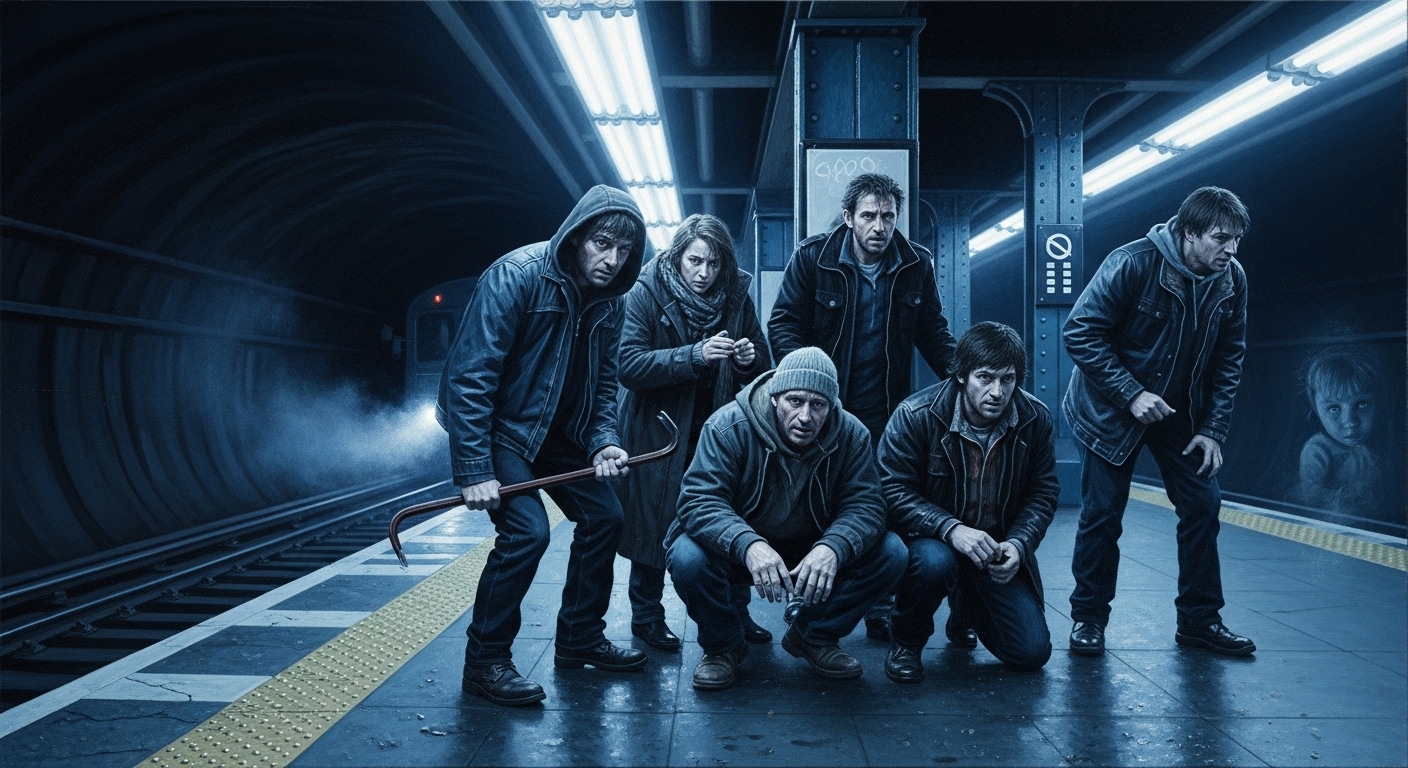
The train was gone. The platform stretched, a sterile, fluorescent expanse humming with the particular frequency of public spaces when the public has departed. Its echoes, once filled with the rhythmic clang of steel on steel, now offered only the distant thrum of the city’s deep, mechanical breathing. Somewhere above, the managed world continued its indifferent rotation. Somewhere below, the truth, Albright’s searing fire, still burned, a constant, unwanted companion in Adrian’s mind. They stood in a loose cluster, a small island of defiance in a tide of bureaucratic control, each face a map of the fear they could not articulate. Daryl’s jaw was a tight knot, his hand never far from the crowbar hidden beneath his jacket. Zeke, pale and trembling, clutched his dead phone like a talisman against unseen horrors. Ashley, whose void-touched eyes still held the afterimage of the child-thing that had ridden the train, stared into the black maw of the tunnel, a sentinel against a return that felt inevitable. Elaine, as always, found Adrian’s hand, her fingers a fragile anchor in a world that sought to unmoor them.
The Calculations of Desperation
“That wasn’t a victory,” Ashley’s voice, hollow as a forgotten well, cut through the quiet. “That was a postponement.” Her words hung in the recycled air, heavy and undeniable. The station’s automated voice, an antiseptic pronouncement from unseen speakers, crackled to life, listing the final departure times for trains that would carry them further into the city’s heart, or away from it. Forty-seven minutes north, fifty-two minutes south, and then the system would sleep. But they would not. They needed to get out, to find a place where the Consensus’s omnipresent gaze could not reach, a thin place where reality frayed at the edges. They had little: a few hundred dollars, a haphazard collection of tools, and Adrian’s dead phone, a symbol of their disconnection. Zeke’s phone remained off, a silent acknowledgment of the price of being a data point in a world that treated them as infection.
Daryl was the first to pace, his heavy boots scuffing the tiles, the crowbar tapping a nervous rhythm against his leg. “Steal a car. Obvious move. Something old, pre-computer. Hotwire it, drive north until north runs out.” He stopped, his gaze sweeping the empty platform, the unseen cameras that guarded every exit. “Problem is cameras. Every intersection, every traffic light, every goddamn ATM has a lens pointed at the street. We jack a vehicle, the plate gets flagged, and we’re lit up on every screen between here and Canada.” Zeke, ever the accountant, offered a thin, uncertain alternative. “We could switch plates. Find a parking garage, swap with something that won’t be reported stolen for days—” Daryl’s sharp, clipped question silenced him: “You know how to do that?” Silence answered. Neither of them did.
Ashley, still fixed on the dark tunnels, offered another path. “Walking is slow. But walking is quiet. Fifty miles over two days. Stay off main roads. Move at night.” Zeke’s accountant’s mind instantly began to calculate the impossible arithmetic. “Fifty miles. That’s—what—twenty-five miles a night? In the dark? Through terrain we don’t know? With Adrian bleeding and Elaine—” He stopped, a glance at Elaine’s fragile form ending the thought unspoken. “With Elaine what?” she asked, her voice soft, devoid of accusation, genuinely seeking the answer. “You’re not exactly dressed for hiking.” None of them were. The November night promised a cold, unforgiving march.
“Buses,” Zeke tried again, a desperate grasp at the mundane. “Cash fare. Anonymous. They run north, don’t they? Community transit, county systems—” Ashley’s hollow voice cut him off, a chilling echo of the system’s pervasive reach. “Cameras on buses too. And drivers. Drivers remember faces. Especially faces that board at midnight looking like—” She gestured at their desperate group: Adrian’s bloodstained jacket, Zeke’s fear, the palpable tension radiating from people running from an unnamable horror. “Like us,” Daryl finished, the words heavy with defeat. Elaine’s hand tightened in Adrian’s. The disparate suggestions, each with its own fatal flaw, dissolved into the oppressive silence. Adrian remembered Elaine’s murmurings from earlier, fragments about a thin place, a valley where coverage was patchy, where old agreements predated the management systems, where gaps existed in the gaps. Fifty miles north. Between here and there lay a city that wanted them gone, cameras on every corner, and whatever else the Major Response decided to deploy. He looked at his team, at their tired, frightened faces, and made a decision. “Bus,” he said. “As far north as it goes. We sit by the exit.”
The Monitored Passage North
The three blocks to the bus stop felt like a journey measured in unseen eyes. They moved in silence, ghosts among the city’s late-night residents, separated by an invisible membrane. People passed, unseeing, or pretending not to see, their faces a managed-world glaze that slid past without catching. The bus shelter, a fragile cage of plexiglass and aluminum, offered no real refuge. The schedule, bolted to the frame, declared the Route 512’s final departure for Lynnwood: 11:15 PM. Nineteen minutes to wait. Nineteen minutes spent watching every passing car, every pedestrian, every window in every building where a light still burned, where someone might be looking out, where looking might be happening. The stillness, the utter lack of overt threat, was somehow worse. It felt like the drawn-out breath before a blow, the calm before the storm that would inevitably break.
The bus arrived, a lumbering beast of steel and glass, its interior sparsely populated. A woman feigning sleep near the front. Two teenagers lost in the private world of shared earbuds in the back, oblivious to the terror that could so easily erupt around them. A man in work clothes, exhausted, his hands calloused from honest labor, his eyes closed. Adrian fed the crumpled bills into the machine, not bothering to wait for change. Daryl claimed the seat nearest the rear exit, Adrian beside him. Elaine and Zeke across the aisle, their faces drawn. Ashley stood, hand on a rail, her void-touched eyes sweeping both doors, a sentinel against an enemy that could manifest anywhere. The driver, a placid automaton of the managed world, did not look at them. The bus moved, its internal combustion a low growl against the city’s hum.
The city, a vast, glittering organism, slid past the windows of the bus. Towers gave way to mid-rises, then to strip malls, then to the particular commercial wasteland of car dealerships and self-storage facilities, their neon signs glowing against the night like promises no one believed anymore. Adrian watched it all, this accumulated infrastructure of a million lives lived in proximity, in density, in the particular arrangement humans called civilization. None of it belonged to him anymore. He had given that up in the chamber, in the burning, when he had said yes to something that could not be unsaid. The bus stopped at Northgate Transit Center. The teenagers exited. A new passenger boarded, an older man with a jacket too thin for the weather, a plastic bag clinking with unseen contents. He sat near the front, never glancing back. The bus moved on.
Elaine’s head tipped against the window, her eyes open but unseeing, lost in the fading fragments of the Library. “Water,” she murmured, her voice a thin thread. “Moving water. That’s what I keep—” She shook her head, the memories dissolving like smoke. “It’s like trying to remember a dream while you’re still dreaming it.” Adrian told her to rest, but she refused, her voice very small. “When I close my eyes, I see the Library. I see myself as I was. Part of it. A function. An index. I don’t know how to rest anymore. I forgot.” The bus stopped again, at Mountlake Terrace. The woman near the front woke, gathered her sparse belongings, and exited. No one boarded. The bus moved. The density of lights thinned further, the managed world’s grip loosening by increments. Suddenly, Ashley stiffened.
“Screen,” she said, her voice a hollow whisper. “Front of the bus.”
Above the driver, a small display showed route information, estimated arrivals, the usual bland data. Between the lines of text, for just a moment, a face. Child-sized. Smiling. Then it was gone, leaving only the ordinary operation of a transit system. “It’s reminding us,” Ashley said quietly. “That it can reach in. Anywhere there’s a screen. Anywhere there’s an image.” Adrian asked if it could do more than remind, but she offered no answer. The bus rattled on, carrying them north, toward a fragile, uncertain destination.
The Counting Man on the Road
Lynnwood Transit Center marked the end of the line. The driver’s monotone announcement brought them back to the mundane, the physical act of disembarking. The night air here was noticeably colder, a subtle shift in temperature that spoke of absence – the absence of urban heat, the presence of something else. The transit center was a functional, unadorned hub of waiting, with buses converging and departing towards destinations Adrian did not know. Zeke’s voice was tight, controlled, a testament to his sheer force of will. “Now what? We’re—what—fifteen miles north? That’s still thirty-five to go. And the buses stop running.” Adrian scanned the bays, his eyes catching on a route number he didn’t recognize. Route 417 – Arlington / Smokey Point. Arlington. That was further north. That was closer to the valley. “There,” he said. Zeke, ever the accountant, noted the change in systems, the invalidity of their transfers. “Cash works,” Adrian countered, already moving towards the bus.
The driver, a woman in her fifties, looked up from her phone as they approached. “Last run,” she announced, her voice weary but firm. “Leaves in eight minutes. Cash fare’s four dollars.” Twenty dollars for the five of them. Adrian paid. Her gaze was different from the previous driver’s managed-world glaze. She looked at them – at Adrian’s bloodstained jacket, at the fear and exhaustion etched on their faces. She saw them. “Long night?” she asked. “Yes,” Adrian replied, offering no more. She nodded, didn’t push, her eyes holding questions she chose not to ask. “Arlington’s forty minutes. Last stop’s the park-and-ride by the highway. After that, you’re on your own.”
The bus was empty save for them, five figures huddled in the back, near the exit, ready to move if moving became necessary. The highway opened ahead, transforming from the bustling I-5 into a more intimate corridor, a passage between the city and the non-city, between the managed and the margins. Daryl rested, his eyes closed, his hand never fully releasing the crowbar beneath his jacket. Zeke stared out the window, perhaps counting mile markers, finding solace in numbers even as those numbers described a worsening situation. Ashley stood at the rear door, watching, always watching. Elaine’s hand found Adrian’s. “The driver,” she whispered. “She saw us. Really saw us.” Adrian acknowledged it, contemplating the risk. “Maybe not. Some people see and don’t report. Some people have their own reasons for not trusting the systems.” He didn’t know if she was one of those, but he had to believe it. He operated on instinct now, on pattern recognition, on Albright’s fire illuminating paths he could not otherwise perceive.
The miles passed. The landscape softened. Suburbs gave way to something darker, quieter, a geography where streetlights were suggestions rather than requirements. Twenty minutes. Thirty. The bus stopped once at an empty park-and-ride outside Marysville. No one boarded, no one exited. The bus moved. Thirty-five minutes. The sign appeared in the headlights: ARLINGTON — 3 MILES. And then the bus slowed. Not for a stop, not for traffic. For something in the road. The driver braked. The bus shuddered, lurching to a halt. Through the windshield, illuminated by high beams that seemed suddenly inadequate, Adrian saw a figure. Standing in the center of the lane. Not child-sized. Adult. Male. Wearing what might be a uniform—dark fabric, official cut, the kind of clothing that suggested authority without specifying its nature. The driver opened her door, leaned out. “Hey! You can’t stand in the—”
“What the hell,” she breathed. “What the hell was that?”
The figure moved. Not walking. Not running. Moving—from the center of the road to the side of the bus in a space of time that defied distance, that suggested impossible speed or a fundamental misunderstanding of spatial reality. It stood outside their window now. Looking in. The face was bland. Forgettable. The kind of face that existed to be not-remembered, a placeholder for attention. But the eyes—the eyes were counting. Adrian felt the gaze moving from Daryl to Zeke to Ashley to Elaine to him. Cataloging. Assessing. Observing. The driver was shouting, Adrian couldn’t hear her over the frantic rhythm of his own pulse. The figure outside the window smiled. It was not a human smile. It was the shape of a smile, rendered by something that had studied smiles, indexed their configurations, understood their social function without understanding their human substrate. Then it stepped back. And was gone. Not walking away. Gone. The driver pulled her door closed, her hands shaking. She didn’t wait for an answer. The bus moved, faster now. Much faster.

Shelter, Inscription, and Fading Fragments
The driver didn’t announce the Arlington Park-and-Ride stop. She simply opened the doors and looked back at them with eyes that had seen something she could not file, categorize, or fit into any framework her life had provided. “This is as far as I go,” she said, her voice flat with residual shock. They nodded, exited into the empty lot, bathed in the pale cone of a single light that only made the surrounding darkness seem deeper, more absolute. The bus pulled away, its taillights dwindling to nothing. In the silence, Zeke’s voice was barely a whisper. “That thing in the road. That wasn’t the child.” “No,” Adrian confirmed. He didn’t know what it was, but Albright’s fire suspected: the Consensus had sent something to look. Not to stop them, not to intercept. Just to observe. To count them. To catalog them. To update the records of the infection moving through their system, the error that could not be corrected, the truth walking north through the thin places where their reach grew weak. They knew where they were now. They would keep knowing.
“We need to move,” Ashley said, her voice firm, pointing into the darkness. “The valley is east. The river. Whatever Elaine remembers about Piece Two—it’s that direction.” There were no streetlights that way. No lights at all. Adrian’s wound ached, a constant throb beneath his ribs, a reminder of the price of the fire he carried. He needed shelter, a moment of respite to tend to the physical decay that mirrored the unraveling of their reality. “Find shelter,” he instructed. “I’m wounded. Elaine’s weak.” Zeke’s face cycled through objection, consideration, acceptance. “Zeke and Ashley. Scout the perimeter. Somewhere to sleep. Somewhere without cameras. Somewhere that doesn’t ask questions.” Ashley nodded, her void-touched eyes scanning the darkness towards the river. “Give us twenty minutes.” The darkness swallowed them.
Adrian waited with Daryl and Elaine under the sparse shelter of the park-and-ride. The bench smelled faintly of old urine and older despair, a sediment of waiting. Daryl stood guard, crowbar loose in his grip, his shoulders taut with a tension that had become his new normal. Elaine sat beside Adrian, staring at her hands, delicate and pale in the meager light. “I remember something,” she said, her voice a secret shared with reluctance. “About water. The Library held records of… transactions. Agreements. The Consensus didn’t build everything from nothing. Sometimes they inherited. Something in the river. Something that made deals of its own, long before the wound opened.” She couldn’t elaborate, the fragment dissolving like smoke. She felt the others screaming in her mind, the voices of the unfiled, still trapped within the corrupted index she had once been.
Twenty-three minutes later, Ashley emerged from the darkness, Zeke slightly breathless behind her. “Two options,” Ashley reported, crouching to draw a rough map in the dirt. “Both have problems. First: motel. Quarter mile south. The Evergreen. Old place. Neon’s half-dead. One ancient camera above the office door, might not even work.” The problem? “It’s a motel. Registry. Payment. A human being who has to look at us and decide whether to rent us a room. We’re—memorable.” Daryl grunted. “Second option: Church. Half mile east. Toward the river. Lutheran, I think. Small. No cars. No lights. Side door looked… negotiable.” Breaking and entering. Or, if lucky, just entering. But it would be cold, with no beds, and if discovered, they’d be criminals. The shelter light flickered. A moth circled. Two options. The motel offered warmth, legitimacy, but the risk of being remembered. The church, cold and illegal, offered darkness and anonymity. Elaine’s hand tightened in Adrian’s. Zeke watched Adrian, waiting for a choice. “Motel,” Adrian decided. “This is becoming a tradition. Zeke, can you handle the counter for us?” Adrian explained that Zeke looked the most normal. Zeke, assessing his team’s disheveled state, conceded. “That’s not a high bar.”
The Evergreen Motel’s neon sign blinked, spelling only VACNCY. The building hunched against the night, doors the color of forgotten things. Adrian, Daryl, Ashley, and Elaine watched from the parking lot as Zeke walked towards the office light. Adrian saw the accountant assembling himself, constructing the performance of normalcy: shoulders relaxing, hands unclenching, face arranging itself into that of a tired traveler. Zeke entered. The door chimed, a small, weary sound. Adrian waited, the silence stretching. The office light flickered, a shadow passing between lamp and window. Four minutes. Zeke emerged, his face unreadable. He walked towards them without hurry, without slowing, the gait of someone carrying information they had not yet decided how to deliver. “Room nine,” he said. “Forty-two dollars. Cash. No ID.” Adrian asked about problems. “The clerk is—she didn’t ask questions. Didn’t look at my face. Didn’t look at anything. Just took the money and gave me the key. She wasn’t there, Adrian. Not really. She was a body behind a counter performing the motions of transaction. Like a recording.”
Room nine smelled of disinfectant and the ghost of cigarettes. Two beds. Carpet the color of exhaustion. Daryl checked the small space, performing the rituals of security in a space that had never known it. “Clear,” he announced, the word meaningless. Ashley drifted to the window, watching. Elaine sat on a bed, her fragile frame seeming to shrink in the shabby room. Adrian stood in the center, the wound in his side speaking now, its voice insistent in the temporary stillness. “Sit,” Elaine said, her voice carrying an unexpected edge. He obeyed. She knelt before him, her delicate hands reaching for his jacket. The shirt beneath was worse, the blood dried and bonded to the wound. Elaine sent Daryl for the first aid supplies. Gauze. Tape. Antiseptic. An insufficient arsenal against the horrors they faced. Elaine’s fingers found the hem of his shirt. “This will hurt.” Adrian knew. She peeled.

The wound was not what Adrian expected. Not a laceration. Not a puncture. Not the simple geometries of damage flesh understood. This was different. The edges were clean. Too clean. A line across his lower ribs, less injury, more inscription – as if something had written upon him in a language that used blood for ink and skin for paper. Elaine stared, her fingers hovering, not touching. “Adrian,” she breathed. “That’s not a cut. That’s not—” She stopped. Adrian remembered the Library, the extraction, the chaos. He didn’t remember the wound. Elaine’s hands trembled as she reached for the antiseptic. “I’m going to clean it. I don’t know if cleaning helps. I don’t know if anything helps with—whatever this is. But I’m going to try.” The antiseptic burned, a normal, comprehensible pain. But beneath it, something else: a warmth. Albright’s fire, the truth Adrian carried, responded to the wound’s exposure, to the attention. As if the injury and the memory were connected. “The wound is part of it,” Adrian said. “Part of what?” Elaine asked. “The price. The transaction. When I accepted Albright’s memory, something was—signed. On me. In me. This is the signature.” Silence. Daryl had stopped pretending not to watch. Zeke stood frozen by the door. Ashley, at the window, turned her head, her void-touched eyes fixed on the wound that was not only a wound. Elaine’s hands resumed their work. Gauze. Tape. The mechanical process of covering what could not be healed. “Then we don’t try to heal it,” she said quietly. “We just keep it clean. Keep it closed. Keep it—hidden.” “Yes.” The bandage settled into place. White over red. A flag of surrender against the body’s betrayal.
The River’s Wrongness and Ancient Agreements
Hours later, the room had achieved a temporary equilibrium. Daryl slept, twitching. Zeke sat by the desk, laptop glowing, searching for maps, for numbers that might offer comfort. Ashley remained at the window. Elaine lay beside Adrian, not sleeping but close enough for warmth. “The river,” she said, her voice barely disturbing the air. “I keep seeing it. Moving water. Dark water. Something beneath the surface, looking up. I think Piece Two is there. Or near there. Or—it’s where the river goes. Where it stops being river and becomes something else. Not the mouth. Deeper. Under.” She spoke of places where rivers went underground, sinkholes, caves, water finding gaps into forgotten places. Ashley spoke from the window. “She’s right. The network is thin here. But there’s something else. Something underneath. Something the thinness is—protecting. Or hiding. Something older. Something that was here first. That made its own arrangements before the wound, before the management, before any of it.” Adrian decided: they would rest a few hours. Then they would find the river.
Morning came, not with light, but with the faint dilution of darkness, birdsong the first declaration of a world that continued regardless of their ordeal. The room stirred. Daryl woke, noting Adrian’s sleepless vigil. Zeke, startled from a desk chair, began counting their remaining cash: two hundred and three dollars. Ashley simply resumed, her eyes opening without transition. Elaine, asked if she had slept, considered. “I stopped watching,” she said. “I don’t know if that’s the same thing.” Food became a necessity. Zeke mentioned a gas station, a half-mile south. Ashley noted the cameras, but the need for fuel outweighed the risk. Adrian turned to Elaine. “The river. How do we find it? The place you described. The underground.” She closed her eyes, reaching for fragments. “East,” she said finally. “Follow the water upstream. There’s a place where the river… bends. Where the current goes wrong. The surface says one thing but underneath—it says something else. That’s where the access is. Where the water goes down.” She couldn’t give a distance, only a feeling. Not helpful. Helpful enough.
“You guys stay here.” Adrian rose, his wound reminding him of its presence. “We need information, and food. I’ll go to the gas station. Ash, come with me. Daryl, keep them safe.” Daryl nodded, his hand finding the crowbar. Elaine’s eyes followed Adrian to the door, a silent acknowledgment of the danger. Ashley, noticing that Adrian’s gift of being Often Overlooked did not extend to her, decided to wait outside the gas station, scanning the road. Adrian walked into the gray morning, a ghost among the oblivious, his presence registering as absence. The gas station materialized, a shrine to roadside commerce. He entered, the chiming door a small protest against his intentional invisibility. Inside, the fluorescence was absolute, painting everything in a flat, artificial light. The clerk, a young man with a face unremarkable in its blandness, stared at a television playing news that was not news.
Adrian moved through the aisles, the gift of being Often Overlooked humming in his bones. He was texture, background, the kind of thing eyes slid past. He gathered protein bars, chips, plastic-wrapped sandwiches – enough for five, for a day or two. At the map rack, he found one for Snohomish County. His finger traced the Stillaguamish River’s blue line. Near a bend, upstream from town, small print caught his eye: LOST CREEK CAVE SYSTEM UNMAINTAINED — NO PUBLIC ACCESS. The cave system. The place where water went underground. He folded the map. At the counter, the clerk didn’t look up. Adrian cleared his throat, a small, deliberate sound. The clerk turned, his eyes widening with the confusion of someone realizing something had been present without being perceived. “Sorry,” he said. “Didn’t see you there.” Adrian paid. “You from around here?” the clerk asked, his voice hesitant. Adrian offered a noncommittal answer. “Passing through.” “Yeah.” The clerk glanced at the gray outside. “Lot of people passing through lately. More than usual. Started a few days ago. Something in the valley. I don’t know what. But the river’s been—wrong.” He stopped. Adrian prompted him. “The river’s been what?” The clerk’s voice dropped, conspiratorial. “My buddy fishes up near Lost Creek—used to fish, anyway. He says the water’s different now. Sounds different. Smells different. He says things come up at night. From the caves. Things that aren’t fish.” Adrian took his bag, the map. “Thanks for the warning.” “You take care out there. Whatever’s passing through—”. He didn’t finish. Adrian left.

Ashley waited where he’d left her, her face asking questions Adrian answered with the bag, the map, and a shake of his head that meant “later.” As they walked back to the motel, Ashley’s voice was low. “You found something.” “Lost Creek Cave System. Upstream. Unmaintained.” “That’s where the river goes.” “That’s where something comes out.” “After dark,” Adrian said, echoing the clerk. “That’s when the things come up.” “So we go during the day,” Ashley concluded. “So we go during the day.” The fire in Adrian’s mind stirred, Albright responding to the word “cave,” to the idea of descending, of entering the dark places where the surface world’s rules lost their grip. Or perhaps just burning, a constant reminder of its presence within him. The motel appeared ahead, its neon still reading VACNCY. The silence that had accompanied them along the river now held the weight of decision. They would go into the valley.
“No time like the present,” Adrian declared, folding the map. “We eat on the way.” The water of the Stillaguamish was the color of tea, its banks slick with moisture and roots. Daryl led, his body instinctively reading the terrain. Adrian walked second, the wound a constant, quiet voice. Ashley and Elaine followed, their breathing marking distance. Zeke brought up the rear, muttering numbers, finding comfort in their accumulation. The river moved beside them, a sound beneath sound, a frequency that registered not in the ears but in the spine, the base of the skull where old instincts nested. They ate protein bars, food for function, not pleasure, maintaining biological machinery that had to continue operating regardless of joy. Adrian chewed, swallowed, continued.
Then, the first wrong thing. A tree had fallen across the path, but not as trees should fall. Its roots pointed uphill, its crown down, reaching into the tea-dark current. It had fallen against its lean, as if reaching for the water, not obeying the physics of wind and gravity. They went around, no one speaking, no one naming the wrongness that watching them, the wrongness that had permeated the valley. Hours later, the river bent, but the water moved wrong. The current should accelerate at the outer edge, slow at the inner. Here, it moved in both directions, the surface flowing downstream, but beneath, something moved upstream, towards source, towards them. “Don’t look at the water,” Ashley’s hollow voice urged, sharp with urgency. “Because something in the water is looking back.” Adrian did not look. He felt it, though – vast, patient attention, turning to follow their passage like a flower to the sun, except this attention turned towards the fire he carried, towards the wound inscribed in his flesh. They walked faster.
Deep Within the Mouth
They stopped to rest, not by the water, but on a rock shelf overlooking the valley. Elaine, though she hadn’t complained, showed the cost of the journey, translucence to her skin. Adrian consulted the map. “Two miles. Maybe less.” Elaine’s next question wasn’t about distance. “And then?” Adrian had no answer. Albright’s fire flickered, responding to the proximity of something, a recognition of one old thing meeting another. “There’s something I should tell you,” Elaine whispered, her gaze on the tea-dark river below. “The agreements. The ones I mentioned. The things in the water and the things on the land. There were costs. For crossing between. For moving from one territory to another.” What kind of costs? “The agreements specified gifts,” she said finally. “Offerings. Things given freely, without expectation of return. The old things—they required acknowledgment. Recognition that their territory was being crossed.” Not possessions. Something intrinsic. Something that, once given, could not be taken back. Something that left the giver less than they were before the giving. The wind moved. The river flowed. Albright’s fire burned a little brighter, and Adrian understood: what waited in the caves beneath Lost Creek would ask something of them. And he would have to decide what he was willing to give.
“You guys okay?” Adrian asked, squeezing Elaine’s arm, then Ashley’s shoulder, looking at Daryl and Zeke. Elaine nodded, a lie. Ashley met his eyes. “I can continue.” Daryl spoke of load-bearing walls, structures failing when too much weight rested on one beam. Zeke’s honesty was startling. “I’m not okay. I haven’t been okay since the diner. But I can walk. I can carry things. I can count the ways we’re probably going to die and arrange them in order of likelihood. That’s what I’m good for. That’s what I can give.” Adrian gave them ten minutes. Ashley watched the water. “It knows we’re here. It’s been knowing. But now it’s—considering.” Adrian reached inward, probing Spinoza. *Old,* her voice came, small and cautious in his mind. *This was not made. This simply is. Has been. Will be.* It existed in categories Spinoza could not contain. He reached deeper, to Albright. The fire flared. *They were here when we arrived.* Albright showed images of dark, wrong water. *They had agreements. With the people who were here before us. The Consensus inherited them. The water was the domain of something that did not need to burn. Now you carry fire into water’s territory. Now you bring the wound’s residue into a place that predates the wound. They will want something. They always do.*
The path descended. The river grew louder, a roar beneath the murmur. Then, ahead, where the river bent again, the bank fell away, replaced by ancient stone. And in the stone, black against gray, a mouth. Not a cave entrance. A mouth. The opening too regular, too deliberate. The darkness inside too complete. Water flowed into the mouth. Water flowed out. The same water. Different directions. “Lost Creek,” Zeke breathed, his voice flat with horror. “That’s where the river goes.” Adrian knew it was where they must go. “Let’s go,” he said. He took point, Ashley, Zeke, and Elaine behind him, Daryl bringing the rear. The gift of being Often Overlooked settled around him. He stepped into the dark.

The cold was immediate, intentional, resenting the warmth he carried, finding the fire in his mind and pushing back. The darkness was absolute, not an absence of light, but a presence of something that swallowed photons. “I can’t see,” Zeke’s voice trembled behind him. “Neither can I,” Daryl admitted. “Follow my voice,” Adrian commanded, his own voice steadier than it should be. “Keep one hand on the wall. Keep moving.” The wall was wet, carved by water into shapes that felt wrong. The floor sloped downward, steeply. The sound of water grew, closer, ahead and behind, approaching and receding. Time lost meaning, dissolving sequence, before and after. Adrian felt Albright’s fire pushing back, asserting the reality of time against the pressure of neither-here-nor-now. “Adrian,” Ashley’s voice came, closer now, her hand finding his shoulder. “I feel it. The attention. It knows we’re here. But now it’s—considering.” The word arrived with weight. They had been tolerated. Now they were being assessed.
The chamber opened, not seen, but felt—the sudden absence of walls, the expansion of space, the shift in sound as echoes had distance to travel. The water was louder here, falling and rising simultaneously. Adrian stopped the team. In the darkness, something moved. Not sound. Not touch. But movement nonetheless—a displacement of presence, a rearrangement of attention. Adrian carried fire. The words arrived without sound, meaning bypassing his ears, going straight to comprehension. *You carry fire into water’s domain.* The cold intensified. *You smell of the wound. Of the burning. Of the arrangements made by those who came after.* Adrian’s fire pushed back, Albright’s defiance burning. *Why have you come?* The question settled into the chamber, expecting an answer.
The Price of Passage
“We need something that is in here,” Adrian said into the dark. “We have no desire to disturb, nor to stay longer than needed. I carry the fire because I have to, not because I wish to threaten you.” He reached for luck. The reaching was not conscious, not deliberate, but a fragment of his impossible fortune asserted itself against circumstances that should end him. He had been lucky, impossibly lucky. He spent a fragment of that luck, and it caught, allowing his words to land. The cold focused. *Five yields. Five fragments. Five small lessnesses to purchase one old thing.* The attention moved. It found Daryl first. A sound like breath being drawn from rather than into. A gasp. Daryl’s voice, when it came, had changed. “I can’t remember how to read blueprints. Twenty years. It’s gone.” The attention moved.
Zeke next. The same sound, the small violence of extraction. “Numbers.” His voice carried horror. “I can still count. I can still add. But the—the feeling of them. The way they fit together. I used to feel math. Now they’re just… numbers.” The attention moved. Ashley. The sound was wetter, closer to the paradox-water. Her voice, when she spoke, had lost something beneath its hollowness. “The memory of being seen. When Adrian first looked at me. It was the first warmth in thirteen years. The proof that I existed. I remember that it happened. But the feeling—”. She didn’t finish. The attention moved. Elaine. Her hand tightened in Adrian’s as the cold found her. Her body stiffened, a small sound escaping in fragments. “My sister’s name.” Her words arrived broken. “I had a sister. I remember having her. But her name—I can’t—I reach for it and there’s—there’s just—”. Silence. The space where a name should be. The attention moved.
Adrian. The cold found the fire. Albright flared, defensive, refusing to yield. But the cold was patient. The cold was older than the fire. It found what the fire did not protect. Not the burning. Not the truth. Something else. Something Adrian carried alone. The extraction began. It did not hurt. This was a thinning, a reduction, the particular sensation of becoming less dense. He felt it go. The capacity for joy. Not happiness. Not satisfaction. Joy. The pure thing. The uncomplicated eruption of gladness that arrived without reason. He remembered joy. He remembered the fact of it. But reaching for the feeling found only absence. It was done. The attention withdrew. Something landed in his hands—cold, wet, heavy, wrong. Piece Two. *Go.* The word was dismissal. *Return to the surface where your kind belong. Do not come back to this place. The cost of return would be—total.* The darkness thinned. Adrian saw them. Daryl’s confusion. Zeke’s horror. Ashley’s emptiness, deeper than before. Elaine’s grief, tears tracking down her delicate features. They had given. They had yielded. They had become less so Adrian could become more, so the formula could acquire its second piece. The fire burned in Adrian’s mind, but it did not warm him. Nothing would warm him now. Not fully. That capacity was gone. Given. Yielded. Cost.
The Weight of Absence
“Let’s go,” Adrian said, his voice flat. The return took less time than it should, the space contracting, urging them out. The darkness thinned, the walls pressed, the paradoxical water sounds receding until they became distant memories. They climbed, no one speaking. Piece Two, cold and wrong, rested in Adrian’s pocket, its weight a constant reminder of the cost. The mouth appeared. Gray light. Afternoon light. They emerged. The Stillaguamish Valley had not changed. This seemed wrong. The world should bear a scar, a wound marking what had happened in the dark. But the river flowed, now in one direction, downstream. The paradox had retreated. They walked, the eight miles passing in silence, until the neon of the Evergreen Motel once again spelled VACNCY.
The room still smelled of disinfectant and old cigarettes. Nothing had changed. Everything had. Daryl sat on the bed’s edge, staring at his hands, those construction worker’s hands that could no longer read blueprints. Adrian sat beside him, shoulder to shoulder. “Daryl, buddy. We’ll make it work. Promise. Hell, I’ll learn with you.” Daryl’s breath was ragged. “Twenty years of knowing what lines meant. And now I look at them and they’re just—lines.” Adrian squeezed his shoulder. “Lines can be learned. We’ll learn them together.” Daryl didn’t respond, but his hand found Adrian’s, held it for a moment, then released. Not acceptance. But something.
Zeke stood at the window, watching nothing, seeing numbers that no longer spoke to him. “Zeke,” Adrian called softly. Zeke turned, confusion on his face. “You always wanted to be a botanist.” Adrian reminded him of the old, drunken confession. “College. You almost switched majors. But the numbers made more sense. The numbers were safer.” Adrian met his gaze. “We’ll help you. Plants don’t need spreadsheets. They just need watching. Patience. The kind of attention that doesn’t calculate.” Zeke stared, a space for hope opening behind his eyes. “Okay,” he whispered.
Ashley had not moved from the corner chair, a shadow occupying a shadow. Adrian crouched before her, eye level. “Ashley.” Her void-touched eyes, emptier now, found him. “I’ll look at you. Remember you. Time and time again. Like every day was the first.” She shook her head. “You can’t replace what’s gone.” “No,” Adrian admitted. “But I can make new ones. Every day. Every time I see you. New moments of being seen. New warmth. It won’t be the first. But it will be real.” Her hand rose, cold fingers tracing his jawline. “Okay,” she said, her voice hollow, but still a word.
Elaine lay curled on the second bed, facing the wall. Adrian sat on the mattress edge, the movement shifting her slightly. “Elaine. After this all blows over.” A ghost of a laugh escaped her. “Let’s go find your sister. You and me. Together.” She turned, her face wet, eyes red. But something was there Adrian hadn’t seen before: hope. Terrible hope. “You’d do that?” “Yes.” “Even though I can’t remember her name? Even though I might find her and not—not know—” “She’ll know you,” Adrian said, offering certainty he didn’t feel. “And when she says her name, you’ll remember. You’ll hear it and it will come back. The way things come back. The way nothing is ever truly lost, only—yielded. Only given. Only paid as cost.” He didn’t say this last part. He held her instead. She let him.
Later, the motel room breathed with the sound of uneasy sleeping. Daryl, Zeke, Ashley, Elaine – all diminished, all present. Adrian did not sleep. Albright’s fire burned low in his mind, conserving itself. Piece Two, cold and wrong, rested in his pocket. Two pieces now. Three remained. The wound still bled. The formula was still incomplete. The Consensus still hunted. And somewhere in the dark, a child listened. Always listening. Adrian stared at the ceiling. It offered nothing. The nothing was, somehow, enough.
The Path Ahead: Absence and Atonement
They have paid. They have yielded. Five lives diminished, a fraction of themselves given to an ancient, indifferent power. Yet, two pieces of the formula are secured, one more rests within Adrian’s own mind, and Spinoza, the fifth and final piece, beats a silent rhythm against his chest. But the path ahead is no less perilous. The Consensus, now aware of their precise location and counting their numbers, will send not just managers, but enforcers. The abstract bureaucratic horror will soon take on the tangible form of badges and firearms. And the child-thing, that insidious manifestation of consequence, waits in the periphery, listening for the moments of weakness, for the echoes of lost joy. Adrian carries a heavy burden: not just the fire, not just the inscription, but the weight of his team’s sacrifices and the terrible knowledge that closing the wound might not bring salvation, but simply usher in a different kind of chaos, untracked and unbounded. What lies ahead is not just a search for truth, but a deeper exploration of what it means to be whole when pieces of oneself, and of those one loves, are forever gone.