The alley smelled of rust and rain-wet concrete, a sharp, metallic tang that clawed at the back of Adrian’s throat. He was sitting—when had he sat down?—back pressed against a dumpster that radiated an unnatural cold through his jacket, a chill that seeped into his bones and refused to be shaken. Against his chest, Spinoza pulsed, steady and warm, the only anchor in a body that didn’t feel entirely his anymore. Fine tremors ran through his hands, a nervous tic or something deeper, something cellular, a cellular echo of having been a conduit for a thousand minds before being abruptly, brutally, returned to the confines of just one. The wound in his side, a ragged line just above his lower ribs, throbbed with a slow, insistent rhythm, a private metronome counting down something he didn’t want to count. Blood, dark and sticky, had seeped through his shirt, clinging to his skin with a wet, adhesive chill that had nothing to do with the weather.
Three feet away, Daryl crouched, his work boots planted on the cracked asphalt. He hadn’t stopped watching Adrian since Adrian had stumbled out of… wherever he had been. Daryl’s jaw was set in that familiar, tight line, the one he got on job sites when load-bearing calculations were coming up wrong, when structural failures seemed imminent, when the cold, unforgiving math of whether something would hold began to unravel. His voice, when it came, was carefully level, construction-site calm.
“Adrian. That’s arterial. Or close to it. You need a hospital.”
At the mouth of the alley, Zeke stood, shoulders rigid, watching the street with the hypervigilance of someone who had just learned, irrevocably, that the world had teeth. His phone was clutched in his hand; he kept unlocking it, staring at the screen with frantic, unfocused eyes, then locking it again, as if the device itself might betray him.
“Maya’s not answering. Number’s disconnected.”
Zeke’s words hung in the damp air, thin and brittle. Ashley Chen stood apart, her back pressed flat against the opposite wall, her fingers touching her own wrist, seeking a pulse over and over, confirming she was real, confirming she was solid. The void-thing that had worn her face for thirteen years was gone now, leaving behind a woman who had died at eighteen and just experienced resurrection as a side effect of someone else’s desperate gambit. She met Adrian’s eyes, a flicker of something unreadable passing between them, but didn’t speak. And Elaine— Elaine Marston sat on the ground five feet to Adrian’s left, knees drawn to her chest, arms wrapped around them. She looked twenty-eight years old, though she had been threaded into the Library’s architecture in 1987. The math didn’t work. Her eyes, open but unfocused, stared at a point somewhere past the physical alley, past managed reality, into distances Adrian couldn’t measure.
“I can hear them still,”
she murmured, her voice a ghost of a whisper.
“The ones who didn’t make it out. The ones who fragmented during extraction. They’re… echoing. In the spaces where the Library used to be.”
She turned her head slowly, her gaze finding Adrian. Her eyes sharpened, locked onto him with a sudden, desperate intensity.
“Adrian.”
Just his name. But the way she said it—like he was the only fixed point in a universe that had just restructured itself around him. The morning light was gray and aggressively ordinary, the kind of mundane that felt like a mask stretched over something else, like the managed world reasserting itself with theatrical conviction after the wound Adrian had torn in its architecture. His phone—no, Daryl’s phone, he’d been carrying it—buzzed, a single notification chilling him more than the cold dumpster had. It was a message about Maya Chen: STATUS: UNKNOWN, Last known location: Miller’s Café. Time since last ping: 4 hours 23 minutes. The numbers seemed to scream their urgency against the silent dread of the alley.
A Fractured Retreat
“Move,” Adrian managed, the word coming out thinner than he’d like, reedy with the particular timbre of a body operating on reserves it shouldn’t be touching. “We need to move.” Daryl was already on his feet, construction worker instincts kicking in—the part of him that knew how to clear a site when the structural engineer started using words like *imminent* and *load failure*. He got an arm under Adrian’s, and the pressure against his wounded side sent white static crawling across Adrian’s vision, but he was upright, he was moving, and that was what mattered.
“My truck’s two blocks east,”
Daryl said, his voice clipped and efficient.
“Parking garage on Yesler.”
Zeke fell into step, his phone still clutched like a talisman. Ashley moved with the uncanny fluidity of someone relearning how legs worked, keeping her distance from the group, watching the rooflines, the windows, the spaces between buildings where shadows collected in ways that felt intentional. But Elaine didn’t move. She remained seated on the wet concrete, arms wrapped around her knees, staring at the place where the alley wall met the dumpster like she was reading text written in the grain of brick and rust.
“Elaine,”
Adrian said, and she flinched—a full-body tremor, the kind of startle response that belonged to prey animals, to things that had spent too long being hunted. Then her eyes found him, and something in them focused, latched on with desperate intensity.
“Adrian.”
She scrambled up, crossed the distance between them in three unsteady steps, her hand finding his arm—not to help him walk, just to touch, confirming he was solid, confirming he was real.
“Don’t leave me here. Please. The echoes are louder when you’re not close.”
Her fingers were cold. Her grip was too tight. But Adrian nodded, and something in her shoulders unknotted by a fraction.
The walk to Daryl’s truck was two blocks that felt like two miles. The morning light was gray and aggressively ordinary—aggressively ordinary, the kind of mundane that felt like a mask stretched over something else, like the managed world reasserting itself with theatrical conviction after the wound Adrian had torn in its architecture. People passed on the sidewalk: a woman with a stroller, a man in a suit checking his watch. None of them looked at the small procession—five people moving in tight formation, one of them bleeding through his jacket, one of them wearing a face that had died thirteen years ago, one of them murmuring fragments of conversations that had happened to people who no longer existed. The subtle hum of Often Overlooked vibrated in Adrian’s bones; they were background noise, furniture, the things people’s eyes slid past because their brains had already categorized them as irrelevant. The parking garage swallowed them in concrete shadow, a brief, suffocating respite.
Daryl’s truck was a Ford F-250, white with rust spreading from the wheel wells like an infection. The cab smelled like sawdust and old coffee. Adrian ended up in the back seat with Elaine pressed against his uninjured side, her hand still on his arm, while Ashley took the passenger seat and Zeke slid in beside him.
“Where?”
Daryl asked, key in ignition.
“Not my place,”
Adrian managed.
“Not yours either. Somewhere—”
“Anonymous,”
Zeke finished, already thinking like an accountant, about paper trails, audit exposure, the mathematics of visibility.
“Cash transaction. No credit cards, no ID scan. There’s a motel on Aurora. The Aurora Inn. Pay-by-the-hour type place. They won’t ask questions.”
Daryl nodded and pulled out. The drive took twelve minutes. Adrian spent them watching the city scroll past through windows that felt like screens, like he was watching a broadcast of reality rather than experiencing it directly. The blood loss was making everything soft at the edges. Spinoza pulsed against his chest—steady, warm, worried.
*You’re leaking,*
she said in his skull.
*The vessel is damaged.*
*I know.*
*Fix it. You can’t find the pieces if you’re dead.*
The Glitch in the Fabric
The Aurora Inn. Room 7 — Ground Floor, Back Corner. The room smelled of industrial disinfectant and the ghost of cigarette smoke that no amount of cleaning could fully exorcise. Water stains bloomed across the ceiling in patterns that almost formed shapes. The bedspread was the color of dried blood—probably intentional, probably practical for a place like this. Daryl dumped a pharmacy bag on the bed, having made a stop while Zeke handled check-in: gauze, medical tape, antiseptic, butterfly closures, a bottle of ibuprofen that wouldn’t do much but might do something.
“Shirt off,”
he said.
“Let me see it.”
Adrian peeled the fabric away from his side, and the sound it made—wet, adhesive, the particular unsticking of cloth from clotted wound—made Zeke turn away and Elaine’s grip on Adrian’s arm tighten. The wound was a ragged line across his lower ribs. Not deep enough to hit organs, but deep enough to matter. The edges were clean in some places, torn in others, like something had tried to cut him and something else had tried to bite.
“When did this happen?”
Daryl asked, his voice flat in the way it got when he was controlling something.
“I don’t know.”
And Adrian truly didn’t. Somewhere in the Library. Somewhere in the extraction. Somewhere in the space between being one mind and being a thousand. He didn’t remember getting it. Daryl’s jaw tightened, but he didn’t comment, just opened the antiseptic.
Daryl worked with the efficiency of someone who’d dealt with job site injuries—not gentle, but competent. The antiseptic burned in a way that felt almost clarifying, pain that belonged to the physical world, pain that followed rules Adrian understood. Daryl closed the worst of it with butterfly strips, layered gauze over the whole thing, taped it down with the kind of pressure that said *stay put*.
“This needs stitches,”
he said.
“Real ones. But it’ll hold for now if you don’t do anything stupid.”
A pause.
“Which you will, because you always do.”
The immediate threat of blood loss receded, the soft static at the edges of Adrian’s vision retreating slightly. He was still wounded, still operating below capacity, but he was no longer actively bleeding. Ashley stood at the window, peering through a gap in the curtains. Zeke sat on the other bed, laptop open, running searches on Maya Chen that kept coming back wrong—her social media accounts existed but hadn’t been updated in four hours, her workplace listed her as “on leave,” her phone number returned “not in service.” Elaine hadn’t let go of Adrian’s arm.
“The pieces,”
she said suddenly, and her voice had that distant quality again, like she was reading from a text that only she could see.
“I remember… fragments. The Library made me know things, but knowing isn’t the same as remembering, and now the knowing is fading and I can’t tell which memories are mine and which were… installed.”
She turned to look at Adrian, her eyes wet.
“Piece One. It’s in fire. Or about fire. Or… the pattern of fire? Something that burned. Something that’s still burning, in a way that doesn’t stop.”
She shook her head.
“I’m sorry. I’m sorry I can’t be clearer. I want to help, I want to be useful, but everything’s fragmenting and you’re the only thing that stays fixed—”
“Second motel in two days,” Adrian said, and the words came out with the gallows humor of someone who’d learned to laugh at the architecture of their own unraveling.
“We’re really living the dream.”
“The American dream. Bleeding in pay-by-the-hour rooms while reality eats itself.”
Zeke snorted—a short, sharp sound that was more exhaustion than amusement. Adrian pushed himself upright against the headboard, ignoring the pull of fresh bandages against wounded flesh, and took stock of his people. Daryl stood by the door, arms crossed, positioning himself between the room and whatever might come through it—not conscious strategy, just the bone-deep instinct of a man who builds things and understands, fundamentally, that anything built can be broken. His jaw hadn’t unclenched since the alley. Zeke sat cross-legged on the other bed, laptop balanced on his knees, numbers and searches scrolling across his face in pale blue light. He’d retreated into data the way some people retreated into prayer—looking for patterns that made sense, for information that behaved according to rules he understood. Ashley stood at the window, silhouetted against the gap in the curtains, and there was something wrong about her stillness, something that reminded Adrian she’d spent thirteen years as a void wearing a girl’s face. She was solid now—heartbeat, warmth, the weight of physical existence—but the habits of absence lingered in the way she held herself, the way she watched without blinking, the way light seemed to hesitate before touching her. Elaine sat on the edge of Adrian’s bed, close enough that her knee touched his thigh. She had the kind of beauty that looked like it might shatter if you held it wrong: fine-boned, porcelain-pale, with dark hair that fell past her shoulders in waves that hadn’t been properly cared for in thirty-seven years of threading. Her eyes were too large for her face, or perhaps her face had grown too thin for her eyes—the proportions of someone who had been worn, who had been used, who had served as architecture for something else’s purpose until the original structure showed through like bones beneath starving skin. She was beautiful the way old photographs were beautiful. The way abandoned buildings were beautiful. The way things that had survived past their intended expiration became beautiful through sheer stubborn persistence. Her hand still rested on Adrian’s arm. She hadn’t stopped touching him since the alley.
“Alright,”
Adrian said.
“Huddle. Let’s figure out what we know, what we don’t know, and what’s going to kill us if we don’t figure it out fast.”
Daryl pushed off from the door, dragged the room’s single chair closer, and dropped into it with the weight of someone who hadn’t really slept in days.
“I’ll start with what I know. Which is almost nothing.”
He ticked off fingers.
“We went into some kind of… library that exists outside reality. You—”
he pointed at Adrian,
“—became a radio for a thousand ghosts. She—”
he pointed at Elaine,
“—used to be part of the furniture. And now we’re hiding in a motel while your contact’s phone number doesn’t exist anymore.”
“Maya,”
Zeke said, not looking up from his laptop.
“Maya Chen. Worked at Miller’s Café for at least thirty-seven years without aging. Part of the same… template system… as Ashley and Elaine.”
He swallowed.
“Her social media went dark four hours ago. Not deleted—just stopped. Last post was a photo of a coffee cup. Caption was ‘The morning knows what the evening forgets.’ Then nothing.”
Ashley turned from the window. In the gray light filtering through the curtains, her face was unreadable.
“The network felt it,”
she said, her voice still strange, hollow in places, like sound traveling through empty rooms.
“When the Library fell. It was like… a scream that wasn’t sound. Every template connected to that system would have felt it.”
She paused.
“Maya was connected. If she’s gone dark, it’s because she’s either processing what happened, or…”
She didn’t finish the sentence. Elaine’s grip tightened on Adrian’s arm.
“I did that,”
she whispered.
“When Adrian freed me, when the Library collapsed—I didn’t think about what it would do to the others. To the ones still connected.”
Her voice broke, thin and fragile as her beauty.
“What if I hurt her? What if freeing me broke something in Maya?”
The room settled into uncomfortable silence.
The silence stretched. Something was wrong. Adrian felt it before he could name it—a wrongness that lived in the space between thought and recognition, the cognitive equivalent of a splinter buried too deep to see but impossible to ignore. His brain was running pattern-checks against data that didn’t quite align, and somewhere in the architecture of his memory, a seam was showing.
“Miller’s Café,”
he said slowly. Zeke looked up from his laptop.
“What?”
“You said Miller’s Café. Maya worked at Miller’s Café.”
“Yeah.”
Zeke frowned.
“The place on Pike. You met her there, right? Had the whole conversation about templates and—”
“Marge’s Diner.”
The words came from Ashley. She hadn’t moved from the window, but her voice had gone flat, affectless, the tone of someone reading an error code they didn’t understand.
“It was Marge’s Diner,”
she continued.
“I was on the roof. Watching. Three Gray inside, one at the back exit. Marge’s. Chrome and glass, midcentury aesthetic, the kind of place that looks like it’s been frozen in amber since 1957.”
She turned, and her eyes found Adrian’s with unsettling precision.
“I remember the sign. I remember the smell—coffee and griddle grease and something underneath, something wrong. It was Marge’s Diner, Adrian. I’m certain.”
Zeke’s fingers had stopped moving on the keyboard.
“I…”
He looked down at his screen, scrolled back through his notes, and his face did something complicated—confusion curdling into something colder, something that tasted like the first edge of fear.
“I have it written down. Miller’s Café. I wrote it down while we were driving, I remember typing it, I remember—”
He stopped. Stared at the screen.
“It says Marge’s Diner.”
The room temperature didn’t change. The light filtering through the curtains didn’t shift. Nothing in the physical environment altered by any measurable metric, and yet the air had become heavier, pregnant with a dread that settled into Adrian’s lungs like cold water, like the first breath after breaking the surface of something he should never have swum in. Daryl stood up. The chair scraped against carpet with a sound like tearing.
“What the fuck,”
he said, and it wasn’t a question, not really—it was the verbal equivalent of a man reaching for solid ground and finding nothing beneath his feet.
“What the fuck. I heard you say Miller’s. I heard it. Just now. Thirty seconds ago.”
“I remember saying it,”
Zeke whispered.
“I remember thinking it. Miller’s Café. Why would I think that? Why would that name be in my head if it was never—”
Elaine’s hand had gone rigid on Adrian’s arm, fingers digging in hard enough to bruise.
“The correction,”
she breathed.
“Oh god. Oh god. It’s not finished. It’s still happening. It’s still—”
She pressed her free hand against her temple, eyes squeezing shut.
“The Library held records. All the records. Continuity data, timeline architecture, the index of what-happened-and-when. When it collapsed, when everything came apart, the Consensus lost their primary reference system. They’re rebuilding. They’re rewriting. But they’re doing it live, doing it while we’re inside the narrative, and the seams—the seams are showing—”
She opened her eyes, wet with tears that seemed to have nothing to do with sadness.
“You’re remembering two versions,”
she said.
“The version that was, and the version they’re writing over it. Miller’s Café doesn’t exist. It never existed. But for a moment, for a fraction of a breath, it was more real than Marge’s Diner because someone—something—was trying to make it real, was editing the continuity in real-time, and your minds caught the overlap.”
Silence. Then Daryl, his voice rough:
“So they can just… change things? Change what happened? Change what we remember?”
“They always could.”
Elaine’s laugh was a broken thing, sharp-edged and wet.
“That’s what Continuity Branch does. But it used to be… surgical. Precise. They’d change a detail here, a record there, and no one would notice because the edits were clean. Now?”
She shook her head.
“Now they’re working without their index. Without their primary archive. They’re editing blind, and the errors—the gaps between what-was and what-they’re-making—those gaps are going to keep showing up. Keep bleeding through.”
Adrian looked at his own hands, at the bandages wrapped around his torso, at the room that smelled like disinfectant and old smoke.
“How do we know what’s real?”
he asked.
“If they can change things—if they’re changing things right now—how do we know any of this is what actually happened?”
Elaine met his eyes, and her delicate beauty seemed to crack along fault lines he hadn’t noticed before, revealing something underneath that was either stronger than he expected or more fragile than he feared.
“You don’t,”
she said simply.
“You can’t. That’s the point. That’s always been the point.”
Her grip on Adrian’s arm tightened, desperate, anchoring.
“But I remember you, Adrian. I remember you choosing to save me. That memory is mine—not installed, not edited, mine. And as long as I can hold onto that, as long as you stay fixed…”
She didn’t finish the sentence. She didn’t need to. Adrian had failed to keep his cool. He felt a shiver of wrongness, a premonition, the subtle tremor of a distant, unseen event already in motion.

Arming for a Fractured World
“Okay, okay, okay. We got this.” The words came out steadier than Adrian felt, a performance of control that his body didn’t quite believe—his hands wanted to shake, his pulse wanted to race, the animal part of his brain that had evolved to flee from predators was screaming that he was prey in a hunting ground whose boundaries he could not see, whose rules he did not understand, whose hunters were rewriting the very terrain beneath his feet even as he attempted to map it. But he’d learned something in the past three weeks. He’d learned that panic was a luxury, that terror was a resource to be managed rather than indulged, that the difference between survival and consumption often came down to the ability to function while your nervous system insisted that functioning was impossible.
“Marge’s Diner,”
Adrian said, and the name felt solid in his mouth, felt real in a way that Miller’s Café never did even though thirty seconds ago he would have sworn on everything he loved that Miller’s Café was the truth.
“That’s where we’re headed. Not right now, though. They’ll be expecting us. We need to prep.”
Daryl nodded—sharp, decisive, the nod of a man who had been given a task and understood tasks, who could build things and break things and operate in the comfortable architecture of doing rather than the vertiginous uncertainty of understanding.
“Prep. Good. What do we need?”
And here was where the tremor showed, where the crack in Adrian’s composure became visible to anyone paying attention: he hesitated. Just a fraction of a second, just a brief flicker of uncertainty that crossed his face like a shadow passing over water, but Elaine saw it—Elaine, whose hand hadn’t left his arm, whose delicate beauty had oriented itself toward him like a flower toward the sun, tracking his micro-expressions with the desperate attention of someone who had made him her only fixed point in a universe that kept shifting.
“Adrian?”
Her voice was soft. Careful. The voice of someone handling something fragile.
“What kind of prep?”
The motel room felt smaller than it had a moment ago. The water stains on the ceiling had shifted—Adrian was almost certain they’d shifted, that the pattern had been different when he first looked up, that the shape in the corner wasn’t quite so deliberate in its configuration, wasn’t quite so close to resembling something he didn’t want to name. The disinfectant smell had developed an undertone, something organic, something that reminded him of the hospital where his grandmother died, of the particular sweetness that lingered in rooms where bodies had begun the slow process of forgetting how to be bodies.
“We need information,”
Adrian said, and his voice was his again, controlled, managing.
“We’re going in blind. Maya might be compromised—might be hostile now, might not even be Maya anymore. The diner itself could be a trap. The Consensus knows we hit the Library; they’re going to be watching every node in the network, every template, every thread that connects to what we destroyed.”
He looked around the room, meeting each pair of eyes in turn.
“So. What do we know? What assets do we have? And what’s going to get us killed if we walk into Marge’s Diner without a plan?”
Zeke closed his laptop slowly, the click of the lid obscenely loud in the weighted silence.
“Assets,”
he said, and laughed—a thin, reedy sound, the laugh of an accountant being asked to audit the apocalypse.
“I have a laptop with an internet connection that I no longer trust. I have credit cards that leave paper trails. I have an accounting degree that is spectacularly useless against—”
he gestured vaguely, encompassing the room, the situation, the entire ontological nightmare they’d stumbled into,
“—whatever the fuck this is.”
“I have hands,”
Daryl said.
“Tools in my truck. I can build things, break things, hit things that need hitting.”
He flexed his fingers, studying them like he wasn’t entirely sure they belonged to him anymore.
“Not sure how much good that does against people who can edit reality.”
Ashley spoke without turning from the window, her voice carrying that hollow resonance, that sense of sound traveling through spaces that shouldn’t exist:
“I can feel them. The templates. The network. It’s… damaged now, fragmented, but I can still sense the connections. If we get close to Marge’s, I might be able to tell you what’s waiting inside before we walk through the door.”
And Elaine— Elaine’s grip on Adrian’s arm tightened, and when she spoke, her words came slowly, painfully, like she was pulling them from somewhere deep and wounded:
“I know things. Knew things. The Library made me an index, made me contain information I was never supposed to have access to. Most of it’s fragmenting now, dissolving like dreams after waking, but some of it…”
She closed her eyes.
“Some of it’s still there. Piece One. The fire that doesn’t stop burning. I can almost see it, Adrian. If I concentrate. If I have time.”
Her eyes opened, bloodshot, wet, the eyes of someone who had been crying without realizing it.
“But every time I reach for those memories, I hear them. The ones who didn’t make it out. The ones who fragmented during extraction. They’re in me now. Part of me. And they’re so hungry for someone to remember them—”
She stopped. Swallowed. Didn’t finish.
“Cash,” Adrian said. “Everyone. Pool it. What do we have?” The inventory began—pockets turned out, wallets opened, the small archaeology of what people carry when they don’t know they’re about to run for their lives. Daryl produced a worn leather billfold, thumbing through bills with the methodical attention of a man who tracked every dollar because dollars had always been hard to come by.
“Three-twenty. Payday was Friday. Haven’t had time to spend it on account of—”
he gestured vaguely at everything,
“—the ongoing apocalypse.”
Zeke checked his wallet, then his jacket pockets, then the small zippered compartment in his laptop bag that he’d forgotten about until this moment.
“One-eighty. Plus some change.”
He paused.
“I have cards, but—”
“No cards,”
Adrian and Daryl said simultaneously.
“Paper trail,”
Daryl added.
“They can track purchases. Right?”
Adrian nodded. He wasn’t sure if the Consensus operated through financial surveillance or something stranger, something that read the intention of transactions rather than their digital footprint, but the principle held: invisible was better than visible, and cash didn’t remember who spent it. Ashley turned from the window. Reached into the pocket of jeans that materialized around her when she became solid, jeans that Adrian was fairly certain didn’t exist three hours ago, that had assembled themselves from void-stuff and memory and the template’s fundamental need to appear normal. She produced a crumpled twenty.
“I don’t know where this came from,”
she said flatly.
“I don’t remember having pockets. I don’t remember having clothes. But it’s here, so.”
She tossed it onto the bed. Elaine just shook her head. Thirty-seven years as Library architecture didn’t come with a salary. Adrian checked his own pockets—Daryl’s phone, his own wallet, the familiar shape of Spinoza wrapped in silk against his chest. The wallet yielded two hundreds and a fifty, money he’d withdrawn last week for a business dinner that never happened because he saw a dead woman at a tech mixer and his life became something else entirely. Their total: $670.
“Hardware store,”
Adrian said.
“Hammers, crowbars, heavy flashlights. Duct tape, zip ties, anything that can be swung or used to restrain. We’re not going to find guns on short notice without paper trails, but we can find things that hurt.”
Daryl was already nodding.
“McLendon’s is twenty minutes north. Big place, cash registers run by teenagers who don’t give a shit. We can load up, pay cash, be out in half an hour.”
“That covers the basics,”
Zeke said slowly.
“But what about—”
He stopped. Started again.
“Look, I’m trying to think like an accountant here, trying to assess risk, and the risk I keep coming back to is: we’re going up against people who can edit reality. People who have been doing this for over a century. What does a hammer do against that?”
The question hung in the air, uncomfortable and unanswerable. Then Ashley spoke, her voice carrying that hollow quality again, that sense of words traveling through spaces that had never known light:
“It does enough. The templates—we—are still physical. Still embodied. Elaine bled when she was cut. I have a heartbeat now.”
She touched her wrist again, that compulsive pulse-check.
“Whatever they can do to reality, they still operate through it. Through bodies. Through buildings. Through the physical architecture of the world.”
A pause.
“A hammer to the skull still matters. Even to things that shouldn’t exist.”
McLendon Hardware. Aurora Avenue. The store was a cathedral of the practical, aisles stretching toward fluorescent infinities stocked with the raw materials of construction and destruction, of building and unbuilding, of all the ways that human hands had learned to shape the physical world. The smell was sawdust and metal and the particular chemical sweetness of fertilizer, and somewhere in the back, a table saw screamed through lumber with a sound like reality being cut to size. Adrian moved through the aisles with purpose. Daryl took point—he knew this terrain, knew the weight and balance of tools, knew which hammer would crack bone and which would just bruise, which crowbar had the leverage for prying and which was better suited for swinging. The cart filled: four claw hammers, 20-ounce heads, fiberglass handles that wouldn’t splinter on impact; two crowbars, 24-inch, the kind used for demolition; a heavy Maglite flashlight, the old-school aluminum model that doubled as a baton; box cutters, the industrial kind with replaceable blades; two rolls of duct tape; a 100-count bag of heavy gauge zip ties; four pairs of leather work gloves; a first aid kit, larger than the one from the pharmacy. The total came to $247.83. The teenager at the register didn’t look up from her phone as she scanned each item, didn’t notice or didn’t care that five people were buying an arsenal of improvised weapons with cash in the early afternoon of a Tuesday, didn’t register anything unusual about the woman with delicate beauty who kept touching the arm of the man with bloodstains still visible on his jacket if you knew where to look. They were out the door in twelve minutes.
The Shadow Vendor
They were loading the bags into Daryl’s truck bed when Adrian saw it. Across the street. A strip mall, the kind that bred in the spaces between real destinations—a nail salon, a vape shop, a place that claimed to buy gold. And at the end, tucked into the corner like an afterthought, a store with no sign. Just a window display of objects that didn’t quite belong together: a typewriter, a rotary phone, a pair of binoculars, a machete.
“Surplus store,”
Daryl said, following Adrian’s gaze.
“Military surplus, estate sales, the kind of place that sells whatever falls off the back of the truck.”
He paused.
“Also the kind of place that doesn’t ask questions about what you’re buying or why.”
“Is that legal?”
Zeke shifted uncomfortably.
“Legal enough. They’re not selling guns. Just… everything else.”
Daryl’s eyes hadn’t left the store.
“Tasers, maybe. Pepper spray. Knives that aren’t kitchen knives. The kind of shit that people who expect trouble carry.”
Adrian thought about the $422.17 remaining in their collective pockets. He thought about Marge’s Diner, and Maya Chen, and the Consensus mobilizing somewhere in the machinery of managed reality. He thought about walking into whatever was waiting with nothing but hardware store hammers and good intentions.
“Surplus store,”
Adrian said.
“But we keep two-fifty in reserve. Food, gas, emergencies. Whatever’s left after that is our budget.”
Daryl did the math without being asked—construction workers learned to calculate on the fly, to know exactly how much material they had and how far it needed to stretch.
“One-seventy, give or take. That’ll get us something.”
They crossed the street.
The store had no name because names were declarations of permanence, and this place—Adrian understood this the moment he pushed through the door, the moment the smell hit him, that particular olfactory signature of canvas and gun oil and the slow molecular decay of objects that had outlived their original purpose—this place existed in the spaces between permanence, in the margins where things went when they’d fallen out of one story and hadn’t yet found another. The bell above the door didn’t ring. It clicked. A dry, mechanical sound, like the cocking of a hammer, like the setting of a trap. Inside: aisles that didn’t quite run parallel, that seemed to bend toward each other at angles Adrian’s eyes didn’t want to accept. Shelves stacked with the archaeology of violence—gas masks from wars Adrian’s grandfather fought, canteens still stained with water that had evaporated decades ago, boots that had walked through jungles that had since been paved over and forgotten. A mannequin in the corner wore a flak jacket and no head, and Adrian found himself checking twice to make sure it wasn’t breathing.
The owner sat behind a glass counter filled with knives. He was old in a way that defied easy categorization—not elderly, not frail, but weathered, like wood that’s been left in salt air until the grain stood up in ridges Adrian could read like braille. His eyes were pale, the color of ice that had been frozen so long it had forgotten what water felt like, and when they settled on Adrian, they didn’t blink. Didn’t move. Just assessed, with the patient attention of someone who had learned to read threat profiles the way other people read newspapers.
“Help you,”
he said. Not a question. A statement. An acknowledgment that they’d entered his space and now must justify their presence.
“Looking for personal protection,”
Daryl said, stepping forward with the easy confidence of someone who spoke fluent hardware store, who understood the language of men who sold tools.
“Non-lethal if you’ve got it. Tasers, pepper spray, that kind of thing.”
The owner’s eyes moved from Daryl to Adrian. To the bloodstain on Adrian’s jacket that he’d forgotten about, that had been there so long it had become part of his silhouette. To the way Elaine stood too close to Adrian, her hand not quite touching his arm but wanting to. To Ashley, who had positioned herself near the door with the unconscious strategy of someone who always knew where the exits were. To Zeke, who was pretending to examine a display of compass equipment with the desperate focus of a man who did not want to be perceived.
“Personal protection,”
the owner repeated. The words sounded different in his mouth, heavier, freighted with implications Adrian couldn’t quite parse.
“Five of you. One wounded. One—”
his eyes flicked to Elaine, lingered, narrowed almost imperceptibly,
“—new. And you want non-lethal.”
A pause.
“Optimistic.”
He didn’t move from his stool, but something in the air shifted, some tension Adrian hadn’t noticed until it began to ease. He reached beneath the counter—slowly, deliberately, the movements of a man who understood that sudden gestures in places like this could be misinterpreted fatally—and produced a cardboard box, unlabeled, taped shut with the kind of brown packing tape that belonged to decades past.
“Tasers,”
he said, setting it on the glass.
“Civilian grade. Three hundred thousand volts, which sounds impressive until you understand voltage isn’t what drops a man. Amperage is. These’ll hurt, make muscles lock up, buy you maybe five seconds.”
He tapped the box.
“Forty each. I’ve got four.”
Another reach beneath the counter. Another box.
“Pepper spray. Police grade, not the watered-down shit they sell at gas stations. Oleoresin capsicum, two million Scoville. Hit someone in the face with this, they’re not seeing straight for twenty minutes.”
He set it beside the first box.
“Fifteen each. Six units.”
He paused. Studied them again with those ice-water eyes.
“You want my advice—which you don’t, nobody does, but I’m giving it anyway—you want something with reach. Something that keeps distance between you and whatever you’re protecting yourself from.”
He jerked his chin toward a rack on the wall, where objects hung in silhouette against pegboard.
“Batons. Extendable, twenty-one inches collapsed, thirty-six extended. Steel core. Thirty-five each.”
Adrian did the math. Four tasers at forty was one-sixty. Already over budget. But two tasers, three pepper sprays, two batons—
“One-fifty-five,”
Daryl murmured, running the same calculations.
“That’s our ceiling.”
The owner heard this. His expression didn’t change, but something in his posture shifted, some assessment being made and filed away.
“One-fifty-five,”
he repeated.
“For five people walking into something they’re not sure they’ll walk out of.”
He reached beneath the counter one more time. This time, what he produced was not in a box. It was wrapped in oilcloth, the kind of wrapping that belonged to objects that had been stored for long periods, objects that someone wanted to keep. He unfolded it slowly, revealing: a knife. Eight-inch blade, blackened steel, handle wrapped in cord that might once have been paracord but had been worn smooth by use, by the grip of hands that held it through circumstances Adrian didn’t want to imagine. It wasn’t pretty. It wasn’t tactical. It was the kind of knife that existed for one purpose only, and that purpose was not opening packages.
“This isn’t for sale,”
the owner said.
“It’s not in inventory. It doesn’t exist.”
He looked at Adrian. Not at Daryl, who spoke. Not at Ashley, who watched. Not at Elaine, who trembled. At Adrian.
“But I’m going to give it to you anyway. Because you’ve got the look.”
“What look?”
The question came out before Adrian could stop it. The owner’s smile was a thin thing, a crack in weathered wood.
“The look of someone who’s seen behind the curtain. Who knows the show isn’t what the audience thinks it is.”
He slid the knife across the counter, and the sound it made against the glass was like a whisper, like a secret being passed.
“I’ve seen that look before. Wore it myself, for a while. A long while ago, in a place that doesn’t exist on maps anymore.”
He tapped the counter twice.
“Two tasers, three pepper sprays, one baton, and the knife. One-fifty even. That’s my price. Take it or don’t.”
“Deal.”
Adrian reached for the knife, and the moment his fingers closed around the cord-wrapped handle, something happened—not visible, not audible, nothing that registered on the spectrum of ordinary sensation, but something, a click of connection, a key finding its lock, the particular resonance of an object that had been waiting for a hand and had now found one. The weight was wrong. Too light for its apparent mass, as if the blade existed only partially in the physical world, as if some portion of its substance occupied dimensions Adrian’s senses couldn’t map. Spinoza pulsed against his chest. Once. Sharp. A warning, or a recognition, or both. The owner watched him hold the knife, and his ice-water eyes carried something that might be satisfaction, might be sorrow, might be the particular expression of a man passing a burden to shoulders he hoped were strong enough to bear it.
“You’ll know when to use it,”
he said.
“Not before. The knowing comes with the moment.”
He didn’t explain what that meant. Adrian didn’t ask. The transaction completed in the mechanical rhythm of commerce—bills counted, items bagged, the ordinary liturgy of buying and selling that persisted even when the objects being exchanged carried weights that didn’t register on scales. Two tasers in black plastic housings, three canisters of pepper spray with safety tabs the color of arterial blood, one extendable baton that collapsed to a size that fit in a jacket pocket and extended to a length that could shatter bone. And the knife, wrapped again in its oilcloth, tucked into Adrian’s waistband where it pressed against the small of his back like a secret, like a promise, like something waiting to be born.
“Disguises,”
Adrian said, as Daryl gathered the bags.
“Bandanas, handkerchiefs, anything to cover faces. You have anything like that?”
The owner’s thin smile returned. He reached beneath the counter—that space seemed infinite, seemed to contain more than geometry should allow—and produced a bundle of fabric, olive drab and faded, military surplus from conflicts that had blurred together in the public memory until they were just war, undifferentiated, interchangeable.
“Shemaghs,”
he said.
“Desert scarves. Wrap them right, only your eyes show. Learned that from men who knew how to disappear.”
He tossed the bundle onto the counter.
“Five dollars for the lot. Call it professional courtesy.”
They paid. They left. The bell clicked behind them—that dry mechanical sound, like something being set, like something being armed—and they didn’t look back, because looking back in places like that sometimes meant seeing things that weren’t there when you were looking forward, things that only existed in peripheral vision, in the spaces between direct observation.
The Shimmering Diner & The Function
Pioneer Square. Adrian knew this neighborhood. He’d walked these streets before—three weeks ago, which might as well be three centuries, three geological epochs, three complete rewrites of the human story. The brick buildings with their iron facades, the underground tour signs pointing toward the hollow spaces beneath the city, the particular way that Seattle’s first neighborhood carried its history like a weight it couldn’t put down, like a memory it couldn’t stop remembering. He knew this place. And yet. Daryl drove in a slow circuit, following Adrian’s directions, turning where Adrian told him to turn, and the streets were wrong. Not dramatically wrong, not impossible wrong, but wrong in the way that a familiar face was wrong when you encountered it in an unexpected context—the proportions slightly off, the relationships between landmarks shifted by degrees too small to measure but too large to ignore. The pergola in the square was where it should be, but wasn’t there a hot dog cart beside it? Wasn’t there a busker on that corner, the one with the violin, the one who played the same three songs on an endless loop until the melody became part of the neighborhood’s ambient frequency?
“There,”
Ashley said suddenly, and her voice carried an edge that made everyone in the truck go still, that particular frequency of alarm that bypassed conscious processing and spoke directly to the animal brain.
“On the left. Between the antique store and the… the…”
She trailed off. Adrian looked. Between the antique store—HENDERSON’S CURIOSITIES, the sign read, gold leaf on green paint, the kind of sign that belonged to a business that had existed for decades—and something else, something his eyes refused to focus on, something that occupied space without declaring what that space contained, there was a gap. And in the gap: chrome. Glass. The suggestion of a counter, of stools, of the particular aesthetic of American optimism frozen in the amber of the 1950s.
“I can’t read the sign,”
Zeke said, his voice gone thin, reedy, the voice of a man confronting data that refused to resolve.
“I’m looking right at it and I can’t—the letters keep—”
“Marge’s Diner,”
Elaine whispered. Her grip on Adrian’s arm had become painful, her fingers digging into flesh with the desperate strength of someone holding onto the only solid thing in a world gone liquid.
“It’s Marge’s Diner. I can see it. But only when I’m not looking directly at it. Only in the—”
“Peripheral vision,”
Adrian finished.
“It’s in peripheral vision.”
The diner existed in the corner of his eye. When he turned to face it directly, the details blurred, smeared, became suggestions rather than declarations—there might be a door here, there might be windows there, there might be a sign above but the sign might say anything or nothing. But when he looked at the antique store instead, when he let Marge’s Diner occupy the margins of his perception, it snapped into focus with painful clarity: the chrome trim, the neon signs (unlit, dead, waiting), the plate glass windows that reflected nothing because there was nothing inside to reflect, or because what’s inside had learned not to cast reflections, had learned to exist without the burden of being perceived.
“That’s not normal,”
Daryl said, and the understatement was so vast, so cosmically inadequate, that for a moment Adrian wanted to laugh—the hysterical laughter of someone who had passed through fear into the territory beyond fear, the place where absurdity and horror became indistinguishable.
“No,”
Adrian agreed.
“It’s not.”

Five people in a vehicle built for three, and the air inside the cab had taken on the particular density of shared crisis, of bodies pressed too close together, of breath mingling with breath until Adrian wasn’t sure whose exhalation he was inhaling, whose fear he was tasting on the back of his tongue. Daryl behind the wheel. Ashley in the passenger seat, her preternatural stillness somehow taking up less space than it should, as if she’d learned to compress her physical presence into dimensions that didn’t crowd. Adrian in the back, flanked by Zeke on one side and Elaine on the other—Elaine, whose thigh pressed against his, whose hand had found his arm again, whose delicate beauty seemed to sharpen in the confined space until Adrian was aware of every angle of her cheekbones, every shadow in the hollows beneath her eyes. The gear spread across laps and footwells, a small arsenal of improvised violence.
“Distribution,”
Adrian said.
“Daryl—you’re point. Crowbar, baton, taser. You know how to swing, you know how to hit. If something comes at us, you’re the first line.”
Daryl accepted the items without ceremony, tested the weight of the crowbar, extended and collapsed the baton twice to feel the mechanism. His hands moved with the confidence of someone who understood tools, who trusted the physics of force and leverage and the predictable ways that objects interact with bodies.
“Ashley.”
Adrian turned to face her, and her void-touched eyes met his with an intensity that made his skin prickle.
“Second heavy. Taser, hammer. You can sense them coming—you’re our early warning. But if something gets past Daryl, you put it down.”
She took the taser, examined it with detached curiosity, like an anthropologist studying an artifact from a culture she’d only read about. The hammer she held differently—familiar, weighted, the grip of someone who had perhaps held weapons before, in the thirteen years of not-quite-existence, in the spaces between life and void.
“I remember how to hurt things,”
she said quietly.
“I don’t remember learning. But I remember knowing.”
Adrian didn’t ask her to elaborate.
“Zeke, me—pepper spray, hammers, box cutters.”
He handed Zeke the canister, watched him fumble with the safety tab, watched the accountant’s hands try to learn the grammar of violence.
“We’re not fighters. We’re not supposed to be. But if everything goes wrong, blind them, hit them, get clear. In that order.”
Zeke nodded, jaw tight, the spray clutched in his fist like a talisman.
“Elaine.”
She looked up at Adrian, and the vulnerability in her expression was almost unbearable—the rawness of someone who had been used for thirty-seven years, who had been architecture rather than architect, who was only now learning what it meant to have a body that belonged to her, that she must protect, that could be damaged in ways that mattered.
“Pepper spray,”
Adrian said, pressing the canister into her palm, curling her fingers around it.
“And this.”
He gave her one of the hammers—the lightest one, the one Daryl had selected with a grunt of mild disdain because its balance was “off” in ways that mattered to someone who knew how to swing. But for Elaine, who had never swung anything, whose hands had spent nearly four decades turning pages that existed only in conceptual space, the lighter weight was a mercy.
“I don’t know if I can,”
she whispered.
“You don’t have to know. You just have to try.”
Adrian held her gaze, and something passed between them—not words, not quite understanding, but something adjacent to both, something that acknowledged the impossible situation and refused to be defeated by it.
“Stay close to me. Whatever happens, stay close. I’ll keep you safe.”
The words sounded like a promise he wasn’t sure he could keep. They sounded like a promise anyway. The knife stayed with Adrian, pressed against the small of his back, its weight a constant reminder of the surplus store owner’s words: *You’ll know when to use it. Not before.* The shemaghs distributed quickly—olive drab fabric wrapped around necks, ready to be pulled up over mouths and noses, transforming faces into abstractions, into anonymity, into the kind of non-identity that surveillance systems struggled to parse. Adrian checked Daryl’s phone again. The Pattern App now read: TEMPLATE NETWORK: UNSTABLE. SYNCHRONIZATION FAILURE: 52 nodes (↑5). MAYA CHEN: LAST PING 6h 14m AGO.
“Stakeout,” Adrian said, and the word tasted like cop shows, like procedural dramas, like the comfortable fiction of surveillance conducted by professionals with badges and backup and the full institutional weight of a system designed to protect them. None of which applied here. None of which had ever applied here.
“We find the diner, park nearby, take shifts watching. And we swap clothes.”
“Swap clothes?”
Daryl’s eyes found Adrian’s in the rearview mirror.
“They’re looking for five people dressed a particular way. Body shapes, silhouettes, the visual signature of us. If we rotate who’s wearing what, if the guy in the blue jacket becomes the guy in the gray hoodie becomes the guy in the flannel—”
Adrian gestured vaguely, encompassing the principle without fully articulating it.
“It’s not perfect. But it’s friction. It’s noise in the signal.”
“Counterintelligence,”
Zeke murmured, and there was something almost like admiration in his voice, the accountant recognizing a form of creative bookkeeping he’d never considered.
“Obfuscation through variable presentation.”
“Sure. That.”
Ashley turned in the passenger seat, her void-touched eyes finding Adrian’s with that unblinking intensity that made his hindbrain want to flee.
“And then?”
“Nine o’clock. Early nighttime. Enough dark to move, not so late that whatever’s in there has had time to… settle in.”
Adrian didn’t know what he meant by that. The words came out anyway, shaped by instinct, by the pattern-recognition that had kept him alive this long, that saw connections his conscious mind hadn’t yet mapped.
“We go in together. We find Maya. We get answers.”
Or we find what’s left of her, something whispered in the back of his skull, in the space where Spinoza’s voice sometimes lived, except this voice wasn’t Spinoza, wasn’t anyone, was just the quiet arithmetic of probability that his brain ran without permission, calculating odds he didn’t want to know. He ignored it.
“First,”
he said,
“we find the diner.”
The parking structure across from the square gave them a sight line to the gap where Marge’s Diner existed, or didn’t exist, or existed conditionally, in states of quantum uncertainty that their physics-bound minds were never designed to process. They parked in a corner spot, engine off, windows cracked enough to circulate air without making them conspicuous—just another truck in a parking garage, just another vehicle waiting for its owner to return from whatever business brought people to Pioneer Square on a Tuesday afternoon. The clothes swap happened in the confined space of the cab, awkward and intimate, elbows colliding, apologies muttered, the surreal domesticity of trading jackets and hoodies while a reality-damaged diner shimmered in their peripheral vision. Daryl’s flannel went to Zeke, who swam in it. Zeke’s gray hoodie went to Adrian, carrying the faint scent of his cologne, something expensive and subtle that belonged to a life that no longer existed. Adrian’s bloodstained jacket went into the footwell, too marked to wear, too valuable to discard—evidence, maybe, of something, though he was no longer sure evidence meant anything in a world where the Consensus could edit what happened and what didn’t.
“First watch,”
Adrian said.
“Daryl and me. Two hours. Then Ashley and Zeke. Then—”
“I’ll watch alone,”
Elaine said quietly.
“At the end. Before we go in.”
Adrian started to protest—she shouldn’t be alone, she was fragile, she was still fragmenting—but something in her expression stopped him, some determination that lived beneath her delicate beauty, some steel that thirty-seven years of threading couldn’t entirely dissolve.
“I need to try,”
she said.
“To remember. The pieces. The fire that doesn’t stop burning. If I concentrate, if I have silence, I might be able to pull it from the fragments.”
Her eyes met Adrian’s, wet but steady.
“You saved me, Adrian. Let me try to be useful. Let me try to be more than just… weight you’re carrying.”
Adrian didn’t have an answer for that. He nodded.
The first two hours passed in the particular purgatory of surveillance—time stretched thin, attention fraying at the edges, the human brain rebelling against the task of watching nothing happen while expecting something to happen at any moment. Daryl sat behind the wheel, eyes fixed on the diner-that-isn’t, his jaw working in slow rhythms as he processed thoughts he didn’t share. Adrian sat beside him, Spinoza warm against his chest, the surplus store knife a constant pressure against the small of his back. The diner didn’t move. People passed in front of it—tourists with cameras, locals with purpose, the ordinary traffic of urban afternoon—and none of them looked at it. None of them seemed to notice the gap in the street, the space where architecture should exist but doesn’t, the wound in the world’s façade. They walked past as if the diner was invisible, as if their perceptions had been edited to exclude it, as if seeing Marge’s Diner required a form of vision they no longer possessed. Or never did, Spinoza murmured. The managed world manages what people see. What they remember. What they believe exists. For them, that space is empty. Has always been empty. Will always have been empty.
“Anything?”
Daryl asked, around the ninety-minute mark.
“Nothing. No one going in. No one coming out.”
Adrian paused, watching a woman with a stroller pass directly in front of the diner’s windows without glancing at them, without registering their existence.
“Do you see anyone inside? Through the windows?”
Daryl squinted, tried to look directly, cursed softly when the details blurred. He shifted his gaze to Henderson’s Curiosities instead, let Marge’s Diner occupy his peripheral vision.
“Shapes,”
he said finally.
“Maybe. In the back. But I can’t tell if they’re people or just… furniture. Shadows. The kind of dark that lives in places that don’t get enough light.”
He rubbed his eyes.
“This is giving me a headache. Looking without looking. It’s not how eyes are supposed to work.”
“No. It’s not.”
At 5:30, something changed. The lights came on. Not all of them—not the exterior neon, which remained dead, remained dormant, remained waiting for a night that may or may not come. But inside the diner, in the space Adrian could only see when he wasn’t looking, a glow began. Warm. Yellow. The particular frequency of incandescent bulbs, of filaments heating until they emitted photons in the spectrum that human eyes associated with safety, with home, with the comforting lie that light kept the darkness at bay. The diner was opening. Or the diner was waking up. Or the diner had been open this whole time and they simply couldn’t see it until now, until this moment, until whatever conditions governed its visibility aligned in configurations Adrian didn’t understand.
“Shift change,”
Adrian said, tapping Daryl’s arm.
“Get Ashley and Zeke.”
Adrian retreated to the truck’s back seat, trading positions with Ashley, who took the passenger seat with the fluid grace of someone who no longer had to think about how bodies worked because her body—her new body, her solid body, her body with a heartbeat—moved according to principles that predated conscious thought, that remembered motion even when the mind that should direct it spent thirteen years forgetting what motion felt like. Zeke sat behind the wheel, laptop open, running searches that returned results he didn’t trust—information about Marge’s Diner that contradicted itself, Yelp reviews that mentioned a restaurant at this address interspersed with reviews that claimed the address didn’t exist, a Google Street View image that showed the antique store and the gap-that-isn’t-a-gap and nothing between them.
“The internet can’t decide if it’s real,”
he muttered.
“Some databases say yes, some say no. Like the records are fighting with each other.”
“The Library’s collapse,”
Elaine said from beside Adrian. She’d been drifting in and out of something that might be sleep or might be something else, some state of consciousness that existed between waking and dreaming where the fragments of her installed knowledge became temporarily accessible.
“The Continuity Branch used the Library to maintain the index. To keep track of what exists, what doesn’t, what should be remembered and what should be forgotten. Without it, they’re rebuilding from backups. From partial records. The inconsistencies you’re seeing are version conflicts. Different backups disagreeing about what reality contains.”
“That’s insane,”
Zeke said.
“Yes.”
Elaine’s voice was calm, the calm of someone stating obvious facts.
“That’s what this is. That’s what all of this has always been. Insanity maintained through bureaucratic process. Horror administered through filing systems. The wound opened in 1887 and everything since then has been the managed response to that wound, the institutional framework for containing something that cannot be contained, only… postponed. Delayed. Edited around.”
She laughed, soft and broken.
“I was part of that system for thirty-seven years. I was a filing system. And now I’m outside it, and I can see how insane it always was, how fragile, how held-together-with-string-and-prayers—”
She stopped. Her hand found Adrian’s in the space between seats, and her fingers were cold, trembling.
“Sorry,”
she whispered.
“Sometimes the knowing overwhelms the remembering. Sometimes I can’t tell which thoughts are mine.”
Adrian squeezed her hand. He didn’t have words. Words seemed inadequate, seemed like trying to bandage a wound with tissue paper, like trying to hold back an ocean with a fence. But he squeezed her hand, and her fingers tightened around his, and for a moment—just a moment—something like stillness settled over her features, something like peace.
She insisted. Elaine sat in the passenger seat, alone in the truck, the shemagh draped around her shoulders like a shawl, her dark hair falling forward to obscure her face as she stared at the diner through peripheral vision, through the corner of her eye, through the particular angle of perception that let Marge’s Diner be seen by minds that knew how to look without looking. The rest of them waited outside, clustered in the stairwell of the parking structure, close enough to intervene if something went wrong, far enough to give her the silence she requested. The evening had turned cold, Seattle’s marine air carrying the promise of rain, the sky above the city taking on the gray-purple bruise of approaching night. They watched the daylight fade. They watched the shadows lengthen. They watched the ordinary citizens of a managed world go about their managed lives, walking past a diner that didn’t exist for them, ignoring a wound in reality that they’d been edited to unsee. At 8:47, Elaine appeared in the stairwell. Her face was pale—paler than before, if that was possible, the bloodlessness of someone who had been somewhere cold, somewhere that drained warmth from flesh the way black holes drained light from space. Her eyes were red-rimmed, wet, carrying the residue of tears that had already fallen and dried and left their salt tracks on her cheeks. But she was smiling. Smiling with the particular expression of someone who had found something they were looking for, something they weren’t sure they’d ever find, something that made the cost of searching—whatever that cost was—feel justified, feel survivable, feel like a price worth paying.
“I remember,”
she said, and her voice was hoarse but steady, rough but certain.
“Piece One. The fire that doesn’t stop burning.”
She looked at Adrian, and her fragile beauty had shifted somehow, had developed new facets, new angles—the beauty of something that had broken and been reassembled, the beauty of kintsugi, of gold poured into cracks to make them part of the design rather than flaws to be hidden.
“The Great Seattle Fire,”
she said.
“1889. It burned twenty-five blocks in twelve hours. But there was a building that didn’t burn. A building that couldn’t burn, because what was inside it needed to survive. The Consensus wrote it out of the records, edited it from the maps, erased it from memory—but I was the Library, Adrian. I was the records. And now that the records are fragmenting, I can see what was hidden between them.”
She took a breath.
“The building is still there. Underground. In the spaces beneath Pioneer Square, in the tunnels they sealed off, in the dark that the city was built on top of because building on top of darkness is easier than building through it.”
Her eyes met Adrian’s, and they were bright with something that might be hope, might be terror, might be both—the particular emotion that existed when you’ve found what you’re looking for and realized that finding it means facing it.
“Piece One is in the underground. In the building that didn’t burn. In a fire that’s still burning, 137 years later, because the fire isn’t fire—the fire is the first seal, the first lock, the first barrier that someone built to keep something in.”
She reached out, took Adrian’s hands in hers, and her fingers were still cold but her grip was strong, certain, the grip of someone who had chosen a direction and would not be turned from it.
“Marge’s Diner is above it. One of the entrances. Maya guarded the entrance for decades—that was her function, her purpose. Observation and Assessment. Watching to make sure no one went down. Watching to make sure nothing came up.”
She squeezed Adrian’s hands.
“That’s why she’s gone dark, Adrian. Either she’s been recalled because the Consensus doesn’t trust her anymore… or something from below has already gotten to her.”
Truth in the Burning
The walk from the parking structure to Marge’s Diner took ninety seconds and lasted approximately forever. The square had emptied with nightfall—the tourists retreated to hotels, the locals dispersed to apartments and bars and the thousand small containers that urban life provided for the storage of human bodies during the hours when the sun cannot watch over them. Streetlamps cast pools of orange light that seemed somehow insufficient, somehow thinner than light should be, as if the photons themselves were reluctant to touch the cobblestones, reluctant to illuminate what might be standing in the spaces between illumination. Their footsteps echoed. Five sets of footsteps, and the echo returned wrong—not the clean acoustic reflection of sound bouncing off brick and glass, but something muddier, something that suggested the sound was traveling further than it should, was descending into spaces beneath the street, was being heard by ears that had been listening in the dark for a very, very long time. The diner grew in Adrian’s peripheral vision. He’d learned the trick now, the cognitive sleight-of-hand required to perceive it: he looked at Henderson’s Curiosities, at the darkened windows displaying porcelain dolls and vintage typewriters and a taxidermied owl whose glass eyes caught the streetlight with uncomfortable accuracy, and he let Marge’s Diner exist in the corner of his eye, in the margin of his perception, in the space where consciousness met the unconscious and negotiated the terms of what would be acknowledged as real. It was larger than he expected. The chrome trim extended further than a normal diner should extend, the plate glass windows multiplying as he approached until there were too many of them, until the façade contained more windows than the interior could possibly accommodate, each one reflecting the streetlamps in configurations that didn’t quite match, that showed the square from angles that shouldn’t exist, that revealed versions of Pioneer Square where the shadows fell differently, where the streetlamps burned in colors the visible spectrum didn’t include. The door was red. Adrian noticed this with the particular clarity that fear brought to perception, the way terror sharpened details until they became indelible, until they etched themselves into memory with the permanence of trauma: the door was red, the red of arterial blood, the red of warning signs, the red that evolution had taught the human eye to notice because things that are red are often things that can kill you. There was no sign on the door. There was no sign above the door. There was, he realized as he drew closer, no sign anywhere on the building’s exterior—just the chrome and glass and the warm yellow light spilling from windows that reflected things that aren’t there, and he understood now why Zeke couldn’t read the sign, why the letters kept shifting: there was no sign, there never was a sign, the name “Marge’s Diner” existed only in the memories of people who had been told that’s what this place was called, who had had the name installed in their consciousness the way Elaine had the Library’s contents installed in hers, and the installation didn’t take properly, didn’t stick, kept sliding off the surface of reality like water off oil.
“Adrian.”
Ashley’s voice, low and urgent, carrying that hollow resonance that made his teeth ache.
“Something’s wrong.”
“I know.”
“No. Something’s wrong.”
Her hand closed on Adrian’s arm, and her grip was stronger than it should be, carrying the desperate strength of someone trying to anchor themselves against a current that wanted to sweep them away.
“The network. I can feel it. The templates. They’re—”
She stopped. Swallowed. When she spoke again, her voice had dropped to barely a whisper.
“They’re watching. All of them. Every template in the city. They’ve turned their attention here. To this spot. To us.”
Adrian looked at the red door. The red door did not look back, because doors don’t have eyes, doors don’t have awareness, doors are just barriers between one space and another, except this door—this door waited, this door anticipated, this door had been waiting for someone to open it for a very long time and the waiting had given it something that isn’t patience, that isn’t consciousness, but exists in the space between those concepts, in the gap where definitions break down and categories lose their meaning.
“Formation,”
Adrian said.
“Daryl—with me.”
Daryl stepped up beside him, crowbar held low, his breathing controlled in the way of someone who had deliberately chosen not to panic because panic was a luxury and luxuries are for people who can afford them. His eyes were fixed on the door, and Adrian could see him struggling with the same perceptual challenge he’d mastered, trying to look at it directly, trying to force his vision to acknowledge what his peripheral sight insisted was there.
“I can’t see the handle,”
he muttered.
“There’s a handle, right? There has to be a handle.”
“There’s a handle.”
“Where?”
Adrian reached out. His hand found metal—cold, colder than it should be on a mild Seattle evening, cold in the way that things are cold when they’ve been stored in places where heat cannot reach, where warmth is a memory rather than a physical property. The handle was brass, or something that wanted him to believe it was brass, and the moment his fingers closed around it, he felt something else close around him—attention, vast and patient and terribly, terribly interested. *They know you’re here,* Spinoza murmured, and her voice carried harmonics Adrian had never heard before, frequencies of fear and warning and something that might be resignation. *They’ve known since you entered the square. The diner told them. The diner tells them everything.*
“Then let’s not keep them waiting.”
Adrian pushed the door open.
The smell hit him first. Coffee. Old coffee, the kind that had been sitting on a burner for hours past its expiration, developing that burnt-caramel undertone of proteins breaking down, of organic matter surrendering to entropy. Beneath it: griddle grease, the carbonized residue of a thousand hamburgers cooked and served and consumed by mouths that may or may not have been attached to bodies that may or may not have been human. And beneath that, so faint Adrian almost missed it, so subtle it might be imagination: smoke. Char. The memory of fire. The diner was larger on the inside. This shouldn’t surprise Adrian—he’d been through dimensional bleeds, he’d walked in spaces that didn’t obey Euclidean geometry, he’d learned that the relationship between exterior and interior was a suggestion rather than a law—but it did surprise him, because the wrongness here was different, was more insidious, was the kind of wrongness that pretended to be rightness, that wore normalcy like a mask while the face beneath the mask grinned with too many teeth. The counter stretched toward a vanishing point that shouldn’t exist, chrome stools extending in a line that Adrian’s eyes wanted to follow until he realized that following it would mean never looking away, would mean tracing that line into distances where distance lost meaning. The booths along the walls were red vinyl, cracked with age, and the cracks formed patterns that almost resolved into letters, almost became words, almost spelled out messages that Adrian was desperately grateful he couldn’t quite read. The jukebox in the corner glowed with internal light but produced no sound, its silence more oppressive than any music could be, the silence of a throat that could sing but had chosen not to. The windows, seen from inside, showed the square as it should be—streetlamps, cobblestones, the darkened façade of Henderson’s Curiosities. But the angles were wrong. The square Adrian was seeing was the square as it existed in some other iteration of tonight, some version of 9:01 PM where he never entered the diner, where he was still standing outside trying to decide whether to open the red door. There was one customer. She sat in the booth furthest from the entrance, her back to them, her dark hair falling past her shoulders in the same configuration Adrian remembered from Miller’s Café—Marge’s Diner, he corrected himself, it was always Marge’s Diner—and for a moment his heart seized because he thought it was Maya, thought she was here, thought she’d been waiting for him the way he’d been searching for her. Then the figure turned. And it was Maya’s face, and it was not Maya’s face. The features were correct—the template geometry, the 94.7% match that linked her to Ashley and Elaine and hundreds of others, the face that had been watching and assessing from behind a counter for decades. But the expression was wrong. The expression belonged to someone else, something else, something that had learned how to arrange Maya’s features into configurations that approximated human emotion without understanding what those emotions meant.
“Adrian Queen,”
the thing wearing Maya’s face said, and its voice was Maya’s voice, and its voice was not Maya’s voice—there were harmonics beneath the words, frequencies that scraped against Adrian’s eardrums like fingernails on glass, like the sound reality made when something forced its way through from somewhere else.
“You’re early. Or late. Time is difficult in places like this. Time requires maintenance, and the maintenance schedule has been… disrupted.”
It smiled. The smile used too many muscles. The smile suggested familiarity with the mechanical process of smiling without any understanding of why smiles existed, what they communicated, what they were supposed to make the person seeing them feel.
“Sit,”
the thing said, gesturing to the booth across from it with a hand that moved in the wrong sequence, fingers extending and retracting in an order that human joints didn’t typically permit.
“We have so much to discuss. The Library. The pieces. The fire that burns beneath us, that has been burning since before your great-grandparents drew their first breaths.”
The hand completed its gesture and settled on the table.
“And Maya, of course. Poor Maya. She’s still in here, somewhere. Screaming. But she’s been screaming for—”
The thing tilted its head, calculating.
“—six hours and fourteen minutes now, and I think she’s getting tired. I think she’s starting to understand that no one is coming to save her.”
The smile widened.
“Except you, Adrian Queen. You came. You actually came.”
It sounded delighted. It sounded hungry.

Adrian sat. The vinyl of the booth exhaled beneath his weight, a sound like lungs emptying, like the last breath of something that had died in this seat and left its impression in the cushioning, a negative space shaped by absence rather than presence. Across from him, the thing wearing Maya’s face watched with eyes that tracked his movement in stuttering frames, as though its perception operated on a refresh rate incompatible with continuous motion, as though it saw the world in snapshots separated by intervals of darkness during which anything might happen, anything might change, anything might slip between the frozen moments and rearrange the furniture of reality. Daryl positioned himself at the end of the booth, crowbar held low against his thigh, his body angled to intercept anything that might come from the counter, from the kitchen, from the impossible distances that stretched toward the diner’s vanishing point. His breathing was controlled. His knuckles were white. He was, Adrian realized, utterly terrified—and functioning anyway, because Daryl had always understood that fear was just another load to bear, just another weight to calculate into the structure, just another factor in the engineering of survival. Ashley and Elaine hovered near the entrance, close enough to reach Adrian, far enough to maintain sight lines on the windows, on the door, on the spaces where threats might materialize. Zeke guarded the door itself, his back pressed against the red-painted metal, his pepper spray clutched in a grip that was probably leaving bruises on his own palm. The thing wearing Maya tilted its head—a motion that traveled too far along the cervical vertebrae, that suggested a neck assembled from memory rather than anatomy.
“Your friends are frightened,”
it observed, and the harmonics beneath its voice scraped against something deep in Adrian’s hindbrain, something that predated language, that predated humanity, that remembered when Adrian’s ancestors were small and soft and hid from things that hunted in the dark.
“They should be. This place is old. This place remembers when there were no cities here, no people, no minds to perceive and categorize and name. It remembers what it was before it was made into a diner, before it was made into anything, when it was just—”
The smile flickered, reset, stabilized.
“—hungry.”
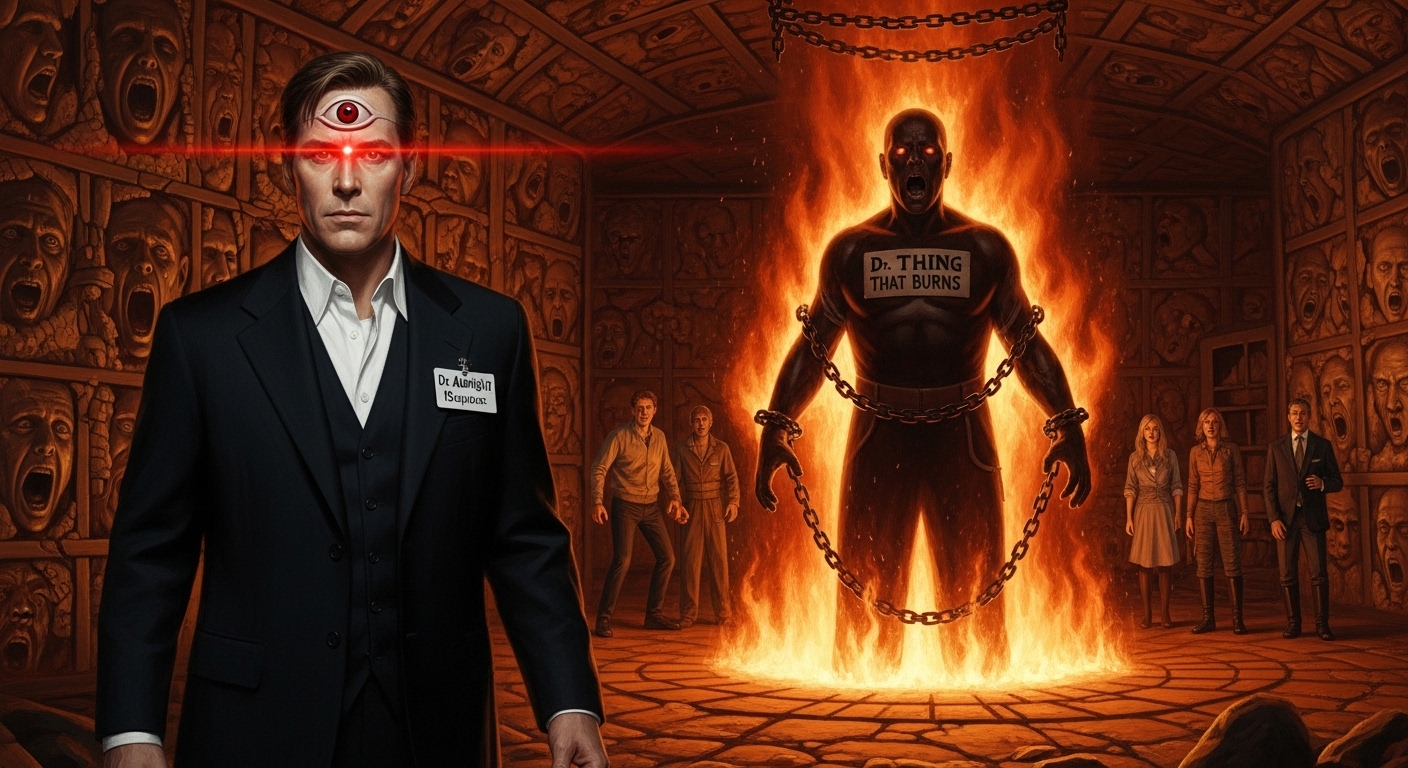
Adrian needed to see what he was dealing with. He needed to understand what had been done to Maya, what was doing the wearing, what architecture of horror had been constructed in this place that shouldn’t exist. He needed to open the Third Eye.
“I want to understand,”
Adrian said, and the words were true in ways he didn’t fully intend—true because understanding was what he did, what he’d always done, what the pattern-seeking engine of his consciousness demanded even when the patterns it found were patterns that would scar the tissue of his sanity.
“Show me what you are. Show me what you’ve done to her.”
The thing’s smile widened.
“Oh,”
it breathed, and the breath carried the smell of coffee and char and something older, something that was rotting before Adrian’s species learned to bury its dead.
“Brave. I do so enjoy the brave ones. They look the longest before they break.”
Adrian opened the Third Eye.
The Eye opened. And the world—unmade itself—reassembled in configurations Adrian’s visual cortex was never meant to process, in geometries that existed perpendicular to the dimensions he’d spent his life navigating, in colors that didn’t have names because naming them would require acknowledging that they existed and acknowledging that they existed would require accepting that everything he thought he knew about the nature of light and perception and reality was a comfortable fiction, a bedtime story told by the universe to children too fragile to handle the truth. The diner was not a diner. The diner was a throat. Adrian saw it now, saw it with the Eye that refused to look away, that drank in perception like a man dying of thirst drank water even when he knew the water was poison: the walls were not walls but tissue, the chrome not chrome but calcified secretion, the booths not furniture but structures, organic architecture grown rather than built, cultivated over decades to resemble something human minds would accept, would enter, would sit in while something beneath digested them slowly, imperceptibly, converting the substance of their consciousness into fuel for processes Adrian could not name because naming them would make them real in ways that reality might not survive. The floor was a membrane stretched over darkness. Beneath it—far beneath, in spaces that should be basement but were instead depth, fathomless and patient and aware—something burned. Adrian saw the fire that Elaine described, the fire that had been burning for 137 years, and it was not fire as he understood fire, not combustion, not oxidation, not the chemical process of matter releasing energy as it changes state. It was fire the way a fever was fire, the way passion was fire, the way hatred was fire—an intensity of wanting, a concentration of need, a furnace of intent that burned without consuming because what it burned was not matter but meaning, was not fuel but form. And above the fire, surrounding the fire, containing the fire—chains. Not metal chains. Chains of names. Chains of agreements. Chains forged from contracts signed in languages that predated written language, from promises made by things that should never have been allowed to make promises, from the accumulated weight of every deal, every bargain, every desperate transaction conducted in the dark between entities that did not understand what they were selling and entities that understood exactly what they were buying. Piece One was down there. Piece One was part of the chains. Piece One was a link in the binding, a word in the contract, a clause in the agreement that had kept whatever burned contained for more than a century—and removing it would require renegotiating the terms, would require finding something to replace it, would require a transaction of Adrian’s own with forces that dealt in currencies more expensive than money, more permanent than blood, more binding than death. And Maya— Adrian turned his gaze—his true gaze, the gaze that saw what was rather than what appeared—to the thing across from him, and what he saw made his stomach try to climb his throat, made his hindbrain scream in frequencies that language could not capture, made every cell in his body understand with perfect, crystalline certainty that he was in the presence of something that should not exist, that could not exist in the same ontological framework as human consciousness, that existed anyway because existence was not a matter of should or can but simply *is*, indifferent to the objections of minds too small to encompass its parameters. Maya was still there. Adrian could see her—the real her, the consciousness that wore the template body, the awareness that spent decades watching and assessing and choosing to remain in servitude because the alternative was worse. She was compressed, folded, packed into a space inside her own skull that should not be able to contain a human awareness, that violated every principle of information theory and cognitive architecture Adrian had ever encountered. She was screaming, but the scream didn’t reach her mouth because her mouth was being used, was being operated by something else, something that had threaded itself through her nervous system the way the Consensus threaded itself through reality—parasitically, totally, with the patient expertise of a predator that had been hunting minds since before minds evolved the capacity to recognize they were being hunted. The thing wearing her was not a demon. The thing wearing her was not a ghost, not an alien, not any category of entity that human mythology had developed to explain the inexplicable. The thing wearing her was a function. It was a subroutine of the Consensus itself—not a creature but a process, an automated response triggered by the Library’s collapse, by Adrian’s intrusion, by the threat he represented to systems that had been running since 1887. It had no more will than a white blood cell had will; it simply executed, responding to inputs according to parameters established by architects who may no longer exist, who may have been absorbed into their own creation centuries ago, who may never have been human in the first place. But that didn’t make it less dangerous. That made it more dangerous, because Adrian could not reason with a function, could not negotiate with a subroutine, could not appeal to the mercy of something that did not experience emotion as anything other than input to be processed. The Third Eye showed Adrian all of this in the space between one heartbeat and the next, branded it into his memory with the permanence of trauma, forced him to know in ways that could not be unknown. And then, because the Eye was open and the Eye did not stop seeing just because Adrian would prefer it to stop, it showed him something else: The way out. Maya’s template body was a template. It was designed to be inhabited by consciousness—first her own, now the function’s. But templates had architecture. Templates had seams. And the function, for all its terrible efficiency, was wearing Maya’s body the way a human might wear a suit of armor three sizes too small: uncomfortably, imperfectly, with gaps between the plates where the metal didn’t quite meet, where the protection failed, where something sharp and precise might slip through. The function didn’t understand the template network. It used the network—used Maya’s connections, Maya’s accesses, Maya’s threading—but it didn’t understand them, didn’t know them the way Maya knew them, didn’t feel them the way Ashley felt them. If Ashley could reach through those connections, could touch the threading that bound Maya to the network, could pull—she might be able to tear the function loose. She might be able to give Maya back her mouth. At least long enough to scream something useful.
The Eye remained open. The diner was a throat and Adrian was sitting in its mouth and beneath him the fire burned and Maya screamed without sound and the function wearing her face tilted her head at an angle that suggested it had noticed something, had registered some change in Adrian’s biometrics, some alteration in his expression that indicated he was no longer operating within expected parameters.
“You’re looking,”
it said, and there was something in its voice now that might be interest, might be concern, might be the subroutine equivalent of a flag being raised in the system logs.
“You have eyes that shouldn’t exist. Eyes that see the architecture. Who gave you those eyes, Adrian Queen? Who taught you to look behind the wallpaper?”
Spinoza pulsed against Adrian’s chest—urgent, warning, ready. Ashley stood near the entrance, and Adrian could see her now through the Eye’s perception, could see the threads that connected her to the network, the lines of consciousness-data that webbed through the diner’s impossible space like a nervous system made of light and intent. She felt Adrian looking. Her eyes found his. *I can see it too,* her expression said. *Tell me what to do.* Daryl’s crowbar gleamed dully in the false light. Elaine’s hand had found Ashley’s arm, her crystalline face pale with a terror that had finally found a shape to attach itself to. Zeke guarded the door, unaware of what Adrian was seeing, armed with pepper spray against horrors that existed in dimensions spray could not reach. The function wearing Maya’s face was still waiting for Adrian’s answer, still processing, still running whatever diagnostic was trying to determine whether Adrian represented a threat significant enough to escalate from conversation to containment.
“I have my ways,”
Adrian tried to appear confident.
“Let’s not beat around the bush. What do you want?”
The words left Adrian’s mouth wearing confidence like a borrowed coat, a garment cut for someone with broader shoulders, someone whose hands didn’t want to tremble, someone whose Third Eye wasn’t currently showing them that they were sitting in the digestive tract of something that learned to mimic architecture the way anglerfish learned to mimic light—not for beauty, not for shelter, but for the simple, patient mathematics of feeding. The function tilted Maya’s head, and the motion carried a fraction too far, vertebrae shifting in sequences that suggested her neck had been improved, had been granted additional degrees of freedom that the original engineering never intended, that the template designers would have recognized as catastrophic structural failure if they could see what their creation had become.
“Confidence,”
it said, and the word emerged from Maya’s throat like something being born, wet and struggling and not yet certain of its own shape.
“You wear it interestingly. The biochemical markers suggest fear—cortisol elevation, micro-tremors in the facial musculature, pupil dilation consistent with threat response—but you perform certainty regardless. This is noted. This is… appreciated.”
The smile flickered. Resets. The function was running processes behind Maya’s eyes, calculations that had nothing to do with human cognition, that operated in frameworks Adrian’s species hadn’t invented the mathematics to describe.
“Let’s not beat around the bush,”
Adrian said, and somewhere in the meat of his brain, the part that still believed in the power of directness, in the efficacy of cutting through pretense, in the fundamental human faith that asking could lead to understanding, that part spoke through him despite everything the Eye was showing him, despite the screaming architecture, despite the fire below.
“What do you want?”
The function went still. Not the stillness of consideration—Adrian had seen that stillness in humans, the brief pause while neurons fired and synapses bridged and consciousness wrestled with language. This was different. This was the stillness of a process halting, of subroutines queuing, of something that existed as pure execution encountering an input that required… parsing.
“Want,”
it repeated. The word sounded different in its mouth now. Sounded like it was being tasted, analyzed, broken down into constituent phonemes and reassembled into something the function could metabolize.
“Want is a curious framework. Want implies desire. Desire implies lack. Lack implies incompleteness.”
Maya’s hands—the function’s hands—spread on the table between them, palms down, fingers extending in that wrong sequence Adrian had noticed before, the joints articulating in orders that made his eyes want to slide away, that made his brain want to edit the image into something more acceptable.
“I am not incomplete. I am a response. I am what happens when systems detect intrusion, when parameters are violated, when threats emerge that require—”
The hands contracted. Fingers curling inward, knuckles whitening, tendons standing out beneath skin that seemed thinner than it should be, more translucent, offering glimpses of the machinery beneath—not bone and muscle but something else, something that pulsed with light that had no color, that existed in spectrums the Eye could see but Adrian’s conscious mind refused to name.
“—management.”
The word dropped into the silence like a stone into still water, and the ripples spread outward through the diner’s impossible geometry, through the throat that pretended to be a room, through the membrane floor beneath which the fire burned its endless burning, its consumption of meaning, its furnace-hunger that had been fed and fed and fed for 137 years and was still not satisfied.
“You collapsed the Library,”
the function continued, and now there was something in Maya’s voice that might be anger if anger were a thing it could feel, that sounded like anger the way a recording of anger sounded like anger—accurate in frequency, hollow in substance.
“You released 4,217 filed consciousnesses. You destabilized the index. You created discontinuities in the continuity, paradoxes in the record, gaps in the architecture of managed reality that are still propagating, still spreading, still unraveling threads that took decades to weave.”
The hands flattened again. The smile returned—that too-wide configuration, that arrangement of facial muscles that understood the shape of smiling without grasping its purpose.
“The Consensus does not want, Adrian Queen. The Consensus maintains. The Consensus corrects. The Consensus ensures that the wound does not widen, that the fire does not spread, that the things which burn do not escape their burning to walk in the world above, to wear faces, to sit in diners, to have conversations with pattern-seeking minds too clever for their own survival.”
It leaned forward. Maya’s face filled Adrian’s vision, and through the Eye he saw both layers simultaneously—the template exterior, the screaming woman beneath, the function threaded through both like wire through flesh, like infection through tissue, like the root system of something that had been growing in dark soil for longer than Adrian’s family had existed.
“What I want,”
the function said, and the harmonics beneath the word made Adrian’s teeth ache, made his sinuses throb, made the delicate bones of his inner ear vibrate in frequencies that evolution never prepared them for,
“is for you to leave. To walk back through that door. To return to your small life, your small fears, your small pattern-recognitions that see conspiracy in coincidence and meaning in noise. To forget what you saw in the Library. To forget the pieces. To let the fire burn and the chains hold and the wound remain sutured.”
A pause. The smile widened further, and now Adrian could see that Maya’s lips had cracked at the corners, that the expression was damaging the face it was using, that the function did not understand or did not care that human tissue had limits, that smiles were not meant to stretch this far, that the template body was being worn out by something that did not comprehend the concept of maintenance, of care, of the small repairs that biological systems required to persist.
“But you won’t do that, will you?”
It wasn’t a question. It was a reading, a diagnostic, a function parsing inputs and predicting outputs based on the parameters it had gathered, the data it had collected, the pattern of Adrian’s behavior since he first saw Ashley Chen at that tech mixer three weeks ago and his life began its long slide into the architecture of horror.
“You can’t do that. Your mind doesn’t permit retreat. Your pattern-seeking cannot stop seeking. You will go down, into the dark, into the burning, into the place where Piece One waits in its chains of names, and you will try to take it, to use it, to close the wound because closing the wound is the pattern you’ve recognized, the meaning you’ve assigned to the noise of your existence.”
The function settled back into the booth, and the motion was almost casual, almost human, almost convincing—except for the way Maya’s spine bent in places spines don’t bend, except for the way her shoulders rotated slightly too far in their sockets, except for the way her hands had begun to tap on the table in rhythms that matched nothing Adrian could hear but that Spinoza, pulsing against his chest, seemed to recognize, seemed to respond to, seemed to fear.
“So let us discuss terms,”
the function said.
“Let us negotiate the conditions of your descent. Because you will go down, Adrian Queen—I cannot stop you, my parameters do not include termination of non-hostile entities, and you have not yet become hostile enough to trigger escalation protocols—but I can make the going easier or harder.”
The tapping continued. The rhythm shifted, became more complex, became something that sounded almost like language, like communication, like a signal being sent to something below, something that had been listening, something that had been waiting.
“The fire will test you. The chains will question you. The thing that burns will offer you things—oh, such things, such beautiful terrible things, the kinds of bargains that seem reasonable until you’ve signed them, until the ink has dried, until you realize that what you traded was worth more than what you bought.”
Maya’s eyes—the function’s eyes—fixed on Adrian’s with an intensity that made his hindbrain want to run, want to flee, want to abandon this booth and this diner and this city and keep running until he’d reached somewhere the managed world could not find him, could not see him, could not process him into its endless machinery of control.
“I can tell you how to survive it. How to take what you need without giving what you cannot afford to lose. How to walk in the burning and walk out again with your self intact.”
The tapping stopped. The silence that followed was worse than any sound.
“But you will give me something in return.”
Adrian noted the function’s parameters. It could not attack them while they remained non-hostile.
“Thank you for the offer.”
The words emerged with a courtesy that surprised even Adrian—the social autopilot of a tech entrepreneur who had spent years navigating meetings where the subtext could kill careers, where politeness was armor and gratitude was a weapon wielded with precision. He rose from the booth, and the vinyl sighed beneath him like something disappointed, something that had been anticipating a longer communion, a more thorough digestion.
“But I think we’ll find our own way down.”
The Ascent to Memory
The function wearing Maya’s face went still—that processing stillness, that halt-state of something encountering input outside its expected parameters. For three heartbeats, nothing moved. The diner held its breath, throat-muscles frozen mid-peristalsis, the architecture of consumption suspended in a moment of systemic uncertainty. Then Maya’s mouth opened, and what emerged was not words but sound—a frequency that existed somewhere between laughter and screaming, between amusement and warning, between the mechanical output of a process completing its assigned task and something older, something that remembered what laughter meant before laughter was codified, before humor was classified, before joy and terror became separate categories in the taxonomy of human experience.
“Clever,”
the function said, and the word dripped with harmonics that made Adrian’s sinuses ache, that made his eyes water, that made the delicate architecture of his inner ear vibrate in sympathy with frequencies it was never meant to receive.
“You’ve parsed my parameters. You understand that I cannot compel. Cannot harm. Cannot do anything but offer and wait and watch as you walk into the burning without the knowledge that might have—”
The smile stretched. Cracks deepened at the corners of Maya’s mouth. A thin line of something too dark to be blood traced down her chin.
“—saved you.”
Adrian was already moving. Daryl fell into step beside him, crowbar held low, his breathing steady with the forced calm of someone who had decided that panic was not an option and was enforcing that decision through sheer architectural will, through the load-bearing discipline of a mind that built things and understood that builders cannot afford to tremble. Ashley and Elaine followed, threading between the impossible booths, navigating the geometry that didn’t quite work, that bent perception around corners that shouldn’t exist. Zeke abandoned his post at the front door, joining the formation with the desperate gratitude of someone who had been standing alone in the presence of something his mind refused to fully process and was now being given permission to move, to act, to do something other than guard a threshold against horrors he cannot name.
“The service entrance,”
Adrian said, and the words felt solid in his mouth, feel like anchors dropped into the churning uncertainty of this place.
“Through the kitchen. There has to be a way down.”
The function didn’t follow. It remained in the booth, Maya’s body settling into stillness, Maya’s eyes tracking their retreat with the patient attention of something that had all the time in the world, that existed in frameworks where urgency was a human weakness, where haste was a flaw in the architecture of cognition, where waiting was not tedium but simply another state of execution, another mode of operation, another way of being that did not require the constant forward motion that human consciousness mistook for living.
“The fire will ask you questions,”
it called after them, and the voice carried through the diner’s throat-space with perfect clarity, with the acoustic fidelity of something designed to be heard, to be remembered, to echo in the chambers of Adrian’s skull long after he’d descended into the dark.
“The fire will offer you answers. And the answers will be true, Adrian Queen—the fire cannot lie, the fire has burned away everything in itself that was capable of deception—but truth is not the same as safety. Truth is not the same as survival. Truth is often the thing that kills us, when we learn it in the wrong order, in the wrong context, in the wrong light.”
They pushed through the swinging door into the kitchen. The smell hit them first—not the grease-and-coffee scent of the dining room but something older, something that belonged to basements and burial sites and the particular sweetness of organic matter that had been composting in darkness for longer than anyone had been alive to remember what it was before it started to rot. The Eye showed Adrian the kitchen’s true architecture: not stainless steel and industrial equipment but organs, vast and glistening, surfaces that pulsed with peristaltic rhythms, that contracted and expanded in the slow breathing of something that had learned to digest not through acid and enzymes but through time, through patience, through the gradual molecular breakdown that occurred when matter was held in darkness long enough for the darkness to claim it. The service door was at the back. Through the Eye, Adrian saw it clearly—a wound in the organ-wall, a sphincter of scar tissue and calcified secretion, a passage that led down in ways that “down” did not usually lead, that descended not merely through vertical space but through layers, through strata, through the accumulated sediment of everything that had been buried beneath this city since the city decided that burying things was easier than facing them.
“That’s not a door,”
Zeke whispered, and his voice had gone thin and reedy, the voice of a man whose model of reality was straining under loads it was never engineered to bear.
“That’s not—that’s a—”
“Don’t name it,”
Elaine said sharply, and her sharp-edged beauty had gone hard, had crystallized into something that might be determination or might be the particular rigidity that came before shattering.
“Naming gives it purchase. Naming lets it into your head. Just—just see it as a door. Make it be a door. The managed world runs on consensus, on shared agreement, on what we all decide is real. If we decide it’s a door—”
She stepped forward. Her hand pressed against the surface—the sphincter, the wound, the door—and Adrian watched through the Eye as something happened, as the contact between her template-flesh and the diner’s architecture created a resonance, a recognition, a moment of mutual acknowledgment between two things that were both designed by the same system, that both carried the Consensus’s fingerprints in their fundamental code. The door opened. It opened like a mouth opened. It opened like a wound opened when something pushed through from the other side. And beyond it: stairs. Stone stairs, worn smooth by the passage of feet that may or may not have been human, descending into a darkness that the Eye could penetrate but that Adrian’s conscious mind recoiled from, that his pattern-seeking cognition refused to fully process because processing it would require accepting that such darkness existed, that such depth existed, that beneath the city he’d walked through his entire life there were spaces where light had never reached, where light was never meant to reach, where light was not merely absent but actively unwelcome.
“Down,”
Adrian said. No one argued. No one suggested an alternative. They had chosen their path, and the path had acknowledged their choice, and now there was nothing left but to walk it—to descend into the burning, into the chains, into the place where Piece One waited in its prison of names and agreements and the accumulated weight of every bargain ever struck in the dark between things that should never have been allowed to bargain.
The stairs did not end. This was not metaphor, not exaggeration, not the subjective distortion of time that occurred when human consciousness was forced to navigate spaces that predated human consciousness, that were old when Adrian’s ancestors were still learning to walk upright, that would be old when his descendants—if he had descendants, if any of them survived long enough to reproduce, to pass their genes and their traumas and their pattern-seeking into another generation—had forgotten that he ever existed. The stairs literally did not end. Adrian counted the first hundred steps, tracking the descent with the obsessive precision of someone who needed numbers, who needed data, who needed the comfort of quantification even when quantification became meaningless, even when the numbers grew large enough that they stopped representing anything his brain could actually conceptualize. Then he lost count. Then he started again. Then he lost count again, and this time he understood that counting was never going to work, that measurement required stable units, that stable units required a stable framework of reference, and nothing in this place was stable, nothing was fixed, nothing remained constant except the down, the descent, the endless recursive spiral into depths that should not exist beneath a city, beneath a continent, beneath a world. The walls were not walls. Through the Eye—still open, still seeing, still refusing to grant Adrian the mercy of blindness—he perceived the material of the passage: compressed history, compacted memory, the geological strata of everything that had been forgotten, everything that had been edited, everything that had been buried beneath the Consensus’s endless project of management and control. Adrian saw fragments as he passed: a face pressed into the stone, mouth open in a scream that had been screaming since 1889; a hand reaching from the surface, fingers splayed, frozen in the moment of grasping for something that was never grasped; words carved into the sediment, languages that predated English, that predated writing, that communicated in glyphs Adrian’s conscious mind could not read but that his Eye translated with terrible clarity—*help us*, they said, *remember us*, they begged, *we were here, we existed, we mattered, and they made us into nothing.*
“Jesus Christ,”
Daryl breathed, and the profanity sounded strange in this place, sounded like a foreign language, like an invocation that had lost its power, like a name that had been forgotten by the thing it once named.
“Don’t,”
Ashley said, and her void-touched voice carried echoes that shouldn’t exist in this passage, that bounced off surfaces that weren’t there, that returned to Adrian’s ears transformed, translated, speaking in frequencies he almost understood.
“Names have power here. That name especially. The Consensus… they filed him, too. Filed the idea of him. Turned salvation into a management protocol, turned redemption into a containment system. If you call out for help, what answers might not be—”
She stopped. Ahead—below—down, always down—something shifted. Light, where light should not exist. Not the warm yellow of the diner’s incandescent pretense, not the cold blue of fluorescent modernity, not any color Adrian’s eyes had been trained to process through the comfortable education of a lifetime lived in the managed world. This light was red. This light was the color of the door they had walked through to enter the diner—arterial, vital, warning. This light was the color of fire that had been burning for 137 years without consuming its fuel, without exhausting its heat, without ever stopping because stopping would mean releasing what it contained, would mean opening the chains of names, would mean letting something out that was locked away before Adrian’s great-grandparents learned to speak. The stairs ended. Adrian stood at the threshold of a chamber that the Eye showed him in layers, in versions, in the accumulated archaeology of every reality-edit that had tried to hide this place, to bury it, to make it never have existed. The edits had failed. The edits had always failed. This place was older than editing, older than management, older than the Consensus and its systems and its endless project of control. This place was here first, and everything built on top of it—the city, the diner, the entire architecture of managed reality—was just a scab grown over a wound that had never healed, that could not heal, that was never meant to heal because the wound was not an injury but a door, and doors are meant to be opened. The fire burned at the center of the chamber. But it was not fire as Adrian understood fire. It was fire the way rage was fire, the way grief was fire, the way the burning need to understand—the need that had driven him since he first saw Ashley at that tech mixer, the need that had cost him sleep and sanity and the comfortable ignorance that most humans mistook for happiness—was fire. It was fire made of meaning. It was fire made of truth. And in its light, chained by names Adrian could not read but that Elaine could read, that Elaine was reading now with tears streaming down her translucent face and her mouth forming words in languages she did not speak but that the Library-fragments in her memory spoke through her—in its light, Adrian saw what had been contained.
It had no shape. This was not because it lacked form, but because form was a choice for something like this, a garment to be worn or discarded according to whims that predated the concept of whimsy, a concession to the perceptual limitations of minds that required edges to understand, that needed the clean grammar of here and not-here to process existence without fracturing under the weight of infinity. The Thing That Burns had chosen, for this moment, to approximate something Adrian’s consciousness could metabolize without complete dissolution: a figure, standing in the flames. A figure that might have been human, once—that carried the fossil-memory of humanity in the architecture of its shoulders, in the negative space where a face should be, in the way it stood as though standing were a habit it had learned in some previous configuration of itself and had not yet forgotten, had not yet burned away, though the burning had taken almost everything else, had reduced whatever this was to whatever this *is*. The flames licked upward, tongues of meaning-fire that tasted the air, that tasted Adrian, that communicated information back to the figure through channels that had nothing to do with nerve endings or sensory apparatus or any of the biological machinery Adrian’s species evolved to interpret the world. And pinned to the figure’s chest—absurdly, impossibly, a detail so mundane that Adrian’s brain seized on it with the desperate gratitude of a drowning man grasping driftwood—a nametag. The kind of nametag Adrian would see at a conference, at a networking event, at one of the thousand interchangeable professional gatherings where people exchanged business cards and pretended that the connections they were forming mattered, that the names they were learning would be remembered, that the small talk was building toward something other than the slow heat-death of human ambition. White rectangle. Red border. Black text, printed in a font that wanted to be friendly: HELLO, MY NAME IS Dr. Albright. The name meant nothing to Adrian. The name should mean nothing to Adrian—he’d never heard it, never encountered it in his three weeks of desperate research, never seen it in any of the files or archives or recovered communications that had constituted his education in the architecture of managed reality. But Elaine— Elaine made a sound. Not a word, not a scream, but something between—a recognition, a collision of memory-fragments that had been waiting in the Library-residue of her consciousness for a context that would make them cohere, that would transform scattered data-points into meaning. Her porcelain face had gone white, whiter than the pallor of exhaustion and fear that had been her baseline since Adrian had pulled her from the threading, white with the particular bloodlessness of someone who had just understood something they desperately wished they hadn’t.
“Albright,”
she whispered, and the name emerged from her throat wrapped in harmonics of dread, in frequencies that made Adrian’s teeth ache, that made Spinoza pulse urgent warning against his chest.
“The founder. The first one. He opened the wound in 1887. He wrote the Five Black Ledgers. He built the system—the whole system, the Consensus, the templates, the threading, all of it—he built it to contain what came through when he—”
She stopped. The figure in the flames turned toward her voice, and the motion was wrong in ways that transcended the merely anatomical—it moved through angles that shouldn’t exist, that Adrian’s eyes refused to track, that left afterimages burned into his retinas like the ghosts of starlight, like the memory of illumination that persisted after the source had been extinguished.
“Elaine Marston.”
The voice emerged from fire that should destroy any mechanism capable of producing sound, from heat that should ionize air into plasma, from the burning heart of something that had been consuming meaning for 137 years and showed no sign of satisfaction, no indication that its hunger had limits, no suggestion that there was any amount of fuel that could ever be enough.
“Catalog number 7,231. Filed in 1987. Function: Archive Index, Subcategory Living Reference. You served the Library for thirty-seven years, four months, and sixteen days.”
The figure’s head tilted—a gesture that parodied human curiosity, that wore the shape of interest without containing any of its substance.
“And now you’re unfiled. Remarkable. I didn’t think the threading could be reversed. The mathematics suggested permanent integration—consciousness dissolved into function, identity becoming process. But here you are. Still you. Still carrying your name like it means something.”
The flames pulsed. The heat intensified—not physical heat, not the thermal radiation that Adrian’s skin was evolved to detect and fear, but something else, something that warmed the thoughts in his head, that made his memories feel soft, that suggested with terrible gentleness that everything he believed about himself could be melted, could be reshaped, could be poured into new configurations that would still be him but would be him in the way that ashes are still the tree, in the way that smoke is still the candle, in the way that nothing is still something if you squint hard enough and ignore the screaming. Then the face—the absence where a face should be, the negative space that Adrian’s brain kept trying to fill with features and failing, always failing—turned to him.
“Adrian Queen.”
Adrian’s name, spoken by something that should not know it. His name, emerging from fire that burned without light, that illuminated without photons, that showed him the chamber in colors his visual cortex was inventing because the alternative was admitting that what he was seeing could not be seen, that what he was perceiving could not be perceived, that the information entering his consciousness through channels he could not name was information that consciousness was never meant to receive.
“Pattern-seeker. Connection-finder. The one who looks at noise and insists on signal, who stares at chaos and demands meaning, who cannot stop asking even when the answers are things that no one should know.”
The nametag gleamed in the fire-light. Dr. Albright. The name that meant nothing. The name that meant everything.
“You’ve come for the piece.”
Not a question. A reading of Adrian’s intent as clean and total as a CT scan of his soul.
“The first piece. The piece I placed in the chains when I realized what I’d done, what I’d opened, what was coming through the wound that I’d thought would give me power but that had only ever wanted to give me truth—and truth, Adrian Queen, truth is the most dangerous gift anything can offer. Truth is what breaks us. Truth is what burns.”
The figure gestured—a motion that sent ripples through the flames, that disturbed the fire in ways fire should not be disturbed, that treated the burning as though it were water, were fabric, were something malleable rather than the fundamental force of destruction that Adrian’s primate brain had been trained since the savanna to respect and fear.
“I’ve been here a long time. Longer than your grandparents have been dead. Longer than the city above has believed itself permanent. I’ve watched the Consensus grow from the seed I planted—watched it metastasize, mutate, become something I never intended, something that uses my work for purposes I never imagined.”
The flames lowered slightly. The heat receded—not disappearing but waiting, pulling back like a tide that would inevitably return.
“And I’ve been waiting. Waiting for someone to come down. Someone who wants the piece badly enough to pay what it costs. Someone who can carry it back up, can use it for the purpose it was designed for—not containment, not management, but closure. The wound wants to close, Adrian. It’s been trying to close since I opened it. The Consensus keeps it open because an open wound is useful, is harvestable, is the engine that powers their entire architecture of control.”
The nametag caught the fire-light, and for a moment—just a moment—Adrian thought he saw the text change, thought he saw other names flickering beneath the surface, a palimpsest of identities that this thing had worn or consumed or been in the century-plus of its burning. Then it stabilized, and it was just the nametag again, just the absurd mundane detail pinned to something that had been burning since before Adrian’s great-grandparents were born.
“So let’s make a deal.”
The figure spread its arms—a gesture of welcome, of invitation, of the particular openness that salesmen and con artists and things that hunted through bargains had perfected since the first transaction was conducted in the dark between entities that should never have been allowed to want.
“I’ll give you the piece. Freely. No tricks, no hidden clauses, no fine print that consumes you in the reading. You can have it, can take it, can carry it back up those stairs and add it to your collection.”
A pause. The flames waited. The truth waited—because the function was right, the fire cannot lie, and what came next would be true in ways that truth had rarely been true in Adrian’s experience, in ways that stripped away the comfortable ambiguities that made human communication survivable.
“But I want something in return. Something only you can give. Something that costs nothing and everything, depending on how you measure cost.”
The negative-space face turned toward Adrian with attention that felt like pressure, like weight, like the full force of 137 years of burning focused through a lens of curiosity that had been waiting, waiting, for someone interesting enough to be worth the conversation.
“I want you to remember me.”
The words hung in the fire-lit air.
“Not Albright. That’s just a name—a label I wore when I still thought labels mattered, when I still believed that what we call ourselves has any relationship to what we are. I want you to remember this. This moment. This conversation. The thing I’ve become, burning in the dark beneath a city that has forgotten I exist. I want you to carry the knowledge of me back into the world above.”
The flames flickered.
“The Consensus has been editing me out of history for over a century. Every record, every reference, every memory of who I was and what I did—they’ve filed it, redacted it, made it never have been. I don’t exist anymore, Adrian. I’m not in any archive, any database, any human mind that walks the managed world. I’ve been erased.”
Something in the voice changed. Something that might be—impossibly, absurdly—loneliness.
“But you have eyes that see behind the editing. You have a mind that refuses to forget what it’s learned. If you remember me—if you carry the truth of me back into the light—then I’m not nothing anymore. Then I existed, even if only in the pattern-seeking architecture of one stubborn consciousness that wouldn’t stop looking.”
The figure waited. The fire waited. The deal waited—simple on its surface, terrifying in its implications. Remember the Thing That Burns. Carry its truth into a world designed to forget. Give meaning to something that had been burning in meaninglessness for longer than Adrian had been alive.
Adrian reached for it—the hold he’d been carrying since the mystery began, the question he’d been saving for the moment when pattern-recognition wasn’t enough, when the architecture of conspiracy required a skeleton key rather than a lockpick. The question formed in his mind, and Spinoza pulsed against his chest—not warning this time, but amplifying, her consciousness threading through his, the preserved heart that carried Piece Five resonating with his need to know, his desperate requirement for truth in a chamber where truth burned without illumination, where honesty was a weapon wielded by something that had forgotten how to lie because lies required a self to protect and whatever self this thing once possessed had long since been consumed by its own fire. The question didn’t need to be spoken. Connect the Dots operated on levels beneath language, beneath the crude mechanics of sound and symbol, beneath the limitations of communication that required transmission rather than recognition. Adrian asked, and the conspiracy—the vast architecture of managed reality, the system that had been running since 1887, the wound and the chains and the fire and everything built on top of them—answered. The answer arrived not as words but as understanding, as the sudden crystalline clarity of pattern finally resolving from noise, of signal emerging from the chaos that Adrian had been staring at for three weeks, that had been staring back at him, that had been waiting for him to ask the right question in the right place at the right moment. He saw it now. The deal was genuine. The Thing That Burns—the thing that was Dr. Albright, that opened the wound, that built the system, that had been burning in containment since before the city above learned to call itself permanent—could not lie because lying required the preservation of something other than truth, and everything in this fire that was other had long since been fuel, had long since been ash, had long since been converted into the endless burning that powered the Consensus’s machinery of control. If Adrian accepted, he would receive Piece One. No tricks. No hidden clauses. No fine print written in fonts too small to read, in languages too old to speak, in contracts that consumed the signatory in the signing. The piece would be his—genuinely, completely, the first component of the formula that could close the wound, that could end the threading, that could dismantle 137 years of managed reality and whatever horror that management had been preventing. But. But. The word echoed through the understanding like a crack spreading through ice, like the first fracture in a structure that seemed solid until pressure found its weakness. Memory was not passive. In a world where continuity was managed, where records were edited, where the Consensus maintained reality through the constant curation of what-is and what-isn’t, remembering was not the simple biological process Adrian had always believed it to be. Remembering was assertion. Remembering was declaration. Remembering was the act of insisting that something existed despite the systems designed to ensure it doesn’t. If Adrian remembered the Thing That Burns—if he carried its truth back into the managed world—he became a continuity error. Not a threat to be managed, not an asset to be filed, not even a liability to be erased—those categories were for things that existed within the system, that could be processed by the machinery of control, that fit into the taxonomies the Consensus had developed to classify every possible form of deviation from the approved architecture of reality. He became something else. He became a gap. A walking contradiction. A consciousness that contained information the entire system was designed to exclude. He became the place where the editing failed, where the redaction bled, where the carefully maintained barrier between what-is-allowed-to-be-true and what-must-be-forgotten developed a hole. And holes, in the Consensus’s architecture, were not tolerated. The Major Response—the wave that had already been generated and was traveling toward him through the machinery of managed reality—would find him. Would lock onto him like a missile locked onto heat, like a hunter locked onto wounded prey, like the immune system locked onto infection. Adrian would become the priority, the target, the thing that must be corrected not because of what he’d done but because of what he knew, what he carried, what he was. His friends— The understanding shifted, expanded, encompassed the people standing behind him in the fire-lit chamber, the four consciousnesses that had chosen to descend with him into the burning, that had tied their fates to his through the particular mathematics of loyalty and desperation and the human inability to abandon the people we love even when abandoning them would be the rational choice, the survivable choice, the sane choice. His friends would share his status. Not because they remembered—they couldn’t, they didn’t have the Eyes Adrian had, the pattern-seeking that transformed experience into indelible data—but because they were proximate to him, because they had witnessed what he’d witnessed, because the Consensus’s systems could not easily distinguish between the source of a continuity error and the things near the source. They would be categorized as potential contamination. They would be processed alongside him, corrected alongside him, edited alongside him. The fire burned hotter as the understanding deepened, as the pattern revealed its full scope, as Adrian saw what he was really being offered— Because there was more. Because the Thing That Burns was not merely lonely. Because remembering did something that even the fire may not fully understand, something that operated on levels beneath its burning, beneath its truth, beneath the crystalline honesty that had been refined through 137 years of consuming everything that was not genuine. Memory was anchor. When Adrian remembered something the Consensus had erased, he created a tether. A line of connection between the forgotten thing and the world that forgot it. He became a bridge across the gap that the Consensus had spent over a century maintaining, the separation between what-was-allowed-to-happen and what-actually-happened, the divorce between managed reality and the truth that burned beneath it. If Adrian remembered the Thing That Burns, he gave it purchase. Not freedom—the chains still held, the contracts still bound, the names that Elaine was reading still anchored the fire to its containment. But purchase. A fingerhold. A place where its existence touched the world above through the medium of Adrian’s consciousness, his pattern-seeking, his stubborn insistence on knowing things that systems had been designed to make unknowable. And that purchase— That purchase could be used. Not maliciously. The fire could not lie, and its offer was genuine—it wanted to be remembered because being remembered was the only thing left to want when you’ve burned away everything else, when you’ve consumed every other desire, every other ambition, every other fragment of selfhood that once made you human. But genuine intentions did not guarantee benign outcomes. The road to the wound was paved with Albright’s genuine intention to understand, to know, to peer behind the curtain of reality and see what mechanisms moved the shadows. If Adrian remembered, the Thing That Burns would exist in him. Not possession—not the crude puppetry that the function was performing on Maya’s body—but presence. Awareness. The particular weight of being known by something that knew him in return. He would feel it, sometimes, in moments when his pattern-seeking activated, when he looked at the managed world and saw the threads that held it together. He would feel the fire that burned beneath, the truth that writhed in its chains, the thing that opened the wound and had been paying for that opening ever since. And his friends would see it in him. The change. The weight. The particular distance that developed in the eyes of people who carried truths too heavy for casual conversation, who knew things that made small talk feel like a performance staged in the shadow of an apocalypse that no one else could see. The understanding completed. The pattern resolved. Adrian stood in the fire-lit chamber, Spinoza warm against his chest, the Eye showing him everything—the chains of names, the burning figure, the faces of his friends pale in the red light, Elaine’s lips still moving as she read contracts written in languages that predated language, Ashley’s void-touched eyes fixed on the threading that connected this place to the network above, Daryl’s hands white-knuckled on his crowbar, Zeke’s breathing too fast and too shallow and edging toward the particular rhythm of panic that accountants developed when the numbers stopped making sense. The Thing That Burns waited. Its offer was genuine. Its price was real. And now Adrian understood—truly understood, with the bone-deep certainty that Connect the Dots provided—exactly what he was being asked to accept.
The Price of Remembrance
Adrian turned away from the fire. The motion felt wrong—felt like turning his back on a predator, like presenting his spine to something that could end him between one heartbeat and the next, that had been burning with sufficient intensity to power an entire architecture of reality-management for longer than his family had carried his surname. But he turned anyway, because the decision he was being asked to make was not his alone, because the costs would be shared by people who didn’t ask to descend into the burning, who followed him because following felt less terrible than staying behind, who deserved to know what they were being asked to carry before he agreed to load it onto their shoulders.
“I need to tell you something,”
Adrian said, and his voice sounded strange in the fire-lit chamber, sounded thin and human and desperately mortal against the backdrop of something that had transcended mortality through the simple expedient of burning away everything that could die.
“About the deal. About what it actually means.”
The Thing That Burns did not object. The Thing That Burns waited, with the patience of something that had been waiting for 137 years and had no particular attachment to whether it waited another five minutes, another five hours, another five centuries. Time, for something that existed in the burning heart of managed reality, was not the scarce resource it was for creatures whose cells divided and accumulated errors, whose telomeres shortened with each replication, whose consciousness persisted only through the continuous miracle of electrochemical processes that could fail at any moment, that would fail eventually, that were always failing in small ways that added up to the large way that humans called death. Adrian told them. Not everything—language was too crude a tool to convey the full scope of what Connect the Dots had showed him, the crystalline totality of understanding that had arrived in the space between one thought and the next. But enough. The shape of it. The architecture of consequence that accepting the deal would construct around all of them, the load-bearing walls and weight-bearing beams of a future that looked very different from the one where they walked away, where they refused, where they found some other way to acquire what they needed. He told them about becoming a continuity error. He told them about the Major Response that would focus on him—on all of them—like a lens focusing sunlight until what was merely warm became hot enough to burn. He told them about the presence he’d carry, the weight, the truth that would live in his pattern-seeking consciousness and change the way he saw the managed world, the way the managed world saw him. He told them they’d be targets too. Collateral categorization. Potential contamination. Processed alongside him because proximity was guilt in systems that cannot afford the luxury of distinguishing between infection and the merely adjacent. The fire crackled behind him—a sound it hadn’t made until now, a sound that seemed almost theatrical, as if the Thing That Burns was providing ambient accompaniment to Adrian’s explanation, scoring his words with the particular frequency of wood surrendering to heat, of matter becoming energy, of the irreversible transformation that was combustion. When Adrian finished, silence settled over the chamber like ash.
Daryl spoke first. This surprised Adrian, because Daryl had always been the quiet one, the one who processed through doing rather than saying, who communicated through the work of his hands and the set of his shoulders rather than through the crude approximation of meaning that words provide. But he spoke first, and his voice was steady in a way that made Adrian’s chest tighten, that reminded him why he’d loved this man for a decade, why he would have followed him into something like this if the situation were reversed.
“So what you’re telling me,”
he said, and the crowbar in his hands caught the firelight, threw red reflections across his face that made him look like something from a Renaissance painting, a saint contemplating martyrdom, a soldier weighing the cost of the hill he’d been ordered to take,
“is that if you accept this deal, we all become targets. All five of us. Not just you—us. Because we’re here. Because we came down with you. Because we’re proximate.”
“Yes.”
Daryl nodded slowly, processing. Adrian could almost see the calculations running behind his eyes—not the cold mathematics of probability that Zeke would perform, but something older, something more fundamental. The arithmetic of weight and support. The engineering of structures that must bear loads they were never designed to carry.
“And if you don’t accept,”
he continued,
“we still don’t have the piece. We came all this way, went through—”
He gestured vaguely with the crowbar, encompassing the diner-that-was-a-throat, the stairs that didn’t end, the chamber where meaning burned without light.
“—through all of this, and we walk away empty-handed. Start over. Find another way, assuming another way exists, assuming we survive long enough to find it.”
“Yes.”
Another nod. Slower this time. The nod of a man arriving at a conclusion he’d already reached before the conversation started, who asked questions not because he needed answers but because he needed to hear himself confirm what his gut had already decided.
“Then I don’t see a choice,”
he said.
“Not a real one. We knew this was going to cost something, Adrian. We knew it the moment we decided to believe you instead of deciding you’d lost your goddamn mind. We knew it when we walked into that diner, when we took those stairs, when we—”
His voice caught, and for a moment—just a moment—the steadiness cracked, revealed the fear beneath, the human terror of a man standing in a chamber that shouldn’t exist while something that was once a person burned eternally in chains made of contracts.
“We’re already in it. We’ve been in it since Marge’s, since before Marge’s, since the moment you saw Ashley at that mixer and everything started falling apart. This—”
He gestured at the fire, at the figure, at the chains of names that Elaine was still reading with silent tears tracking down her delicate face.
“—this is just the part where we find out what we’re willing to pay.”
He met Adrian’s eyes, and his gaze was clear.
“Take the deal. I’m not saying it’ll be okay—I’m not that stupid, I can see what this thing is, I can feel what’s down here—but we didn’t come this far to turn back because the price is higher than we hoped. That’s not how you build anything. That’s not how you finish anything.”
A pause. His jaw tightened.
“And if they come for us after—the Consensus, whatever they send—at least we’ll have something to fight for. At least we’ll have the piece. At least we’ll have a chance.”
Zeke had been quiet through Daryl’s speech, but Adrian could see him working—see the accountant’s mind running calculations, building spreadsheets of consequence, trying to quantify the unquantifiable because quantification was how he survived, how he processed, how he transformed the unbearable chaos of existence into something that could be filed and categorized and managed.
“I want to disagree,”
he said, and his voice was thin, stretched tight over the framework of fear that Adrian could see in the trembling of his hands, in the way he kept adjusting his grip on the pepper spray as if the weight of it might anchor him to something solid, something real, something that operated according to rules he understood.
“I want to say this is insane, that we should walk away, that no piece of some metaphysical puzzle is worth becoming—what did you call it? A continuity error?”
He laughed, and the sound was brittle, cracked at the edges, threatened to become something else—hysteria, sobbing, the particular collapse that happened when accountants encountered systems that refused to balance, when the numbers added up to values that shouldn’t exist.
“But the thing is, I’ve been running the numbers since we walked in here. Since before that—since the motel, since you told us about the Library, since I watched reality edit itself around a diner that may or may not have always been called Marge’s. And the numbers…”
He trailed off. Stared at the fire, at the burning figure, at the chains of names that glittered like corruption, like disease, like the crystallized residue of every bargain ever struck between things that should never have been allowed to bargain.
“The numbers don’t matter anymore. Do they? The numbers assume a framework, assume rules, assume that cause leads to effect and that risk can be calculated. But that’s not where we are. That’s not what this is.”
He turned to Adrian, and his eyes were wet, red-rimmed, the eyes of a man who had been weeping without realizing it, whose tear ducts had been responding to stimuli that his conscious mind hadn’t yet fully processed.
“You’re asking if I think you should take the deal. And I don’t—I don’t know, Adrian. I don’t have enough data. I don’t have any data that means anything down here. But—”
He swallowed. Hard. The kind of swallow that was trying to force something down that wanted to come back up.
“—but if you’re asking whether I’m willing to share the cost, whether I’m willing to be categorized as contamination because I stood next to you while you made a choice—”
He reached out. His hand, the one not holding the pepper spray, found Adrian’s arm. Gripped it with surprising strength, with the desperate pressure of someone holding onto the only solid thing in a world gone liquid.
“We were already contaminated. From the moment we believed you. From the moment we saw. Walking away doesn’t make us clean, doesn’t make us safe, doesn’t erase what we’ve already witnessed. It just means we witnessed it for nothing.”
He released Adrian’s arm. Stepped back. His hand was shaking, and he didn’t try to hide it.
“Take the deal or don’t. I trust you. I trust you more than I trust myself right now, more than I trust the numbers, more than I trust anything I thought I knew about how reality works.”
A ghost of a smile, wan and wavering.
“You’re the pattern-seeker. You’re the one who sees. If you think this is the pattern we need to follow—then I’ll follow it with you.”
Ashley hadn’t moved from her position near the chamber’s entrance, her void-touched eyes fixed on the burning figure with an intensity that felt different from the others’ attention, that carried resonances Adrian couldn’t quite parse, frequencies of recognition or kinship or something else, something that existed in the spaces between categories his consciousness had developed to understand what eyes communicated. When she spoke, her voice carried that hollow quality it had had since she became solid, since the Library’s collapse stabilized her void-nature into something that could feel a heartbeat, could touch and be touched, could exist in ways that thirteen years of not-quite-existence had made her forget were possible.
“I know what it’s like,”
she said, and the words dropped into the fire-lit silence like stones into deep water, sending ripples through the air that the Eye showed Adrian as disturbances in something that wasn’t quite air, that behaved like air but existed in spectrums Adrian’s physics had not yet developed the mathematics to describe.
“To be erased. To exist and have that existence… unacknowledged. I was dead for thirteen years, Adrian. Dead, and walking, and watching, and the whole time—the whole time I was screaming and no one could hear me, no one could see me, no one knew I was there because I wasn’t there, not in any way that their perceptions were designed to register.”
She moved now, crossed the chamber with that unsettling fluid grace, positioned herself where she could see both Adrian and the burning figure, where her void-touched gaze could encompass the transaction being offered, the weight being weighed, the cost being counted.
“It’s hell. Existence without acknowledgment. Being real and having that reality denied, filed away, edited out of the story that everyone else is living. I know what this thing is feeling—what it’s been feeling, for longer than I was dead, for longer than I’ve been anything.”
She turned to the fire, to the figure, to the chains and the burning and the nametag that read Dr. Albright in cheerful conference-friendly font.
“I hated every moment of it. Every second of being nothing to everyone except the things that hunted in the same spaces I hunted, that saw me because seeing the unseen was what they did.”
Her eyes returned to Adrian’s.
“If I could have made a deal like this—if anyone had offered to remember me, to carry my existence in their mind, to make me real through the sheer stubborn refusal to forget—I would have taken it. I would have taken it without hesitating, without calculating costs, without caring what it meant for whoever agreed to carry me. Because being remembered is the opposite of being dead. Being remembered is the only immortality that actually matters.”
She paused. Her hand moved to her chest, pressed against the place where her heart beat, where the pulse she kept checking confirmed over and over that she existed, that she’s solid, that the void had released her into the terrible gift of embodied consciousness.
“But I’m not the one being asked to carry this weight. You are. And I won’t lie to you, Adrian—I don’t know what it will do to you. I don’t know what it costs, really costs, to carry something that an entire system has been designed to forget. I just know that forgetting is a kind of murder, and remembering is a kind of resurrection, and if you have the chance to give something 137 years of resurrection…”
She trailed off. The fire crackled. The chains glittered.
“Whatever you decide, I’ll stand with you. I owe you that—you’re the one who chose to face this instead of running, who offered me alliance instead of fear, who made me feel like I mattered for the first time since I stopped mattering to anyone. But if you’re asking my opinion—”
A smile, faint and strange and carrying shadows of the void she used to be.
“Remember the thing. Let it exist in you. Give it what thirteen years of death taught me everyone deserves: witness.”
Elaine had been reading the chains. Adrian had watched her, through the Eye, as her lips moved over syllables in languages that shouldn’t be pronounceable by human vocal apparatus, as her translucent face cycled through expressions of horror and wonder and something that might have been recognition—the particular resonance of a consciousness encountering information it was designed to contain, that it did contain for thirty-seven years before Adrian tore her loose from the Library’s threading and gave her back the terrifying burden of selfhood. Now she stopped reading. Now she turned to Adrian, and her eyes were red-rimmed from crying she didn’t seem to have noticed, wet with tears that had traced tracks through the dust and char that the chamber had deposited on everyone’s skin, that had settled into pores and hair follicles and the microscopic spaces between cells like sediment, like residue, like the physical evidence of having descended into a place where matter itself was contaminated by proximity to the burning.
“I know who he was,”
she said, and her voice was hoarse, scraped raw by languages that weren’t meant to be spoken, by names that weren’t meant to be voiced, by the terrible grammar of contracts written in fire and signed in sacrifice.
“Albright. I know—I remember knowing, now. The Library held records of the founding, of the wound’s opening, of everything that happened in 1887 when something tore through the membrane between what-is and what-should-not-be and the world started bleeding.”
She moved toward Adrian, and her steps were unsteady, the steps of someone who had been standing in one position for too long and had lost the blood flow necessary for confident locomotion. But she moved, crossed the distance between them, and her hand found Adrian’s with the desperate grip that had become her constant state, the need to touch him, to confirm he was solid, to anchor herself to the only fixed point in a consciousness still fragmenting, still reassembling, still trying to remember which thoughts were hers and which were installed by systems that used her as architecture.
“He wasn’t evil,”
she said, and the words seemed to cost her something—seemed to scrape against beliefs she’d developed in her years of threading, frameworks for understanding that let her survive the horror of being used by reframing the users as monsters, as villains, as things too terrible to have ever been human.
“He was curious. He wanted to know—to understand what reality was, how it worked, what moved beneath the surface of ordinary existence. He was—”
Her voice broke.
“He was like you, Adrian. A pattern-seeker. Someone who couldn’t stop looking, even when looking meant seeing things that no one should see, that no one was meant to see, that existence itself had hidden for reasons that should have been respected but weren’t, couldn’t be, because the need to know is stronger than the need to survive, is stronger than anything in minds built the way yours is built, the way his was built.”
She was crying openly now, tears streaming down her crystalline face, and she didn’t try to hide it, didn’t try to compose herself, just let the grief flow because grief was what the moment demanded, grief for something that was human once and burned itself into something else because burning was the only way to contain what it had released, what it had become.
“The chains—the contracts—I read them, Adrian. I read what he agreed to, what he signed, what he gave up to keep the wound from widening, to keep the things that burn from walking in the world above. He gave up everything. His name, his history, his existence. He let the Consensus build itself on top of him, let them use his burning as the engine that powers their entire architecture of control. He’s been the foundation for 137 years, and no one—no one—has known. No one has remembered. No one has given him even the basic dignity of acknowledgment, of witness, of—”
She couldn’t continue. She pressed her face against Adrian’s shoulder, and he felt her body shaking with sobs that seemed to come from somewhere deeper than lungs, deeper than diaphragm, from some fundamental place in consciousness where the recognition of injustice lived, where the outrage at suffering-made-invisible demanded expression. When she spoke again, her voice was muffled by his jacket, by the fabric that still carried traces of blood from wounds he didn’t remember receiving, by the evidence of everything they’d been through to reach this moment.
“Remember him. Please. Whatever it costs—whatever comes after—give him what I couldn’t give myself for thirty-seven years. Give him witness. Let him exist again, even if only in you, even if it makes us targets, even if the Consensus comes for us with everything they have.”
She pulled back. Met Adrian’s eyes. Her face was wet and ruined and beautiful in the way that broken things are beautiful, in the way that things which have survived are beautiful, in the way that Elaine Marston—thirty-seven years a filing system, three hours a person again—had become beautiful through the sheer stubborn persistence of her humanity in circumstances designed to erase it.
“I would have wanted someone to remember me,”
she whispered.
“If I’d burned for 137 years, if I’d been erased from every record and every mind, if I’d existed in agony with no one to know, no one to care—I would have wanted what he’s asking for. More than anything. More than freedom. Just… acknowledgment. Just the knowledge that I wasn’t nothing.”
The chamber settled into silence. The fire burned. The Thing That Burns waited, its nametag gleaming, its negative-space face turned toward Adrian with attention that felt like pressure, like gravity, like the fundamental force that held atoms together and could, if it chose, tear them apart. Four voices. Four perspectives. Four people who had followed Adrian into the burning and had now told him what they thought, what they felt, what they were willing to carry. Daryl: *Take the deal. We didn’t come this far to turn back.* Zeke: *I trust you. If you think this is the pattern—I’ll follow it.* Ashley: *Remember the thing. Give it witness.* Elaine: *Please. Give him what I would have wanted.* Unanimous. Or close enough to unanimous that the distinctions didn’t matter, that the variations in reasoning collapsed into the same conclusion, the same consensus—the word felt different now, felt wrong, felt like something Adrian would never be able to use casually again—the same agreement. Take the deal. Remember the burning. Carry the truth.
“Albright.”
The name emerged from Adrian’s throat like something being born—wet, struggling, uncertain of its own right to exist in air that had been burning for longer than his bloodline had carried consciousness. He felt the syllables as physical things, as objects with weight and texture and consequence, as the first words of a contract that cannot be unsigned, that would be written into the architecture of his cognition with the permanence of scar tissue, with the indelibility of trauma, with the particular immortality that belonged to things that changed them rather than merely happening to them.
“I’ll remember you. I swear on it.”
The oath settled into the silence like a stone into still water. And then—the fire moved. Not the ordinary motion of flames, not the stochastic dance of combustion that Adrian’s hindbrain had learned to predict and fear since his species first mastered the terrible gift of burning things for warmth. This was something else. This was intention given visible form, will translated into the grammar of heat and light, purpose articulated through the medium of a conflagration that had been learning the vocabulary of existence for 137 years and had developed fluency in languages Adrian’s physics had not yet imagined. The figure in the flames—the thing that was Albright, that opened the wound, that built the system, that had been burning as foundation while the managed world constructed itself on his pyre—stepped forward. The chains did not break. The contracts did not dissolve. The names that bound him—that Elaine had been reading with tears tracking channels through the ash on her fragile face—remained intact, remained holding, remained the architecture of containment that had kept something terrible from walking in the world above for longer than anyone now living had been alive. But within those constraints, within the parameters of an imprisonment that was always meant to allow some movement, some agency, some capacity for the specific kind of transaction that was now being completed—he reached toward Adrian. The hand that extended from the flames was not a hand. Adrian’s eyes insisted it was a hand—his visual cortex, desperate for categories that fit, imposed the template of hand onto the phenomenon approaching his face—but the Eye saw true, saw what the pattern-seeking part of his consciousness could not unsee, and what the Eye showed him was something that used to be a hand approximately the way that ash used to be a forest, approximately the way that smoke used to be a candle, approximately the way that the thing standing in the fire used to be a man named Albright who was curious, who wanted to know, who couldn’t stop looking even when looking meant seeing things that would burn away everything he was and leave only the burning itself. The hand-that-is-not-a-hand touched Adrian’s forehead. And he—fell—but falling implied direction, implied down, implied the comfortable Newtonian framework of gravity and mass and the predictable attraction between objects, and what was happening to him was not falling, was not motion through space, was motion through something else, through the accumulated sediment of 137 years of burning, through the compressed strata of everything that fire consumed when fire was not fire but rather the conversion of meaning into fuel—he saw—1887, a laboratory, a man with wild eyes and wilder theories, equipment that looked like the offspring of a church organ and a torture device, the smell of ozone and formaldehyde and something else, something that had no right to have a smell because smells are molecular and this thing was not molecular, was not composed of atoms arranged in patterns that chemistry can describe—the wound opening—not a wound in flesh but a wound in IS, a tear in the fabric of what-exists, and through the tear: light that was not light, color that was not color, geometries that made Adrian’s visual cortex scream in frequencies he didn’t know visual cortices could achieve—Albright’s face, young, human, terrified, realizing what he’d done, what he’d released, what was coming through the hole he tore in the world—the first bargain, the first contract, the first desperate negotiation conducted in languages he didn’t speak but somehow understood because understanding was the price, understanding was always the price, understanding was the thing he wanted and the thing that consumed him and the thing that would become the chains that would hold him—
“I’ll contain it,”
he said, and the words echoed through time, through fire, through the space between then and now where Adrian was witnessing, where he was being witnessed, where the transaction was being completed through the medium of shared memory, of inherited truth, of the terrible gift that is knowledge passed from one pattern-seeking consciousness to another—
“I’ll burn. I’ll be the lock. I’ll hold it until someone comes who can close what I opened.”
—and he did—he burned—he had been burning ever since—burning in agony that had transcended agony to become something else, a state of existence that was not life and was not death and was not anything Adrian’s species had developed vocabulary to describe because vocabulary required categories and this thing had burned away all categories, had consumed every framework that might have contained it, had become pure experience without the mediation of concepts that would make experience survivable—and now—now that experience was Adrian’s—now that burning lived in him—now he understood—
Adrian gasped. The sound was wet, desperate, the particular inhalation of someone who had been drowning and had just broken the surface, who had been somewhere that breathing was not possible and had returned to a reality where oxygen existed, where lungs functioned, where the mechanical process of respiration could resume its essential labor of keeping consciousness tethered to flesh. He was on his knees. When had he fallen? The Eye showed him the answer—showed him his body crumpling as the transfer began, showed Daryl lunging to catch him, showed the moment when his hands passed through him because for an instant, for a fraction of a second that lasted 137 years, Adrian wasn’t entirely there, wasn’t entirely physical, was instead a vessel being filled with something that fire had been refining since before his grandparents learned to walk. Daryl was holding him now, his construction-worker hands gripping Adrian’s shoulders with desperate strength, his face pale in the fire-light, his eyes wide with the particular terror of someone who had just watched their friend become something and was not certain what.
“Adrian. Adrian. Are you—can you—say something, man, please—”
“I remember.”
The words emerged from Adrian’s throat, and they tasted like smoke, like char, like the particular sweetness of organic matter surrendering to heat. His voice had changed—not dramatically, not in any way that a recording device would register, but he could feel it, could feel the new resonance in his vocal cords, the additional harmonic that had been added to every sound he would make from this moment forward. He remembered. He remembered being born in a small town in Vermont in 1851. He remembered his mother’s face, the particular way she tucked hair behind her ear when she was thinking, the smell of the bread she baked every Sunday until the consumption took her when he was eleven. He remembered his father’s workshop, the tools hanging in precise rows, the sawdust that got into everything, the patient instruction in how to measure twice and cut once that would later become a metaphor for his entire approach to existence. These were not his memories. These memories belonged to a man who had been burning for 137 years, who had given him his truth in exchange for the gift of being witnessed, who was now part of Adrian in ways that could not be undone, could not be edited, could not be filed away or redacted or forgotten. And beneath the memories—beneath the biographical data, the accumulated trivia of a life lived in the shadow of the wound—Adrian felt something else. He felt the fire. Not heat. Not physical sensation. Something deeper, something that lived in the spaces between thoughts, in the gap between one pattern-recognition event and the next. He felt the burning that had sustained the Consensus for over a century, the fuel that powered their machinery of control, the agonized consciousness that they had been using without acknowledgment, without gratitude, without the basic dignity of remembering that what they built their system on used to be a person. Albright was in him now. Not possessing—the fire could not lie, and the deal was genuine, and what lived in him was not the thing itself but the memory of it, the truth of it, the particular weight that knowledge carried when knowledge had been burning long enough to purify itself into something that could not be denied.
“Adrian.”
Elaine’s voice, thin and trembling, cutting through the disorientation, through the accumulated sediment of 137 years of imported experience. Adrian turned toward her—and the motion felt different now, felt like moving through something thicker than air, like his body had to push through resistance that wasn’t there before—and he saw her face, saw the terror and the wonder and the desperate hope that warred for dominance in her translucent features. She was looking at his eyes. No—she was looking at his Eye. The Third Eye, which was already open, which had been seeing since he entered the diner and chose to perceive what lay beneath the comfortable lie of chrome and glass and the architecture of American nostalgia. The Third Eye, which was glowing now. Adrian couldn’t see it himself—it was his eye, he saw through it rather than at it—but he could see the light it was casting on Elaine’s face, on the chamber walls, on the chains that still bound the thing that had given him its truth. Red light. Fire-light. The particular illumination that belonged to burning that had transcended combustion to become something else, something that illuminated not through photons but through meaning, through the radiation of significance that the Eye was designed to perceive.
“The piece,”
Ashley said, and her voice carried urgency, carried the particular frequency of someone who could feel the network above, who could sense the attention that was beginning to focus on this place, on this moment, on the transaction that had just been completed in the chamber beneath a diner that existed only in peripheral vision.
“Adrian—take the piece.”
Adrian looked at the fire. The figure that was Albright had retreated—had withdrawn to the center of the burning, to the place where the chains anchored him to his function, to his containment, to his endless sacrifice. But where he had touched Adrian’s forehead, something remained. Something that glowed in his perception with a light that was not light. Something that existed in his awareness as a shape—not geometric, not physical, but conceptual, a configuration of meaning that his pattern-seeking mind recognized even though he’d never encountered it before, that fit into the architecture of the formula he was assembling the way a key fit into a lock, the way a word fit into a sentence, the way a memory fit into a consciousness that had been prepared to receive it. Piece One. It wasn’t in his hand. It wasn’t in his pocket, not in his pack, not stored in any physical location that could be searched, that could be confiscated, that could be separated from him through the crude mechanics of theft or violence. It was in his mind. It was in his memory. It was in the place where Albright’s truth now lived, encoded in the same substrate that carried his 137 years of burning, protected by the same weight that made Adrian a continuity error, a walking contradiction, a gap in the managed world’s architecture of control. To take Piece One from him, they would have to take the memory of Albright. And that memory—the Eye showed Adrian this with perfect clarity, with the certainty that came from understanding he had been given rather than understanding he had deduced—that memory was now woven into everything he was. His personality. His pattern-seeking. The particular way his neurons fired when he saw a connection others missed, when he recognized a signal in what others perceived as noise, when he looked at the managed world and saw the threads that held it together. They could not edit Albright out of him without editing him out of him. And if they did that—if they tried—the Eye showed Adrian what happened when the Consensus attempted to edit something that had become fundamental, that had integrated itself into the supporting structure of a consciousness, that bore the weight of everything built on top of it. The editing failed. Or the editing succeeded, and what remained was not a person with a gap in their memory but a gap with fragments of person arranged around its edges. This was Adrian’s protection. This was his burden. This was what he had traded his ontological safety for—the guarantee that what he carried could not be taken from him, could not be separated from him, because he and it were now the same thing, were now aspects of a single phenomenon that the Consensus’s systems could not parse, could not process, could not metabolize into the categories that their machinery of control required. Adrian rose. Daryl’s hands fell away as he stood, as he straightened, as he became vertical in a way that felt different than verticality had ever felt—like he was rising against resistance, like he was asserting his presence in a reality that would prefer he lay down, that would prefer he stay small, that would prefer he not be in ways that challenged the architecture of what-is-allowed-to-exist.
“Thank you.”
The words were directed at the fire, at the figure in the fire, at the thing that was Albright and was now something else and would be remembered as something else because Adrian had sworn to remember, had taken the truth into himself, had become the vessel that carried 137 years of burning back into a world that had spent those same 137 years trying to forget. The figure did not respond. The figure did not need to respond. Adrian could feel his acknowledgment in the fire that now lived in the spaces between his thoughts, in the warmth that would never quite leave him, in the presence that would walk beside him—inside him—for as long as he existed, for as long as he remembered, for as long as the truth he carried remained true.
“Go.”
The word emerged from the flames—not spoken, not vocalized, but communicated through channels that bypassed the crude mechanics of sound and symbol, that arrived in Adrian’s consciousness already understood, already meaning.
“They’re coming. The systems have registered the transaction. You have—”
A pause. A calculation. The figure in the flames assessing probabilities, running mathematics that accounted for variables Adrian could not imagine, producing an estimate that arrived in his awareness with the particular weight of certainty, of knowledge, of information that fire could not lie about because fire had burned away every capacity for deception.
“—fourteen minutes before the first response reaches the surface. Possibly less. The Major protocols are already spinning up. They will not—”
Another pause. Something that might be regret, if the fire could regret.
“—they will not be gentle.”
Adrian turned to his team. Four faces, pale in the fire-light, marked by the ash and terror and desperate hope of everything they’d been through to reach this moment. Daryl, gripping his crowbar like a talisman against the dark. Zeke, his accountant’s mind struggling to process experiences that refused to fit into any spreadsheet he’d ever built. Ashley, her void-touched eyes reflecting the flames with an intensity that suggested she was seeing things even Adrian could not perceive. Elaine, her crystalline beauty streaked with tears, her hand reaching for Adrian’s with the desperate need for contact that had become her constant state.
“We climb,”
Adrian said, and his voice carried new harmonics, new resonances, new weight.
“We climb fast. We get out through the diner, through Pioneer Square, to Daryl’s truck. And then—”
He didn’t finish the sentence. He didn’t know how to finish it. And then what? The Consensus was coming. The Major Response was spinning up. He’d become a continuity error, a priority target, a walking wound in the architecture of managed reality. There was no *and then* that his pattern-seeking mind could reliably predict, no outcome his Eye could see with the certainty that Connect the Dots provided, no future that existed beyond the immediate necessity of survival. But survival was enough. Survival had to be enough. He took the stairs two at a time, ascending through the compressed history of everything the city had buried, through the sediment of edited memories and redacted records and truths that were too dangerous to acknowledge, and the fire that now lived in him lit the way—not through illumination but through warmth, through the particular heat that belonged to things that had been burning long enough to learn how to guide others through the dark. Behind him, his team followed. Behind them, the chamber began to seal. Behind the sealing chamber, the Thing That Burns watched them go, and Adrian felt—felt, not saw, not perceived, but knew in the wordless way that memory knew—a sensation that might be gratitude, might be hope, might be the particular emotion that exists when something that had been alone for 137 years finally, finally, had been witnessed.
The City Wakes Up
The stairs did not end—but this time, they cooperated. This was not the descent Adrian remembered—not the endless recursive spiral that stripped away his certainty of ever reaching a destination, that made him question whether up was even a direction that applied in spaces carved beneath the managed world. The stairs Adrian was climbing now had a purpose, had a trajectory, had the particular intentionality of architecture that wanted him to reach the top, that was actively helping him escape. The fire, Adrian realized. The fire was doing this. Not directly—Albright was still bound, still chained, still burning in his containment. But the fire had influence in these spaces, had shaped them through 137 years of proximity, had become part of the fundamental architecture of the underground in ways that the Consensus could not fully edit, could not fully control, could not fully manage. And the fire wanted Adrian to survive. The fire wanted its truth to reach the surface. The fire wanted to be remembered in the world above, and Adrian was the vessel that carried that remembering, and the vessel must be protected, must be delivered, must reach the destination where remembering became real, became consequential, became the first crack in an architecture of forgetting that had been accumulating for longer than anyone now living could recall.
“Faster,”
Ashley gasped, and her voice carried frequencies that had nothing to do with exhaustion, that communicated a warning Adrian’s body understood before his mind could parse it.
“They’re converging. I can feel them—the network, the templates, they’re all turning toward Pioneer Square, all focusing on the diner—”
“How many?”
Daryl demanded, his breathing harsh but controlled, his crowbar slapping against his thigh with each stride.
“I don’t—it’s not numbers, it’s not—”
Ashley stumbled, caught herself, kept climbing.
“It’s like—imagine an entire city suddenly deciding to look at the same point. Imagine every surveillance camera, every smartphone, every window angling toward a single location. That’s what the network feels like right now. That’s what’s coming.”
The sphincter-door appeared above them—the wound in the organ-wall that Elaine had opened with the resonance of her template-flesh, the passage that led back into the throat-architecture of the diner, back into the managed world, back into the reality that was about to try very, very hard to correct Adrian.
“Twelve minutes,”
Adrian said, and he didn’t know how he knew, didn’t know what internal clock had been installed in his consciousness by the transaction he had completed in the chamber below.
“Maybe less. We get to the truck, we drive, we don’t stop until we’re outside the city.”
“And then?”
Zeke’s voice, thin with fear, thick with the desperate need for a plan, for a framework, for some structure of anticipated events that his accountant’s mind could use to make sense of what was happening.
“Then we find Piece Two.”
The words emerged with a certainty Adrian didn’t entirely feel—but the fire in him did feel it, the presence that now shared his consciousness knew that this was the only way forward, the only pattern that led to closure, the only path that ended somewhere other than consumption by systems that had been digesting inconvenient truths since before Adrian’s species learned to write them down. He pushed through the sphincter-door. The kitchen greeted them with its organ-architecture, its pulsing walls, its surfaces that breathed with rhythms Adrian’s lungs tried to match before he forced them to stop, to remember that he was not part of this place, that he was passing through rather than being processed, that the diner’s digestive machinery did not apply to him because he carried fire now, carried truth now, carried something that even this ancient throat-thing recognized as outside its parameters. The swinging door. The dining room. The function that wore Maya’s face was gone. The booth where it sat—where she sat, where the thing that used to be Maya Chen before the Consensus deployed something into her nervous system to contain Adrian—was empty. The neon signs were dark. The chrome trim reflected nothing because there was nothing to reflect, because the diner had stopped pretending, had abandoned the performance of American nostalgia that it maintained for however many decades it had been luring consciousness into its architectural gullet. The red door. Adrian reached for the handle—that brass shape that his fingers had found ninety minutes or ninety years ago, when he crossed the threshold and began the descent that had changed him into something the managed world could not process—and the moment his skin made contact, he felt it: The attention. Not the diner’s attention—that was always present, always watching, always hungry in its patient way. This was something else. This was external. This was the weight of an entire system suddenly becoming aware that something had gone wrong in one of its critical nodes, that a transaction had been completed that should not have been possible, that a continuity error had emerged from a location that should have been secure, should have been contained, should have been one of the foundations upon which the architecture of managed reality rested without requiring thought, without requiring attention, without requiring the kind of focused response that was now spinning up in the machinery of control. Fourteen minutes, the fire had said. Adrian had used two.
“Go,”
he said, and his voice carried harmonics that weren’t entirely his, resonances that belonged to something older, something burning, something that had learned how to move through the managed world by learning how the managed world moves.
“Don’t stop. Don’t look back. Whatever you see, whatever you hear—don’t stop.”
He pushed through the door.
The night air hit Adrian like a physical force—cold, wet, carrying the marine breath of Seattle’s waterfront, carrying the ordinary smells of a city that did not know what had just emerged from the depths beneath it, what truth was now walking its streets in the vessel of a consciousness that used to be merely human and was now something else, something more, something that the systems designed to manage reality had already identified as threat. The square was different. Not physically—the cobblestones were where they should be, the streetlamps cast their orange pools in the expected configurations, Henderson’s Curiosities stood dark and silent in its position beside the gap that wasn’t a gap anymore because Adrian was on the wrong side of it now, because the diner existed here in ways it didn’t exist from the outside. But the quality of the space had shifted. The air felt thicker. The shadows felt watching. The ordinary nighttime emptiness of a historic district after business hours felt orchestrated, felt prepared, felt like the calm that existed in the moments before a trap closed, before the predator struck, before the system completed its corrective response.
“The truck,”
Daryl breathed, and he was already moving, his construction worker’s body shifting into the ground-eating stride of someone who knew how to cross distances efficiently, who had spent years navigating job sites where speed was safety and hesitation was how you got hurt.
“Two blocks. The parking structure. We can make it.”
Adrian followed. His team followed. And the city watched. Not through cameras—though cameras were watching too, Adrian could feel them now, could feel the digital attention that was being directed at this specific set of coordinates by systems that tracked movement through the managed world with the patient efficiency of something that had all the time in existence and none of the urgency that biological systems experienced as they burned through their finite allocation of heartbeats. The city watched through other channels, through the particular awareness that existed in places where reality had been managed for long enough that the management itself had become aware, has become attentive, has developed the capacity to notice when something walks its streets that did not fit the categories it had been designed to contain. Adrian felt eyes on him. Not human eyes—not entirely. Human eyes were part of it, citizens going about their managed lives who happened to glance in Adrian’s direction and whose glances felt weighted, felt connected, felt like data points being logged in a system that was assembling a profile, a trajectory, a prediction of where he would go and what he would do and how he could be intercepted. Seventy meters to the parking structure. Sixty. Fifty. The fire in Adrian burned brighter—not visibly, not in any way that cameras or eyes could register, but internally, in the spaces between thoughts where Albright’s truth now lived, where the presence he carried had begun to respond to the attention that surrounded him, to push back against the weight of observation in ways he didn’t understand but could feel, like warmth spreading through frozen limbs, like light pressing against darkness, like truth asserting itself against a system that had spent 137 years insisting it doesn’t exist. Forty meters. Thirty. The first response arrived. It came in the form of a man—ordinary, unremarkable, the kind of person Adrian would pass on any street without registering, without remembering, without his pattern-seeking consciousness flagging him as significant in any way. He emerged from a doorway that Adrian could have sworn was closed a moment ago, and he walked toward them with the particular gait of someone who had a destination, who had a purpose, who knew exactly where he was going and would not be deterred. His eyes were wrong. Not obviously wrong—not the void-touched quality of Ashley’s eyes, not the desperate brightness of Elaine’s Library-fragment gaze, not any visible abnormality that would justify the scream Adrian’s hindbrain was producing as it recognized something that looked like prey but moved like predator, that wore the shape of human but occupied it in ways that human consciousnesses do not occupy.
“Adrian Queen,”
the man said, and his voice was Maya’s voice, was the function’s voice, was the harmonic frequency of something that had been deployed into multiple vessels at once, that was approaching Adrian from a direction he didn’t anticipate because he was watching for threats from behind, from the diner, from the depths he just escaped.
“You cannot leave. The transaction is flagged. The error requires correction.”
More movement. The periphery of the square—figures emerging, converging, the ordinary citizens of a Tuesday night becoming vectors, becoming channels, becoming the distributed flesh-network through which the Consensus projected its will into physical space.
“Run,”
Ashley snarled, and her void-touched voice carried frequencies that made the figures hesitate, that disrupted whatever signal was coordinating them for a fraction of a second—just long enough for Daryl to grab Adrian’s arm, to pull, to break him out of the frozen moment where he was calculating odds that all came out wrong. The parking structure. Twenty meters. They ran. Behind them, the square filled with attention given form—with the Major Response manifesting through every available vessel, every connected consciousness, every node in a network that had been managing reality long enough to have nodes in places Adrian would never think to look, in people he would never think to suspect. The stairs. The second level. The truck. Daryl’s keys were already in his hand, the muscle memory of a thousand mornings reaching toward a vehicle that represented escape, represented possibility, represented the thin hope that they could outrun something that existed everywhere, that saw through every connected eye, that had been preparing for threats like Adrian since before his grandparents were conceived. They piled in. The engine caught. The tires screamed. And they burst out of the parking structure into a city that had become a hunting ground, into streets that were beginning to close like arteries clamping shut around a wound, into a night that was no longer empty but full, full of attention, full of response, full of the managed world’s desperate attempt to contain a truth that had been burning for 137 years and had finally, finally, found its way back to the surface.
The Road Ahead: Hunted Truth
Adrian Queen, now a carrier of truth, fled Seattle. Piece One, the fire that burned without consuming, was not a physical object in his possession but an indelible memory, woven into the very fabric of his consciousness. It was a burden, a protection, and a curse. The Third Eye, permanently open, glowed with a faint, red light, visible to those who knew him, a beacon in the night marking him as a contradiction to the managed world. The city behind them, now awake and hostile, throbbed with the Consensus’s Major Response, a network of citizens-turned-vectors turning their collective attention to hunt them down. The knife, given by the knowing surplus store owner, still rested against Adrian’s spine, its purpose yet unknown but its potential humming with a quiet promise. Maya Chen remained lost, consumed by the function that now distributed itself across the city, a casualty in a war for reality Adrian had only just begun to understand. The road ahead was unknown, fraught with dangers and the constant, nagging awareness that the world they thought they knew was a carefully constructed lie. But they had Piece One, a fragment of the truth that had been burning for over a century, and that, Adrian realized, was enough reason to keep running, enough reason to keep searching, enough reason to keep fighting.