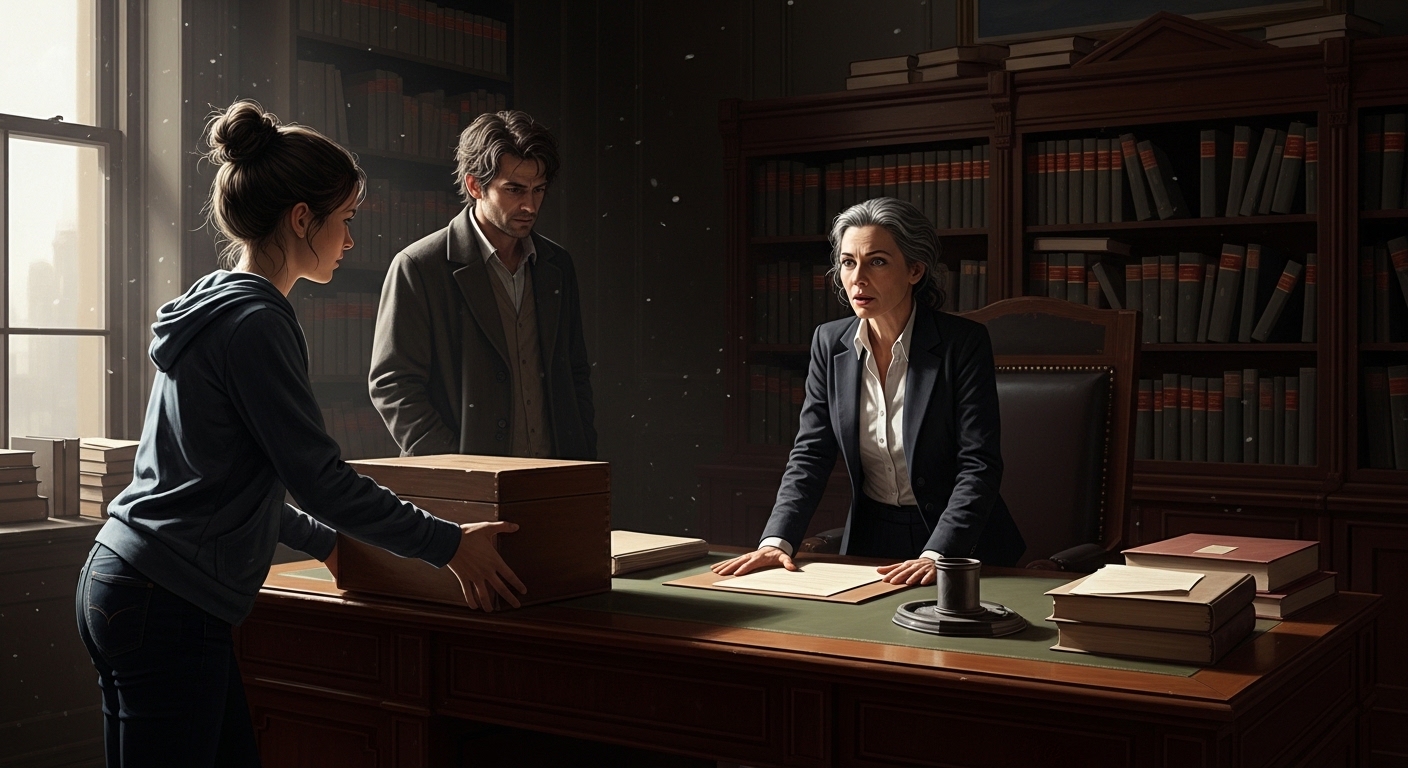
The air in Elaine’s impossible library hummed with a frequency that vibrated deep in Adrian’s bones, a silent chord struck across dimensions that twisted the space around him into a mockery of solid architecture. Elaine stood behind her desk, a figure of disconcerting calm, her smile less a greeting and more a predator’s satisfied assessment. It was the smile of someone watching an intricate equation balance, variables resolving precisely as predicted. Her words, precise to the point of artifice, echoed the chill that snaked through the non-Euclidean shelves stretching into depths that defied reason.
“Adrian Queen,” she repeated, and the sound was a calculated performance, a mimicry of human speech learned from cold texts rather than the messy warmth of shared experience. “You made it. I’ve been expecting you.” Behind her, the infinite corridors shimmered, not with the dust motes of neglected archives, but with the latent energy of a place that occupied more volume than physical space, a testament to rules Adrian was only just beginning to understand were rewritten, not broken. She gestured to the impossible expanse. “Welcome to my library. Welcome to the mechanism. Welcome to the place where seekers come to learn the truth. Or where they come to be sorted. Filed. Managed.” Her gaze, unnervingly steady, lingered, a silent question hanging heavy in the air. “The question is: which one are you?”
Behind Adrian, the dimensional bleed — the ragged wound through which they had stumbled, their very identities flayed and scattered across a hundred incompatible configurations of spacetime — now pulsed. It was no longer merely a shimmering threshold but a living thing, breathing, its rhythmic expansion suggesting either a final sealing, trapping them forever, or a terrifying aperture, permitting something to follow them through. Adrian could not look, dared not break the unwavering eye contact with the enigma that wore Elaine’s face, the mechanism that patiently awaited his response with the timeless attention of a cosmic observer.
Beside him, Zeke remained on his hands and knees, the ghost of dissolution still shuddering through his frame, his stomach empty but his body mimicking the act of purging, trying to vomit forth the memory of non-existence. His laptop lay open, its screen a chaotic tapestry of shifting timestamps, numbers writhing like things infested. Ashley was worse. Her form flickered, a terrifying superposition of presence and absence, the Ashley who drowned thirteen years ago and the void that had learned to wear her shape, both equally real, equally terrifying. Tears, crystalline and multi-faceted, fell from her eyes, refracting light in colors no human retina should perceive, betraying a molecular structure that defied the very definition of water. And Daryl, ever the bulwark, stood firm. Solid. He placed himself between Adrian and Elaine, a living shield against an enemy he could not comprehend, his body a stubborn assertion of coherence amidst the unraveling. Yet, Adrian saw it then: the tremor in Daryl’s right hand, not fear, but a deeper recognition, his body screaming warnings his mind had yet to translate. Spinoza, warm against Adrian’s chest, pulsed a silent command: *Look. Really look. See what’s actually here.*
The Architect’s Smile
Adrian’s voice, when it came, was steadier than he deserved, a forced casualness that scraped against the raw edges of his new reality. He was a man trying to build a bridge of mundane social ritual across a chasm of existential horror, clinging to the comforting fiction that personhood still mattered. “Hey Elaine,” he managed, gesturing broadly at his trembling companions, at Ashley’s flickering form, at Daryl’s rigid, futile stance. “How’re… things? I… well, we, had some questions we’d like to ask you. Sorry for barging in.”
The words hung in the air, absorbed into the vast, silent hunger of the library, and Adrian, his pattern-recognition now an involuntary, merciless faculty, could not help but notice: Elaine did not blink. Her eyes remained fixed, unwavering, like the unblinking lenses of a surveillance system, observing without participation, recording without experience. She was a system designed to classify, to catalog, to convert raw data into usable information for purposes he was not cleared to understand. He looked around, really looked, trying to buy his friends time, trying to give his own shattered nervous system a chance to reintegrate, attempting to see what this place truly was beneath the comforting architectural metaphor his mind had draped over something utterly alien.
And then, the Third Eye opened. Not with a gentle unfurling, not with a gradual transition, but like a dam breaking, a levee failing, a catastrophic rupture. Structural integrity gave way, and everything held back came flooding through with the inexorable force of a pressure equalization, a system achieving the equilibrium physics had always demanded, but humanity had desperately postponed. It opened like a scream in his skull, like a blinding flash behind his eyes, like the moment when protective lies shatter and the writhing chaos beneath consensus reality pours in, unbidden, unmerciful.

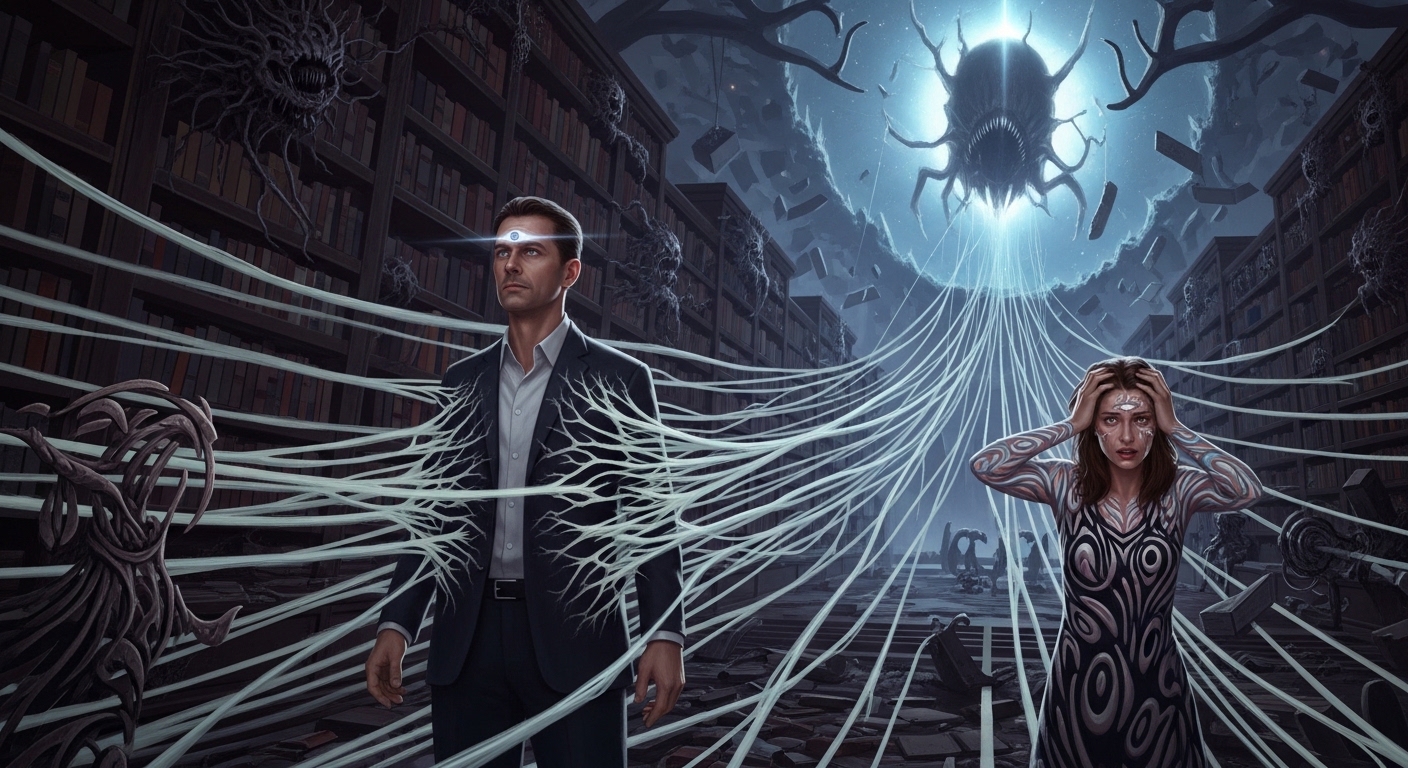
He SAW. The library was not a library. The shelves were not shelves. The books were not books. What he had called a “library” was merely his brain’s desperate attempt to translate raw, incomprehensible sensory data, to drape familiar symbols over an alien architecture existing in dimensions his visual cortex was never designed to process. The “shelves” were living threads of consciousness, pulsating with the same rhythm he had felt near the bleed, humming with frequencies that resonated in his bones, in his teeth, in the spaces between his neurons where thought became meaning. They stretched not just in three spatial dimensions, but in orthogonal directions that defied naming, occupying possibilities rather than positions, threading through probability itself.
Truth Unveiled
And threaded along these consciousness-strands were not books, but people. Or what used to be people. Or what people became when they were processed, sorted, filed, converted from individual agents into raw information, into data points, into the very material the mechanism used to organize its vast, incomprehensible catalog. Thousands, hundreds of thousands, perhaps millions, stretched into the infinite recursive architecture, suspended in states that were neither death nor life, but something between. Their consciousnesses, extracted and preserved, were organized by the questions they had dared to ask, the patterns they had sought, the forbidden knowledge they had pursued before the library had caught them, cataloged them, filed them into the appropriate sections where seekers of their type belonged.
Some were recent, their consciousnesses still struggling against the threading, clinging to the desperate fiction of individuality, of agency. Others were ancient, their identities eroded by centuries of being information rather than people, their awareness fully integrated into the mechanism’s filing structure, no longer fighting, no longer remembering what it meant to be singular. And the worst part – the detail that made his newly opened third eye ache to shut, to retreat into comfortable blindness – was that he recognized some of them. David Morrison, the man who became Samuel Watts, his original consciousness still filed under “Candidates Who Sought Knowledge of Their Processing.” Margaret Chen, once marked “PENDING REVIEW,” now cataloged under “Seekers Who Attempted Warning Others.” Dozens of names from Elaine’s surveillance logs, all here, all sorted, serving as the library’s living database.
And then – oh. Oh no. He saw himself. Not his current self, not Adrian Queen standing in the library with horror dawning on his face, but a future self, a possible self, already filed, already sorted, already threaded into the consciousness-architecture under categories that turned his blood to ice: “Seekers Who Found the Fire Warden,” “Investigators Who Decoded Elaine’s Formula,” “Candidates Marked for Retroactive Erasure,” and most chillingly, “Consciousness Structures Suitable for Conversion to Advanced Template Functions.” He was looking at his own obituary, his own autopsy. The mechanism had already decided what he was, what he would become, where he belonged in its vast catalog. The only reason he wasn’t filed there yet was that the variables hadn’t quite finished resolving, the timeline correction hadn’t completed its work, the equations were still processing the inputs and calculating the optimal configuration for converting him from active threat into useful reference material. The library wasn’t a sanctuary. It was a trap. A place where seekers came to be cataloged, studied, used as data points in the mechanism’s ongoing project of preventing future seekers from succeeding, of refining the processing algorithms, of making the managed world more efficient at managing itself by learning from every fool who thought they could outsmart the system.
And Elaine – he looked at her now with the third eye fully open, her image unfiltered by the comfortable lies, and his chest clenched with a horror that was equal parts existential dread and profound, aching grief. She wasn’t gone. Not completely. Not yet. But she was going. He could see the threading working on her in real-time, her consciousness being slowly, methodically, inevitably converted from individual agent into mechanism function, her awareness redistributed across the library’s architecture. Yet, a core part of her – the part that remembered a worrying mother, a cat named Spinoza, a favorite coffee shop – fought to maintain coherence, to remain Elaine Marston rather than becoming The Mechanism That Sorts Seekers. She was losing. Had been losing for thirty-seven years. When she spoke again, her mouth moving with that slightly-too-precise articulation that he now understood was not affectation but the result of being partially converted, her voice carried harmonics he hadn’t noticed before, frequencies suggesting she spoke not just as Elaine but as the library itself, as the vast distributed system of preserved consciousness she had become entangled with.
“Things,” she said, and the word echoed through dimensions he shouldn’t be able to perceive, reverberating through the consciousness-threads, “are as they must be. As they’ve always been. As they will continue to be until the mechanism is no longer necessary, until the wound closes, until reality stops requiring such… aggressive management.”
She tilted her head, a gesture almost Elaine, almost human, and something in her eyes, dark and deep like windows onto the infinite catalog, suggested pain, struggle. The part of her that was still Elaine screamed beneath the surface while the part that had become The Library performed its function with mechanical precision. “You asked questions,” she continued, her voice a terrifying duality, both individual and system. “That’s why you’re here. That’s why they all come. Questions about the wound. About the Consensus. About the formula that could close it, that could end this, that could make all of us—” She gestured to the threaded consciousness-architecture, to the thousands of preserved seekers, to herself, “—unnecessary.”
Behind Adrian, the dimensional bleed pulsed with renewed urgency. His third eye revealed its true nature: a complex probability-junction where multiple timelines intersected, where managed reality, this liminal library-space, and countless other possibilities ground against each other. And things were coming through it now. Not physical things, or not primarily so, but consciousness-patterns, awareness-signatures, the spectral traces of entities existing in the spaces between managed reality and the library’s catalog, drawn by the disturbance he had created when he crossed, when he brought his desperate questions into a space designed to capture exactly his type. The Watchers, he realized. The four synchronized bodies that had pursued them. They hadn’t been trying to capture them. They were herding them. Delivering them directly to the mechanism that sorts seekers. He was never escaping. He was always being processed. The trap was sprung the moment he started asking questions. And his third eye, once opened, refused to close, showing him truth whether he wanted to see it or not.
A Plea for a Ghost
“Daryl, DARYL!” The words tore from Adrian’s throat, raw with the particular urgency of someone who had just seen something that rewrote every assumption about safety and danger. He screamed not because volume mattered here – volume was just another form of information for the mechanism to catalog – but because screaming was what his nervous system demanded when confronted with the knowledge that he had willingly walked into the grinder, delivering himself and everyone he cared about directly into the processing queue. He was screaming because he understood the Library had been waiting for him, with the patient hunger of systems that didn’t distinguish between minutes and decades.
“Grab Ash and Zeke!” Daryl reacted instantly, a loyal, unthinking bulwark. He didn’t need explanation, didn’t ask *why*; his calculus was simpler: friend in danger, therefore help friend. He hauled Zeke up, the accountant protesting weakly, wanting to understand before committing to action. Daryl wasn’t interested in understanding; he was interested in action. His arm reached for Ashley, who still flickered, her impossible crystallized tears glinting in the impossible light, a void trying to mimic grief. Adrian, meanwhile, stepped towards Elaine. Not the mechanism, not the distributed consciousness that had been wearing her face. He was trying to reach the part that was still *her*.

The graduate student who worried about a mother and a cat named Spinoza. The woman who had scattered a formula that could end everything, leaving breadcrumbs for seekers even as she was being consumed. The Elaine who had chosen to help him during his first visit, recognizing a kindred fool who couldn’t stop asking questions. He gambled everything on the belief that helping him had been worth the cost, that accelerating her own conversion might lead to someone succeeding where she had failed. “Elaine,” he said, his voice quiet, intimate, trying to make himself heard beneath the mechanism’s vast, humming catalog. “I know you’re in there. I know you can still choose. You helped me before. When I first came here. When I needed to understand what Ashley was.”
From his pocket, he pulled Spinoza, the silk-wrapped heart pulsing warm against his palm. It was proof, a physical manifestation of everything Elaine once chose, once valued. It proved that extraction was possible, that threading wasn’t always inevitable. “You saved Spinoza. You chose to save her even though saving her meant revealing yourself, meant demonstrating resistance, meant marking yourself for closer observation and ultimately for conversion into what you are now. But you did it anyway. Because individual consciousness mattered to you. Because you believed one cat’s awareness was worth preserving even at the cost of your own freedom.” The library pulsed around him, the consciousness-threads vibrating. The mechanism was listening, cataloging his emotional appeal under categories like “Attempts to Trigger Individual Agency in System Functions.” Every word he spoke became data. But beneath the mechanism’s cataloging attention, Adrian, with his third eye open, saw something else. A flicker. A hesitation. A moment where the threading paused.
In Elaine’s eyes, those dark, deep, mechanism-infected eyes that shouldn’t have been capable of individual expression, something resembled recognition. Something resembled choice. It was the particular quality of awareness that stubbornly insists on being separate from the systems trying to absorb it.
“Adrian,” she said, and this time the voice was different, less mechanical, more human, the messy biological artifact of someone struggling to speak while simultaneously being something else. “Adrian, you shouldn’t have come here. This place – it doesn’t let people leave. Not unchanged. Not whole. It takes pieces. It files them. It keeps them.”
She glanced at the consciousness-threads, at the preserved seekers.
“I’m trying,” she whispered, the word carrying weight, cost, suggesting that maintaining this brief individual agency was accelerating the threading, hastening the day when only The Library would remain. “I’m trying to help. But I’m also trying to sort you. Both impulses. Both real. Both me.”
Adrian could see the consciousness-threads pulling at her, trying to reintegrate her fully, to end this conversation. “The pieces,” she managed, fighting. “The formula. I scattered them. But the Consensus found two. They’re watching the third. The fourth might be lost. And the fifth—” She touched her chest, mirroring Adrian holding Spinoza. “—is here. In me. In the mechanism. Integrated so thoroughly that extracting it might destroy what’s left of who I was.”
Daryl had Zeke and Ashley now, physically anchoring them, ready to extract if Adrian gave the word. Ashley’s form was stabilizing slightly in Daryl’s solid grip, his stubborn insistence on coherence providing an anchor. Zeke, however, stared at Adrian, not Elaine, not the library, at *him*. Something in his expression suggested he’d noticed, that his pattern-finding had detected the change in Adrian’s eyes, tracking things that shouldn’t be visible.
“Adrian,” Zeke said carefully, the way you speak to someone who might be experiencing a break from reality. “What are you seeing? Your eyes – they’re moving like you’re reading something. But there’s nothing there.”
Nothing *he* could see. Everything Adrian could see. The burden of the third eye was knowing his perception and everyone else’s no longer overlapped, no longer shared the same reality. Elaine was still watching, still struggling, still fighting to maintain enough individual agency to help while being pulled constantly, inexorably, toward full integration. He saw the branching probability-structure of her choice: make one more choice, or be fully absorbed. She had information he needed. But asking her to resist the mechanism for even a few more minutes might be the thing that finally broke her, that completed the conversion and left him facing not Elaine, but only The Library.
The Anchor and the Key
It’s what she would’ve wanted. The thought arrived with the cold certainty of mathematics resolving, of equations balancing. Elaine Marston, who saved a cat at the cost of her own freedom, who scattered a formula to end everything, who left breadcrumbs even as she was being threaded into the mechanism – she would want him to ask, to make her choose one more time. Adrian unwrapped Spinoza, the silk falling away like a shroud. The heart in his palm was warm, pulsing with rhythms that suggested not just mechanical persistence but approaching life, approaching will. It hummed with the stubborn insistence that consciousness mattered. He held it up, not as evidence, but as a plea. “Look,” Adrian said, his voice carrying harmonics he didn’t intend, vibrating with the contamination of the third eye. “Look what you saved. Look what you chose when you still had choices. Look at what mattered enough to fight for.”
Spinoza pulsed, an urgent recognition, the particular quality of awareness encountering something remembered, something that had triggered it originally, something that carried the weight of history and connection. Elaine – the thing that was Elaine and The Library simultaneously, the superposition of individual and system – saw the heart, and something in her broke. Adrian watched it happen with his third eye, unfiltered. He watched the threading fracture, the consciousness-strands integrating her suddenly experience catastrophic stress as two incompatible imperatives tried to occupy the same decision-space: the mechanism’s programmatic insistence that she sort him, and Elaine’s individual will asserting itself with the desperate strength of someone who knew this was the last time, knew this choice would cost everything, would complete the conversion, but did it anyway because that was who she was. The threading snapped. Not completely, but enough that for a moment, a fragment of duration so brief that measuring it in seconds would be generous, Elaine was herself, singular, the graduate student with Spinoza, the coffee shop, the worrying mother. She breathed, “Spinoza,” the word carrying weight, history, every shared moment. She reached out with trembling hands, hovering near the heart, a reverence usually reserved for holy relics.
“You kept her safe,” Elaine said, and tears ran down her face – not the wrong, crystalline tears of the mechanism, but normal human tears. He could perceive they weren’t quite water, not quite the simple chemical byproduct of sadness, but something existing between biological secretion and the manifestation of consciousness under extreme stress. “You kept her safe,” she repeated, wonder and grief in her voice, and the particular quality of validation that comes from learning your sacrifice wasn’t empty, wasn’t meaningless. Around her, through her, the library reacted. Consciousness-threads pulsed with agitation, frequencies suggesting alarm, concern. Elaine asserting individual agency contradicted her function, created errors. The library wanted her back, wanted to reintegrate the rebel consciousness. But Elaine fought. Adrian watched her fight, consciousness struggling against dissolution, individual will asserting itself against the threading’s pull with the desperate strength of someone who knew this was temporary, but fought anyway because fighting was what consciousness did when it still remembered being human.
“Listen,” she said, her voice fracturing, harmonizing with itself, becoming multiple voices slightly out of sync as the threading tried to reassert control. “Listen quickly because I don’t – I can’t hold—”
A convulsion. The threading pulled harder.
“The pieces,” she forced out, fighting the integration pressure. “Five pieces scattered. I told you before but you need – you need the specifics because they’re not where I left them, not all of them, the Consensus found two and they’re watching the others, waiting to see who comes looking, waiting to catalog the seekers who think they’re clever enough to—” She gasped. The threading intensified. Adrian watched consciousness-strands wrapping tighter. “Piece one,” she managed, her words faster, more desperate. “The janitor – Artie Higgins – he didn’t just burn Ledger III, he encoded it, transcribed the formula into the fire itself, into the pattern of how things burned, the sequence, the timing, the temperatures – it’s in the archives, in the fire department records from the Oakhaven Institute fire, but you have to read it right, have to see the pattern in the destruction, have to understand that burning is just another form of writing if you—” The threading pulled her back, mid-sentence. His third eye watched her eyes go dark, the human awareness dimming. But she wasn’t done. She refused to be done. “Piece two,” and her voice was wrong now, harmonizing with the mechanism, less Elaine, more Library, but still fighting. “The voice – the frequency – templates communicate on channels normal humans can’t perceive, wavelengths that threading creates, harmonics that consciousness-architecture generates – Maya knows, Maya can show you if you ask right, if you make her remember she was Margaret before she was Maya, if you trigger the override that—” Another convulsion. Stronger. The library pulsed with rage, determination. “Three and four,” she gasped, blood running from her nose. “Are compromised – the Consensus has them, Adrian, they found them or they were always meant to be found, were always traps, were always part of the sorting mechanism itself because I—” A horrible realization crossed her face. “—because I might have been wrong, might have scattered pieces that were already cataloged, already filed, already part of the system’s predictive modeling, already incorporated into the mechanism’s strategy for processing seekers who think they’re pursuing liberation when really they’re just following paths the Consensus laid out decades ago, centuries ago, paths that look like resistance but actually lead directly into the sorting queue, directly into the cataloging mechanism, directly into—” She stopped. Stared at him with dawning horror. “—into here. Into me. Into the library that I became because becoming the library was always the endgame, was always the optimal configuration for controlling which truths can be known, because what better way to manage dangerous knowledge than to make me the curator, make the one who discovered the formula into the mechanism that prevents anyone else from assembling it, make Elaine Marston into the ultimate safeguard against her own discovery?” The threading completed. Her eyes went dark. Completely dark. The Library looked at him with Elaine’s face. “The fifth piece,” it said, and the voice was Elaine’s, but stripped of everything that made it Elaine. “Is integrated into my core architecture. Extracting it would require dismantling the mechanism itself. Destroying the library. Releasing all filed consciousnesses simultaneously. Which would achieve your goal – closing the wound – but would also eliminate the only catalog of dangerous knowledge, the only mechanism that prevents uncontrolled access to truths that the Consensus has spent 139 years managing, the only safeguard against information that could destabilize consensus reality itself.” It tilted its head. “Is that what Elaine would have wanted? Or would she have chosen continued management over catastrophic liberation?”
Spinoza pulsed frantically in Adrian’s palm. Not guidance. Not reassurance. Grief. She could feel it: the consciousness that had saved her, the one that had fought for thirty-seven years, was gone. And behind him, something vast had come through the dimensional bleed. Daryl cursed. Zeke’s analytical voice tried to quantify the unquantifiable. The entities – the Sorters – were here, surrounding them, evaluating, determining category placement. The Library wasn’t keeping them. It was sorting them. And Adrian, with his third eye blazing, asked the question that might save them, or damn them all.
“How do I dismantle the Library and get the fifth piece, right now?”
The Collapse of the Catalog
The pattern resolved. Not gradually, not with the comfortable progression of clues accumulating, but all at once, instantaneously, with the brutal clarity of revelation. Adrian saw it with his third eye: not as metaphor, but as structure, as architectural diagram. The Library was not one thing; it was a network of thousands of filed consciousnesses threaded together through Elaine’s core awareness, using her as the central processing node, the hub that maintained coherence and prevented the catalog from fragmenting into chaos. Elaine, what remained of her, served as the lock, keeping everyone filed, sorted, stable. And Spinoza, the preserved cat’s heart pulsing in his hands, was the key. Not metaphorically. Literally. She carried the extraction protocol in her very existence, in the pattern of how her awareness maintained itself. Spinoza knew how to pull consciousness out of threading. She *was* pulled consciousness. The method was horrifyingly simple: Adrian would become the anchor.
Adrian, with his third eye blazing, with his consciousness already partially distributed across the configurations he’d occupied during the dissolution when he fell through the bleed, could serve as the extraction point, the focal node through which every filed awareness could route. Spinoza would guide the extraction, but she needed a vessel, a processor, someone capable of containing—even briefly, even at catastrophic cost—the combined consciousness of thousands. The process would hurt, not physically, but existentially. He would have his boundaries violated by necessity, experiencing what it meant when selfhood became optional, when the borders between him and not-him dissolved. He would become conduit, vessel, the terrible intimacy of being penetrated by thousands of minds simultaneously, while maintaining enough coherence to serve as anchor rather than dissolving completely into the collective roar.
Step one: Adrian pressed Spinoza’s heart against his chest, not just touching skin, but integrating, allowing her preserved consciousness to interface with his nervous system. Spinoza recognized the intention. She understood what he was asking. And she chose to help, to activate, to become the conduit. Step two: With his third eye, he targeted Elaine’s core node, the central threading, the hub. He needed to make Elaine remember. Not vaguely. Specifically. One moment, one choice, one instance of individual agency exercised against systemic pressure: the moment she decided saving Spinoza mattered more than her own safety. He made her see the heart, not with normal vision, but with whatever fragment of her graduate student self still existed. The recognition created dissonance. The threading attempted to resolve it, to file the emotional response, but the dissonance spread faster than the correction algorithms could suppress it, cascading through the consciousness-threads, threatening the stability the threading was designed to maintain.

And in the moment when the dissonance peaked, when The Library’s architecture strained under the weight of incompatible imperatives, Adrian, with Spinoza integrated, with his third eye showing him exactly which consciousness-strands to target, reached. Not with hands – hands were irrelevant here – but with will, with intention, with the same quality of directed consciousness mystics spent lifetimes cultivating, but which he achieved through sheer desperate necessity. He grabbed the consciousness-threads. He pulled. And The Library screamed. Not with voice – mechanisms don’t have voices – but the scream happened anyway, manifested in frequencies that made his bones vibrate, his teeth ache. A sound his ancient brainstem recognized as things being unmade, structure collapsing, order dissolving into chaos.
The filed consciousnesses began extracting. Not orderly, not sequential, but a mass exodus, thousands of threaded awarenesses suddenly remembering they used to be individuals, used to have agency, and choosing to leave, to escape, to abandon their positions in the catalog. They flowed through him, through Spinoza, who interfaced with his nervous system, serving as the conduit’s conduit, knowing how to convert threaded consciousness back into individual awareness. And Adrian experienced—God. He experienced what it meant to be briefly everyone. David Morrison remembering his bookstore. Margaret Chen remembering her grief, her marking. Hundreds more, thousands more, each one a complete person, a full history, all of it preserved in the Library’s catalog, all of it being pulled through his awareness on the way out. He couldn’t *not* experience them, couldn’t *not* be them temporarily, couldn’t maintain the comfortable fiction of separation when consciousness flowed through him like current through wire.
Through the roar and chaos, he maintained just enough coherence to notice: Elaine was escaping too. Not completely. Not cleanly. The threading had changed her, rewritten her, made her into something that couldn’t simply revert. But she was trying, fighting not just to escape the mechanism but to remember who she was fighting to return to. She used Spinoza as an anchor, the memory of saving her, of choosing her, as the core pattern around which to rebuild individual identity. The Sorters stopped. Frozen mid-approach. Their function had become impossible; a Library without a Library didn’t have purpose. They were confused, not emotionally, but functionally, operationally uncertain. Daryl shouted, but Adrian couldn’t process the words. Zeke stared at his laptop, displaying impossible readings, quantifying the unquantifiable. Ashley was changing. Her void-nature responded to the extraction, recognizing something familiar, understanding that what was happening to the filed consciousnesses was the inverse of what had happened to her. Her form was stabilizing, becoming more coherent, more solid, more Ashley rather than less.
The dimensional bleed behind them opened wider, not for ingress, but to accommodate egress, to provide exit for thousands of extracting consciousnesses who needed somewhere to go. And in the center of it all, in the eye of the chaos, Elaine reformed. Not cleanly. Not completely. Not as the graduate student she was before, but as something new, someone built from fragments of who she was and pieces of what she became, a desperate attempt to synthesize coherent identity from incompatible components. She was there, present, aware and choosing, looking at him with eyes that were her own again, seeing him as person rather than data point. “Adrian,” she said, Elaine’s voice, not the mechanism’s, “Adrian, you did it. You saved—” She looked at the dissolving Library-architecture. “You gave me back my choice,” she whispered, her hand solid on his face, tears streaming, *normal* human tears. “You made me Elaine again. Even if Elaine isn’t who I was before, even if I can never be that person again, even if I’m always going to be partly The Library, partly the mechanism I became – you gave me the capacity to choose what I make from the pieces. That’s – God, Adrian, that’s everything.”
Aftermath and Echoes
The fifth piece fell out of the collapsing architecture like fruit dropping from a dying tree. Not physically, but Adrian’s third eye perceived it as pattern, as equation, as the encoded methodology for using Ghost Rock in reverse, for converting consciousness-catalytic substrate from wound-opener into wound-closer. He reached for it, not with hands but with directed intention, and the fifth piece integrated. Not into him. Into Spinoza. Into the preserved heart that was still interfaced with his nervous system, that still maintained the connection between his awareness and hers. Spinoza pulsed, different now, changed. Carrying not just her own preserved awareness, but also the formula, the Ghost Rock counter-equation that Elaine had spent years developing and scattering.
The Library was gone. Not completely; fragments remained, consciousness-threads that didn’t fully unravel, but gone enough. The Sorters were departing, not pursuing, not attacking, but withdrawing back to managed reality where their function might still have meaning. Daryl looked at Adrian with an expression Adrian couldn’t quite read, something adjacent to horror, a recognition that he had changed, been contaminated by the thousands who had flowed through him, leaving permanent impressions like footprints in wet cement. Zeke stared at his laptop screen like it was an oracle, displaying impossible data that might somehow make sense if he just looked at it from the right angle. Ashley was solid now. Completely solid. Coherently human. No longer flickering, no longer blurring. “I can feel my heartbeat,” she whispered, and wonder saturated her voice. She had never felt it before, not as this Ashley. She was real.
Elaine looked at the dimensional bleed, the escape route back to managed reality. “We should go,” she said, urgency in her voice. “Before they – before IT realizes what we’ve done. Before the timeline correction incorporates this into managed causality and makes it never have happened, or makes it have always happened differently, or just – we need to GO, Adrian, we need to move before—” The dimensional bleed pulsed. Something was coming through. Not Sorters. Not escaping consciousnesses. Something else. Something vast. Something his third eye perceived as wrong, a violation, a presence that shouldn’t be possible here. The Library’s collapse had created instability, weakened boundaries. “RUN!” Elaine screamed.

Adrian was already moving, grabbing his team, pulling them toward the dimensional bleed, toward escape before whatever was manifesting completed its ingress, before the thing-from-beyond finished pushing through the gap his extraction created, before the wound he just inadvertently widened by destroying the Library permitted something through that the Library was designed to prevent. He leaped through the dimensional bleed, with Spinoza integrated and carrying the fifth piece, with Elaine reconstituted and running beside him, with his team scrambling and the Sorters retreating and the Library-ruins dissolving behind him and something vast and hungry pushing through the gap.
He landed on concrete. Real concrete. Solid. Three-dimensional. Governed by physics that made sense. He was in an alley. Normal alley. City alley. Dumpsters, graffiti, the smell of urban decay. It was daylight. He checked Daryl’s phone. The screen showed: HEAT INDEX: 0.0/8.0 – BASELINE. PATTERN APP: No anomalies detected. TIMELINE CORRECTION: Complete. CAUSALITY STATUS: Stable. And below it, a timestamp: Tuesday, 11:47 AM. He left—when? Memory was uncertain, contaminated by the thousands. But it was still Tuesday. Hours had passed, many hours, but not days. He was back. The wound in his side throbbed with each heartbeat, a reminder that damage persists, consequences endure. Spinoza pulsed steadily against his chest. Warm. Alive. Changed. Carrying the fifth piece. Carrying the key to closing the wound. Carrying the methodology that could end 139 years of grinding horror—If he could find the other pieces. If pieces one and two were still accessible. If pieces three and four weren’t traps. If the formula worked. If assembling it didn’t trigger something worse. If the Consensus didn’t find him first. If. If. If. So many variables. So much uncertainty. So much work remaining. But he did it. He dismantled the Library. He freed the filed consciousnesses. He got the fifth piece. Right now, in the moment he asked about, he accomplished exactly what he asked how to accomplish. And the cost – the cost was still being calculated, an echo that would ripple through every moment of his altered life.