The persistent ache in his shoulder was a constant companion, a dull throb that anchored him to the mundane reality of Elaine’s apartment. It was small, a third-floor walk-up in that undefined stretch of Fremont where Ballard bled into Wallingford, a place where the rent was manageable, and the landlord asked few questions. He had been here for four weeks. Four weeks of stillness, of the quiet hum of recovery, of the world outside pretending it hadn’t nearly collapsed. The sutures, long gone, had left a puckered scar, a permanent testament to the copper’s searing passage. Carson’s improbable field work had held; the infection never took root. The flesh had knitted itself back together, a stubborn testament to the body’s will. Sandra, the physical therapist who had efficiently ignored the obvious signs of a through-and-through gunshot wound, promised eighty, maybe eighty-five percent function. The remaining fifteen? That was the cost. The permanent accounting. The body’s indelible memory of what fire and metal had taught it, a lesson it would never fully forget.
He could lift a coffee cup now, the ceramic warm and comforting against his palm. But weights? An impossible fantasy. Typing was fine, the rhythmic click of keys a new, quiet battle. Push-ups remained a distant, mocking challenge. Dressing himself was a victory, each slow movement a deliberate act of defiance against the pain that would seize him if he reached too high, reminding him to stop, to breathe, to remember that breathing itself was a triumph when breath had been so precarious. The world outside the window, a blur of rain-streaked grey, felt distant, almost unreal. The quiet thrum of Elaine’s laptop across the small kitchen table was the soundtrack to their new, tenuous normalcy.
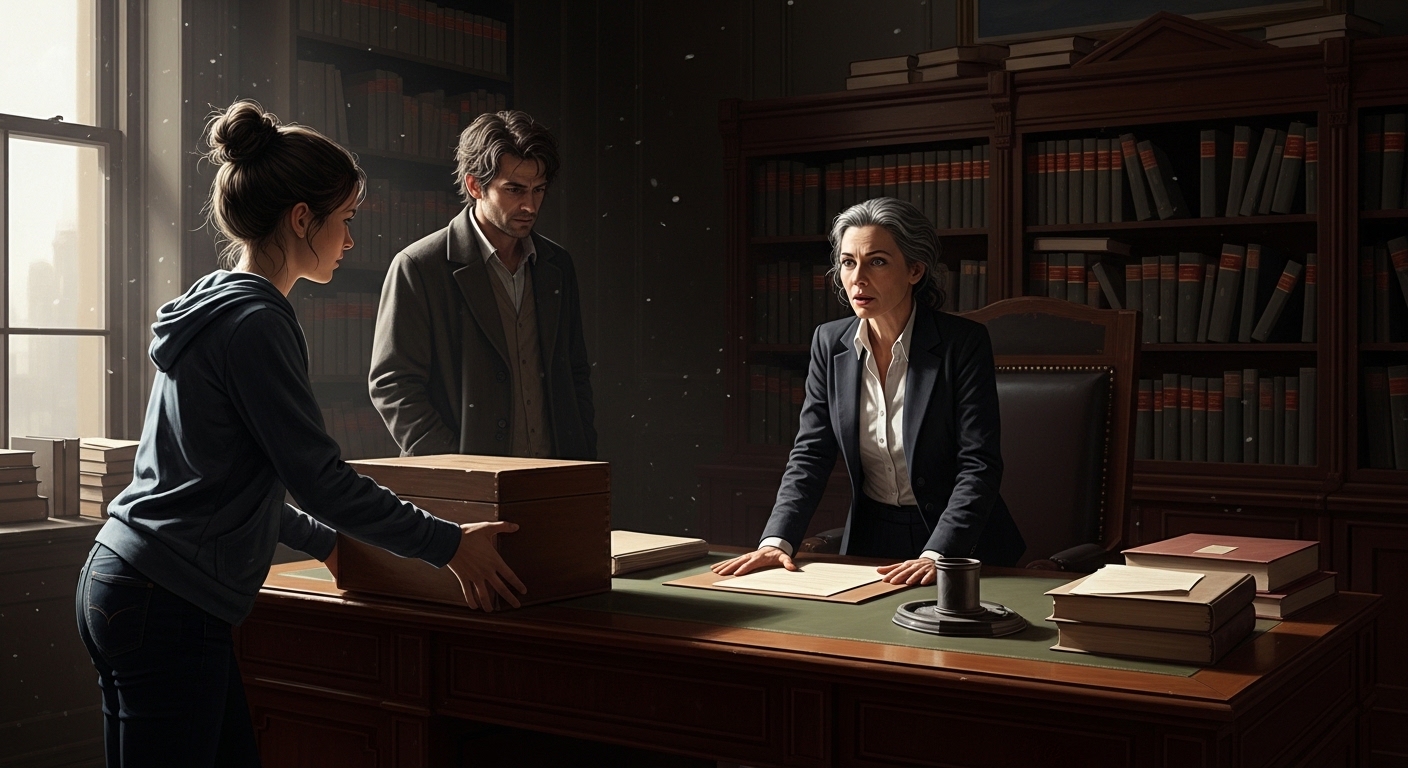
Elaine worked, her fingers dancing across the keys, a blur of motion as she sorted, organized, and made sense of other people’s documents. Freelance indexing, she called it. The Library, that monolithic, silent entity, would not have her back. Too many questions, too many blank spaces in her employment history that could not be explained without unraveling everything, and everything was not for public consumption. Not for those who still believed in the predictable order of reality. Her headphones were a silent barrier, a subtle demarcation of the line between her world and his, a bubble of focus in the small space. Making sense, he realized, was what she did. It was what she had always done, what the Library had honed in her before it had stolen her sister’s name and given nothing but a void in return. The name had not returned.
He had asked, tentatively, in the second week, when the fever had finally broken, and the wound had stopped its weeping, when consciousness had finally permitted questions again. His voice, hoarse from disuse, had barely been a whisper in the quiet room.
The Echo of Copper
The scent of brewing coffee mingled with the faint, metallic tang of disinfectant that still clung to the apartment, an invisible cloak of convalescence. Adrian watched Elaine, her brow furrowed in concentration, the soft glow of the screen illuminating the subtle changes time had wrought. The tension in her shoulders was less pronounced, the haunted look in her eyes softened, though never entirely gone. Her meticulous nature, once a tool of the Library, was now directed at the chaos of freelance contracts, a way to impose order on a world that had tried to strip them of all logic. He found a strange comfort in her presence, in the silent understanding that passed between them without words, a bond forged in the crucible of shared impossible truths.
He remembered the raw desperation in her eyes, the moment she had accepted the unthinkable cost, the memory of her sister’s name, traded for a sliver of hope. It was a wound far deeper than any bullet, a phantom limb of identity that ached in the silence. Yet, she persevered. The small, almost imperceptible lift at the corners of her mouth when she successfully organized a particularly dense index was a profound thing, a quiet defiance. They were two broken things, mending in parallel, their shared space a cocoon against the lingering shadows of what they had faced. The sofa, a worn floral pattern, had become his nightly anchor, a silent acknowledgment of the undefined space between them, a fragile truce between crisis and something that had yet to find its name.
Sometimes, in the quiet hours when sleep refused to come, Adrian would trace the scar on his shoulder, a rough ridge against his skin. It wasn’t just the physical sensation; it was the memory embedded within the fibers of his being, the echo of the fundament, the impossible architecture of reality bending and tearing around them. He had seen things, experienced sensations that defied human comprehension, and the quiet domesticity of this apartment often felt like a dream from which he might abruptly awaken, finding himself back in the desolate, collapsing spaces between worlds. But then the scent of Elaine’s coffee, the soft clack of her keyboard, or the distant rumble of a passing truck would pull him back, grounding him in the fragile, hard-won present. This was real. This quiet, imperfect existence was real.

The Carpenter’s Peace
The sound of the lock turning, then the familiar creak of the door, broke the morning’s quiet. A new scent entered the apartment, a rich, earthy aroma of cedar and pine, the particular perfume of freshly cut wood. Daryl stood framed in the doorway, a faint dusting of sawdust clinging to his worn work jacket, a quiet strength settling into his broad frame. He had the calm demeanor of a man who had wrestled his demons into submission, not through brute force, but through meticulous, painstaking creation. He always brought the scent of something tangible, something made with hands and purpose, a stark contrast to the ethereal horrors they had faced.
“Built you something,” Daryl said, his voice a low rumble, the usual tremor gone. He set a small wooden box on the kitchen table, its surface smooth, the grain beautiful. The joinery was flawless, dovetails interlocking with an almost impossible precision, held not by glue or nails, but by the perfect geometry of wood embracing wood. It was a simple object, yet held the weight of profound effort, a quiet act of healing. Adrian opened it. Inside, there was nothing. Just empty space, waiting.
“It’s empty,” Adrian said, a faint surprise in his voice. Daryl smiled, a genuine, unburdened expression. “Yeah. Figured you’d fill it.”
“Got a commission,” Daryl announced, taking a slow sip of coffee. “Kitchen cabinets. Some tech guy in Madison Park. Custom work. Pays well. Pays enough I can finally quit the job site. Just build. Just make things.” A quiet satisfaction bloomed in his eyes, the light of a man who had found his true calling after wandering through the wilderness. Adrian nodded, a small smile touching his lips. “That’s good.” “Yeah,” Daryl affirmed, his gaze sweeping across the small apartment, lingering on Elaine, then Adrian. It had become their sanctuary, a makeshift recovery ward, a safe house where three damaged souls were slowly learning to be people again, rather than a crisis response unit.
“Zeke’s garden is coming along,” Daryl continued, a hint of genuine amusement in his voice. “Bonsai. Got six trees. Says they’ll take years. Says that’s the point. Says counting time in years instead of seconds is the whole reason for doing it.” He still shook sometimes, Adrian knew, the phantom tremors of a world unmaking itself, but less now. Zeke, finding solace in the quiet mathematics of a bookstore. “Says numbers are easier when they’re just prices,” Daryl relayed, “when they don’t have to mean anything except what things cost.” And Ashley. Daryl’s face shifted, a subtle, guarded expression replacing the openness. Information was delicate, he had learned. Sometimes silence carried more weight than words.
“She asks about you.” Elaine’s fingers, which had been a blur of motion, stilled on the keyboard. The faint click-clack faded. “She came by the shop yesterday,” Daryl elaborated, choosing his words with care. “Wanted to know if you were okay. If you needed anything. If.” He trailed off, the unspoken question hanging heavy in the air. “If what?” Adrian prompted. “If you were staying here. With Elaine. If that was. If you two were.”
“Tell her he’s okay,” she said, her voice clear and steady. “Tell her he’s healing. Tell her she’s welcome to visit.” Daryl nodded. “She knows that.” “Then tell her anyway.”

The Unthreaded Soul
Maya Chen arrived the next afternoon, a stark figure against the worn linoleum of the hallway. Adrian opened the door, the shoulder pulling, a familiar protest, but holding firm. His arm, eighty percent, maybe eighty-five, functioned. She looked different, not physically, but something in her eyes. The flat, distant gaze was gone, replaced by a restless awareness. They moved, tracking him, registering his presence, responding with a spark of recognition. The automation had vanished, the invisible threads that had bound her to the Consensus now severed. The wound, the impossible architecture of her being, had closed, rewritten, and the seal was permanent.
“You’re awake,” she stated, her voice devoid of its former metallic precision, now tinged with a strange, hesitant quality. “Yes.” “I wasn’t sure. After. After the platform. After I warned you. After everything went. I don’t remember. I remember being on the platform and then I remember waking up in my apartment and a month had passed and I don’t know what happened in the month and no one will tell me.”
A profound sadness settled in the small room, thick as the afternoon fog outside. She held out a crumpled letter. “I got mail,” she said, her voice barely a whisper. “Letters. From people I don’t remember. From a mother I don’t remember having. From a brother who says we used to be close. They’re coming to visit. They want to see me. They want me back. And I don’t know how to tell them that the person they remember is gone. That whoever I was before the threading. She doesn’t exist anymore. Can’t exist. Too much time passed. Too much changed. You can’t just. You can’t just go back.” Elaine, who had been listening intently, finally spoke, her voice soft but firm.
“Why did you come here?” Adrian asked, cutting through the silence. “To say thank you. To say. I don’t know. To say you closed it. You ended it. I’m free now. Even if free means empty. Even if empty means lost. I’m not threaded anymore. I’m not template. I’m not part of something larger. I’m just. Me. Whoever that is. And I wanted you to know that mattered. That what you did. It mattered.” She stood, the movement still a little stiff, as if her limbs were foreign. At the door, she paused, turning back. “I’m going to try,” she said, her voice stronger, a fragile thread of determination. “To see my mother. My brother. To see if I can. If there’s anything left of the person they remember. If not. If there’s nothing. Then at least I tried. At least I know.” And then she was gone. The door clicked shut, leaving only the quiet hum of Elaine’s laptop, the steady click-clack resuming its rhythm. Adrian returned to the couch, the shoulder pulling, the arm holding. Eighty percent. Maybe eighty-five. The weight of Maya’s words, of her emptiness, settled upon him like a shroud.

A Shared Silence
Evening came, drawing its grey curtain across the city, the ordinary death of another day. The light failed, the world outside fading into a wash of muted colors before surrendering to black. A knock, gentle but firm, broke the creeping silence. Adrian answered. Ashley stood there, a paper bag clutched in her hands, the warm, tantalizing scent of basil, lime, and coconut milk wafting from it. Thai takeout. The small comfort of food someone else had prepared, of calories that required no effort, that simply *were*, because restaurants existed, and restaurants meant civilization, and civilization meant the world still pretended it knew what it was doing.
“Daryl said you were here,” Ashley said, her voice soft, tentative. “I’m here.” “Can I come in?”
“I brought food,” Ashley offered, her voice breaking the spell. Elaine pushed herself away from the table. “I’ll get plates.” Soon, the small kitchen table was set for three. Three plates, three forks, an ordinary ritual, imbued with extraordinary meaning. A shared meal. Eating together, because eating together meant family, and family was the thing one built when the thing one was born into failed, or was never there, or existed somewhere one could not return. They ate, the conversation small, almost mundane. Work. The weather. The small accumulated debris of living that required discussion. Zeke’s bonsai, Daryl’s commission, Marshall’s continued silence, the Consensus’s unsettling absence. Ordinary victories and ordinary losses that comprised days, now that days were no longer measured in seconds of crisis, but in the slow, rhythmic pulse of healing.
After the food was gone, the plates cleared, and the small rituals complete, Ashley spoke, her voice quieter now, a tremor of vulnerability beneath the surface. “I’m staying in Seattle,” she said, looking between Adrian and Elaine. “Got a job. Coffee shop. Pioneer Square. It’s not. It’s nothing. Just work. Just normal. But normal is. I don’t know. I’ve never had normal. Never tried. I want to try.” Adrian found himself nodding, a profound understanding passing through him. “That’s good,” he murmured. “I have an apartment. Small. Studio. But it’s mine. My name on the lease. My space. No one else’s. I’ve never. I’ve never had that.” She looked at him again, then at Elaine, at the unspoken space between them. “I wanted you to know. In case. In case you wanted to. To visit. Or. Anything.” The invitation hung in the air, clear and gentle. It spoke of presence, of open doors, of choices left unpressured, unassumed.
The Space Between
Elaine stood then, a sudden, decisive movement. “I’m going to shower.” She left, the bedroom door closing softly behind her. The muffled sound of running water began, the ordinary ritual of steam and soap, of cleansing that was just cleansing, not a metaphor for anything larger. Adrian sat with Ashley in the comfortable silence that followed, a quiet understanding that words were optional when presence was sufficient. The subtle scent of her, like rain and distant pine, filled the space. “I don’t know what I’m doing,” Adrian confessed, the words a raw whisper. Ashley reached across the table, her fingers briefly touching his, a fleeting, comforting contact.
She stood, moving towards the door, the small, quiet strength in her posture more pronounced than ever. “The void is gone,” she said, her voice almost a wonder. “Completely. I tried. Last week. Tried to feel it. To remember what it felt like. To check if I could still. And there’s nothing. Just me. Just solid. Just this.” She touched her arm, the living flesh, the proof of existence, tangible and real. “I hated being void. But I miss it too. Isn’t that stupid? Missing the thing that made me nothing. But it was. It was mine. It was what I was. And now I’m just. This. And I don’t know what this is supposed to be.” Adrian looked down at his own hands, scarred and imperfect. “Neither do I.” Ashley’s gaze met his, a flicker of something fierce and determined in her eyes. “Then we’ll figure it out.” She left. The door closed, a soft click that resonated with finality and beginning.
The Open Door
The running water from the bathroom stopped. Elaine emerged, hair damp, skin flushed from the heat, wrapped in a large towel. She moved with a quiet grace, her presence filling the suddenly empty space left by Ashley. She sat beside him on the couch, close, the space between them measured in inches, in the small, comfortable distance that spoke of proximity without commitment, nearness without definition. He felt the warmth radiating from her, the soft scent of shampoo replacing the lingering spice of Thai food.
“My sister’s name,” she said, her voice barely a whisper, a thread of ancient sorrow woven through the present quiet. “I still don’t remember.” Adrian simply squeezed his shoulder, a silent acknowledgment. “I know.” “But I remember her. I remember what she felt like. What her laugh sounded like. What it meant to have her. I just. I can’t say her name. Can’t write it. It’s gone. That specific thing. That specific word. Gone.” “I’m sorry.” “Don’t be,” she said, pulling back to look at him, her eyes clear and unclouded by regret. “I gave it. I chose to give it. To save her from knowing about the Library. About what I became. About what I saw. She’s safe now. She doesn’t know. And the not-knowing cost her name but saved her mind and I would make the same choice. I would give it again.” The conviction in her voice was absolute, a testament to a love that transcended memory.
She sat up fully, her gaze searching his. “What are we?” she asked, the question hanging between them, fragile and real. “I don’t know.” “Do we need to know?” He considered this, the slow rhythm of his breathing a counterpoint to his thoughts. “Not yet.” A ghost of a smile touched her lips. “Then not yet.” She stood, moving towards the bedroom, stopping at the threshold. She looked back at him, a subtle invitation in her eyes, in the tilt of her head.
His shoulder pulled. His arm held. Eighty percent. Maybe eighty-five. Outside, the city continued its ceaseless, indifferent hum. Inside, the water heater rumbled, the refrigerator clicked, the ordinary sounds of ordinary life, sounds that had been earned through fire and seams, through the fundament pressing, through five disparate pieces combining, through costs that would never be fully paid, for some costs accumulated interest forever. But he was here. Alive. Healing. Uncertain. And uncertain, he realized, was enough when enough was all there ever was. He stood, the decision a quiet certainty blooming in his chest. He walked to the bedroom, the open door a silent affirmation. Not the final choice. Not the only choice. Just the choice for tonight. For now. For the small moment that existed between this breath and the next. He stepped through. The door closed. The light went out. The city slept. And in the morning, when morning came, there would be coffee and indexing, and perhaps Ashley would visit, and perhaps Daryl would bring another wooden box, and perhaps Maya would learn her mother’s face, and perhaps Zeke’s trees would grow one careful increment closer to the shapes he imagined. And perhaps none of it would matter in the long arc of time, which had no concern for the small choices of small things. But it mattered now. Here. In this apartment. In this moment. In this life that had been earned through sacrifice and blood, and the fundamental, stubborn refusal to let the fundament win. It mattered.