Previously on… The Letter is Ash
A Gentleman of Unpleasant Edges
The man in the charcoal grey coat held his cup of coffee as if it were a biological sample he had been tasked with transporting through a war zone. He hadn’t touched it. He hadn’t so much as glanced at the menu, which Mick had painstakingly rewritten that morning in a script that trembled with both artistic flair and raw, existential terror. The man, who had introduced himself as Mr. Sterling, was not here for caffeine. He was here for answers, and his very presence made the air in the Brass Ring Café thick enough to carve.
Eddi Voss descended the stairs from his office, the practiced smile of a humble proprietor fixed firmly on his face. He felt the man’s gaze on him, a look as sharp and unyielding as the crease in his trousers. Downstairs, the café was a symphony of stress. The scent of cinnamon, ginger, and scorched sugar—the unmistakable aroma of Mick’s “Desperate Professional Anxiety” baking cycle—hung heavy in the air. Through the kitchen hatch, Eddi could see the baker himself kneading dough with the kind of focused violence usually reserved for settling old scores.
“Mr. Voss?” Sterling’s voice was the sound of an expensive pen scratching across high-quality vellum. “I am Mr. Sterling, from the Office of Administrative Oversight. I trust I am not interrupting anything… urgent?”
His eyes flicked to a small smudge of marsh-mud Eddi had missed on his cuff. A silent accusation.
“I represent the interests of the City Administrator’s office regarding the unfortunate collapse of the South Marsh Terminus last night,” Sterling continued, setting the untouched coffee cup down. “We have a report—highly unofficial, but remarkably detailed—that places a man of your description at the scene during the, shall we say, ‘unscheduled demolition.’ Along with a certain… Mr. Reeve.”
Eddi’s heart gave a little lurch, but his face remained a placid mask of polite confusion. The ashes of the letter he’d recovered were still warm in his office hearth. Reeve was a “guest” of the authorities, which was a polite way of saying he was in a cell that probably smelled of damp stone and regret.
“I believe it would be in everyone’s best interest if we had a very private, very thorough conversation before the City Watch decides to turn this charming establishment into a crime scene,” Sterling finished. “Wouldn’t you agree?”
“No,” Eddi said, the smile finally tightening at the edges. “That won’t be ideal.” He gestured up the stairs he’d just descended. “My office. It’s… cozier.”
The office was a masterclass in organized chaos, filled with ledgers that looked important and maps that looked expensive. Sterling followed him up, his posture so rigid it seemed to offend the creaking floorboards. Eddi called for his second-in-command.
“Rabbit!”
One moment, the doorway was empty. The next, she was there, leaning against the frame as if she’d been part of the architecture all along. Her fingers were stained with graphite, and she regarded Sterling with the detached curiosity a cat might afford a particularly slow-moving beetle. Sterling, to his credit, didn’t flinch, but he did adjust his cuffs.
“Let us skip the pleasantries,” the bureaucrat said, taking a seat and placing a leather portfolio on Eddi’s desk. The sound was a soft, final thud. “We know Mr. Reeve was attempting to secure a certain… artifact from the terminus. We also know that you and your associates were present. What the City Administrator dislikes is missing paperwork. There was a letter. We believe you have it.”
Rabbit’s eyes flicked to the fireplace, then to Eddi. A universe of meaning passed in that single glance. The letter was a smear of carbon, its secrets gone to the Great Filing Cabinet in the Sky.
“Give us the letter,” Sterling said, his voice dropping. “Provide a statement that places the blame for the collapse squarely on Mr. Reeve’s… ‘enthusiastic’ shoulders, and the Brass Ring Café remains a ‘respectable establishment.’ Refuse, and well… I hear the tax audits this time of year are particularly… thorough.”
Eddi leaned back in his chair, forcing a casualness he was a thousand miles from feeling. He was a simple purveyor of caffeine and comfort, he explained, his voice as smooth as a freshly polished counter. If he’d been in a marsh, he’d be much more damp. The only correspondence he handled involved the price of coffee beans. He projected the very image of a man too busy and successful for such grubby affairs.
Sterling’s eyes drifted to the fireplace. He couldn’t see the ash, but he saw the brass poker still leaning against the hearth. A thin, knowing smile touched his lips. It was not a friendly smile. It was the smile of a man who has just found a loophole in a contract.
“A simple purveyor,” Sterling repeated, the words dripping with sarcasm. “Of course. Then you won’t mind if I leave a couple of my associates outside? Just to ensure no ‘unauthorized’ documents leave the premises while we conclude our investigation.”
He stood, his point made. “I’ll give you until noon to ‘find’ anything that might have slipped behind a desk, Mr. Voss. At noon, the City Watch arrives with a warrant. I’d prefer to find the letter before they find… whatever else you have hidden in the cellar.”
Eddi escorted him to the door, pressing one of Mick’s more tragically over-baked pastries into his hand. It was a charcoal-edged lump that had once dreamed of being a pain au chocolat. Sterling accepted it with the tips of two fingers, wrapped it in a silk handkerchief, and departed. From the window, Eddi watched him go, and saw two men in heavy wool coats detach themselves from the shadows across the street. The café was under siege.
He turned back to the room. Rabbit was still there, whittling a small piece of wood with a wickedly sharp knife. Turtle, the café’s massive, silent protector, had appeared at the top of the stairs, his presence making the floorboards groan in protest.
“Problem,” Eddi said.
“That’s one word for it,” Rabbit replied without looking up. “Other words might include ‘catastrophe,’ ‘fiasco,’ or ‘that thing where we all end up in the Iron-Grip Prison eating thin soup for the next twenty years.’”

An ‘It’, a Moustache, and a Loophole
The office felt small, the walls closing in with every tick of the clock on the mantelpiece. It was just past nine. They had less than three hours. Mick appeared behind Turtle, his apron so white with flour he looked like a very nervous ghost.
“They’re watching the back door, too,” Turtle rumbled, his voice like two tectonic plates having a civil disagreement. “Two of ’em. Not Watchmen. Pell’s private security. The ‘Accidental Falling Down Stairs’ specialists.”
Rabbit flipped her knife, catching it perfectly. “We can’t give Sterling what he wants because what he wants is currently floating out over the chimney-pots,” she said, her dark eyes narrow. “The clock’s ticking, boss. We need a third option.”
A slow smile spread across Eddi’s face. “I might know a guy.”
Rabbit sighed, a long, weary sound. “Is this the ‘someone’ who helped us with the Valdris ledger, or the ‘someone’ who nearly got us turned into fertilizer in the Warrens? Because I have a very specific preference, Eddi, and it involves not being compost.”
“It’s not a guy,” Eddi clarified. “It’s an ‘it’.”
Rabbit’s eyebrows performed a feat of narrative acrobatics that suggested they were considering emigrating to the back of her head. “An ‘it’? Eddi, we are being circled by the legal equivalent of vultures, and your solution is a mechanical man-at-gears?”
“Falstaff,” Eddi said. The name belonged to a three-hundred-pound automaton of brass and copper, the failed experiment of an alchemist who had wanted a friend and instead created a walking encyclopedia of municipal law with a penchant for quoting poetry. Falstaff was currently “volunteering” at the City Watch House, where he served as a filing cabinet that didn’t complain about the damp.
“He’s more than a filing cabinet,” Eddi explained, pacing. “He has every city ordinance, every obscure by-law, and every health and safety regulation etched into his brass brain. The Sergeant is too lazy to read, so he lets Falstaff sign off on ‘Minor Nuisance Dispersals.’”
The plan bloomed in his mind, beautiful in its sheer, unadulterated pettiness. “Falstaff can move them. Not with force—that’s messy. With bureaucracy. He can make their lives a living hell of paperwork that will take them three hours to resolve. Just long enough for us.”
Turtle grunted in approval. “I can go. I’ll carry a sack of flour to the bakery two doors down. They’ll see a big man doing big man things. They won’t see me slip a note to the street urchin by the well.”
Eddi scribbled the note, a masterpiece of legal gibberish coded in a way only a machine with an alchemist’s logic could decipher. It cited a loophole regarding “unlicensed observation of a licensed cardamom-processing facility,” a felony if the wind was blowing North-Northwest. Turtle tucked it into his boot, hefted a sack of rye flour, and lumbered out the front door. The men in wool coats watched him go, one of them having to step aside as Turtle “accidentally” swung the heavy sack a bit too wide.
They didn’t have to wait long. A distant, rhythmic sound began to echo through the Merchant Quarter. A sound like a steam engine having a polite disagreement with a blacksmith’s shop. Clank. Hiss. Clank.
“He’s coming,” Rabbit whispered, a look of genuine glee on her face. “I hope he’s wearing the ceremonial sash.”
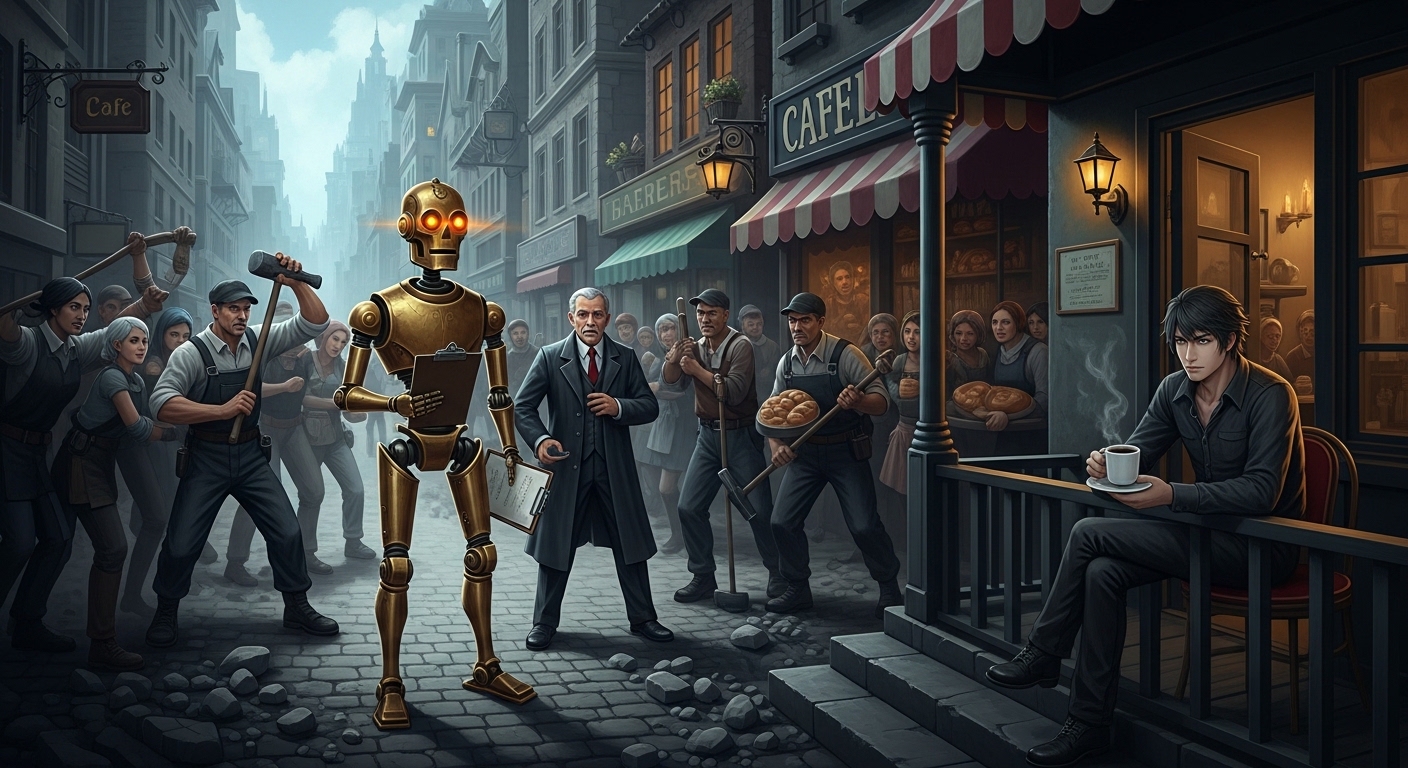
He was. A massive figure of polished brass, wearing a dusty City Watch sash and carrying a clipboard that looked like it had been fashioned from a tower shield, rounded the corner. He stopped directly in front of the two observers, his shadow swallowing them whole. A hatch on his chest vented a small, aromatic cloud of lavender-scented steam.
“GREETINGS, CITIZENS,” Falstaff bellowed, his voice a pipe organ being played by a very polite earthquake. “I AM UNIT 04-F. I AM CONDUCTING A STATISTICAL AUDIT OF PAVEMENT WEAR AND TEAR. YOU ARE CURRENTLY EXERTING UNSANCTIONED PRESSURE ON A DESIGNATED ‘FRAGILE COBBLESTONE ZONE.’”
The man with the newspaper looked up, blinking. “A what? We’re just standing here, tin-man.”
“NEGATIVE,” Falstaff’s optics glowed a soft, judgmental amber. “ACCORDING TO CITY ORDINANCE 74-C, STATIONARY PRESENCE EXCEEDING SEVEN MINUTES WITHOUT A VENDING PERMIT OR A VISIBLE LUMBAGO EXEMPTION IS CLASSIFIED AS ‘UNAUTHORIZED ARCHITECTURAL INTERFERENCE.’ PLEASE PRODUCE YOUR PERMITS.”
This was Eddi’s cue. He stepped out onto the café’s porch, leaning casually against the doorframe. He caught the lead observer’s eye and offered a small, winning smile. He lifted two fingers in a slow, jaunty, and utterly infuriating wave.
“Terrible business, the cobblestones,” he called out sympathetically. “Very sensitive this time of year. Good luck with the paperwork, gentlemen!”
Before they could form a reply, Eddi spun on his heel and vanished back into the café, slipping through the kitchen as Falstaff began reciting the legal definition of “loitering.” Rabbit was waiting in the back alley, having dropped from the rafters like a particularly stylish soot-sprite. Turtle was at the end of the block with a coal-cart he’d “borrowed.” They were out. They were mobile. But the clock was still ticking.

The Impromptu Gala Gambit
In the relative safety of the coal-cart, nestled between sacks that smelled of soot and industry, Eddi looked at Rabbit. Her face was grim, her mind already calculating angles and escape routes.
“Rabbit,” he said with complete earnestness. “We need to throw a party.”
She stared at him. It was a long, unblinking look, the kind of look one gives a person who has just suggested putting out a fire with a bucket of lamp oil. “A party,” she repeated, her voice flat. “We have two hours and change until Sterling returns with a warrant to dismantle our lives, and your plan is… finger foods and festive bunting?”
“Exactly,” Eddi confirmed, a wild grin spreading across his face. “A ‘too many important witnesses for the Watch to break things’ kind of party. If the Brass Ring is hosting the Annual Merchant’s Guild Appreciation Breakfast, Sterling can’t just kick the doors in. Not without creating a diplomatic incident that would make his boss’s head spin.”
Rabbit’s own grin finally broke through. It was not a nice grin. It was the grin of a predator who had just realized the trap was actually a buffet. “The chaos of a crowd,” she whispered. “Hiding in plain sight. We can plant a forged letter right under their noses.”
The plan shifted, evolving from a simple escape into a masterpiece of social engineering. Rabbit vaulted from the cart, a blur of leather and determination heading for the rooftops to rally the runners who would spread the “invitations.” Turtle rumbled that he would get the extra chairs from the cellar and inform Mick that he was going to need a lot more butter. Eddi, meanwhile, had his own errand to run.
He slipped through the labyrinthine alleys to a shop that didn’t so much have a front door as a series of obstacles designed to discourage casual browsers. The air inside Oskar Flint’s House of “Almost” History smelled of dust, damp vellum, and secrets that had gone slightly moldy. Oskar himself was hunched over a desk, peering through a jeweler’s loupe at what he was trying to turn into a 4th Century coin.
“Voss,” he croaked without looking up. “The answer is no.”
“Oskar, my friend, my confidant,” Eddi began, leaning over the desk. “I don’t need a map. I need a letter. Administrator-grade cream vellum. Blue-black ink from the 10th year of the Republic. And the seal of the South Marsh Terminus Authority.”
Oskar froze. “Pell’s office? Are you trying to get me hung, Eddi?”
“I’m trying to throw a party, Oskar. And I need a guest list that looks like it was signed by the late Construction Lead.” Eddi then relayed the most important part of the plan. The letter wouldn’t just exonerate them; it would be poisoned. It would contain a juicy, plausible, and utterly fictitious detail about secret payments from the construction lead to one of the City Administrator’s chief political rivals.
After a healthy amount of grumbling, complaining about his gout, and the negotiation of a steep fee, Oskar set to work. His hands moved with the terrifying precision of a surgeon whose soul had been replaced by a fountain pen. Eighteen minutes later, he handed Eddi a document that felt heavy, smelled of old ink and subtle corruption, and looked more real than the original ever could have.
Before returning to the café, Eddi made one last stop. He met Falstaff, who had successfully escorted the wool-coat twins to the Watch House for “re-calibration of their sense of public space.” As a reward, and to complete the new plan, Eddi carefully applied a jaunty, waxed handlebar moustache to the automaton’s facial plating.
“AERODYNAMIC DRAG HAS INCREASED BY 0.002 PERCENT,” Falstaff rumbled, his internal gears clicking with what sounded suspiciously like pride. “I FEEL… DISTINGUISHED. I SHALL BE ‘OFFICER FALSTAFF: UNDERCOVER SPECIALIST.’”
The Dance of Deception
When Eddi returned to the Brass Ring, the street had been transformed. A long piece of red velvet served as a carpet, leading to the open door. A crowd of local merchants, lured by the promise of free “Secret Reserve” coffee and the chance to be seen at the city’s most talked-about new event, were already milling about. Turtle, wearing a bowtie that looked to be actively strangling him, was greeting guests with the terrifying politeness of an executioner turned butler.
“The guests are arriving, Eddi,” Mick whispered as he slipped inside, carrying a tray of pastries shaped like little brass gears. “Sterling should be here any minute. Where are we putting the ‘evidence’?”
“On. Me,” Eddi whispered back, tucking the perfect lie into the inner pocket of his waistcoat, right over his heart.
He stepped out from the kitchen and into a hurricane of social ambition. He moved through the crowd like a shark in a velvet suit, patting shoulders, laughing at jokes, and projecting an aura of effortless success. He was the Legitimate Businessman personified. And then he saw her.
Rabbit was by the punch bowl, looking as if she were contemplating the most efficient way to pick the pocket of the entire Guild at once. She’d polished her iron ring, and her hair was pulled back with a precision that bordered on military.
“A dance, Miss Ashford?” he asked, extending a hand.
Rabbit looked at his hand as if it were a suspicious piece of evidence. “Eddi, we are in the middle of a high-stakes bureaucratic shell game, and you want to… frolic?”
“Atmosphere, Rabbit,” he whispered. “A guilty man hides. An innocent man dances.”
She sighed, a sound of profound resignation, and placed her callused, steady hand in his. A trio of street musicians struck up a jaunty, slightly off-key waltz, and he spun her into the center of the room. For three glorious minutes, Eddi wasn’t a con artist with a forged letter in his pocket; he was the King of the Merchant Quarter. He was magnificent. As the music swelled, he dipped her low, the grey light from the window catching the matching iron rings on their fingers, flashing in a brief, perfect unison.
“You’re actually not terrible at this,” Rabbit muttered, her face inches from his.
“Too late,” he grinned back.
Suddenly, the music died. The front door hadn’t just opened; it had yielded. The crowd parted like a nervous sea, and in walked Mr. Sterling. He was flanked by four City Watchmen in ceremonial plate that clanked with the weight of legal authority, and the two wool-coat twins, who looked significantly ruffled and smelled faintly of the Watch House’s dampest holding cells.
Sterling stepped onto the red velvet. He looked at the pastries, the merchants, and finally, at Eddi, still holding Rabbit in a theatrical dip.
“Mr. Voss,” Sterling said, his voice cutting through the festive air like a guillotine blade. “I believe I told you noon. It is exactly twelve o’clock. And I believe I mentioned a warrant.” He held up a scroll, its heavy wax seal looking very, very final. “The party,” Sterling announced to the room, “is over.”

A Performance on the Porch
The silence in the café was absolute. A merchant dropped a gear-shaped pastry, and the sound echoed like a gunshot. Sterling’s eyes, cold as two chips of flint, were locked on Eddi. The four Watchmen secured the exits, their presence an iron cage closing around the party.
Instead of panicking, Eddi straightened up, releasing Rabbit. He then executed a bow so deep, so florid, and so exquisitely terrible that it was a physical insult. It was the bow of a man technically complying with social norms while simultaneously implying that Sterling’s grandmother was a very unattractive goat.
“Sterling,” Eddi declared, his voice ringing through the room. “The party’s just started. Step outside with me for a while.”
“Outside?” Sterling repeated, his voice thin with rage. “Mr. Voss, I have a warrant. I don’t need a tour of the cobbles.”
“And you shall have the contents of this building!” Eddi boomed, playing to the captive audience of Guild members. “But as you can see, the Brass Ring is hosting the cream of Caulfield’s commercial heart. If you start pulling up floorboards now, you’ll be doing it in front of the very people who pay the taxes that fund your expensive boots. A moment of your time, Sterling. In the fresh air. Unless, of course, the City Administrator is afraid of a little… public opinion?”
Sterling was trapped. To refuse in front of this many witnesses would make him look like a common thug. He snapped his fingers at the Watchmen. “Stay here. Secure the exits.” He turned back to Eddi. “One minute, Voss. Spend it wisely.”
Eddi led him out onto the front porch. The door closed behind them, muffling the nervous chatter. It was just the two of them, the simmering wool-coat twins, and a seven-foot-tall, moustachioed automaton standing at perfect attention. Falstaff’s presence was a silent, brass question mark in the middle of the confrontation.
“The letter, Eddi,” Sterling whispered, dropping all pretense now that the audience was gone. “Give it to me now, and I might find a way to make this warrant disappear.”
This was the moment. Eddi threw a hand to his forehead, his body language a symphony of wounded dignity, fully aware that every merchant inside was pressed against the window, watching the drama unfold.
With that, he flourished the forged document from his waistcoat. It was Oskar Flint’s masterpiece. It looked damp, slightly scorched, and utterly authentic. Sterling’s eyes locked onto the heavy wax seal, his hunger palpable.
“Is this it?” he hissed, reaching.
Eddi pulled it back an inch. “To have my private, confidential business documents seized in such a… boorish fashion!” he declared for the benefit of the watchers.
Next to them, Falstaff shifted his weight, the sound like a ship hitting a pier. “PROCEDURAL OBSERVATION,” the automaton bellowed, his moustache vibrating. “AS A SWORN AUXILIARY OF THE CITY WATCH, I MUST NOTE THAT THE TRANSFER OF EVIDENCE SHOULD BE LOGGED. WOULD YOU LIKE ME TO… STAMP IT?” Falstaff raised a hand that held a stamp the size of a dinner plate.
“No!” Sterling flinched away from the mechanical giant. “I’ll handle the filing. This is… sensitive.” He snatched the letter from Eddi’s hand. He broke the seal on the spot, his eyes darting across the text. Eddi watched his face. He saw the flicker of confusion, then the dawning realization, then the avaricious gleam as Sterling read the part about the secret payments to his boss’s rival.
He hadn’t just found evidence of a collapse; he’d found political dynamite.
“This…” Sterling stammered, tucking the letter into his breast pocket as if it might catch fire. “This changes things. The search is… suspended. For now.” He shouted through the glass to the Watchmen. “Withdraw! We have what we came for!”
And just like that, he was gone, practically running down the street, clutching the beautiful, perfect lie to his chest.
The Untouchable Proprietor
The porch was suddenly quiet, save for the gentle hissing of Falstaff’s cooling vents. The café door creaked open, and the merchants began to pour out, murmuring in a state of collective shock. Rabbit was the first to reach Eddi’s side. She stood beside him, watching Sterling disappear around the corner.
She looked at Eddi, then at Falstaff’s moustache, which was starting to peel, then back at Eddi.
“He took it,” she said, her voice a low, admiring whisper. “He took the fake. And he just cancelled a warrant in front of twenty of the most influential people in the city.” A small, genuine smile tugged at the corner of her mouth. “Eddi… that was the most beautiful disaster I’ve ever seen.”
“Well, Rabbit,” Eddi smiled, smoothing his waistcoat. “We have guests to entertain.”
He threw the doors open and stepped back into the stunned silence of the café. “GENTLEMEN! LADIES! ESTEEMED MEMBERS OF THE GUILD!” he roared. “My sincerest apologies for the… administrative interlude! A minor misunderstanding regarding the city’s ‘Strategic Pastry Reserve’ policy!”
A few nervous ripples of laughter broke the tension. He signaled the band, who launched into a rowdy folk tune. The party swung back into gear, louder and more energetic than before. The Brass Ring wasn’t just a café anymore; it was the most politically interesting spot in the Quarter, and its proprietor was no longer just a businessman, but a folk hero who had stood down the Administrator’s office and won.
As the afternoon wore on, Turtle brought Falstaff inside for a bucket of “Tactical Lubrication.” Rabbit reappeared at Eddi’s side with two glasses of something amber and expensive. She handed one to him, and their iron rings clinked together in a silent toast.
“To the letter,” she said softly.
“To the letter,” he replied. “May it cause exactly as much trouble as I intended.”
Across the city, in a cold office, Mr. Sterling was about to unleash a political firestorm based on a lie baked in a forger’s shop and delivered with a theatrical bow. But here, in the Brass Ring, the air was warm, the coffee was bitter, and for the first time all day, Eddi Voss didn’t have to look over his shoulder. He had become, for a time, untouchable.