Previously on… Loose Ends and Ledger Lines
An Unscheduled Audition
The Fourteenthday afternoon in Caulfield arrived with a rare, apologetic beam of sunlight that cut through the usual grey haze, illuminating the dust motes dancing in the Brass Ring Café. The lunch rush had successfully concluded, leaving behind the comforting scent of roasted coffee and the lingering aroma of whatever Mick had stress-baked at three in the morning. Eddi Voss leaned against the worn grain of the bar, the bruise on his jaw finally fading from chartreuse to a slightly less aggressive shade of violet. In the corner, where the cartographers usually sat hunched over their maps, was a small mountain of musical instruments. A traveling bardic troupe had run up a spectacular tab the night before, realized they were entirely without coin, and left their gear as collateral until they could “secure funding from a wealthy patron.”

Mick, the café’s proprietor and a man whose nervous system was perpetually vibrating at a high frequency, was staring at an acoustic guitar as if he expected it to bite him.
“You know,” Mick said, his voice hitting that dangerous pitch of optimistic energy that usually preceded a terrible suggestion. “If they don’t come back for these… we could have live entertainment. It draws a very respectable evening crowd. We could… we could be the entertainment.”
At her usual table, Rabbit stopped stirring her coffee—black with three sugars, “sweet but bitter, like me.” She was a woman who picked locks, not strings, and her dark hazel eyes flickered toward Eddi, practically begging him to shut this down before it gained momentum.
But Eddi Voss was a man who listed “improvisation” as a genuine talent. He’d spent the last week fighting syndicates, dodging corrupt officials, and nursing bruised ribs. The idea of forming a hypothetical band was the exact palate cleanser his soul required.
“Let’s humor the baker,” Eddi announced, crossing his arms and surveying the pile of collateral. “If the Brass Ring Crew were a band, who plays what?”
“I pick locks, Eddi,” Rabbit said dryly, though she didn’t immediately leave the room, which was a victory in itself. “I don’t pick strings.”
“You’re percussion,” Eddi said, pointing at her. “You tap your fingers in complex patterns whenever you’re bored or thinking. You have rhythm, Bea. Plus, you get to hit things with sticks. Tell me that doesn’t appeal.”
Rabbit’s scarred eyebrow twitched. Her gaze fell upon the snare drum. “I suppose it has tactical applications,” she muttered.
“Turtle,” Eddi continued, turning to the massive former longshoreman who was wiping down a table nearby. “You’re the upright bass. You are the foundation. You move deliberately, you never rush, but you always get the job done. Plus, you’re the only one here who hums in tune.”
Turtle looked at the massive wooden bass leaning against the wall. He reached out with a hand the size of a shovel, plucked the thickest string, and listened to the deep, resonant thrum that vibrated through the floorboards. He gave a slow, tectonic nod. “Acceptable.”
“What about me?” Mick asked, his sandy blond hair falling into his eyes as he fidgeted with the acoustic guitar.
“You’re rhythm guitar, Mick. You have nervous energy and you fidget constantly. You can channel all that anxious people-pleasing hospitality into keeping the tempo going. If you mess up, just smile and apologize constantly. The crowd will love it.”
“And Ropey?” Rabbit asked, taking a sip of her coffee.
Right on cue, a shadow detached itself from the exposed rafters. Ropey dropped silently to the floor, executing a flawless forward roll before popping up next to the instrument pile. They wore a bright magenta scarf and a grin that suggested they’d been listening for at least ten minutes.
“I claim the fiddle,” Ropey declared, snatching the instrument from its velvet case and immediately tossing the bow into the air, catching it behind their back. “It is theatrical, it requires impossible posture, and I can play it while suspended upside-down from a chandelier. Also, what are we playing?”
“Nothing,” Rabbit said firmly. “This is a hypothetical exercise designed to keep Eddi’s mouth busy.”
“Actually,” Ropey said, their dark, almost black eyes glittering with perpetual amusement. “I’m very glad we had this conversation. Because I just came from the Garden District. There is a private, highly exclusive gala happening tonight at the estate of Lord Fenwick. The kind of gala with a vault in the master study that happens to hold a set of antique naval chronometers worth roughly a thousand crowns on the black market.”
Ropey struck a dramatic pose, resting the fiddle under their chin.
“Lord Fenwick’s entertainment cancelled an hour ago due to a mysterious bout of food poisoning. He is desperate for a replacement troupe. The pay is terrible, but the access is unprecedented.” Ropey winked. “So. A one-night-only performance. Do we know any available bands?”
The café went entirely quiet.
Turtle looked at the upright bass. Rabbit looked at the snare drum. Mick looked absolutely terrified, his hand instinctively flying to the iron ring on his left hand. They all looked at Eddi.
“And you, Eddi?” Rabbit asked, the corner of her mouth twitching. “If we’re the band, what exactly is your instrument?”
Eddi spun the iron ring on his right middle finger, a slow, deliberate turn. He thought about his Uncle Billy’s old lessons. You don’t sell the product, kid. You sell the feeling. He thought about the fact that his hands were always moving when he talked, always gesturing, always performing.
“Oh, I’m definitely the lead guitar,” he said, grabbing one of the acoustics. “As for our frontman… Turtle. You’ve got the voice.”
Turtle stared, a thirty-four-year-old man whose hands resembled shovels, processing the idea with his usual patient deliberation. “I know the hauling songs,” he rumbled, his voice like grinding slate. “And the rigging calls. I suppose if I sing loud enough, they might not notice you aren’t actually playing that guitar.”
Ropey did a backflip off the instrument pile. “Avant-garde! A massive dockworker singing sea shanties, an anxious baker having a panic attack on guitar, and me on the fiddle. The Garden District nobility will think it’s a profound critique of the working class. It’s brilliant.”
And just like that, a band was born. A terrible, unqualified, and entirely criminal band.
Opening Night at the Fenwick Estate
The sun set, painting the Merchant Quarter in shades of bruised purple and charcoal as they loaded the instruments into a hired cart. The air outside the Fenwick estate smelled of expensive jasmine and the damp chill of a Caulfield evening. The wrought-iron gates were formidable, guarded by two men who looked like they were hired specifically for their lack of imagination and abundance of muscle.
Eddi stepped up to them, his newly acquired guitar case in hand, projecting the absolute certainty of a man who belonged exactly where he was standing. His crew, an assortment of nervous energy and barely concealed contempt for the upper class, arranged themselves behind him in a formation just bizarre enough to be considered “high art” by people with too much money.
“Hello,” Eddi greeted the gatekeepers. “The Turnbuckle. We’re expected?”
The larger of the two guards stopped chewing his lip and gave them a long, flat look. He took in Turtle, effortlessly carrying an upright bass that looked like it belonged on a pirate ship. He took in Rabbit, holding a snare drum with the casual disdain of a woman who slept with a knife under her pillow. He saw Ropey leaning against the cart in a posture that shouldn’t be anatomically possible, and finally, he saw Mick, who was visibly sweating in the cool evening air.
“The Turnbuckle,” the guard repeated flatly. He pulled a small, leather-bound ledger from his coat, running a thick finger down the page. “The master was expecting the Silver Chords. But word came down they contracted the rot. Said a replacement troupe was being sourced.”
He looked at them one more time. The sheer audacity of their mismatched appearance did the heavy lifting. In the minds of the Garden District elite, true art was supposed to look mildly deranged. They fit the bill perfectly. “Didn’t say the replacements would look like… this,” the guard muttered. But he stepped aside, gesturing for the gates to be opened. “Service entrance is around the back. The majordomo will tell you where to set up. Don’t touch the topiary.”
As they walked the gravel path, Rabbit leaned in. “The Turnbuckle? That was the best you could do on three seconds’ notice?”
“Hey, the Brass Ring, wrestling, turnbuckle,” Eddi tapped the side of his head. “Thematically appropriate.” He turned to Mick, who was clutching his guitar like a shield. In the shadow of a hedge maze, Eddi quickly placed the baker’s flour-dusted fingers on the frets, a crash-course in the three chords that formed the foundation of most popular music. It lacked soul, finesse, and sounded slightly like a distressed cat, but it was, mathematically speaking, music.
Before he could offer any further tutelage, the heavy oak service door was yanked open. A majordomo in a powdered wig and a velvet coat stood there, a man whose blood pressure seemed high enough to shatter glass. “The replacements,” he hissed, ushering them inside. “You are late. And you look terribly… bohemian. No matter. The Master is desperate.”
He herded them through kitchens thick with the rich smells of roasted duck and sizzling butter, through swinging velvet doors, and into the belly of the beast. The grand ballroom of the Fenwick estate was an ocean of wealth. Crystal chandeliers dropped glittering light over dozens of nobles clad in silk and fine wool. At the far end, a small, raised dais awaited.
“Get up there,” the majordomo whispered harshly. “Play something atmospheric. Lord Fenwick is currently entertaining the Duke of Aldenmere. If you displease him, I will have the guards throw you into the canal.”
As they filed onto the stage, the glittering eyes of Caulfield’s elite slowly turned toward them. Ropey sidled up to Eddi. “The master study is on the second floor, east wing,” they whispered, their voice masked by a sharp scrape of their fiddle bow. “Heavy iron door. Someone needs to slip away while all these lovely rich people are staring at our terrible band.”
Eddi nodded. The plan was simple, and therefore, bound to go horribly wrong. “Rabbit, you’re our anchor here. Mick, Ropey, you two slip out when the music starts.”
“Just so we are entirely clear on the tactical distribution here,” Rabbit said, her voice dangerously flat. “You are sending the circus acrobat and the chronically anxious pastry chef upstairs to bypass a heavy iron vault, while your dedicated lockpick stays down here to hit a piece of parchment with wooden sticks?”
Before Mick could voice his completely valid objections, the majordomo violently cleared his throat. Lord Fenwick and the Duke of Aldenmere had stopped talking. They were looking at the stage. The crowd was waiting. Eddi stepped forward and gave Turtle the nod.
The Paralysis of the Laborer
Eddi struck a chord. It was loud, harsh, and technically correct. Turtle inhaled, his massive chest expanding like a ship’s bellows, and unleashed a deep, booming baritone. It was a grueling, rhythmic sea shanty about hauling dead leviathans through frozen waters. Rabbit, ever the professional, immediately caught the tempo, laying down a sharp, precise, almost violently military beat on the snare drum. It was completely, utterly bizarre.
Which meant, to the Garden District elite, it was an absolute revelation.
Lord Fenwick blinked, then leaned back, stroking his chin with the expression of a man trying to look like he understood the profound working-class metaphor unfolding before him. A few younger nobles began nodding along to Rabbit’s aggressive drumbeat. They had them. The crowd was captivated by the sheer, unpolished audacity of it all.
Seeing the opening, Ropey played one frantic, screeching glissando on the fiddle, executed a flawless backward handspring off the dais, and completely evaporated into the shadows near the east wing stairwell. Nobody noticed.
Mick, realizing this was his cue, stopped aggressively strumming his single chord. He tried to slip backward off the stage. Instead, fueled by sheer panic, his foot caught on the base of a heavy brass candelabra. He stumbled, the acoustic guitar banging loudly against a marble pillar with a discordant GONG. He froze perfectly still, a deer that had just wandered into a wolf convention.
A few heads in the front row began to turn. Lord Fenwick’s brow furrowed. Before the illusion could shatter, Eddi acted. He locked his joints, held his guitar at an awkward angle, and let his expression go completely, intentionally blank. Rabbit, catching his cue instantly, halted her drumsticks a millimeter above the snare. Turtle stopped his booming shanty mid-syllable, becoming a petrified, six-foot-three mountain of muscle. The entire band went rigid.
The ballroom was plunged into a breathless silence. Lord Fenwick looked at the frozen baker, then at the frozen frontman. He turned to the Duke of Aldenmere.
“The paralysis of the laborer,” the Duke murmured, swirling his champagne, completely spellbound. “A bold, unflinching critique of the industrial machine. When one cog fails, the entire apparatus simply… ceases.”
A smattering of polite, incredibly pretentious finger-snapping rippled through the front row. They bought it. Hook, line, and sinker. While the nobility was transfixed by their profound, unblinking stillness, Mick slowly, agonizingly, edged backward and vanished through the velvet curtains. He was gone. The infiltration team was on its way to the vault.
But you can’t stay frozen forever. Without warning, Eddi snapped his arm down, striking a chord so violently discordant it echoed off the chandeliers. Rabbit brought both sticks down with a concussive CRACK. Turtle resumed his sea shanty at twice the volume. The sheer, concussive wall of sound hit the front row like a physical wave, providing the perfect acoustic camouflage for whatever noise Mick and Ropey were about to make upstairs. The violent awakening of the working class, a Duchess whispered. Raw! Primal! They were eating it out of his hand.
An Interlude of Cogs and Chronometers
The roar of sound was a success, but it did not escape the notice of the venue’s management. Hemlock, the majordomo, began pushing his way through the crowd, his face purple with suspicion. He had counted the musicians, and he was quite certain one of them was missing. Eddi saw him coming. Slowly, he decreased the intensity of his strumming. Rabbit eased off the snare, and Turtle’s booming shanty descended into a low, gravelly hum. The song ended on a single, resonant pluck of the upright bass.
The room erupted in polite, pretentious applause. It did not deter the majordomo. He reached the edge of the dais just as the applause peaked. “Where is the other one?” he hissed, his voice a venomous whisper. “The sweating, sandy-haired one?”
Eddi looked down at him, strumming a single, poignant note. “Alas, but we are human bodies, with bodily waste,” he said, his voice echoing with profound, tortured artistic sorrow. “It’s a good thing *An Ode to Cogs and The Mechanical Men and Whomever Else This Ode May Concern* did not require an extensive rhythm section.”
The majordomo’s face underwent a complex journey from purple rage to profound, aristocratic revulsion. He could not argue without acknowledging the horrific vulgarity Eddi had just introduced. He was trapped in the prison of his own etiquette. “You have exactly five minutes,” he hissed, before marching away, vibrating with indignation.
Meanwhile, upstairs in the east wing, Mick was plastered against the flocked wallpaper of a dimly lit corridor. Ropey dropped silently from a crossbeam next to the heavy iron doors of the master study. “It’s a beautiful lock,” Ropey whispered cheerfully. “Probably trapped. We don’t need to pick it. We just need to convince whoever is on the other side to open it for us.”
“There’s someone *in* there?!” Mick panic-whispered.
Mick knocked. A wide-shouldered, deeply bored guard peered out. Bolstered by the certainty that the entire ballroom was distracted, Mick deployed a masterclass in confused innocence. “Oh, thank the heavens,” he breathed. “I’m the rhythm guitarist. I was looking for the lavatory and I think I’ve entirely lost my bearings.”
The guard grunted, completely disarmed by the baker’s sheer incompetence, and stepped out to point the way. As he did, Ropey dropped silently from the ceiling and slipped through the open door into the master study without displacing a single molecule of air. Mick thanked the guard profusely and scurried away. Phase one of the infiltration was complete.
Downstairs, Eddi had acquired a shadow. The Duke of Aldenmere, desperate to understand the working class, followed him to the punch bowl. “Your silence on the stage,” the Duke said directly to him. “Was it a commentary on the voiceless nature of the indentured docks?”
Eddi took a sip of punch, letting the silence stretch until it became uncomfortable. “Just know that the sea shanty, and our frontman, who used to be a dockworker, it all connects,” he murmured. “If you know, you know.”
The Duke’s eyes widened. To admit he didn’t know would be a fate worse than death. “Profound,” he whispered, entirely satisfied. But the five minutes were evaporating. The majordomo was returning, his face a thundercloud. Eddi leaned into the Duke, launching into a hypnotic, long-winded treatise on the poetry of the crushed spine and the beautiful tragedy of the uncelebrated laborer. The Duke was utterly transfixed. When the majordomo arrived to evict them, the Duke waved him away without a glance. “Not now, Hemlock. The Maestro is explaining the existential dread of the pulley system.”
Eddi had bought them more time. Which was fortunate, because upstairs, things had gone wrong. Ropey, humming a circus tune while working on the vault’s complex lock, had made a mistake. A sharp SNAP echoed in the study. A slow, mechanical ticking began. An alarm, winding up to sound the bell.
The Inevitable Encore
Blissfully unaware of the ticking countdown above, Eddi was forced back to the stage. “The next act is a performative act. My frontman, myself, and the drums,” he announced. Turtle began a low, guttural dirge. Rabbit unleashed a slow, menacing, martial rhythm. It was raw, chaotic, and borderline unlistenable. The Duke of Aldenmere was weeping with joy.
“Minimalism!” he gasped. “They have stripped away the excess to expose the bleak, unyielding bone of the working-class struggle!” The crowd swayed, spellbound. But Hemlock the majordomo was not. He cared about symmetry and order. He silently summoned two guards and pointed them toward the east wing stairwell.
The game was up. In a moment of divine inspiration, or perhaps sheer madness, Eddi dropped his guitar. It hit the marble with a hollow CRACK. He stepped to the center of the stage and began to flail his arms to the beat. There is a very fine line between “avant-garde working-class critique” and “a man having a localized, rhythmic breakdown.” Eddi sprinted across it.
The illusion evaporated. The Duke’s rapture drained from his face, replaced by the cold realization he’d been made a fool of. “Oh,” he murmured, his lip curling. “They aren’t artists at all. They’re just… deranged.”
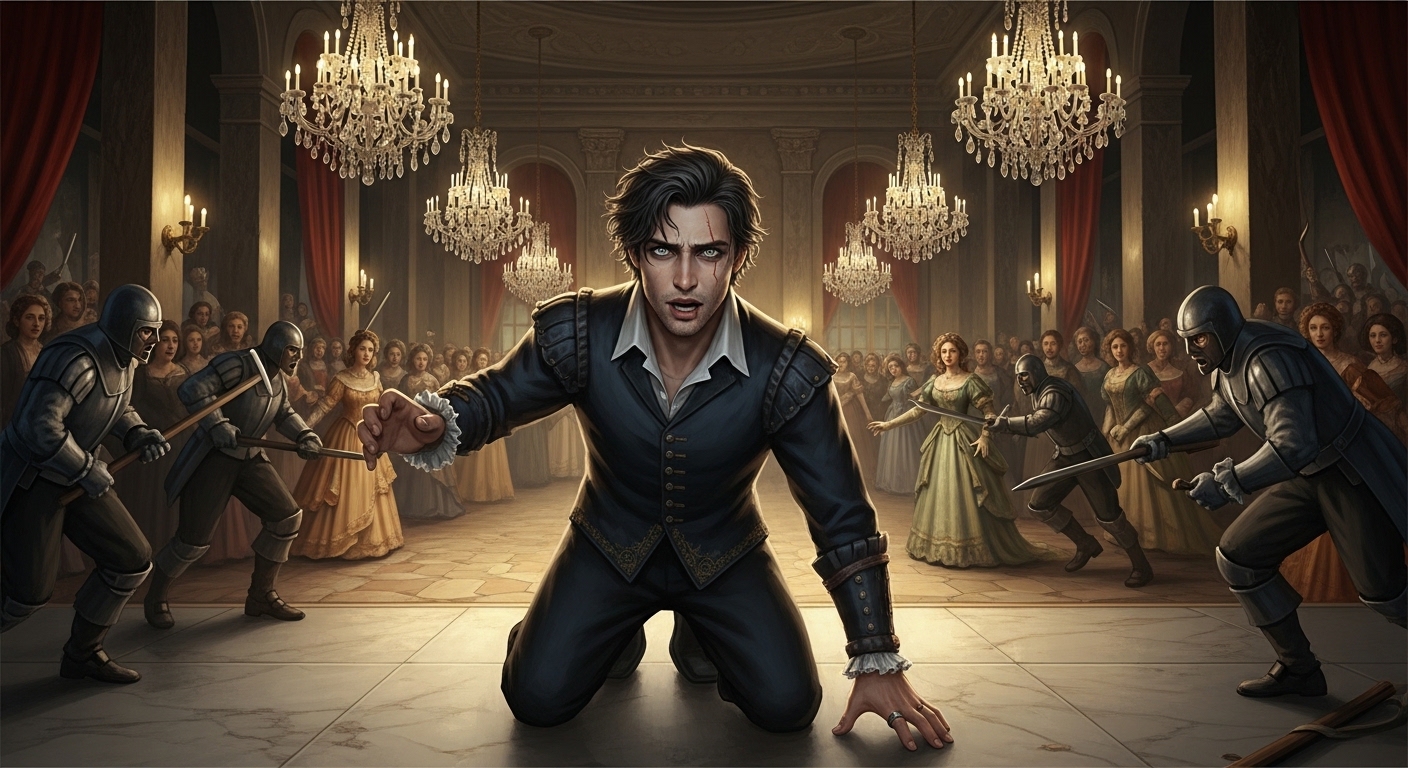
“I KNEW IT!” Hemlock shrieked, vindicated. “Charlatans! Seize them!” Four guards charged the stage. But as the illusion shattered, Eddi leaned into the fall. He dropped to his knees, looking directly at the Duke, and let out a raw, wordless, agonizing wail. He reached his hands out, grasping at the empty air, trembling with the theatrical desperation of a man broken by the system.
The Duke froze. The sheer vulnerability of it hit him squarely in his pretentious heart. “Wait!” he bellowed, surging to his feet. “Halt, you philistines! Do you not see it? The literal collapse of the laborer! He is offering us his soul!”
A thunderous applause erupted. The nobility surged forward, physically blocking the guards’ path. Eddi had bought more time, but at a cost. The guards formed a tight, inescapable ring around the dais. Their exit was gone.
Upstairs, the other guards reached the master study. They found Mick, sweating, blocking the door. “The music stopped, pastry boy,” the lead guard growled, raising his bludgeon. “Move.”

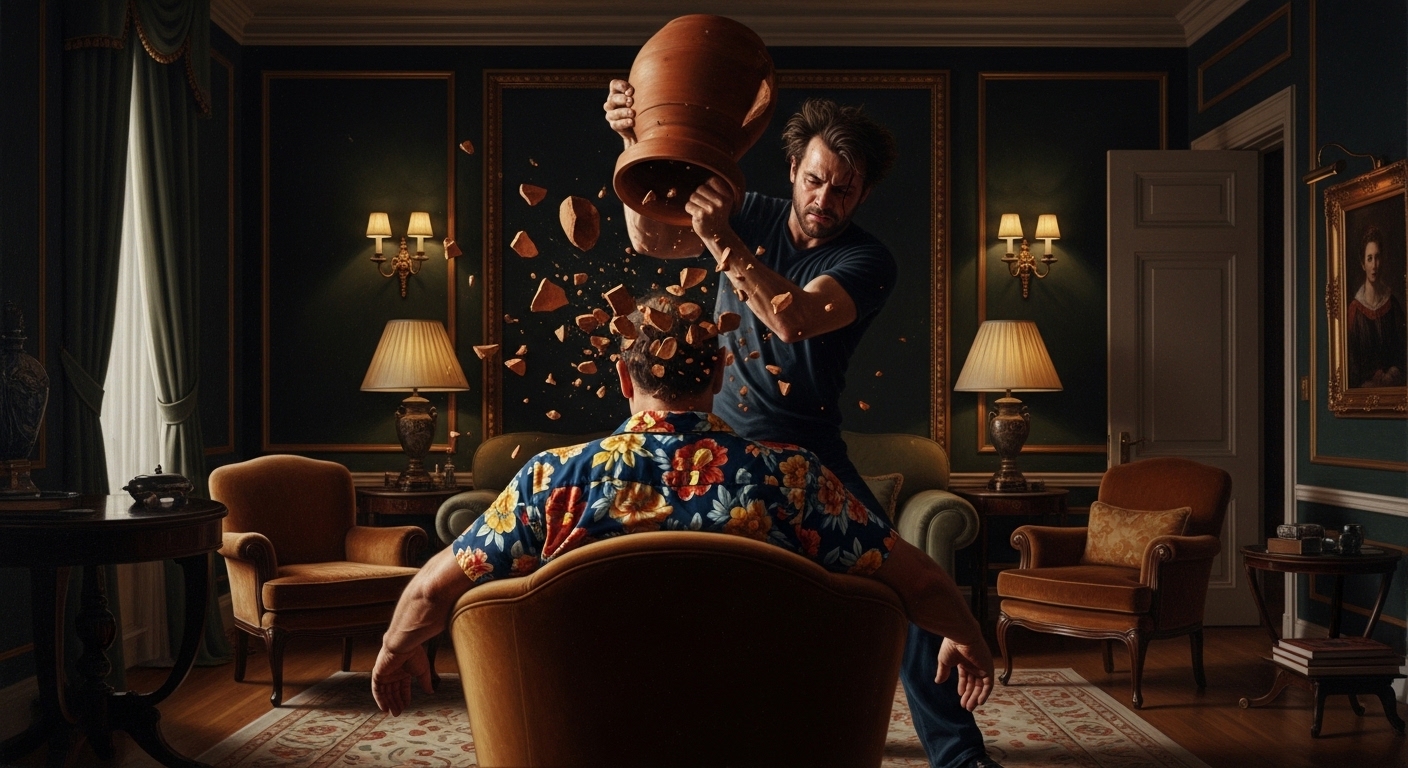
Mick’s brain bypassed all higher logical functions. He grabbed the acoustic guitar by the neck and swung it like a lumberjack. The hollow spruce body exploded against the side of the guard’s skull with a concussive, atonal CRASH. The guard crumpled. The second guard froze, stunned by the absurd violence. Mick didn’t hesitate. He unleashed a wild, panic-fueled haymaker that connected with the man’s jaw. He, too, went down.
Mick stood panting, clutching the splintered neck of the guitar. “Oh dear,” he squeaked. The study door clicked open. Ropey leaned out, taking in the scene. “Michael,” they said, their eyes wide with genuine professional respect. “I didn’t know you played percussion.” Inside, a splintered fiddle bow was jammed into the vault’s alarm bell, silencing it, but the prize was still locked away.
Aftermath: A Standing Ovation and a Clean Getaway
Trapped on the stage, Eddi scanned the perimeter. The Duke was a human shield. Turtle’s upright bass was a potential siege engine. And behind them, heavy velvet curtains masked a service door. He snatched a microphone. “And we, esteemed ladies and gentlemen, were The Turnbuckle!” he boomed, his voice echoing through the estate. “Thank you, and have a wonderful night.”
As he turned, Rabbit drove her boot into the brass cleat holding the curtain rope. The mechanism shattered. A tidal wave of crimson velvet plummeted, burying the guards and the front row of the audience. Turtle hit the service door like a battering ram, and they burst into the cold night air. “Go,” Eddi told them. “I’m going back up.”
He snatched a footman’s jacket from a trellis, slipped it on, and grabbed a passing tray of empty champagne flutes. The universe, it seemed, was offering him a prop. He marched back inside and up the stairs, a terrified servant too burdened and unimportant to be noticed. He found the corridor in ruins. Two guards unconscious, splintered wood everywhere. Mick stood over them, gripping his ruined guitar. Ropey, having finally cracked the vault, was cheerfully tying off a ticking canvas sack.
But their reunion was cut short. Four more guards surged into the hall, trapping them. An attempt at a quick-change into the guards’ uniforms resulted in Mick being swallowed whole by a coat three sizes too large. A distraction with thrown crystal glasses failed spectacularly. A guard lunged, slamming Eddi against the wall, pinning him, the air driven from his lungs. He tried to wrestle free and was rewarded with the sickening CRACK of an iron-tipped bludgeon against his ribs. The pain was blinding, but the force of the blow broke the pin.
His arms were free. His fingers found the weighted pen in his pocket. He locked eyes with Ropey and shouted a single word in circus cant. As the guard swung again, Eddi dropped. Ropey used another guard as a springboard, vaulting through the air and driving both heels into the back of the lead guard’s neck. He collapsed.
Eddi surged to his feet, driving the heavy end of his pen into a nerve cluster on one of the guards attacking Mick. The man went down, screaming silently. Ropey swung the ticking sack of chronometers like a medieval flail, connecting with the last guard’s jaw with a musical GONG. He folded over Mick like a blanket.
Only one guard remained, staggering to his feet. Eddi gestured to the bodies on the floor. “My friend, you can join your colleagues,” he said, his voice calm. “Or I think you might have seen something on the balcony. You never even came here.”
The guard did the math. He turned, pointed his bludgeon down the hall, and bellowed, “THE BALCONY! THEY’RE ON THE BALCONY!” before sprinting in the opposite direction. They were clear.
The carriage ride back to the Merchant Quarter was a blur of aching ribs, adrenaline comedowns, and the quiet ticking of their prize. Back in the safety of the Brass Ring, Rabbit took the chronometers and disappeared into the night, returning at dawn with a heavy purse of crowns. The Duke would tell stories of the deranged performance artists who stole his clocks as a profound statement on capitalism. He would never connect the tortured Maestro to the untouchable proprietor of a backstreet café.
Eddi sat at the bar as the sun came up, the ache in his side a sharp counterpoint to the quiet satisfaction of a job done. They had played the fool in a palace, paid the price in blood and bone, and walked out with the prize. And somewhere in the city, a baker who once feared his own shadow was staring at his bruised knuckles, a quiet, dangerous pride dawning in his eyes.