Previously on… The Accountant, The Broker, and The Wardrobe Malfunction
The Unyielding Mathematics of Municipal Law
The scent of roasted coffee and woodsmoke inside the Brass Ring Café was entirely overshadowed by the distinct, ozone-sharp smell of a career bureaucrat being systematically dismantled. The gas lamps outside hissed against the bruised twilight of Fourteenthday, casting long, wavering shadows through the front windows, but inside, all light and attention was focused on the mahogany bar.
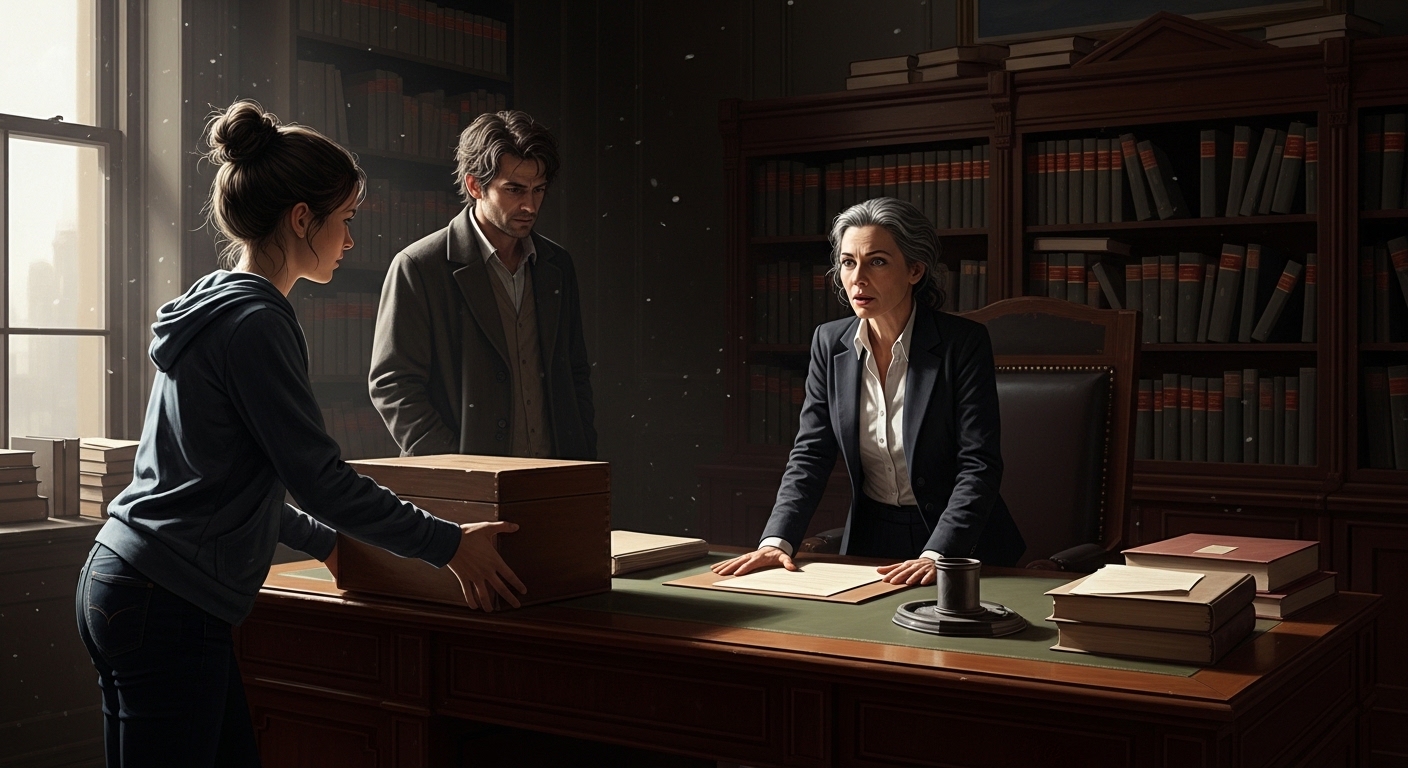
Cornelius Caulfield, the crew’s newly hired and terrifyingly efficient accountant, stood perfectly straight. He held the thick, wax-sealed municipal scroll—a suspension notice for the café’s deed—in one hand, and a red pen in the other. He did not raise his voice. He did not need to.
“Section four, paragraph B of the Urban Renewal Mandate,” Caulfield read, his voice the dry, unhurried rustle of autumn leaves, “dictates that any structural suspension requires a preliminary engineering survey signed by an independent architect in the presence of a guild magistrate.”
He looked up from the parchment, his flat, shark-like gaze locking onto the trembling City Works clerk who had delivered the notice. The young man’s face was the color of old milk.
“I see the Commissioner’s signature. I see your highly irregular, slightly smeared wax seal,” Caulfield continued, his tone dangerously pleasant. “What I do not see, my young, unfortunate friend, is the architectural addendum. Which means you are currently attempting to seize a legitimate commercial property using an invalid municipal instrument.”
With a soft, authoritative *click*, Caulfield uncapped his red pen. He didn’t just reject the notice; he aggressively corrected it. Three sharp, bleeding red lines were drawn through Commissioner Aldric Pell’s signature. A sprawling citation to a forgotten by-law was scrawled in the margin. He then slapped the ruined parchment onto the bar.
“Return this to Commissioner Pell,” he said. “Inform him that the Brass Ring Café formally contests the suspension under By-Law 401. If he wishes to proceed with the tribunal hearing in three days, we will require the preliminary surveys, the soil impact studies, and a full audit of the City Works Commission’s recent zoning reallocations.”
Caulfield leaned in, just a fraction, the movement precise and predatory.
The clerk stared at the bleeding ink. He glanced at the sheer, tectonic mass of Turtle looming near the door, then at Eddi Voss, the proprietor, watching this execution from behind the collar of his bespoke coat. The clerk swallowed hard, grabbed the scroll, and practically sprinted backward out of the café. The bell above the door jingled a frantic, retreating rhythm.
Silence descended, profound and ringing. Rabbit, leaning against the corner of the bar with her coffee, let out a slow, deeply cynical breath. “Well,” she murmured. “I suppose that covers the dental plan.”
Mick peeked out from the kitchen hatch, wiping sweat from his brow. “Did he… did he just threaten the City Administrator candidate with paperwork?”
“I merely established the parameters of the battlefield, Mr. Tallow,” Caulfield replied, meticulously capping his pen. He turned to Eddi. “Mr. Voss. The suspension is delayed. However, Pell has officially declared hostility. You have three days before the tribunal. If he secures the Administrator seat before then, he will simply rewrite the by-laws and demolish your establishment.” He picked up his silver ruler and turned back to a dry stores manifest. “I suggest you remove him from the board before Thirdsday.”

The Caulfield Kiss and Other Remedies
Pell hadn’t sent thugs. He’d sent a legal document, a quiet paper knife aimed directly at the heart of Eddi’s small corner of the universe. But thanks to his terrifying new hire, he had a three-day window to strike back. Eddi gave Caulfield a nod of deep appreciation.
“First off, well done, Cornelius,” he said, the throbbing in his cracked ribs a constant reminder of the last engagement. “That’s a shot fired, and we are never ones to go down without a fight.”
He began to orchestrate. “Mick, a word with Pell is in order. Take Cornelius with you, and Turtle as well.”
Mick’s face vibrated with an anxiety so potent it threatened to achieve sentience. “Right,” he said, his voice a high-frequency hum. “I am taking the man who calculates murder margins, and the man who can bench-press a horse, to have a polite diplomatic chat with the man actively trying to demolish our café. Excellent. I will simply… project hospitality.”
“I shall bring the relevant zoning ledgers, Mr. Tallow,” Cornelius added smoothly, tapping a thick red leather book. “And a micrometer. In case his structural arguments require literal dismantling.”
Turtle said nothing. He simply put down his keg mallet and opened the front door. The Delegation of Anxiety, Audit, and Avalanche filed out into the cold evening.
“I, meanwhile,” Eddi announced, glancing down at his torso, “am due for a visit to the doctor.”
Rabbit, who had been watching the reshuffling with a practiced stillness, drained the last of her coffee and stood up. She didn’t ask if he wanted company. She grabbed her reinforced leather duster, checked her pockets for the familiar weight of picks and blades, and fell into step beside him as he walked out the door.
“If you pass out in an alleyway, I am not carrying you,” she said flatly. “I will simply leave you with a note attached to your lapel identifying you as a public nuisance.”
“I appreciate the loyalty, Bea,” he said, wincing.
“It’s purely logistical. You owe me next week’s wages.”
The walk to Dr. Pyotor von Alick’s clinic took them to the fringes of the Silk District, to an unmarked door wedged between a tobacconist and a closed apothecary. The clinic smelled of iodine, camphor, and expensive pipe tobacco. From a back room, a jovial voice boomed.
“Ah!”
Dr. von Alick emerged, wiping his hands on a reasonably clean apron. He was a delightfully round man of forty-six, his double chin wobbling with a permanent good humor. He had the rosy cheeks of a man who enjoyed his supper and the steady hands of a man who had dug bullets out of some of the worst people in the city.
“Mr. Voss! And the formidable Miss Ashford!” he cried, his eyes twinkling. He gestured to a heavy leather examination table. “Come in, come in! What tragic misfortune has gravity or blunt instruments inflicted upon you today?”
“A minor disagreement with a brick wall, Doc,” Eddi said, gingerly removing his coat and unbuttoning his shirt. The doctor’s cheerful expression didn’t waver as he surveyed the spectacular, multi-colored ruin of Eddi’s left side.
“Ah, the Caulfield Kiss,” the doctor noted merrily, prodding the bruised tissue with thick, incredibly strong fingers. Eddi inhaled sharply, tasting copper. “Two ribs cracked. Not fully broken, thank the heavens! We must wrap them tightly. It will be excruciating, my friend, but you will breathe much better tomorrow.”
He turned to a cabinet for bandages and a jar of pungent ointment. “Deep breaths, Mr. Voss. Miss Ashford, perhaps hold his shoulders? He is going to want to squirm.”
Rabbit stepped up behind him. Her usual mockery was absent. She placed her callused, lock-oil-stained hands firmly on his shoulders, anchoring him to the table. The grip was unyielding, but it was also a distinct, wordless comfort.
“And… exhale!” Dr. von Alick chirped, pulling the heavy linen bandage tight. A sharp, white-hot spike of pain arced through Eddi’s torso, but he gritted his teeth and held perfectly still, Rabbit’s hands providing the exact counter-pressure he needed. “Beautifully done! The stoicism of a statue, Mr. Voss. Keep the wrap on for two weeks. No heavy lifting, no acrobatics, and absolutely no arguing with brick walls.”
He patted Eddi’s good shoulder and produced a small brown bottle. “Laudanum drops,” he said, his voice dropping slightly, the professional underneath the jovial mask surfacing. “For when the pain prevents sleep. Two drops. No more. I will put this on your tab, yes?”
“Add ten crowns for the discretion, Doctor,” Eddi managed, his breathing now shallower but more supported. He slid off the table as Rabbit stepped back, wiping her hands on her trousers as if the contact had been a chore.
“Well,” she said, her tone returning to its pragmatic baseline. “Now that you’re structurally sound again, what’s the play? Are we heading back to wait, or are we crashing the Administrator’s evening?”
Eddi pulled his coat tight over the doctor’s handiwork. “We, Rabbit,” he said, wincing, “are going to see Pell’s butler.”

An Unannounced Visit to Thornwood
Rabbit’s scarred eyebrow ticked upward. “Divide and conquer,” she noted, her tone dry enough to strike a spark. “Pell is currently busy having his operational boundaries audited by a man who treats cardamom tariffs like a personal insult. Which means his house is occupied only by the help. Opportunistic. I approve.”
They left the clinic and stepped back into the damp evening. The laudanum began its quiet, fuzzy work, dulling the sharp edges of his fractured ribs into a heavy, manageable ache. The journey to the Thornwood neighborhood was a shift into a world of old money made architectural—wide streets, mature trees, and heavy walls.
Pell’s private residence was a substantial three-story gray stone townhouse, understated in the way of people who don’t need to announce their wealth. His carriage was absent from the drive, confirming their window of opportunity was open. They stuck to the deep shadows, gliding through blind spots like a localized rumor, bypassing the perimeter gate to slip into the manicured garden beside the house. Soft light spilled from a few ground-floor windows.
Rabbit crouched beside a heavy stone planter, her eyes fixed on the heavy oak service door. “Well, Maestro,” she murmured. “Pell isn’t home, but his staff is. Are we knocking, or am I picking this service lock so we can introduce ourselves in the pantry?”
“We’ve come this far,” Eddi whispered back. “The lock’s all yours.”
A flicker of approval in her eyes was her only reply. She extracted a slender tension wrench and a half-diamond pick from her duster. Her fingers moved with the fluid, thoughtless grace of a virtuoso. The lock was a reinforced, multi-pin deadbolt, a challenge she met with focused silence. A tense ten seconds passed, broken only by the microscopic, metallic snick of pins setting. Then, a heavy, satisfying *clunk* echoed deep within the oak.
She pushed the door open on silent, well-oiled hinges and melted into the darkness inside. Eddi followed, pulling it shut behind them. The damp, floral scent of the night was replaced by the dry, meticulously curated smell of an aristocratic pantry: bundled lavender, polished silver, and floor wax. Through a swinging door at the far end of the unlit kitchen, they could hear the faint clatter of china and the muffled voices of staff.
“Staff dining room is occupied,” Rabbit whispered, peering through a small glass porthole. “But the main house sounds dead. We’re inside, Eddi. But unless you plan on stealing his silverware, we need a destination. His private study, or the master bedroom?”
A study was a place of business; staff would have cause to be there. But a master bedroom—especially one belonging to a man whose wife lived in the country—was a sanctum. When the master was out, the staff stayed clear.
“Bedroom first,” Eddi confirmed.
Rabbit gave a fractional tilt of her head. “Sound logic. Lead the way, Maestro. Try not to wheeze.”

Skeletons in the Armoire
They slipped out of the kitchen. The air in the main house was cooler, smelling of lemon polish, beeswax, and the suffocating weight of generational wealth. They ascended the grand, curving staircase like ghosts, Eddi knowing exactly where to place his boots to avoid the groans of settling wood. The second floor was a wide, carpeted corridor lined with portraits of men who looked like they fundamentally disagreed with the concept of joy.
At the end of the hall, the double mahogany doors of the master suite were unlocked. They stepped inside, easing the doors shut. Pell’s bedroom was exactly what one would expect from a man who used zoning laws as a weapon: vast, immaculately clean, and entirely devoid of warmth. It was a museum exhibit dedicated to the concept of rest.
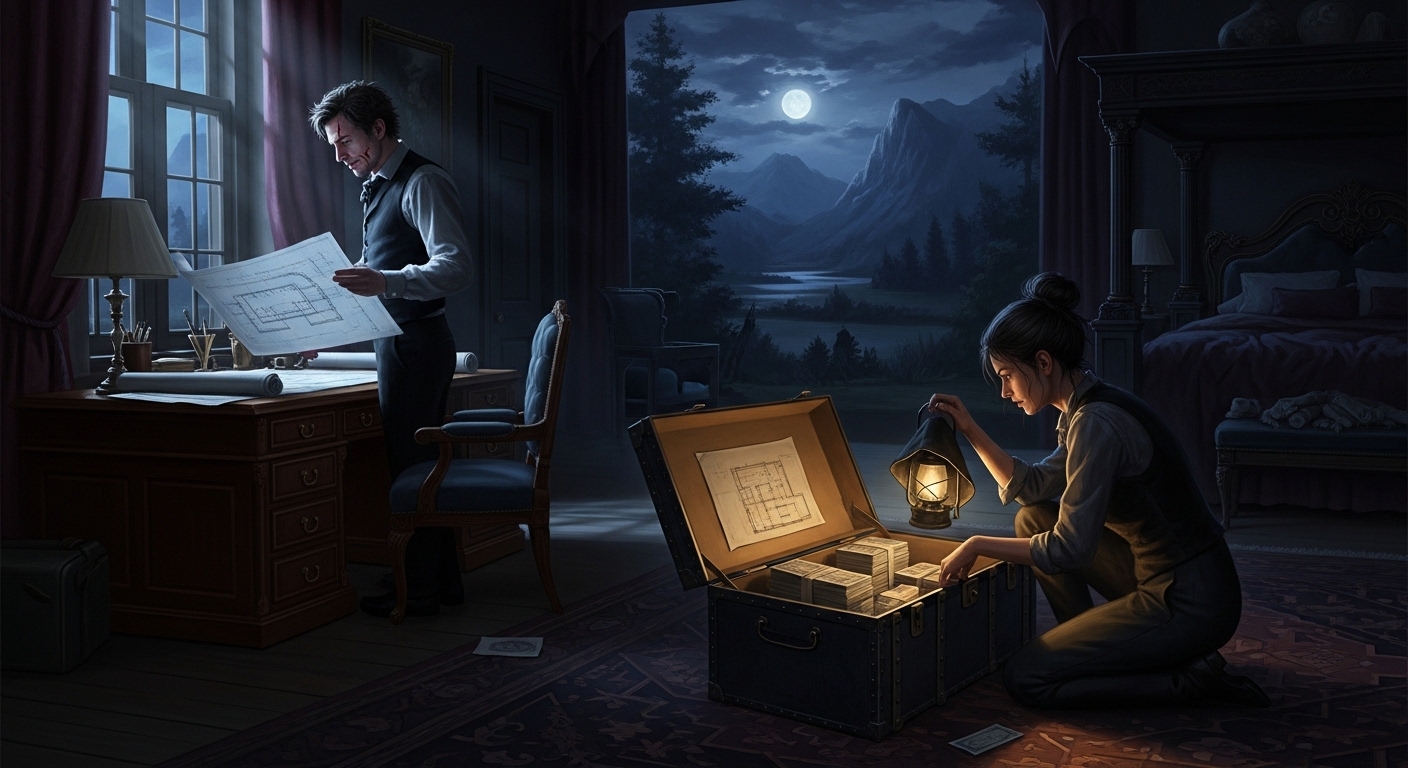
“He certainly doesn’t bring his work home to cuddle,” Rabbit murmured, clicking on a small, hooded lantern that cast a tight beam of amber light. The room held a pristine writing desk, a massive armoire, and a heavy iron-bound trunk at the foot of the bed.
“Rabbit, the trunk,” Eddi directed. “Look for anything, hidden compartments, the works. I’ll get the writing desk.”
He turned to the mahogany desk. It was too pristine. When a man like Pell was this tidy, he was hiding something. Ignoring the obvious drawers, Eddi ran his fingers along the underside, feeling for imperfections. Near the back right leg, he found a microscopic indentation. He pressed it.
With a soft, pneumatic hiss, a shallow, velvet-lined drawer dropped down from beneath the central blotter. Inside lay a neat stack of architectural blueprints and a bound ledger. The blueprints were a survey of the Merchant Quarter, with the Brass Ring Café circled in thick red ink. Clipped to it was the very engineering survey Caulfield had mentioned was missing—a survey that explicitly stated the café was structurally sound, but with a secondary note in Pell’s own hand instructing the surveyor to “fabricate foundational irregularities sufficient for immediate seizure.” It was premeditated, documented fraud.
“Eddi,” Rabbit whispered from the foot of the bed. She had the heavy trunk open and was using her knife to pry up a false bottom. The wood popped loose. She reached into the cavity and pulled out a heavy, leather-bound strongbox. Three seconds of work with her picks and the lock clicked open. The box was packed with untraceable bearer bonds, but on top lay a single, sealed, unmarked envelope.
“This isn’t just money, Eddi,” she murmured. “He’s got his escape route packed.”
Just then, the heavy *thud* of the front door closing echoed up the grand staircase. Heavy, measured footsteps began to click across the marble foyer below. Pell was home.
There was no time. The original plan—a frantic scramble to hide everything—was a disaster in the making. The pain from his ribs flared, a drawer refused to close, the false bottom of the trunk wedged at an angle. For a horrifying second, failure was absolute. But then, something shifted. Their shared will, forged in a dozen other impossible situations, took over. Eddi gritted his teeth against the agony, shoving the drawer home until it clicked flush. Rabbit, seeing the wedged wood, flipped her knife and brought the heavy brass pommel down in a single, vicious, perfectly targeted strike. The cedar snapped into place. She slammed the trunk lid shut.
She crossed the room, grabbed Eddi by the unbruised shoulder, and hauled him into the massive mahogany armoire, pulling the slatted doors shut just as the bedroom door handle began to turn.
They were plunged into a suffocating, pitch-black space, pressed shoulder-to-shoulder amidst the scent of cedar and mothballs. Through the narrow slats, they watched Pell enter. He looked exhausted, the kind of deep, bureaucratic fatigue that comes from being lectured by Cornelius Caulfield. He tossed his gloves on the desk, oblivious. He walked to the foot of his bed. He stopped.
Eddi stopped breathing. Beside him, Rabbit went lethally still.
Pell looked down at the iron-bound trunk. The lid was perfectly sealed. He saw nothing amiss. With a long, heavy sigh, he rubbed his temples and began to unfasten his collar, preparing for bed, entirely unaware of the ghosts in his wardrobe.

The Brass Ring Holds
They waited. They remained perfectly, agonizingly still in the cramped darkness. Eddi focused on the rhythm of Rabbit’s breathing, her face inches from his. Her steady, stoic warmth was an anchor in the cedar-scented purgatory. Outside, Pell’s breathing leveled out into the deep snores of a man who believed his fortress was secure.
One hour passed. Then two. Then three. The townhouse settled into the profound silence of the dead of night.
“Now,” Rabbit breathed, the word a vibration against his cheek.
They pushed the armoire doors open. Stepping out was an agony of locked joints and screaming muscles. They navigated the moon-shadows of the house like ghosts, down the grand staircase, through the unlit kitchens, and out the service door into the cold, damp chill of the Caulfield night. The suffocating smell of mothballs was replaced by the clean scent of crushed jasmine.
Rabbit let out a long, slow breath. “Well,” she murmured dryly. “I’ve had worse dates.” She glanced at the bulge in Eddi’s coat where the blueprints and ledger sat. “We have the proof. Pell’s suspension is dead the second Caulfield presents this to a magistrate.”
As she began to walk toward the perimeter wall, Eddi stopped her. “The night’s nice out,” he said, looking up at the bruised, slaty sky. “Are you in a hurry? I’m not. Care for a stroll?” His voice wavered slightly.
Rabbit turned. She looked at the sky, then back at him, her eyes lingering on the rigid way he held himself to protect his ribs. The scarred eyebrow crept upward.
“Eddi,” she said, her voice as dry as cedar dust. “It is four in the morning. We are standing in a hostile, patrolled district. You are clutching stolen municipal blueprints, and you are currently bound together by heavy linen and sheer stubbornness. Your definition of a ‘nice night’ is borderline pathological.”
He didn’t take it back. He just stood there, letting the vulnerable question hang in the air between them.
She let out a long, slow sigh, and the defensive set of her shoulders dropped a fraction. “Fine,” she muttered. “We’ll stroll. But we are strolling toward the Merchant Quarter, and if your lung punctures on the way, I am leaving you in a horse trough.”
It was, from Beatrice Ashford, practically a sonnet. They walked in a comfortable silence, her pace slowed to match his injured one. The opulent smells of Thornwood gave way to the honest, working-class aromas of coal smoke and baking bread as they neared home.
“We have him,” Rabbit murmured eventually. “The Brass Ring holds,” Eddi said quietly. She glanced at the matching iron rings on their hands. “Yeah,” she said softly. “It does.”
They stopped at the front door of the café as pale, washed-out daylight began to break. The warm, golden light from the lamps spilled out, carrying the scent of coffee and Mick’s stress-baking.
“Hey,” Eddi said, turning to face her. To face Bea. “We should do this more often. I like walking. I mean, cracked ribs are supposed to be fixed quicker when you walk-” He paused, ruffling his hair. “What I’m meaning to say is, Bea, thanks. For always having my back. I promise I’ll stay off the avant-garde stuff.”
The name hung in the cold morning air. She stood on the threshold, unblinking. The corner of her mouth lifted in a fractional, almost invisible movement. “I’ll hold you to the avant-garde promise, Eddi,” she said, her voice remarkably devoid of its usual cynicism. “Because if you ever make me pretend to be a tortured percussionist again, I am breaking your other ribs.”
She reached out, a brief, uncharacteristically gentle movement, and her lock-oil-stained fingers brushed the lapel of his coat, straightening the thick black wool. “Anytime, Maestro,” she murmured.
She turned the handle and pushed the heavy oak door open. The biting chill was replaced by enveloping warmth. Turtle was at his post, polishing brass. Mick looked up from behind the bar, his face dusted with flour. And at a corner table, Cornelius Caulfield was auditing the structural integrity of a ginger biscuit with lethal intensity.
Eddi stepped over the threshold, his crew intact, the leverage secured, and the deed to his café safe, at least for one more bruised and beautiful dawn.