Previously on… The Bureaucratic Gambit, or How to Throw a Party at the End of the World
The peace in the Brass Ring Café was a fragile, beautiful thing, and it shattered to the sound of a chiming bell and expensive silk. Thirteenthday morning in Caulfield had arrived with a suspicious amount of sunshine, casting sharp shadows that made the Merchant Quarter look almost respectable. Inside, Eddi Voss was enjoying his new status as the Untouchable Proprietor. The usual morning crowd—cartographers, junior accountants, the occasional off-duty watchman—spoke in hushed, reverent tones. It was the kind of quiet that suggested they all half-expected him to solve the city’s energy crisis with a well-brewed espresso.
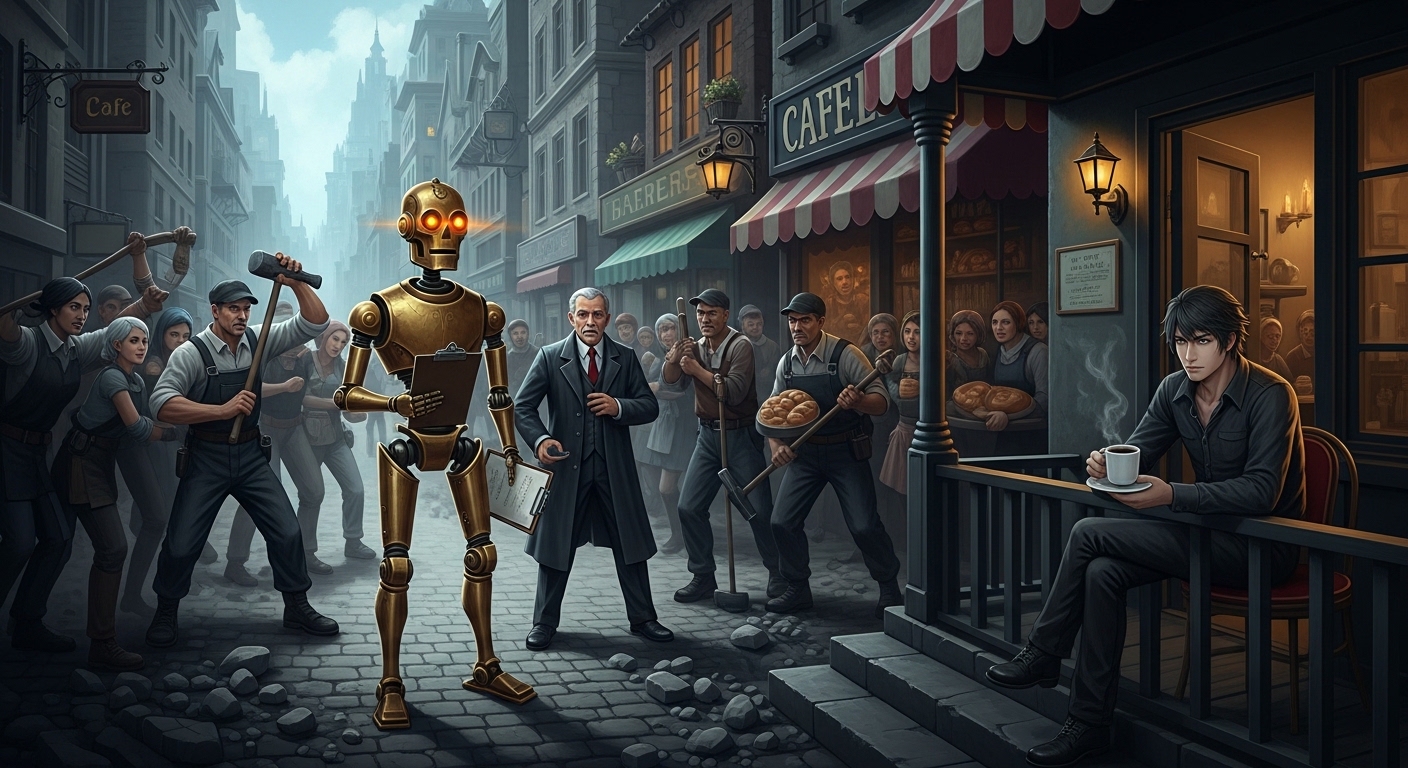
Mick, free from the crushing weight of impending doom, moved between tables with the grace of a gazelle that had finally realized the lions were all on vacation. He was distributing lemon-cardamom buns, his social intelligence firing on all cylinders. Turtle, a mountain range given sentience and a love for nautical novels, was stationed by the door, his copy of The Albatross and the Apathy held in hands that could bend iron bars. And in her usual corner, Rabbit sat with her black coffee and three sugars, watching the room with the grim certainty of a woman who knew that any period of calm was simply the universe taking a deep breath before it started screaming again.
Eddi stood behind the bar, the familiar warmth of his iron ring a comforting presence on his finger. The ledger was balanced. The coffee was hot. Everything was, for once, perfectly fine.
Then the bell chimed.
The woman who entered did not belong. She was an oil painting of a polite but firm breakdown, a creature of the Garden District marooned in the humble shores of the Merchant Quarter. Dressed in a traveling suit of indigo silk that cost more than the café’s weekly profit, she carried a parasol like it was a loaded musket. Her wide, panicked eyes scanned the room, dismissing the patrons as mere scenery, until they landed on Eddi. She marched toward the bar, her heels clicking a staccato rhythm of expensive desperation on the floorboards. Turtle lowered his book a fraction of an inch. Rabbit stopped stirring her coffee. The fragile peace didn’t just break; it evaporated.
“Edward Voss?” Her voice was crisp, cultured, and thrumming with a high-tension wire of panic.
“That depends,” Eddi replied, his hands never pausing as he wiped down the counter.
“I was given your name by a mutual acquaintance,” she said, leaning in so close he could smell the rosewater and raw fear. “A Mr. Pembrook. He said you are a man who… locates things. Things that cannot be looked for officially.” She planted two gloved hands on the bar, a gesture of finality. “My name is Lady Genevieve Sterling.”
The name rang a bell, though she bore no resemblance to the dour, paper-shuffling Mr. Sterling from the Administrator’s office. A niece, perhaps. It didn’t matter. The important part came next.
“I am to be married in exactly three days to Lord Arthur Vance.” She took a ragged breath, the composure cracking. “Mr. Voss, the Vance family heirloom—the Ring of the First Founder—has been stolen from my fiancé’s dressing room. If it is not on his finger when we take our vows on Sixteenthday, his grandmother will declare a blood feud, my father will call off the dowry, and the resulting social warfare will likely burn down half the Garden District.” She looked at him, her eyes pleading. “I cannot involve the City Watch. The scandal would be terminal. The caterer is already threatening to quit over the floral arrangements.”
From her corner, Rabbit raised a single, cynical eyebrow. The silent question was clear: *And what’s that got to do with us?*
Lady Genevieve seemed to hear it, too. She produced a heavy leather purse and placed it on the bar. The clink of coins was loud in the suddenly silent café. “I have two hundred crowns in this purse. Will you help me?”
An Indigo Panic
“This way, Miss Genevieve.” Eddi’s voice was calm, the detached professionalism of a doctor about to examine a particularly nasty, and lucrative, wound. He lifted the counter flap and gestured toward the creaking stairs that led to his office.
Turtle, ever the silent guardian, gave a fractional nod and shifted his immense frame, subtly blocking the view of any curious patrons. Mick, catching on, managed a polite, if slightly terrified, bow as the whisper of indigo silk swept past him. Only Rabbit remained unmoved, watching the procession over the rim of her coffee cup, her hazel eyes entirely unimpressed by the arrival of the Garden District and its attendant anxieties.
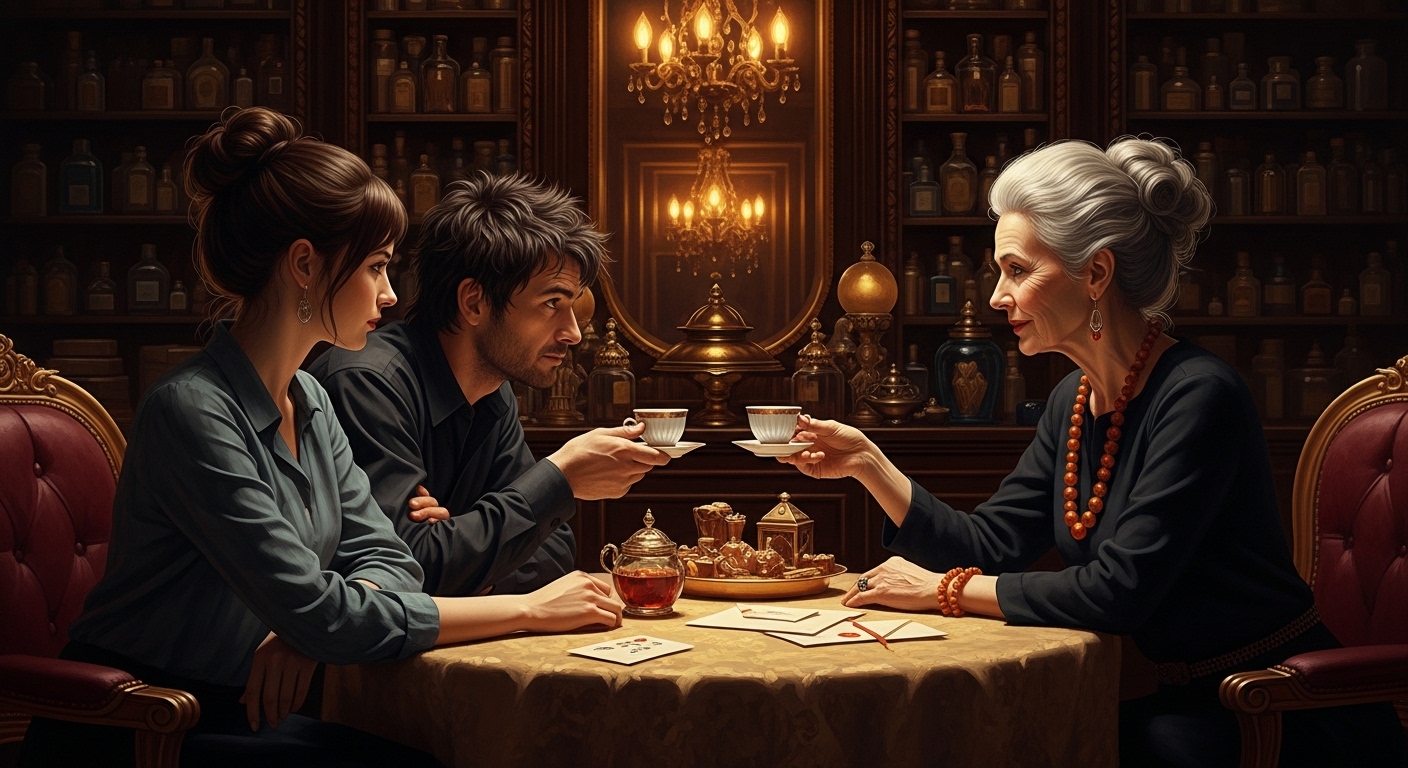
The office upstairs was a sanctuary of organized chaos, smelling of old paper, late nights, and strong coffee. Eddi offered Lady Genevieve the sturdy guest chair, the one that hummed faintly if you sat in it for too long. She perched on the very edge, placing the heavy purse on his desk. The two hundred crowns inside clinked, a sound that usually represented a very good week, but today sounded like a very specific kind of headache.
“It was in his dressing room,” she said, her voice dropping to a conspiratorial whisper now that the door was closed. “Arthur—Lord Vance—took it off to wash his hands before the evening gala. When he returned, it was gone. The only people in the manor were his immediate family, the household staff, and…” She hesitated. Her gloved hands twisted in her lap, a tiny, frantic storm of white leather.
Eddi had spent a lifetime reading people. He knew the tells, the shifts in tone, the darting eyes of someone withholding a crucial piece of the puzzle. His recent ordeals had honed that instinct into something sharper, a tool he called The Long Read. He sat back in his chair and simply watched her. He saw the flicker of her eyes toward the door, then to the purse, then back to her lap. Her knuckles were white on the handle of her parasol. This wasn’t about protecting a thief. She was protecting Arthur.
He smiled, a gentle, disarming thing. “I can’t help you,” he said softly. “Not when my clients decide to withhold information from me.”
The gentle refusal did what shouting never could have. It bypassed her high-society armor completely. The crispness in her voice finally cracked. “Please,” she said, a raw edge of desperation showing through. “You must understand. If my father finds out who Arthur has been associating with, he will pull the dowry. Arthur’s grandmother will disown him.”
She leaned forward, the scent of rosewater momentarily overwhelmed by the old paper in his office. “There was a man,” she whispered, as if the words themselves were poison. “A man from the Warrens. He arrived unannounced while Arthur was preparing. He bypassed the butler entirely and walked right into the private wing.” A shaky breath. “Arthur owes him money. A substantial gambling debt from before our engagement. They argued. Arthur stepped out to ensure the servants hadn’t heard, leaving the man alone for perhaps two minutes.” She looked at him, the whole ugly truth finally laid bare. “When Arthur returned, the man was gone. And so was the Ring of the First Founder.”
Eddi kept his face a perfect, professional blank. “And this man’s name?”
“Ketch,” she said, the name tasting foul in her mouth. “Silas Ketch. An information broker, Arthur said. A fence.”

The Baker, the Acrobat, and the Smoke Bomb
Silas Ketch. The name landed on Eddi’s desk like a familiar, tarnished coin. Sharp, amoral, a man who knew the precise value of everything, from state secrets to a lordling’s desperation. Eddi had sold him encrypted documents just three months ago. Ketch was not a man who stumbled into good luck; he manufactured it.
“One question,” Eddi said, spinning the iron ring on his finger. “Why not offer to buy it back from him?”
Lady Genevieve let out a short, bitter, and profoundly exhausted laugh, a sound entirely alien to the Garden District. “Because, Mr. Voss, Silas Ketch doesn’t want the ring’s value. The gambling debt Arthur owes is nearly five thousand crowns. If we approach him, he will demand the entire debt. And worse—” she tapped a gloved finger on the desk for emphasis, “—he will know how desperate we are. He will know the ring is the key to the wedding, the dowry, and the Vance family fortune. He won’t sell it back. He will keep it, and he will bleed Arthur for the rest of his natural life. Ketch doesn’t want a quick payout. He wants a leash on a future Lord.”
She sat back, pulling her silk suit tight as if a chill had entered the room. “He cannot know Arthur sent you. The ring must be stolen from him, so he believes it was just the cost of doing business in the Warrens. It has to look like bad luck, not a countermove.”
Eddi gave her a reassuring nod. “Go home, Genevieve. Or stay. We’re trying out a new pastry that’s simply delicious. On the house.”
The abrupt dismissal, coupled with the offer of a complimentary baked good, seemed to short-circuit her aristocratic brain. She blinked, looked at the purse of crowns still on his desk, and seemed to understand this was how contracts were sealed in the Merchant Quarter. With a bewildered whisper of thanks, she swept out of the office. A moment later, Eddi heard Mick’s cheerful voice intercepting her downstairs.
He called for Rabbit.
She appeared in the doorway moments later, leaning against the frame with the silent grace of a shadow. Her fingerless gloves were stained with fresh lock oil. She glanced at the empty chair, at the purse of crowns, and then at Eddi. “High society,” she noted, her voice dry as dust. “Smells like rosewater and bad decisions.”
Eddi laid out the situation. The ring, the debt, Silas Ketch, and the absolute need for a quiet retrieval. Rabbit crossed the room, picked up the purse, tested its weight, and dropped it back on the desk with a solid thud. “Simple,” she said, the word tasting sour. “Eddi, Silas Ketch operates out of a basement in the Warrens. He sleeps with one eye open and his valuables in a Kessler & Sons heavy-duty safe. If we just kick his door in, a man like Ketch doesn’t write it off as bad luck. He asks questions. He puts bounties on heads.”
“He won’t fall for a simple break-and-enter,” Eddi agreed. “As much as I trust your hands, Rabbit.” Then an idea, brilliant and terrible in equal measure, lit up his eyes. “Let’s torch the place.”
Rabbit gave him a long, flat look, identical to the one she’d given him when he suggested putting a mustache on a seven-foot automaton. “Eddi,” she said, her voice dangerously calm. “It’s a basement. In a neighborhood made of dry rot and structural optimism. If you torch it, the building collapses. I will then have to pick a Kessler & Sons safe while buried under three tons of flaming brick. Also, Ketch will be dead, which tends to attract the City Watch.” She paused, a scarred eyebrow twitching. “However,” she said slowly, the gears turning. “The *panic* of a fire. The *smoke* of a fire. A fire makes a paranoid man open his own safe to save his ledgers.”
A slow, wicked grin spread across her face. “We don’t need to torch the place. We just need him to *believe* it’s torched. We need smoke. Thick, blinding, acrid smoke, dropped straight down his ventilation shafts.” Her gaze drifted to the floorboards, toward the clatter of baking sheets from the kitchen below. “Mick knows how to burn things. He made a pastry yesterday that looked like a lump of coal. If we tell him to do it on purpose…”
The plan coalesced in a beautiful, chaotic rush. Mick would bake the smoke. Ropey, their resident acrobat and gravity-defier, would deliver it down the chimney. Turtle would create the panic on the street. Rabbit would slip in during the confusion and liberate the ring. And Eddi? Eddi would conduct the symphony.
“Yours truly,” he said with a terrible bow as he gathered the crew. He laid out the strategy. Mick’s eyes went wide with a kind of terrified, pyromaniacal glee. “Smoke,” he whispered reverently. “Not just burnt. Smoldering. If I double the molasses in the ginger biscuit base…”
“I’ll carry it,” a voice said from above. Ropey dropped from the rafters, landing without a sound. “Chimneys are my specialty.”
Turtle just nodded, a tectonic shift of his massive shoulders. Rabbit pocketed the lock she’d been fiddling with. “Five minutes. If it takes longer, Tommy rips the whole safe out of the floor. Try not to drop it on my foot.”
“Never have,” Turtle rumbled.

Smoke and Mirrors in the Warrens
Two hours later, the sky over the Warrens was the color of a bruised plum. The air smelled of grease, wet stone, and generations of bad decisions. Silas Ketch’s operation was tucked beneath a dilapidated boarding house, a black iron door at the bottom of a set of stairs leading below street level. It was a fortress of paranoia.
Eddi and Mick huddled in an alley across the street. Mick clutched a heavy iron pot that smelled so aggressively of scorched molasses and sulfur that it made Eddi’s eyes water. On the roofline above, Ropey was an invisible ghost waiting for the signal. In the shadows near the stairwell, Turtle and Rabbit were coiled springs of potential energy.
Eddi gave the nod.
A rope descended from the darkness, and Mick attached the pot. It vanished upward. Ten seconds later, a thick, greasy, yellow-grey column of smoke began to billow from the boarding house chimney. It didn’t rise; it sank, heavy and cloying, pouring straight down into the ventilation shafts that fed Ketch’s basement fortress.
The effect was immediate. First came the coughing, a muffled, wet sound from below the street. Then, shouting.
“FIRE! FIRE IN THE WALLS!” Turtle’s voice boomed from the street corner, a perfect imitation of a panicked dockworker. It cut through the ambient noise of the Warrens like a foghorn.
The heavy iron door at the bottom of the stairs banged open. Silas Ketch stumbled out, his face a mask of terror, followed by two hired thugs. They were all coughing violently, blinded by the noxious smoke. “The ledgers!” Ketch screamed, his voice cracking with panic. “Leave the heavy stuff, grab the current ledgers!”
He’d done exactly as Rabbit predicted. The safe was unlocked. As Ketch and his men clawed their way up the stairs, blinded and disoriented, Rabbit and Turtle slipped past them like water finding a crack, descending into the smoke-filled basement.
But the plan was already hitting a snag. One of Ketch’s thugs, a thick-necked bruiser with a heavy club, paused at the top of the stairs. He squinted back down into the gloom, his initial panic giving way to professional suspicion. If he went back down, he would walk right into Rabbit and Turtle. The five-minute clock was ticking, and they were about to be discovered before they’d even started.
A Well-Deserved Punch
Eddi’s mind raced. They needed a bigger distraction. Something loud, immediate, and impossible to ignore. He leaned close to Mick, who was watching the scene unfold with wide, anxious eyes.
“Punch me,” Eddi whispered.
Mick stared at him. “What?”
“In the jaw. Hard. Then grab my wallet and run.”
“Punch you?” Mick squeaked, his voice hitting a register usually reserved for frightened mice. “Eddi, I can’t—”
“Do it, Mick! Now!”
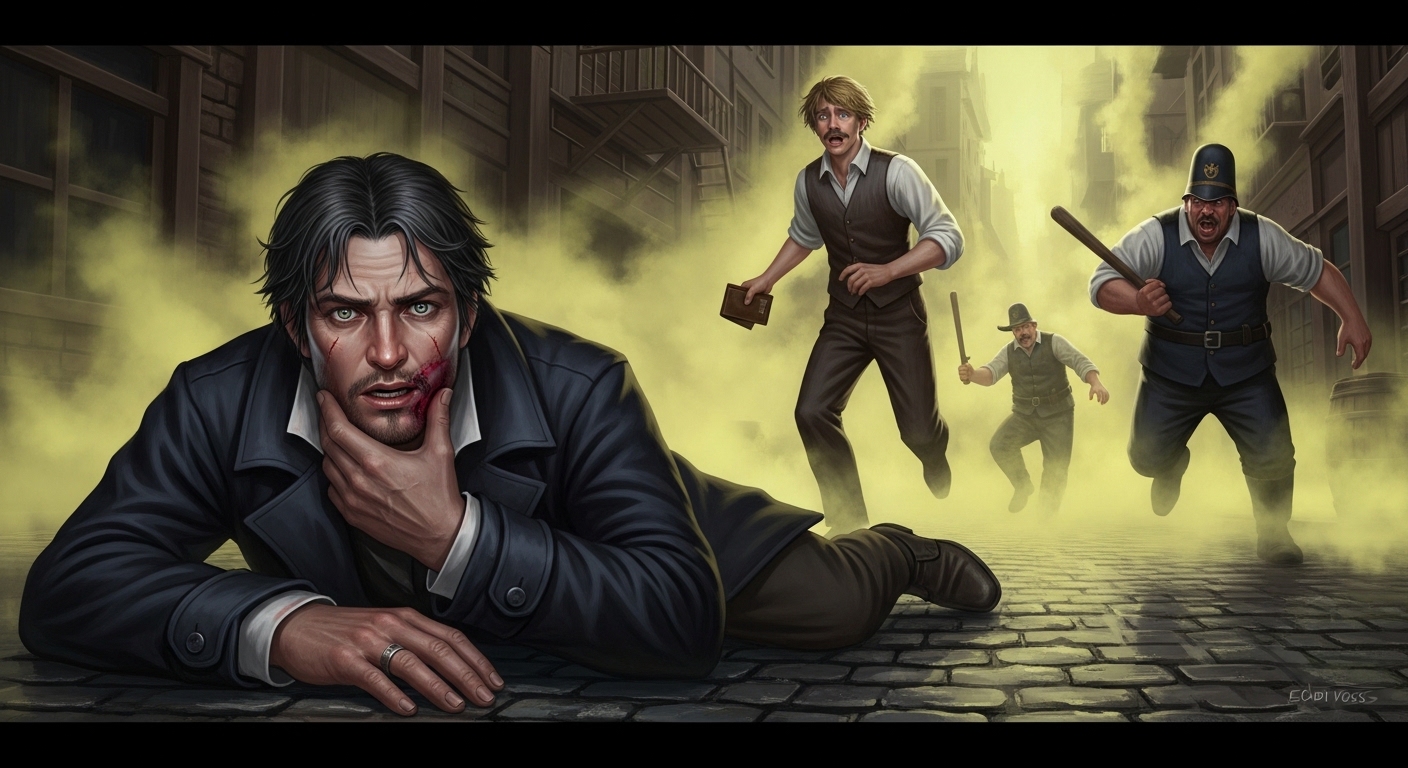
Mick closed his eyes, let out a sound that was half a sob and half a battle cry, and swung. The punch was not the gentle tap of a staged distraction. It was fueled by pure, unadulterated panic, and Mick, as it turned out, had a surprisingly solid right hook. His fist connected perfectly with the thin scar along Eddi’s left jawline. Eddi’s head snapped back. He saw a brief, sparkling constellation of stars and felt a jarring thud as his teeth clicked together. He went down hard on the wet cobblestones, the impact genuine and dizzying.
Mick, his eyes wide with horror at what he had just done, fumbled for Eddi’s wallet, grabbed it, and sprinted into the yellow smoke. “I’M SO SORRY!” he wailed as he vanished, a cry that sounded to any observer like the deranged gibberish of a common footpad.
Help! Guards! Watch! He took my wallet! My week’s takings!
Eddi yelled, channeling every ounce of his charm into sounding like a panicked, out-of-town merchant. The thick-necked guard at the top of the stairs, who had been about to descend, froze. His loyalty to Silas Ketch was a professional arrangement. The prospect of catching a mugger with a fat wallet was a sudden, lucrative, and personal opportunity.
“Hey! Stop right there, you little rat!” the guard bellowed, completely abandoning his post. He charged past the stairwell, club raised, and plunged into the smog after the terrified, fleeing baker. The way was clear.
Eddi lay on the wet stones, nursing a jaw that was already beginning to throb with a deep, spectacular ache. Twenty feet away, Silas Ketch was still coughing, wiping streaming eyes with a handkerchief. If he recognized the man who had sold him Alderman Crowe’s secrets three months ago, the entire ruse would collapse. Eddi pulled his coat collar high, obscuring his face, and staggered to his feet. He didn’t run. Running draws the eye. He just stumbled, clutching his jaw, and let the thick, sulfurous clouds of Mick’s culinary disaster swallow him whole, melting into the chaos he had so carefully orchestrated.

Aftermath: A Recuperative Tart
Thirty minutes later, the bell of the Brass Ring Café chimed again. The transition from the damp, greasy gloom of the Warrens to the warm, coffee-scented air of the café was dizzying. At a corner table, Lady Genevieve Sterling sat like a tightly wound spring. Mick hovered nearby, a teapot rattling in his trembling hands, his face a mural of guilt.
He saw Eddi’s face first. The spectacular, darkening bruise blooming along his jawline. “Eddi, I—” Mick began.
Eddi held up a single finger. *Not now.*
He walked straight to Lady Genevieve’s table. Rabbit stepped up beside him, pulled her hand from her pocket, and placed a small, heavy velvet box on the table. She flipped the lid. Inside, the Ring of the First Founder gleamed against dark silk, heavy, gold, and blessedly intact.
The mask of aristocratic composure on Lady Genevieve’s face crumbled away, replaced by profound, collapsing relief. She reached out a gloved hand, touched the ring to ensure it was real, then snapped the box shut and clutched it to her chest. She looked up, her gaze taking in the mud on Turtle’s boots, the lock oil on Rabbit’s gloves, and the fresh bruise on Eddi’s face.
“You actually did it,” she whispered. “Silas Ketch—”
“Silas Ketch had a small atmospheric emergency at his establishment this morning,” Eddi said smoothly. “In the confusion, it seems the ring simply… walked out. He is completely unaware of your fiancé’s involvement.”
She stood, grasping his hand with both of hers, her gratitude genuine and overwhelming. “Mr. Voss, you have saved my future. If there is ever anything the Vance or Sterling families can do for you… you have our gratitude.” She left the purse of two hundred crowns on the table and swept out of the café, her personal disaster averted.
The crew gathered around the table and the small fortune it held. Eddi winced as he touched his jaw. “Ow. You taking boxing lessons behind my back, Mick?”
Mick went the color of a ripe tomato. “I was aiming for your shoulder!” he mumbled. “I’ll make an ice pack. And a tart. A recuperative tart.”
“Honest day’s work,” Eddi said, starting to count out the shares. “Hope every day’s like this.” He pushed forty crowns to Rabbit, forty to Turtle, forty to Mick, and kept forty for himself, leaving a final forty for the café’s funds.
Rabbit looked at the neat stacks, then pointedly at the ceiling. “Which leaves exactly zero for the person who actually started the fire.”
On cue, a soft rustle of fabric announced Ropey’s arrival. They dropped from the rafters, landing silently and already reaching for the last stack of crowns. “I’ll accept my payment in café shares,” Ropey said cheerfully, making the coins vanish in a blur of sleight-of-hand. “But crowns are slightly more liquid. Brilliant plan, Voss. The smoke smelled terrible. Ten out of ten.” With a mock salute and a stolen ginger biscuit, they were gone.
Rabbit made a sound that wasn’t quite a laugh. “Put some ice on that before it swells shut, Eddi,” she advised, heading for the stairs. “You talk for a living.”
And Eddi was left standing in his café, forty crowns richer, his jaw a spectacular shade of blue-black, surrounded by a crew that hadn’t missed a single cue. The business was safe. The job was done. It was, all things considered, a very good afternoon in Caulfield.